NEWS
Alphabet’s Server Budget Faces a 15% Nvidia Markup in 2027
Alphabet locked a $195-205 billion 2026 budget before Nvidia racks rise more than 15% in 2027, when memory is set to take 68% of cloud capex.
Alphabet will spend $195 billion to $205 billion this year, and its finance chief said servers took about 60% of second-quarter technical infrastructure cash. On Saturday, Bloomberg reported that many Nvidia AI servers will cost more than 15% extra on shipments early next year.
That extra charge does not rewrite the 2026 budget already being spent. It lands on 2027 Cloud contracts, after Google Cloud just grew 82% and after the company already told investors next year’s buildout would get larger.
Servers Took 60 Cents of Every Infrastructure Dollar
On the July 22 earnings call, chief financial officer Anat Ashkenazi said about 60% of technical infrastructure spending in the second quarter went to servers, with the other 40% going to data centers and networking gear. She also lifted full-year capital spending to $195 billion to $205 billion from a prior $180 billion to $190 billion, citing faster delivery of capacity to meet demand.
The second-quarter outlay was $44.9 billion, about double the year-ago figure, and free cash flow turned negative by $5.9 billion. Operating cash flow was still $39.1 billion in the quarter and $185.7 billion over the trailing 12 months. Cash and marketable securities ended at $242.5 billion, against $98.2 billion of long-term debt.
Google Cloud revenue rose 82% to $24.8 billion, with operating income of $8.8 billion, more than triple a year earlier, and the segment margin at 35.6% versus 20.7%. Backlog reached $514 billion after a sequential jump of more than $50 billion. Total revenue was $119.8 billion, up 24%.
CEO Sundar Pichai said the company remains supply constrained. Model APIs were processing about 22 billion tokens a minute, up from 16 billion the prior quarter. The spend is the bill for that demand, and servers are the largest line inside it.
ALPHABET QUARTERLY CAPITAL SPEND
- Third quarter 2025: Capital expenditures are $24.0 billion as the AI buildout steepens.
- Fourth quarter 2025: Spending rises to $27.9 billion.
- First quarter 2026: Outlays reach $35.7 billion, and April guidance sits at $180 billion to $190 billion for the year.
- Second quarter 2026: Spending hits $44.9 billion, free cash flow turns negative, and full-year guidance is lifted to $195 billion to $205 billion.
If the second-quarter mix holds, most of that cash still buys machines, not buildings. The Motley Fool noted that a simple 60% share of a budget near $200 billion would put servers in the neighborhood of $100 billion, though Ashkenazi’s split applies to technical infrastructure in one quarter, not to every dollar of the full-year range.
Why Nvidia AI Server Prices Rise in 2027
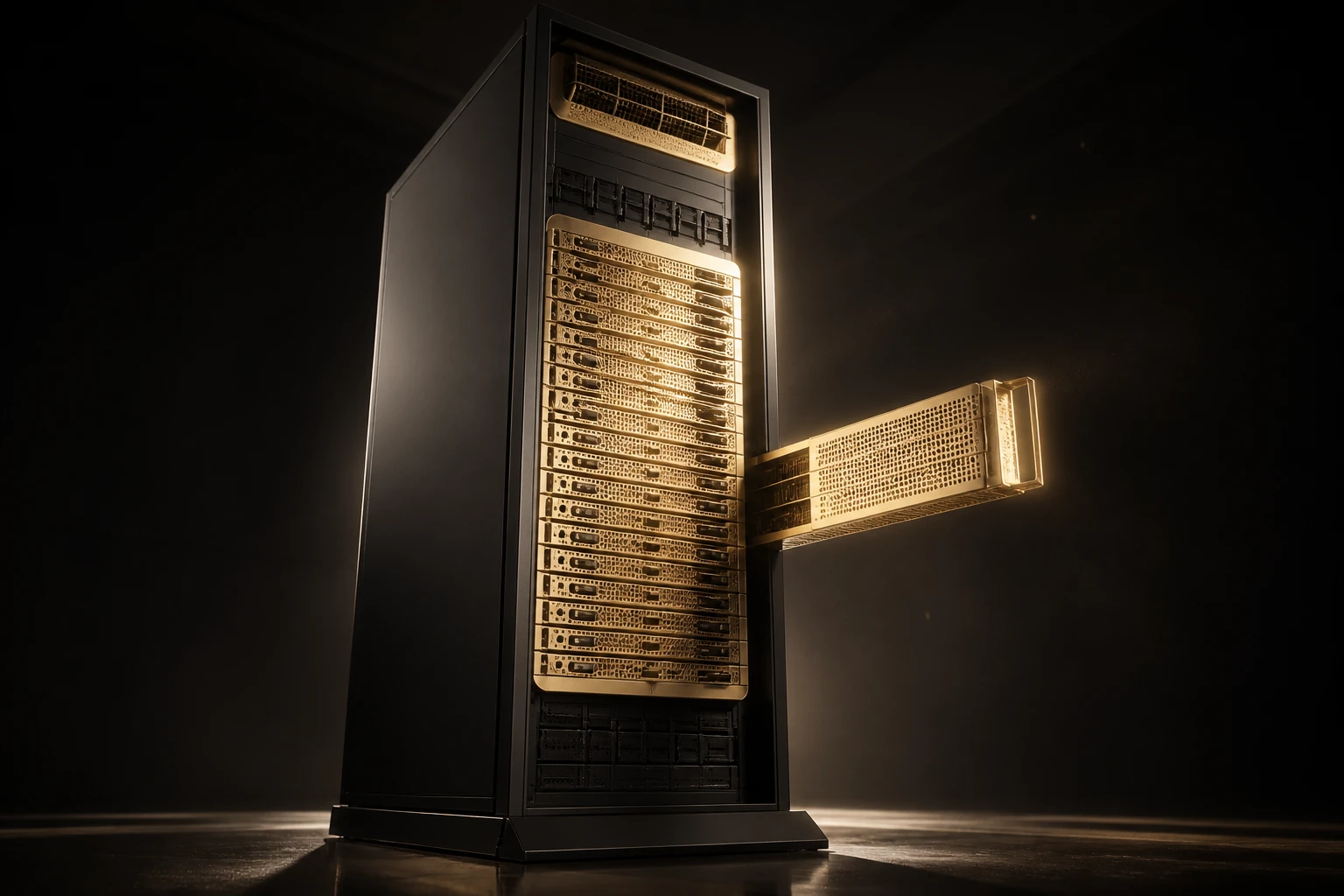
Bloomberg, citing people familiar with private notices, said contract manufacturers that build AI servers for Microsoft, Google, and Oracle have told customers that prices are rising by more than 15% in many cases on systems shipped early next year. The affected boxes include racks built around Nvidia’s Vera Rubin and Grace Blackwell chips, and the size of each increase depends on the chip generation and the memory mix. Nvidia did not comment, the South China Morning Post reported, repeating Bloomberg’s account.
Ed Ludlow, a Bloomberg Television tech anchor, put the mechanics plainly on X: “This is not Nvidia directly announcing a 15% GPU price hike.” The notices cover finished systems. Hardware-trade coverage in Tom’s Hardware said a 15% rise on rack-scale machines that already sell for several million dollars each adds hundreds of thousands of dollars per rack across deployments that run to thousands of racks.
Memory is the stated reason. Tom’s Hardware, citing market analysts, said conventional DRAM contract prices jumped 90% to 95% in the first quarter and were projected to climb another 58% to 63% in the second, as suppliers shifted wafers toward high-bandwidth memory and server parts. SK hynix said last October it had sold out 2026 production, and Samsung and SK hynix raised 2026 HBM3E supply prices by close to 20% before the year began, according to that same recap.
Dan Ives, partner and senior managing director at Yorkville Ives & Co., told Bloomberg Television on Monday that a “memory supercycle” is underway and that Nvidia has little choice but to pass some of the extra cost through. He put advanced-chip demand at as much as 15 times supply and said he does not expect a core balance until the middle to late part of 2028. “You cannot take the foot off the gas right now because of the demand cycle,” he said.
As we previously shared, we continue to expect our CapEx to increase significantly in 2027, and we’ll provide more details at a later date.
Anat Ashkenazi, chief financial officer, Alphabet Q2 2026 earnings call
That 2027 warning was already on the tape in July, and in a June investor presentation Google had already said capex would rise again in 2027 from a 2026 plan then pegged at $180 billion to $190 billion. The new rack stickers arrive on top of a budget the company had already promised to grow.
Memory Is Set to Be Most of the Cloud Bill
TrendForce, in an Aug. 25 research note, estimated that major cloud providers’ capital spending will jump 98% this year and another 50% in 2027. It also put DRAM and NAND Flash at 47% of those providers’ capex in 2026, then at 68% in 2027. That is the second bill hiding inside Alphabet’s server line: a growing share of each rack is memory, and memory is the piece still getting more expensive.
| Metric | 2026 | 2027 |
|---|---|---|
| Cloud-provider capex growth (TrendForce) | Up 98% year over year | Up another 50% |
| DRAM and NAND share of that capex | 47% | 68% |
| Server DRAM contract prices | About 270% higher through 2026, after a 64% rise in late 2025 | Still elevated |
| Enterprise SSD prices | About 235% higher through 2026, after a 35% rise in late 2025 | Still elevated |
| HBM contract prices | Some new long-term deals include ceilings | Could rise 70% to 140% |
TrendForce says HBM and registered DIMMs will take 51% of DRAM bit supply this year, with combined server DRAM and HBM bit supply rising 27% in 2027 as new fabs ramp in the second half. Even then, it expects memory prices to stay high enough that memory taking 68% of cloud capex becomes the base case, and that those costs give server and chip suppliers such as Nvidia cover to raise product prices.
The research house also flags the other lever: cloud companies can shrink memory per box, trim registered DIMM counts, or cut the HBM attached to future chips. Nvidia has already reduced planned SOCAMM capacity on Vera Rubin after suppliers could cover only about 60% of its 2027 low-power DRAM needs, according to trade reports citing TrendForce. Less memory per rack is one way to hit shipment targets. It is also a performance trade.
Google Still Lists Vera Rubin Next to TPU Racks
Pichai told investors Google offers “the industry’s broadest range of accelerators from Google and NVIDIA, including the new NVIDIA Vera Rubin platform, and TPU 8t and 8i.” The company is not choosing one stack. It is selling both, on the same call where it raised the spending range.
A flagship Nvidia rack is a memory box as much as a compute box. Nvidia’s own DGX Vera Rubin NVL72 listing specifies 72 Rubin GPUs and 20.7 TB of memory, paired with 36 Vera CPUs, and bandwidth up to 1,580 TB/s. Tom’s Hardware notes that each Rubin GPU can carry up to 288GB of HBM4, so a 72-GPU NVL72 holds more than 20TB of HBM before counting the LPDDR on the Vera CPUs.
Former Google product manager Tomasz Tunguz, writing from the earnings transcript, said Ashkenazi told investors the company “began to recognize revenues from TPU system sales, which we delivered to customer data centers for the first time in Q2,” while adding that the dollars were small and that the bulk of TPU hardware revenue lands in 2027. Cloud growth, she said on the call, still accelerated after excluding those sales. TheStreet reported that she declined to say how much of the $514 billion backlog is signed TPU deals, and that typical Google Cloud contracts still make up the vast majority.
So 2027 is when two clocks ring at once. Nvidia-based racks get the new sticker. TPU systems sold into customer sites were supposed to start mattering in dollar terms. Google still needs both, because enterprise software is tied to CUDA even as Gemini runs on TPU iron inside Google’s own fleet.
Cloud Buyers Inherit the Bill After 2026
Ives argued the extra cost will keep moving down the chain to enterprise customers, because hyperscalers will not slow the build. That matches the live order book. Google is still compute-constrained, is renting third-party capacity that Ashkenazi said will create “modest margin pressure in the near-term,” and is converting a $514 billion backlog of which just over half is due as revenue inside 24 months, per call recaps.
The people who write the checks are not only chip investors.
WHO EATS THE 15% ON 2027 RACKS
- Google Cloud tenants: GPU and Rubin-class instances priced off Nvidia racks will reset as 2027 hardware replaces this year’s contracted fleet.
- Microsoft and Oracle: Bloomberg named both alongside Google as operators whose contract builders have already sent the notices.
- Samsung, SK hynix, and Micron: The three HBM suppliers hold the scarce wafers; Counterpoint data cited by The Korea Herald put SK hynix at 58% of HBM revenue in the first quarter.
- Smaller AI labs: Groups without a TPU, Trainium, or Maia program still buy merchant Nvidia systems at the new system price.
- PC and phone buyers: Capacity shifted into HBM and server DRAM is the same squeeze lifting consumer RAM; Tom’s Hardware’s tracker had a mainstream 32GB DDR5 kit near $392 in August against $110 to $140 a year earlier.
Alphabet can fund the invoice. Cloud is growing at 82%, the Gemini app has 950 million monthly users, and AI Mode has passed one billion monthly actives since its global expansion last October. The company also raised about $84.75 billion of equity in June to expand AI infrastructure, according to its investor-relations news list, then posted negative free cash flow in the second quarter anyway. Paying 15% more for 2027 Nvidia racks is a cash-flow event, not a going-concern event. It is still a price that shows up in Cloud rate cards once 2026 supply, bought at older quotes, is used up.
Custom Chips Still Stand in the Memory Queue
The tempting reply to a Nvidia system markup is to design around Nvidia. Google has been at that work longer than anyone, with TPUs. Amazon has Trainium. Microsoft has Maia. Meta has MTIA. Those chips still sit on HBM from the same three memory companies, and TrendForce says 2027 HBM demand will be driven by Nvidia’s Rubin Ultra and by AI ASICs together, not by one camp replacing the other.
Industry notes circulating after the Bloomberg story made the same point from the other direction: an ASIC can look cheaper per token and still pay the HBM invoice. Switching boards does not create extra HBM wafers. It reallocates them. Google’s own TPU 8 parts, which Pichai listed beside Vera Rubin, raise Google’s bit demand even when they cut Nvidia’s unit share.
TrendForce’s other 2027 path is a thinner memory recipe per server, the same family of cuts already showing up in Nvidia’s SOCAMM plan. That keeps rack shipments on track while putting less HBM in each box. For Cloud customers, that can mean a different instance shape, not a lower bill.
Ashkenazi already told investors that 2027 capital spending will rise from this year’s $195 billion to $205 billion range. Bloomberg’s notices now put a number on one of the inputs to that next budget: more than 15% on many Nvidia systems Google still offers, in a year when research houses say memory itself becomes most of the cloud-provider capex stack. The 2026 server binge is largely priced. The 2027 fleet is not.
Disclaimer: This article is news reporting and analysis of public earnings remarks, supplier research, and press accounts of private price notices. It is for information only and is not investment advice, a recommendation to buy or sell Alphabet, Nvidia, memory-maker shares, or any other security, and it is not a forecast of Cloud pricing for any customer. Readers who are weighing hardware purchases or stock decisions should consult a licensed financial adviser or their own procurement team. Figures and statuses reflect the cited sources as of Aug. 26, 2026, and capital budgets, contract prices, and shipment terms can change.


X Finds a Chinese Bot Farm Cartooning AI Power Bills

Meta’s $10 Billion Anthropic Bill Can Move the IPO

The Yankees Trusted Lombard’s Glove and Tied 1915

Williams Sisters Need a Wild Card for US Open Doubles

Salesforce Shares Soar as an Anthropic Mark-Up Pads Profit

Guizhou Sells Cool Caves as a Summer Tourism Product

Zynga Puts a New Ned Stark on Sale in September

Pere Marquette Township Freezes Data Centers for One Year

SEC Proposes Regulation Crypto Assets After Scrapping Friday’s Vote
