BUSINESS
Peirce’s Exit Clock Now Hangs Over Regulation Crypto Assets
The SEC issued Regulation Crypto Assets after cancelling its vote, but comments close October 20, weeks before Commissioner Hester Peirce leaves.

The SEC published Regulation Crypto Assets on August 18, four days after it scrapped a public vote on the same package. Comments close October 20. Commissioner Hester Peirce, who spent years pushing a crypto safe harbor, is due to leave in November.
A yes vote on Friday, August 14 would only have opened notice and comment. The agency still opened that file, just without the meeting. The person whose 2020 draft sits underneath the text is the one running out of time to vote on a final rule.
An Unforeseen Scheduling Issue, Then a Proposal
The commission posted the August 14 open meeting on August 11, with a single agenda item: whether to propose a tailored offering regime for certain investment contracts involving crypto assets. By August 12 the White House Office of Information and Regulatory Affairs had the notice of proposed rulemaking under RIN 3235-AN38. Chair Paul Atkins had spent the prior weeks calling the package a top job.
On August 13, around 4:30 p.m. Eastern, the agency replaced the notice. A spokesperson said the session would move “due to an unforeseen scheduling issue.” Secretary Vanessa Countryman’s Sunshine Act filing recorded only that the 10 a.m. meeting “has been cancelled.” No new date went up. The cancelled listing sat on the public calendar through the weekend.
Four days later the commission put the text out anyway. Press release 2026-76 announced a tailored securities offering regime for crypto, filed as S7-2026-27, with release numbers 33-11434 and 34-106150. The official account posted the same morning.
🚨 TODAY: The SEC proposed new rules, “Regulation Crypto Assets,” that would create a clear and fit-for-purpose framework for certain investment contracts involving crypto assets. pic.twitter.com/SAA2sErMXF
— U.S. Securities and Exchange Commission (@SECGov) August 18, 2026
The follow-on proposal after the cancelled vote used the paths the Friday agenda had listed. Talk in Washington had tied the pause to Senate bargaining on market-structure legislation. The agency did not withdraw the file from White House review, and it did not wait for that bargaining to finish.
THE WEEK THE PUBLIC VOTE VANISHED
- August 11, 2026: The SEC posts an open meeting for Friday at 10 a.m. on a tailored crypto offering regime.
- August 12, 2026: OIRA logs the Crypto Assets proposal under RIN 3235-AN38.
- August 13, 2026: A cancellation notice cites an unforeseen scheduling issue and names no replacement date.
- August 14, 2026: The public session does not occur.
- August 18, 2026: The commission issues Regulation Crypto Assets without holding that meeting.
- August 21, 2026: The proposing release runs in the Federal Register.
- October 20, 2026: Public comments are due.
A delay of four days is not a burial. It is also not a final rule, and the calendar after October 20 is where Peirce’s exit starts to bite.
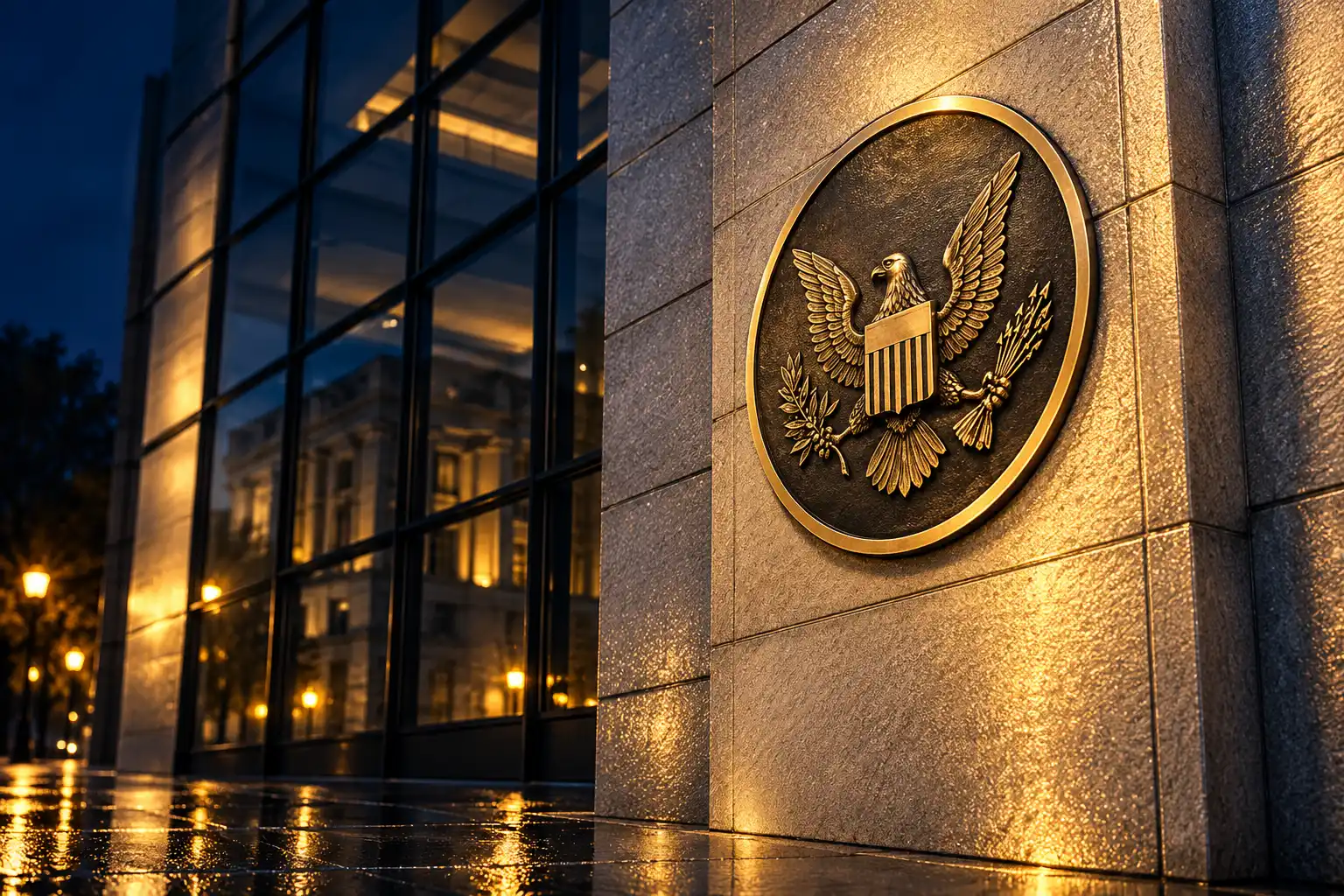
Peirce’s November Exit Shrinks the Final-Vote Window
Peirce has served since January 2018 and led the Crypto Task Force from early 2025. The industry still calls her Crypto Mom, a nickname that stuck during years of dissents against enforcement-first crypto cases. Her second term ended on June 5, 2025. Agency rules let a commissioner stay up to 18 months after that if no successor is confirmed, which would have run through December 2026. She chose November instead, to join Regent University School of Law in Virginia Beach as an associate professor.
Atkins used his August 18 statement to credit her by name. He said today’s action is a fulfillment of her original idea, the February 2020 “Running on Empty” safe harbor speech. Commissioner Mark T. Uyeda thanked her “for her longstanding leadership on crypto issues, from the dark days of the prior administration through her leading the Crypto Task Force.” The proposing release is, in that sense, her document.
It is also on a timer she will not fully control. She asked the public to write in during a sixty-day comment period on the proposal. Sixty days from the Federal Register date lands on October 20. Staff then have to read the file, rewrite, and tee up a final vote. Standard comment review runs months, not days. November is the month she has said she will go.
A whole generation has struggled with the SEC’s insistence, without regard for adverse effects on investors and entrepreneurs, that people apply a set of inapt rules to crypto. Today, as part of the broader initiative of which legislative efforts are the centerpiece, the Commission took an important step toward putting clear, sensible, enforceable rules in place for crypto offerings.
Hester M. Peirce, SEC Commissioner, August 18 statement
She also asked for views on letting crypto assets play a role akin to equity, so token holders can share in the growth of the network they fund. That is a design question for the comment file, not something a proposal can settle on day one. If the final vote slips past her last week in the building, the rule she spent six years arguing for would be adopted by the two men who remain.
What Regulation Crypto Assets Would Change
The March 17 joint SEC and CFTC interpretive release already sorted crypto assets into five buckets: digital commodities, digital collectibles, digital tools, stablecoins, and digital securities. It named 16 large tokens, including Bitcoin, Ethereum, Solana, and XRP, as digital commodities under the CFTC. That reading answered a decade-old question for those names. It did not tell a new team how to sell a token, what to disclose, or when the asset can leave securities law.
Regulation Crypto Assets is aimed at that gap. Atkins said issuers that raise money by selling non-security crypto assets subject to an investment contract have had to use SEC rules “which were not adopted with these assets in mind, and many of which originated in the 1930s.” He called that a square peg in a round hole, and said it pushed work offshore. The new text would add two Securities Act exemptions and a conditional safe harbor from the term “investment contract.”
THREE PATHS IN THE AUGUST 18 PROPOSAL
| Path | Ceiling | Clock | What issuers still owe |
|---|---|---|---|
| Startup exemption | $5 million | Four-year window, one time | Principles-based narrative disclosure; antifraud rules still apply |
| Fundraising exemption | $75 million | Each 12-month period | Financial statements, ongoing reports, audits once raises hit set levels |
| Investment-contract safe harbor | No raise cap | When promised work has stopped | A certification to the SEC that essential managerial efforts have been completed or permanently ceased |
Uyeda described the assets in the net as “covered investment contracts.” Both raise paths would use narrative disclosure written for tokens rather than a full 1933 Act registration statement. The larger path borrows its annual ceiling from the familiar Regulation A+ Tier 2 figure. The press release also says the exemptions would preempt state registration and qualification rules for those offers and for certain secondary trades, a detail that matters in a market that has been sued state by state.
This is not live. A proposal is an invitation to argue. Teams cannot sell under the $5 million path or the $75 million path until a final rule is adopted and effective. Until then the old tools remain: Regulation D private placements, whatever other exemptions already exist, and the March commodity labels for the 16 named tokens.
$5 Million, $75 Million and the Off-Ramp
The startup path is the one written for thin teams. $5 million over four years is seed money, not a late-stage round, and the disclosure is meant to look more like a white paper than audited financials. The fundraising path is the institutional cousin: $75 million a year, with books, ongoing reports, and audits once the raise crosses thresholds Atkins flagged in his statement. Well-staffed issuers can live on Regulation D while they wait. A three-person protocol that budgeted a public sale for the second half of 2026 cannot.
The safe harbor is the piece founders actually argue about. Under the text, if an issuer certifies that it has ceased or terminated all essential managerial efforts it promised under the investment contract, and meets other conditions, the commission would no longer treat the non-security crypto asset as subject to that contract. Atkins put it in plain terms: the asset would no longer sit under the SEC’s authority. Peirce said the harbor complements the March joint reading of how a crypto asset may cease to be subject to an investment contract.
The phrase that now eats lawyer hours is “essential managerial efforts.” For years, the street joke was that a team had to walk away from its own product to escape securities law. The draft is written around ending the work that was promised at sale, not around deleting a GitHub org. That still leaves a hard fact pattern: who certifies, what counts as “permanently ceased,” and how an already-launched token with years of foundation control tries to qualify. Those are comment-file questions, and they will not be answered before October 20.
Atkins was careful not to sell the package as a substitute for Congress. “Legislation remains indispensable to enacting ‘future-proofed’ rules of the road that are durable enough to protect the work we are undertaking today from being unwound by a future rogue regulator,” he said. He added that the SEC has and will continue to support Congress in delivering the CLARITY Act to President Trump’s desk. The agency is writing rules and, in the same breath, telling the industry those rules can be unwound.
Thune Files Cloture for a September 15 Test
The Digital Asset Market Clarity Act, H.R. 3633, passed the House in July 2025 by 294 to 134. The Senate Banking Committee cleared its version in May 2026 by 15 to 9. Then the bill stuck on ethics language for officials who hold digital assets, DeFi treatment, stablecoin yield, and how Senate Agriculture text gets folded in. Majority Leader John Thune said Democrats were blocking a vote and left for the August recess without a floor fight.
Early on August 8 he filed cloture on the motion to proceed, at the end of an overnight session, so the first procedural vote can happen when the chamber comes back. The Senate is due to reconvene September 14. The cloture test is September 15. Invoking cloture takes 60 votes. Republicans hold 53 seats, so the motion needs at least seven Democrats or independents if every Republican is in. Cloture would only limit debate on whether to take the bill up. It would not pass it, and it would not start the amendment fight.
FIGHTS STILL BLOCKING THE CLARITY ACT
- Ethics language: Democrats have wanted limits on officials who hold digital assets, and that fight sat on top of the August stall.
- Stablecoin rewards: Negotiators have circled a split that would bar interest on idle balances while allowing activity-based rewards, and that split is not locked.
- DeFi and illicit finance: Protocol treatment and anti-money-laundering text still have to survive a floor that has only a few working weeks before campaign season.
Prediction-market prices on a 2026 signing peaked at 82 percent in February, fell to 43 percent in July after an ethics deal was floated, and crashed to 16 percent when the Senate left town. Late-August pricing sat in the mid-teens. The chamber has about three working weeks after recess before midterm campaigns swallow the calendar. Failure on September 15 would, as a practical matter, park the bill until 2027. Atkins has already said he will write rules if Congress cannot. He has now done the first half of that sentence, and he has also said those rules are not enough.
After November, a Two-Member Quorum
The Securities Exchange Act of 1934 built a five-member commission. The SEC now has three, all Republicans: Atkins, Uyeda, and Peirce. Two Democratic seats have sat empty. When Peirce goes, only Atkins and Uyeda remain. A 1995 commission rule says a quorum is three members, and that if fewer than three are in office, a quorum of the members in office can still act. On paper, two people can adopt a final rule.
On paper is the problem. A two-member SEC has no modern run of major rulemaking to point to. A tie produces no decision. Administrative law scholars have already asked whether a rule finished by two commissioners would survive a courtroom, especially after the Supreme Court’s 2024 ruling in Loper Bright Enterprises v. Raimondo cut the old deference agencies used to lean on. Industry lawyers have started flagging that risk on Regulation Crypto Assets specifically: a final rule voted 2-0 is a different target than a final rule voted 3-0.
That is why the cancelled Friday session still has a cost even though the NPRM exists. Each week of comment-file drift pushes the adopting vote closer to a body that will have two names, not three. Atkins and Uyeda have not always moved at the same speed on crypto this year, and a three-person commission has no spare vote if one of them peels off. None of the three has said on the record that disagreement caused the August 13 cancellation. The public explanation remains scheduling.
Seed Teams Still Lack a Live Exemption
The only binding federal map for classification remains the March 17 interpretive release. It did real work for the named commodities, including a burst of Bitcoin ETF inflows in March after the labels landed. It does not give a new token a public-sale path. Dozens of projects shut down or left the United States in 2026, and industry groups keep citing legal fog as the reason. Custody, product maps, and compliance shops all wait on which agency owns a given token and what filing is required.
The CFTC has been preparing its own digital-asset session, and the White House pulled crypto executives in for meetings in early August. Atkins’s own statement treats Congress as the durable lock and the SEC text as a bridge. For a seed team that planned to use the $5 million white-paper path this fall, a bridge that is still in comment is not a path. Every extra month burns runway without the sale the budget assumed.
Existing tokens sit in a second queue. The safe harbor is written so an issuer can delink an asset from the investment contract that once wrapped it. Whether a foundation that has been running a network for years can make that certification, and what it must stop doing first, is the question practitioners keep working. The off-ramp is not a joke about founders vanishing. It is a documentation test the comment file has to sharpen before anyone should treat it as a clean exit.
The comment file is open through the date printed in the Federal Register version of the release, with comments due on October 20. Peirce is still on the commission. The Senate’s first procedural test is September 15. After that, the only clock that cannot be slipped by a new meeting notice is her last month in the building.
Disclaimer: This article is news reporting and analysis of SEC rulemaking and pending legislation, and it is for information only. It is not investment advice, legal advice, or a recommendation to buy, sell, or hold any digital asset, token, or related security. Readers should consult a qualified securities lawyer and a licensed financial adviser before making decisions based on proposed rules, comment deadlines, or bill schedules. Figures, comment dates, commissioner status, and legislative calendars reflect the official notices and public statements available as of September 2, 2026, and they can change.


Saks Kept 15 Stores While Rivals Took the Shoppers

Fallout Season 3 Spend Hits California’s $42 Million Cap

Ebola Outran Congo’s Contact Lists and Reached Nairobi

Jagex Builds RuneScape 4 Beside the Games Players Already Have

SimpL Bets €1.2 Million on Meetings Paid When Held

Boston Scientific Cyberattack Leaves Hospitals Waiting on Implants

Guizhou Cave Cafes Spread When Each Cavern Fills

The Second Ned Stark Kit Lands When a Banner Dies

OpenAI’s Jalapeño Chip Turns Watts Into Faster Agent Steps

Satellites Saw Nepal’s Ice Slope Move Before the Flood
-
 NEWS2 months ago
Boston Scientific Cyberattack Leaves Hospitals Waiting on Implants
-
 NEWS2 months ago
Guizhou Cave Cafes Spread When Each Cavern Fills
-
 GAMING2 months ago
The Second Ned Stark Kit Lands When a Banner Dies
-
 NEWS2 months ago
OpenAI’s Jalapeño Chip Turns Watts Into Faster Agent Steps
-
 NEWS1 month ago
Satellites Saw Nepal’s Ice Slope Move Before the Flood
-

 NEWS2 months ago
MLB Quiet Periods Copy a Freeze Other Leagues Use
-

 NEWS2 months ago
Roman Space Telescope Launches After a Decade-Long Budget Bet
-

 NEWS2 months ago
Pere Marquette Freezes Data Centers on a Power-Rich Shore