
NEWS
Guizhou Cave Cafes Spread When Each Cavern Fills
Guizhou cave cafes and 1,280-yuan Shilong tickets now grow by copying new caves, because each opened cavern hits a daily crowd wall.

Guizhou cave cafes and Shilong Cave’s 1,280-yuan ($181) paddle tickets drew more than 13,000 visitors in 2025. The same operators opened a second underground river in Anshun this May, because each cave fills long before the province runs out of mapped mouths.
The 1,280-Yuan Ride Under Qingzhen
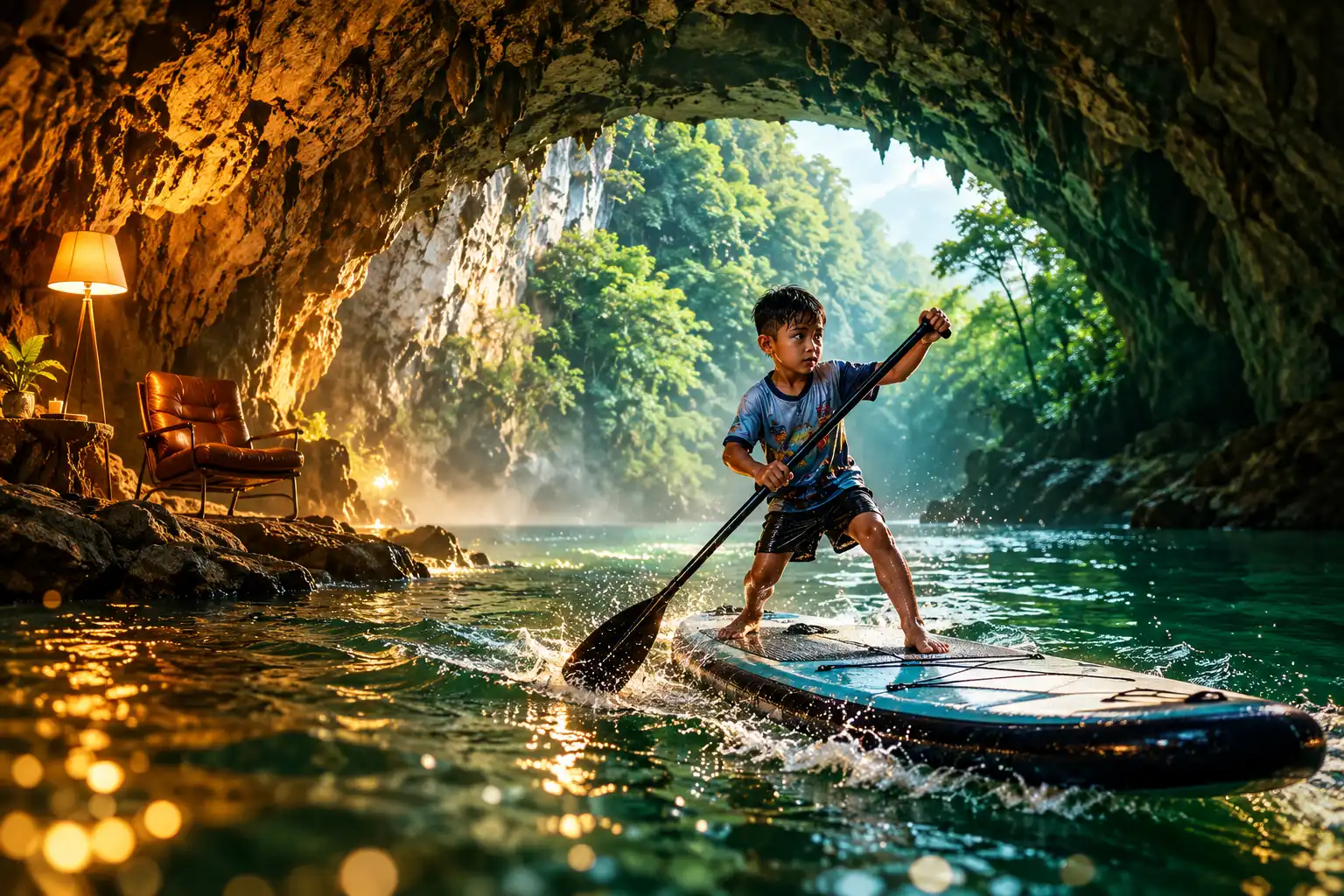
Shilongdong Cave in Qingzhen, west of Guiyang, opened the paid paddleboard run in August 2024. A 2025 roundup put tickets at 1,280 yuan and said the project hosted more than 13,000 visitors that year, with revenue above 10 million yuan.
Qingzhen’s own government page says the cave first broke out in 2022, when its pools landed on a magazine cover. By August 2023, Mafengwo, Wwan Youth Travel, and Guanyou village had put paddle-boarding and snorkeling on sale, and the clips passed a billion views.
That high ticket is the point of the model. In May 2026 the Shilong team repeated it at Huangheying Cave in Anshun, which has a 2.5-kilometer underground river. Ning Jie, the Huangheying project manager, said many tourists come specifically for the underground rafting.
CAVE RECEIPTS IN GUIZHOU
| Site | Offer | Take |
|---|---|---|
| Shilong Cave, Qingzhen | Paddleboard route, paid from August 2024 | 1,280 yuan a ticket; more than 13,000 visitors and over 10 million yuan in 2025 |
| Xixiu cave cafe, Anshun | Coffee beside a waterfall wall | More than 3 million yuan in three months; over 9,000 visitors on the May Day holiday |
| Forest Coolpark, Libo | Caving, camping, cave hotpot | Nearly 10,000 visitors and more than 7 million yuan since May Day 2025 |
| Swallow Cave, Guiding | Zip lines, steel bridges, via ferrata | More than 300 explorers in an eight-day May Day 2026 trial |
Song Yuanqiao, who runs the Swallow Cave project in Guiding with fellow rescuer Zhao Fei, said he started leading trips in 2018 with little public interest. Inquiries jumped in 2023, he said, after first-time tourists began asking for routes. “We never imagined it would become so popular now,” Song said.
The pair went to Hungary and Spain to study route design, industrial codes, and safety rules before they hung zip lines and steel bridges on the raw passages. Chang Ting, a visitor from Xi’an, told interviewers she spent two days of a three-day Guizhou trip on caves after seeing them on social media. Signal died about 100 meters in. “It felt like stepping into a crack in time, and all the noise faded away,” she said.
Guanyou Village Banks the Guide Wages
The 1,280-yuan price only works if someone on a board knows the river. Qingzhen trained local residents with the Chinese Mountaineering Association and turned them into certified outdoor instructors from Guanyou village. Chen Gang, founder of Mafengwo, said that work lifted villagers’ monthly pay to more than 10,000 yuan.
By 2024, per capita disposable income in Guanyou village had passed 24,000 yuan, and collective village income reached 300,000 yuan, the city page said. Beijing, Shanghai, and Guangzhou buyers, plus some foreign visitors, were already on the boats.
Lei Yinggui, 23, a cave tour instructor, said sports graduates like him used to look at ball-coach jobs. Cave routes gave them another payroll at home. The boom also pulled migrants back. Returning from Shenzhen last year, Peng Wei opened a cave cafe in Xiuwen County with former classmates rather than keep his wage on the coast.
“The longer I work away, the more I miss my hometown’s scenery,” Peng said. They left most of the rock alone, added little décor, and sold waterfall-cooled coffee. At peak the cafe moves up to 600 cups a day.
Six Hundred Cups Beside a Cave Waterfall
Adventure tickets skim a thin, high-paying line. Cafes catch the rest of the family. A cave cafe in Anshun’s Xixiu District passed 3 million yuan in three months and drew more than 9,000 people over the May Day holiday. Umber Coffee sits in five natural caves against a rock face, with warm lamps on the stone and a restaurant that hosts string concerts.
Danila, a young Russian who works in Guiyang, drove more than an hour with friends for that stop. “It’s incredibly cozy to drink coffee and watch the waterfall inside a cave,” she said. Xiu Café, photographed in Xiuwen in November 2025, is the same idea in a different mouth: a coffeehouse built inside a working karst cave.
Viral clips tagged “Guizhou cave exploration” have taken more than 5 million likes, with related topics in the hundreds of millions of views. More than 60 percent of the province is karst, and a 2025 survey by the provincial department of natural resources counted 42,800 cave entrances. That inventory is why coffee can spread even when a single river ride cannot.
HOW THE CAVES ARE SOLD NOW
- Water routes: Shilong and Huangheying sell guided paddle runs on underground rivers at a four-figure ticket.
- Hard sport: Swallow Cave and other sites hang zip lines, tightrope bridges, and via ferrata on unbuilt passages.
- Soft stops: Xiuwen and Xixiu cafes sell coffee, concerts, and waterfall seating to people who will not crawl.
- Mixed parks: Forest Coolpark in Libo, inside the South China Karst, layers caving, camping, and cave hotpot on one ticket.
Zhao Fei put the shift in one line. Tourists are no longer satisfied with looking at a cave, he said. They want to join the route. That is also why a styled cafe interior now reads, on a phone, like a set. Some viewers call the rooms fake. The lamps and the menu are doing that, not a generator.
Why the Cool Air Cannot Scale
The product is the cave’s own weather. Heat stays outside; the stone holds a steady chill, which is why families will pay for a board, a coffee, or a via ferrata in July. Pack too many bodies into that weather and it stops being the thing on the ticket.
Ren Peng, general manager at Forest Coolpark, said his team keeps construction out of deeper sections and hauls waste out daily. Jean Bottazzi, a French caver who has studied Shuanghedong in Suiyang for more than 30 years, has been telling local officials the same thing: the science has to come before the route, and jobs for villagers only last if the hole is still a cave.
Guizhou has already packaged cool caves as a summer product through village shares and high-ticket water lines. The next unit of growth is another cave, not another hundred people on the same river.
Karst caves are nonrenewable geological heritage. Proper resource management is the key to turning underground wonders into local benefits, and we must adhere to development within protection.
Zhang Zaijie, director of the green development strategy research institute, Guizhou University of Finance and Economics
Incomplete tallies put the direct market for Guizhou cave tourism at about 1 billion yuan. That figure only holds if the cool rooms remain cool. Horizontal copies (Huangheying after Shilong, a cafe in the next county) are how operators raise revenue without stuffing one chamber.
Zhijin Cave Already Runs Carbon Sensors
Older show caves already live with that physics. Zhijindong Cave, a UNESCO Global Geopark in Bijie, finished a full laser scan in 2015, and Liu Haibo, general manager of Guizhou Zhijindong Cave Tourism Development Co., said a second scan was due the following year so staff can see whether each stalactite is growing or damaged.
Since 2019 the geopark has run a live system for temperature, humidity, carbon dioxide, and visitor flow. A paper in Carsologica Sinica on Zhijin Cave found that after tourist activity, average temperature inside rose 0.23 to 0.86 C, and carbon dioxide lagged behind visitor flow, with larger rooms taking longer to react.
Zhou Wenlong, deputy director of the Guizhou Institute of Mountain Resources, said terrestrial laser scans now build 3D models of interiors that are too fragile for a crowd, then those models go out as virtual access. Caves that stay closed still earn a use. Caves that open still need a cap.
FROM QUIET HOLES TO A FILED RESOURCE
- 2018: Song Yuanqiao is leading cave trips that almost nobody books.
- 2022: Shilong Cave hits outdoor circles and a National Geographic cover.
- August 2023: Guanyou village, Mafengwo, and Wwan Youth Travel put paddleboards on the river.
- August 2024: Shilong’s paid paddle run opens at 1,280 yuan.
- February 2025: Guizhou issues a plan for cave classification, restoration, and orderly use.
- 2025: Shilong logs more than 13,000 visitors; Xiuwen and Xixiu cafes start selling cups by the hundred.
- May 2026: The Shilong crew copies the river model at Huangheying in Anshun.
- August 29, 2026: An official provincial account films live music and machine-made sound inside Jiudongtian.
New cave fishes keep turning up in the same karst while the tickets sell, including loaches described this year from Guizhou groundwater. The rock still holds species with no Chinese common name on a menu. That is the other payroll the cool air supports, and it does not show up in a cafe till.
Beijing Put Cooling Retreats in the Plan
In February 2025 Guizhou rolled out classified management of cave resources, with filing, ecological red lines, orderly development, and full-chain supervision. The province wants ecological, scientific, and tourism value named in the same filing, not a free-for-all of lamps and espresso machines.
National consumption policy caught up this summer. China released the plan for expanding consumption for the 15th Five-Year Plan period (2026-2030) in July, and it tells local governments to build summer cooling retreats in the plan, plus winter warm getaways and coastal trips. Heilongjiang is selling forest shade, Xizang high-altitude camps, Xinjiang grassland. Guizhou’s version is a hole in the limestone.
Li Zexin, posting in June, tied the old slogan to the new till: “In Guizhou, that means cave cafés, mine-turned coffee spots… Tourism brings money.” The line is neat because it is also a warning. Lucid water and lush mountains become tickets only while the chamber still behaves like a cave.
Jiudongtian Turns a Cave Into an Instrument
On 29 August 2026, UP Guizhou, the province’s official account, posted from Jiudongtian: China’s first immersive cave music therapy, with natural reverb, dripping stone, live players, and AI soundscapes. The clip treats the cavern as an instrument. Coffee was never going to be the last use of that room.
Aug 29 – Jiudongtian, Guizhou. China’s first immersive cave #music therapy is here! The karst cave became a living instrument – natural reverb, flowing water, dripping stones, plus live music & #AI soundscapes. An all‑new healing experience in the heart of nature. #SonicHealing pic.twitter.com/HHGXtaAq2c
— UP Guizhou (@UpGuizhou) August 30, 2026
A day later the same account called an ancient karst cave “nature’s own healing space.” The International Mountain Tourism Alliance spent 1 September pushing Shuanghe Cave in Zunyi as a national geopark stop. The marketing has already moved past the paddleboard.
Song’s 2018 trips had no queue. Shilong’s 2025 books had a four-figure price and a village payroll. Jiudongtian’s 2026 tape has a violin in the drip. Zhang Zaijie called the chambers nonrenewable. Each new copy, cafe, or concert is a bet that this one more use still leaves the stone cold enough to sell tomorrow.

Saks Kept 15 Stores While Rivals Took the Shoppers

Fallout Season 3 Spend Hits California’s $42 Million Cap

Ebola Outran Congo’s Contact Lists and Reached Nairobi

Jagex Builds RuneScape 4 Beside the Games Players Already Have

SimpL Bets €1.2 Million on Meetings Paid When Held

Boston Scientific Cyberattack Leaves Hospitals Waiting on Implants

Guizhou Cave Cafes Spread When Each Cavern Fills

The Second Ned Stark Kit Lands When a Banner Dies

OpenAI’s Jalapeño Chip Turns Watts Into Faster Agent Steps

Satellites Saw Nepal’s Ice Slope Move Before the Flood
-
 NEWS2 months ago
Boston Scientific Cyberattack Leaves Hospitals Waiting on Implants
-
 GAMING2 months ago
The Second Ned Stark Kit Lands When a Banner Dies
-
 NEWS2 months ago
OpenAI’s Jalapeño Chip Turns Watts Into Faster Agent Steps
-
 NEWS1 month ago
Satellites Saw Nepal’s Ice Slope Move Before the Flood
-

 NEWS2 months ago
MLB Quiet Periods Copy a Freeze Other Leagues Use
-

 NEWS2 months ago
Roman Space Telescope Launches After a Decade-Long Budget Bet
-
 NEWS2 months ago
Pere Marquette Freezes Data Centers on a Power-Rich Shore
-

 BUSINESS2 months ago
The Bank of Korea Bets Chips Can Carry 3% Rates