
NEWS
Allison Says Mercedes Cannot Switch Off the 2026 Car
Mercedes still cannot stop 2026 development despite an 87-point lead, with Kimi Antonelli starting Sunday’s Italian Grand Prix from last.

Kimi Antonelli leads the 2026 Formula 1 championship on 242 points, and this weekend he will start the Italian Grand Prix from the back of the grid. Mercedes has eight wins from 12 races and a constructors score of 425, yet technical director James Allison says the factory still cannot switch the current car off.
The lead was supposed to buy a clean turn toward 2027. Battery failures, a spent first car, and a cost cap that Toto Wolff says has left them without money for extra parts have turned that choice into a bind, with 11 races still to run after Monza.
Antonelli Starts His Home Race From the Back
Deputy team principal Bradley Lord said on the team’s radio show that both Mercedes drivers will take grid drops for going beyond the four power units allowed this year, and that Antonelli’s penalty lands at Monza. Lord said the team has not settled the race for George Russell.
The 19-year-old Italian is 59 points clear of Russell and of Ferrari’s Lewis Hamilton, who are tied on 183. He still has to start Sunday’s race at the back of a 23-car field on a circuit that rewards clean air and punishes traffic. Mercedes has not presented the fresh Monza engine as the extra homologation the FIA opened for it in August.
WHAT WE KNOW
- Antonelli’s drop: He takes a new power unit this weekend and starts last at Monza.
- Russell’s drop: Lord said both drivers will be hit, and the race for Russell is not final.
- The allowance: Each driver is allowed four power units; extra units bring a grid penalty.
WHAT IS UNCONFIRMED
- Engine spec: Mercedes has not said the Monza unit is the extra 2026 homologation.
- Russell’s date: The second drop could land on a street circuit or a later flyaway.
A last-place start does not end a 59-point lead by itself. It does put the championship leader in the one place an eight-win team is not supposed to be, on the weekend the Italian crowd came to see him.
A Quarter of a Second a Month Is the Trap
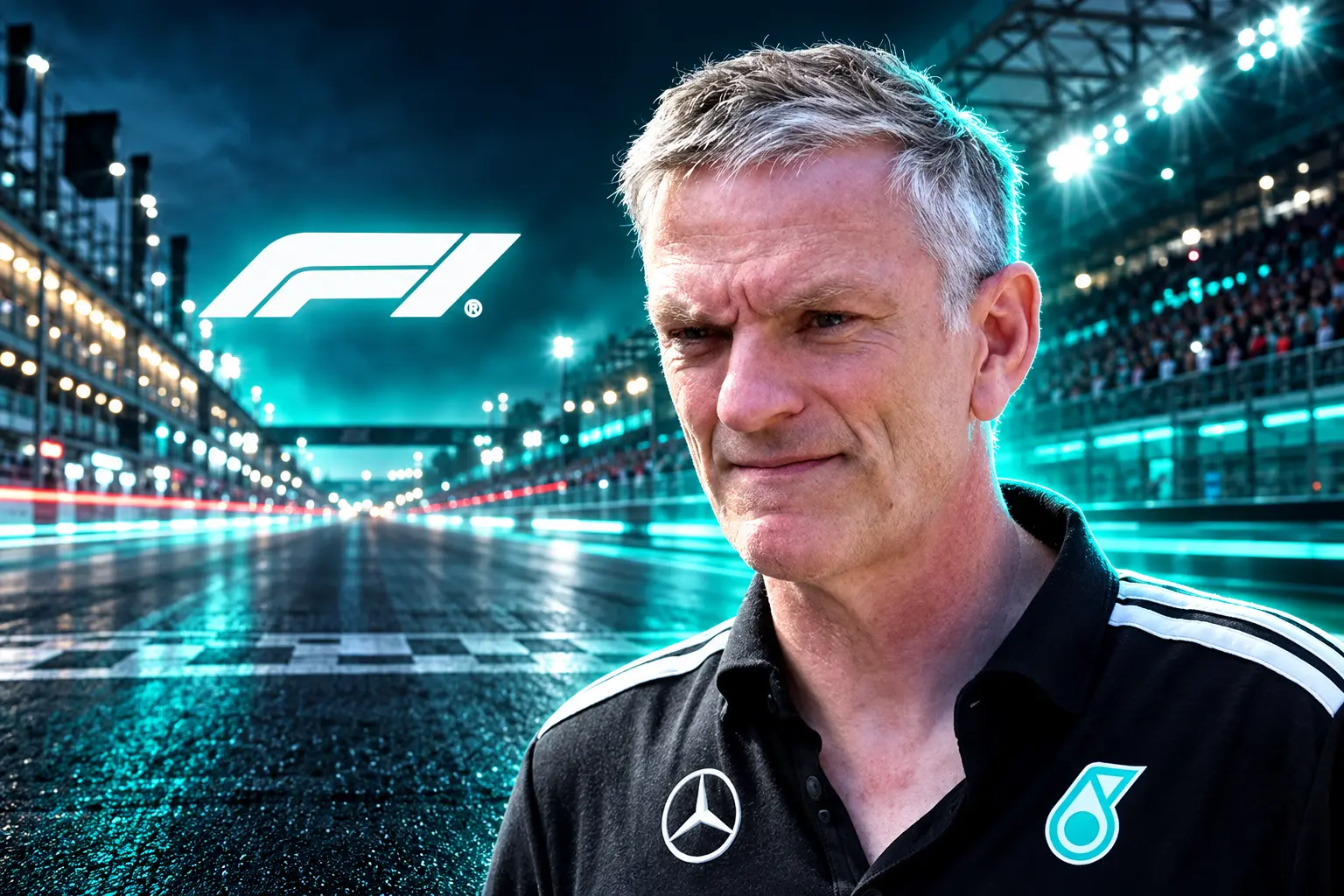
Allison set the problem out on the team’s mid-season radio show, recorded in Brackley and Brixworth before the summer shutdown, with managing director Hywel Thomas of Mercedes AMG High Performance Powertrains. He treated the switch-off as a live judgement, not a winter memo.
Every Formula 1 team always faces the dilemma of when should you switch off your efforts on the current car and invest in next year. And when the development rate is as steep as it seemingly continues to be, that decision gets more difficult because if you switch off too early and your competitors continue to develop at a quarter of a second a month, then the world can get a bit itchy in the final third of the season or whatever.
James Allison, Mercedes technical director, Nu Silver Arrows Radio Show
He said the job is to keep enough new performance coming to the track to stay ahead of that leapfrogging, and that the odds are good because he knows what the wind tunnel has already produced. “I know what’s sitting in the wings and will eventually make its way to the track,” he said. The parts are real. The calendar slot for them is the argument.
He also said the tunnel is finding about six to seven times the lap time per week it found last year. That slope is why a team with eight wins still talks as if it is being hunted.
Battery Failures Ate the Cushion Eight Wins Built
Allison’s other mid-season brief was blunter. The DNFs, he said, are “very, very painful,” and they cluster in the battery the team calls the module. Customer cars have been hit as well, including a McLaren double non-start in China and a power-unit retirement for Lando Norris in Monaco.
Team principal Toto Wolff did not wrap it in process language after Barcelona, when Antonelli’s car went silent from second. “We just can’t compete for a championship if every second race a car is losing fat points,” Wolff said. After Silverstone, where Antonelli started on pole and was classified 16th with a broken front wheel shield, Wolff said, “It’s on us. A car should not break.”
THE POINTS MERCEDES HANDED BACK
- Canada, 24 May: Russell retired from the lead on lap 30 after a battery failure Allison later called catastrophic, an engine kill with heat damage in the pack.
- Barcelona, 14 June: Antonelli shut down late from second, the same sudden loss of power, his first retirement of the year.
- Monaco, 7 June: Russell scored nothing after the team failed to serve a five-second pit-lane penalty, a weekend Allison later filed under self-inflicted wounds.
- Silverstone, 5 July: A broken wheel shield around the brake duct left Antonelli unable to turn; Wolff said the call was to retire and the driver tried to salvage a result anyway.
- Spa, 19 July: A software fault dumped 30 to 40 percent of battery charge after the start. Deputy technical director Simone Resta said the same code sat on both cars and punished Russell harder; he retired after contact at turn five.
Those weekends are why eight wins have not produced the kind of cushion a switch-off is supposed to rest on. Hamilton has not had a race-ending failure, which is one reason he sits on 183 beside Russell rather than well behind a Mercedes lockout.
Brackley Spent the First Car Before Melbourne
Allison’s less quoted admission is that Mercedes chose this squeeze. Other teams, he said, did not arrive in Australia with quite such a late-braking first car. Mercedes emptied the cupboard to make the opening package as fast as it could. “We arrived bristling with performance, but with all of it spent,” he said. “We’ve been filling up our tanks to give more, and we’re a bit out of phase.”
That phase shift is the mechanical reason rivals keep looking faster in bursts. Ferrari, McLaren, and Red Bull have been adding parts through the year. Official upgrade filings show Mercedes has brought 24 new components, against 40 for Ferrari and 38 for McLaren. The last major Mercedes package went on in Canada. The team took no big aero step to Zandvoort, where Norris won and Antonelli finished 11.536 seconds behind.
Wolff has been saying the same thing in fewer words. “We haven’t got the money to put developments on the car,” he said, arguing the cost cap forces an even split rather than a part at every race. Russell, in July, said some teams might pay for that volume at the end of the year. Norris then won Hungary and the Dutch Grand Prix, so the warning now sits next to a two-race McLaren streak rather than a theory.
The FIA Handed Mercedes an Engine Token It Has Not Spent
On 26 August the FIA published the first two reviews under its Additional Development and Upgrade Opportunities rules, the 2026 system that lets manufacturers whose combustion engine sits at least 2 percent behind the best ICE add homologated upgrades, plus extra cost-cap room and dyno time. A manufacturer in the 2 to 4 percent window gets one extra homologation this year and one in 2027, and up to $3.0 million (USD) of extra cap space in that band.
The governing body’s one additional homologation in 2026 went to Mercedes after the first review, which closed after Canada. Audi, Ferrari, and Honda were judged more than 4 percent behind and received two extra homologations in each of 2026 and 2027. No manufacturer received a further grant after the second review, which closed after Hungary. Nikolas Tombazis, the FIA’s director of single seater, said the analysis of the period-two data was thorough and that the findings were confidential beyond those bands.
Red Bull was treated as the combustion benchmark, so it received nothing. That outcome is awkward in a year when the regulations split power about 50/50 between the engine and the electric side, and when Mercedes’ own retirements have come from the battery, not from a weak ICE. An extra token judged on the combustion engine does not fix the module that has been switching cars off. Mercedes has been free to spend that token since June and is still taking a same-era unit to Monza, on current team messaging, while the third review window runs from the Dutch Grand Prix through Mexico City.
THE ENGINE LEDGER
- First review: Mercedes in the 2 to 4 percent ICE window, one extra 2026 homologation and one for 2027.
- Second review: No further grants to any manufacturer.
- Third review: Netherlands to Mexico City, still open.
- Monza this week: A new unit for Antonelli, not presented as that extra homologation.
Holding the token is a choice. It is also the clearest sign that Allison’s switch-off problem is not a speech about next winter. The team has development rights it has not put on the car, and the championship leader will still start last on Sunday.
How Close Has McLaren Come?
Former driver Johnny Herbert has already flagged McLaren as the side that can make the second half messy, and Norris as the driver who can walk back into the title fight if the orange car keeps this run. The Mercedes 2026 championship standings still show a Mercedes 1-2 in wins and a fat constructors stack. The last two Grands Prix did not.
THE TITLE BOARD AFTER 12 ROUNDS
| Driver | Team | Points | Wins |
|---|---|---|---|
| Kimi Antonelli | Mercedes | 242 | 6 |
| George Russell | Mercedes | 183 | 2 |
| Lewis Hamilton | Ferrari | 183 | 1 |
| Lando Norris | McLaren | 159 | 2 |
| Charles Leclerc | Ferrari | 155 | 1 |
Norris is 83 points behind Antonelli after wins in Budapest and Zandvoort, the first McLaren victories of a season the team did not win until round 11. Ferrari is 87 behind Mercedes in the constructors, on 338. McLaren is 162 back, on 263. Verstappen sits sixth on 112 after a crash at Zandvoort, with Red Bull on 186.
Those gaps are still large. They are not the gaps Mercedes had when Antonelli won five of the first six races. Hamilton took Spain. Leclerc took Silverstone. Norris has now taken two on the bounce. The leapfrog Allison described is no longer a forecast from the tunnel.
The Wind Tunnel Still Has Work Sitting in the Wings
Allison’s bet is that the delayed spend still lands in time. Wolff has said the team tried to keep more of its upgrades for the second half, and that the cap position is healthy enough to do that if the others have already burned their kits. The next obvious window on the 2026 race calendar is a hard one: Monza this weekend, Madrid’s new race the week after, Baku, then the Bahrain Grand Prix run at Sepang on 2 to 4 October.
THE NEXT FOUR RACE WEEKENDS
- 4 to 6 September: Italian Grand Prix, Monza, Antonelli from last.
- 11 to 13 September: Spanish Grand Prix at the Madrid street circuit.
- 24 to 26 September: Azerbaijan Grand Prix, Baku.
- 2 to 4 October: Bahrain Grand Prix in Malaysia, Sepang.
Seven more rounds still follow, through Singapore, Austin, Mexico City, Sao Paulo, Las Vegas, Qatar, and Abu Dhabi on 4 to 6 December. Allison wants those weekends “untroubled by reliability errors and sort of self-inflicted wounds that have been too prevalent in the first half of the year.” He also wants the upgrade stream to arrive “smoothly, cleanly, effectively.” Those two asks have been in conflict since Montreal.
The factory can still win both titles from here. It has 242 points in one car, 425 on the table, and tunnel work Allison says is already done. What it does not have is the quiet second half an eight-win start is supposed to purchase. Sunday at Monza is the first of the 11 races left, and the championship leader will start it from last place.

Xbox Sells Cloud Playtime Packs Ahead of November Caps

Xbox Puts a $1,800 Helix Behind a 2027 Handheld

Brussels Asks If Bio-Based Plastic Can Replace Recycled Content

EU Organic Deal Gates the Leaf and Doubles Exemptions

Barilla Strike Exposes Who Gains the Italian Plants

Boston Scientific Cyberattack Leaves Hospitals Waiting on Implants

Guizhou Cave Cafes Spread When Each Cavern Fills

The Second Ned Stark Kit Lands When a Banner Dies

Satellites Saw Nepal’s Ice Slope Move Before the Flood

OpenAI’s Jalapeño Chip Turns Watts Into Faster Agent Steps
-
 NEWS2 months ago
Boston Scientific Cyberattack Leaves Hospitals Waiting on Implants
-
 NEWS2 months ago
Guizhou Cave Cafes Spread When Each Cavern Fills
-
 GAMING2 months ago
The Second Ned Stark Kit Lands When a Banner Dies
-
 NEWS2 months ago
Satellites Saw Nepal’s Ice Slope Move Before the Flood
-
 NEWS2 months ago
OpenAI’s Jalapeño Chip Turns Watts Into Faster Agent Steps
-

 NEWS2 months ago
MLB Quiet Periods Copy a Freeze Other Leagues Use
-
 NEWS2 months ago
Roman Space Telescope Launches After a Decade-Long Budget Bet
-

 BUSINESS2 weeks ago
Saks Kept 15 Stores While Rivals Took the Shoppers