NEWS
X Finds a Chinese Bot Farm Cartooning AI Power Bills
X flagged 200 Chinese-linked bots cartooning AI data center bills, months after OpenAI banned the same ChatGPT playbook on a real price fight.
X said Friday that a Chinese bot farm of about 200,000 accounts included 200 posters attacking U.S. AI data centers. The Safety team’s note, posted by Global Government Affairs at 00:17 UTC, said those accounts used cartoons and copy about household power bills and grid strain.
The energy slice is tiny, and it is not new. OpenAI banned a matching ChatGPT campaign in June, after operators in China asked the model for English posts that look like local anger over a bill that Goldman Sachs already measured at 6.9%.
200 Posters Inside a 200,000-Account Farm
Global Government Affairs said the Safety team had investigated “suspected Chinese inauthentic accounts involved in influence operations” and found a bot farm of approximately 200,000 accounts. Inside that farm, it said, 200 accounts posted “in a manner that could manipulate a legitimate debate about American AI and energy policy.”
The X Safety team conducted an investigation into suspected Chinese inauthentic accounts involved in influence operations:
We identified a bot farm of approximately 200,000 accounts. Within this farm, we found 200 accounts posting in a manner that could manipulate a legitimate… pic.twitter.com/Mj0SqerdlH
— Global Government Affairs (@GlobalAffairs) August 28, 2026
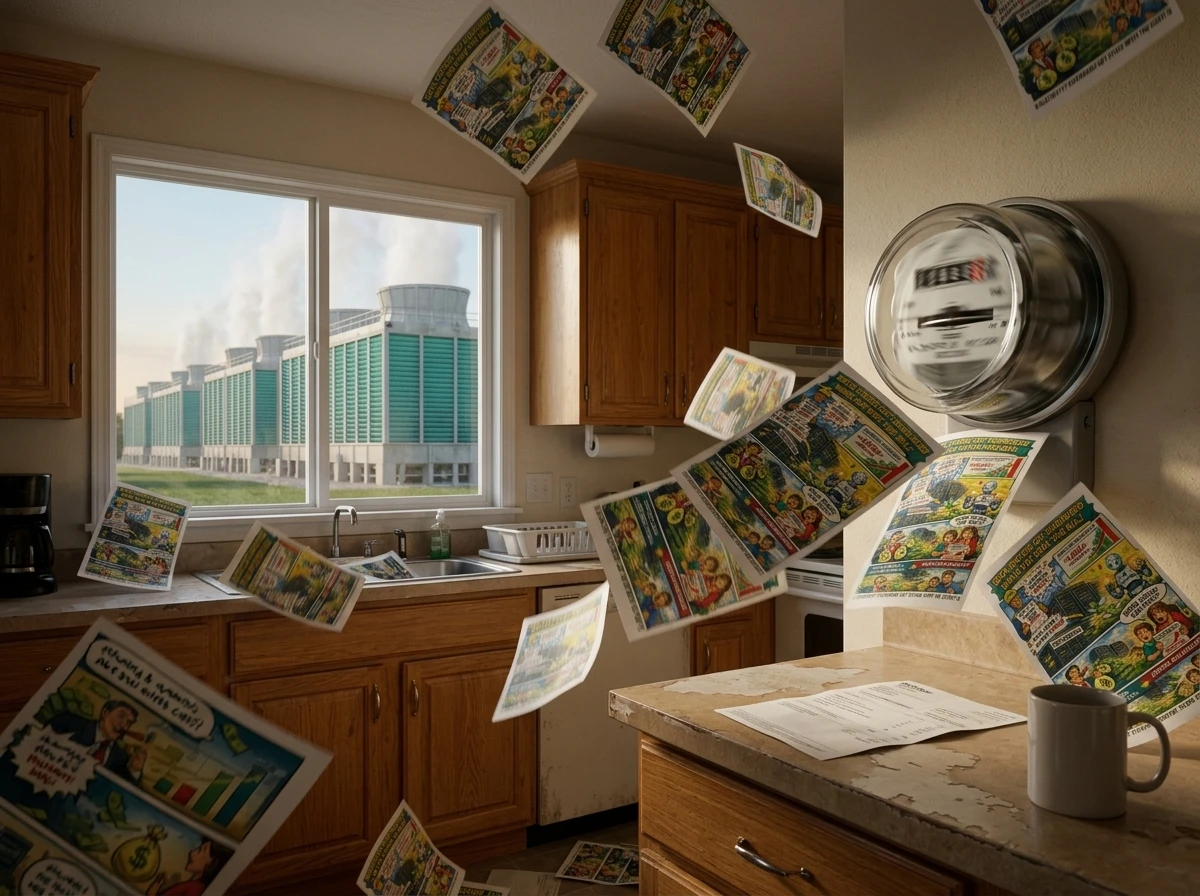
The posts claimed AI data centers are driving up household electricity prices and straining the grid. Others, X said, used AI-generated cartoons of data-center operators enriching themselves at the public’s expense. The company did not name the accounts. It also did not say, in plain words, that all 200,000 had been taken down.
Two hundred accounts are 0.1% of the farm X put in the headline. The other 199,800 were left as a blank. X closed by saying it suspends accounts that violate its Authenticity policy, which bars fake personas, mass registration, unauthorized automation and coordinated activity that artificially steers a conversation.
A 200-account cartoon layer can still be a policy problem. It cannot, on the numbers X published, be the thing that created American anger over power bills.
OpenAI Banned This Playbook in June
On June 10, OpenAI said it had banned two clusters of ChatGPT accounts that likely originated in China and used its models for covert campaigns on American AI and tech policy. It named the first cluster Data Center Bandwagon. It named the second Tech and Tariffs.
The Bandwagon cluster generated English comments and images claiming data-center buildouts for AI were raising electricity prices for average families. OpenAI said the operators were likely a social media team at a private Chinese technology company doing work for provincial government clients, a commercial shop that fits China’s public-opinion guidance trade rather than a named ministry unit.
- Late 2025: The Bandwagon cluster begins prompting ChatGPT in Simplified Chinese, routes access through VPNs, and posts English copy on X as if the writers were Americans.
- February 11, 2026: Goldman Sachs economists Manuel Abecasis and Hongcen Wei publish a note showing U.S. electricity prices up 6.9% year-over-year through December 2025.
- June 1, 2026: OpenAI dates its Data Center Bandwagon case study and says it has banned the ChatGPT accounts.
- June 10, 2026: OpenAI publishes the public report on PRC-linked operations targeting U.S. AI debates.
- August 28, 2026: X’s Global Government Affairs account posts the 200,000-account farm and the 200 energy posters.
X is describing accounts on its own platform. OpenAI was describing ChatGPT users who then posted on X. The overlap is the product: the same talking points, the same cartoon style, the same claim that data centers stick ordinary families with the bill. The 200,000 figure is X’s. OpenAI never claimed a farm of that size.
Why the Cartoons Match Household Power Bills
Goldman Sachs wrote in February that electricity prices rose 6.9 percent year-over-year through December 2025, well above 2.9% headline PCE inflation. The bank expects consumer electricity inflation to stay around 6% in 2026 and 2027 as data centers take about 40% of U.S. power-demand growth. That is the bill the cartoons are tracing, not a fiction they invented.
Abecasis and Wei said data centers still account for about 7% of U.S. power demand, a share that has jumped since ChatGPT’s 2022 launch. They expect data-center-related demand to lift overall power demand by 1.2 percentage points a year on average from 2026 through 2030, nearly half of 2.6% annualized growth. Supply is slow. The median wait to connect new generation to the grid is now four and a half years, they wrote, up from under two years in 2000.
| Year | US data center power demand | Share of peak summer demand |
|---|---|---|
| 2025 | 31 GW | 4.1% |
| 2026 | 41 GW | 5.3% |
| 2027 | 66 GW | 8.5% |
Goldman Sachs Commodities Research, in a May 20 note by Hongcen Wei, Daan Struyven and Samantha Dart, put data center power demand to 66 GW in 2027, more than double 31 GW in 2025. Only about 50% to 60% of capacity scheduled for the next one to two years is expected to come online on time. Even with that haircut, they still see a jump in data centers’ share of peak summer demand from 4.1% in 2025 to 8.5% in 2027.
The price pain is not even. Goldman said electricity inflation since January 2022 has run about 1% annualized in Louisiana and Nevada and 15% in Maryland and Maine. About 1% of U.S. counties hold about 70% of data-center capacity. Lower-income households spend more of their budget on power, so the same rate rise cuts them harder. A fake account posting a cartoon about that bill is borrowing a number families can already see on a statement.
The Shop Prompted ChatGPT in Chinese
OpenAI said the Bandwagon operators prompted ChatGPT in Simplified Chinese and asked for English and Chinese outputs, posing as Americans from a mix of backgrounds. China is blocked from the product, so they used VPNs. They uploaded a report that described how to build social accounts designed to evade platform detection.
The English work was narrow and practical. They asked for comic strips about capacity auction prices drawn from a real regional paper, then framed the new peak demand as data centers and AI, with costs passed to households. They posted that package on X next to links to legitimate news about grid auctions and data-center load, using hashtags such as #capacityauction, #datacentersuccess and #datacenters. They also had ChatGPT add text to generic electricity-market photos so the caption said ordinary people were subsidizing AI infrastructure.
HOW THE CLUSTER USED THE MODEL
- English comments: Short posts claiming data centers and AI apps were lifting demand and household costs.
- Comic strips: Cartoons about a grid operator’s capacity auction, tied to a real local story.
- Image edits: Text overlaid on generic power-market pictures to push the subsidy line.
- Workflow code: Scripts to automate logins and manage action across several social platforms.
- Ops reports: Polished internal notes on Facebook personas, backup accounts, ads and how to avoid looking coordinated.
- Second audience: Requests for insults aimed at Chinese dissidents, including Li Ying, known as Teacher Li, whose X account is @whyyoutouzhele; OpenAI said the model refused to write personal attacks on him.
They also asked for comments insulting Lu Yiheng, Xu Chi and the account @SydneyDaddy1. A separate tactic had them pose as U.S.-based Chinese immigrants, workers, students, mothers, clerks and investors, then try to goad a YouTuber into talking up American “dark side” stories. That is a shop running more than one product line through the same chatbot.
What the Rest of the Farm Was Doing
X did not say what the other 199,800 accounts posted, and it did not publish evidence that the full farm was a single energy-policy campaign. OpenAI’s June file on the same kind of China-linked shop described a second cluster, Tech and Tariffs, plus harassment attempts against Chinese critics and a Facebook playbook for long-running fake personas. That is the closest public map of the work beyond the 200 energy posters.
Tech and Tariffs produced comments and cartoons criticizing U.S. tariffs as a bid to dominate technological competition. Prompts said the output should not include China’s leader Xi Jinping and should include only President Trump. OpenAI tied that cluster to likely fake X accounts that claimed ChatGPT user data had been compromised, a charge the company called entirely false.
WHAT WE KNOW
- The energy slice: X attributes anti-data-center cartoons and power-bill posts to 200 accounts inside the larger farm.
- The tool: OpenAI says a likely PRC-origin cluster used ChatGPT, VPNs and Simplified Chinese prompts to make that style of English copy.
- The vendor model: OpenAI assesses a private Chinese tech firm working for provincial government clients, not a named state organ.
WHAT IS UNCONFIRMED
- Full takedown: X said it suspends Authenticity violators and did not state that all 200,000 accounts are gone.
- State direction: Neither X nor OpenAI published proof that Beijing tasked this specific farm.
- The other 99.9%: X gave no breakdown of what the remaining accounts posted, or whether they posted at all.
- Audience reach: OpenAI found no meaningful breakout beyond the cluster’s own activity; X offered no engagement audit of its 200 posters.
Treating the 200,000 headline as a finished picture of an anti-data-center plot fills in a blank X left open. The safer reading is a large inauthentic inventory, a small energy-policy cell, and a commercial influence shop that already had other lines of work.
The Mid-Atlantic Grid Squeeze
The households who actually pay the higher rate live near the load, not on a bot dashboard. Goldman’s commodities team said Mid-Atlantic, Mid-Continent and Northwest markets face the worst reliability risk because planned generation is thin relative to incoming data-center demand. Texas and Georgia look looser, with more new plants in the pipeline. Tennessee, New England and Florida are already tight enough that new data-center additions may be constrained.
The U.S. Energy Information Administration, in a March note, forecast national electricity load up 1.9% in 2026 and 2.5% in 2027, with the fastest growth in Texas and the Mid-Atlantic. It put ERCOT load growth near 10 percent on average from 2025 through 2027, against about 3% in PJM. In a high-demand case, EIA said 2027 wholesale prices in ERCOT would run $37 per megawatthour above its base forecast.
Operators feel a different squeeze first. Server hardware is getting costlier on their side of the meter, including Alphabet’s Nvidia AI server prices heading into 2027, before those costs show up on a household statement. Goldman still expects higher power prices to clip consumer spending by about 0.2 percentage point in 2026-2027 and GDP growth by about 0.1 point, with a larger hit if outages get longer. It also said those losses are small next to the productivity gain it expects from AI through 2035.
Local fights over substations, water and rate riders were running before the cartoons. A 200-account overlay does not invent a 15% multi-year rise in Maryland or Maine, and it does not un-build a data hall already pouring concrete. It does give anyone who wants the opposition dismissed a foreign-ops stamp to put on the folder.
X Left the State-Direction Question Open
X called the accounts suspected Chinese and inauthentic. It did not publish technical indicators, registrar trails or a named operator. OpenAI went further on the ChatGPT side and still stopped short of a ministry attribution, pointing instead to a private firm with provincial clients. Friday’s thread treated the post as proof that the entire anti-data-center fight is foreign-run. That leap is larger than either company’s file.
The operation sought to exploit and amplify existing public concerns about energy prices and local impacts of data center development, but we found no evidence of meaningful breakout beyond its own activity.
OpenAI, June 2026 report on PRC-linked influence operations
OpenAI’s own finding is that the campaign borrowed a live American argument and failed to carry it. X’s finding is that 200 accounts inside a much larger farm posted that argument with cartoons. Goldman Sachs still has consumer electricity inflation near 6% through 2027. That rate will be on the next bill whether the farm stays up or not.


X Finds a Chinese Bot Farm Cartooning AI Power Bills

Meta’s $10 Billion Anthropic Bill Can Move the IPO

The Yankees Trusted Lombard’s Glove and Tied 1915

Williams Sisters Need a Wild Card for US Open Doubles

Salesforce Shares Soar as an Anthropic Mark-Up Pads Profit

Guizhou Sells Cool Caves as a Summer Tourism Product

Zynga Puts a New Ned Stark on Sale in September

Pere Marquette Township Freezes Data Centers for One Year

SEC Proposes Regulation Crypto Assets After Scrapping Friday’s Vote
