In a Malawian village stripped of electricity, food, and any safety net, a 14-year-old boy built a windmill from junkyard scraps and a borrowed library book. The Boy Who Harnessed the Wind, directed by Chiwetel Ejiofor, tells that story with a raw, unhurried honesty that makes it genuinely impossible to shake off.
The Real Story Behind the Film
William Kamkwamba was born on August 5, 1987, in Wimbe village, Kasungu District, in rural Malawi. His family farmed maize and tobacco, like most families in the region. Life was difficult but manageable, until the 2001 to 2002 famine arrived and stripped everything away.
The famine affected more than five million people across Malawi. Crops failed on a massive scale. Emergency grain reserves had been mismanaged and quietly sold off. Families rationed meals down to once a day, then less than that.
William’s family could no longer afford school fees. He was turned away at the school gate, not with anger or confrontation, but with the flat and exhausted finality that poverty produces. He walked home and started thinking.
He found his way to a small library near his village and borrowed a worn textbook called Using Energy. It was written in English, a language he barely spoke at the time. He worked through it mostly by studying the diagrams. And in those pages, he found the outline of an idea that would eventually change everything.
Scraps, Curiosity, and One Library Book
What William built was not polished or precise. He gathered tractor fan blades, PVC pipes, old bicycle parts, and scrap metal pulled from the local junkyard. He spent months testing, failing, adjusting, and rebuilding.
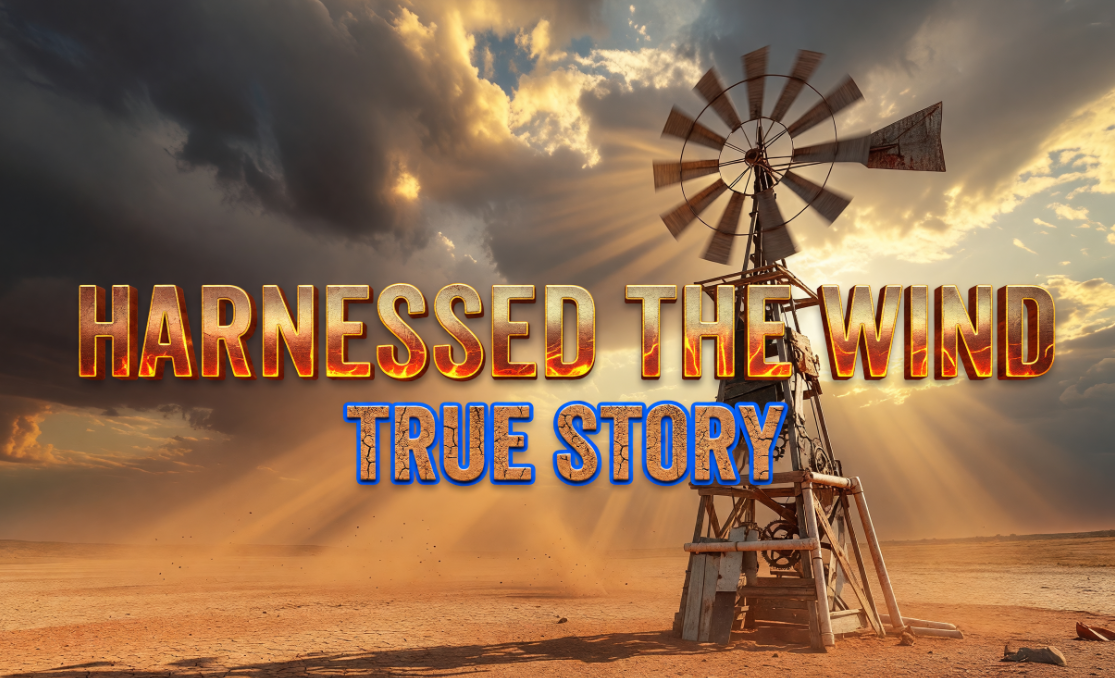
The windmill he finally erected stood roughly five meters tall. It produced enough electricity to power four light bulbs and a radio inside his family’s home. He later built a second, upgraded version that powered a water pump, helping irrigate crops during dry spells.
Consider what he was working without during all of this:
- No formal training in engineering or physics
- No tools beyond what he could scavenge from the junkyard
- No electricity or internet access to research further
- No mentor, no funding, and no institutional support of any kind
The most emotionally loaded moment in the film comes when his father Trywell hands William the family’s bicycle to strip for parts. That bicycle was almost certainly the most valuable thing the family owned at that point. Giving it up was not a small practical decision. It was a father choosing to believe in a son at the exact moment when belief felt most dangerous.
How Ejiofor Brought This Story to Life on Screen
Chiwetel Ejiofor, widely known for his acting roles in 12 Years a Slave and Doctor Strange, made his directorial debut with this film. He also wrote the screenplay, adapting William Kamkwamba’s 2009 memoir co-written with journalist Bryan Mealer.
The film was shot almost entirely on location in Malawi. That decision matters more than it might seem. The landscape, the quality of light, the dust, the architecture, the faces of local community members used as supporting cast, none of it can be manufactured on a soundstage. Ejiofor knew that authenticity required presence.
Maxwell Simba plays William with a controlled, watchful intensity that is difficult to teach. There is a scene early in the film where William connects a bicycle dynamo and watches a single bulb flicker on. He just stares at it. No music swells. No dramatic camera push. Just a boy looking at proof that his instinct was correct. That restraint alone separates this film from most feel-good survival narratives.
Ejiofor plays Trywell himself, and the performance carries a very specific grief. It is the grief of a father who wants everything for his son but has almost nothing to offer. It is acted with the restraint of someone who understands the role from somewhere personal.
What William’s Journey Teaches About Real Innovation
The version of this story that circulates in startup culture and business schools is not wrong, but it misses something important. William was not innovating to capture market share or build a personal brand. He was innovating because the alternative was watching his family go hungry.
In 2007, at age 19, William gave a TED Talk in Arusha, Tanzania. He spoke in halting English, nervous and uncertain on stage. The audience gave him a standing ovation before he had even finished speaking. That talk was seen by millions online and remains one of the more genuinely moving moments in TED history.
What followed changed the direction of his life entirely. He received a scholarship to the African Leadership Academy in Johannesburg. He later attended Dartmouth College in the United States, graduating in 2014. He has since dedicated his work to expanding clean energy access across sub-Saharan Africa, turning one windmill built during a famine into a lifelong mission.
His story makes four things very clear:
- Constraints do not kill innovation. They often sharpen it in ways comfort never could
- Access to even one book can completely redirect an entire life
- The most overlooked communities often hold the most untapped potential
- Real breakthroughs are rarely born from privilege or ease
A Film That Refuses to Look Away
What separates this film from most poverty narratives is its refusal to soften the systemic failures at the heart of the story. The government is absent. Markets are indifferent. The famine is not a backdrop. It is treated as the direct consequence of policy decisions and broken institutions.
There is a line in the film where a village elder says democracy is “like imported cassava, it rots quickly.” Seven words. It lands harder than most political editorials manage in thousands.
The film also does not sacrifice intimacy for message. William’s sister weighing an early marriage partly as one less mouth to feed is not a critique of her character. It is a portrait of someone ground down by survival. His mother Agnes’s quiet, constant worry is not melodrama. It is the specific dread of someone who has already done the math and does not like the answer. The poverty on screen is systemic, not personal. The family did not fail. The institutions around them failed first.
And in that gap, a teenage boy picked up scrap metal, read a diagram in a language he barely understood, and built something that actually worked.
William Kamkwamba’s story feels as urgent now as it did in 2001. There are still millions of villages without reliable electricity, still students turned away from schools over unpaid fees, and still young people dismissed because they lack the right credentials or connections. The windmill he built poses a quiet, uncomfortable question to anyone paying attention: how much could the world gain if we simply stopped writing off the people we have already failed? This story deserves to be shared widely. Drop your thoughts in the comments and tell us what part of William’s journey hit you hardest.