
NEWS
Swatch Wins $11.6 Million After a $170 Million Claim
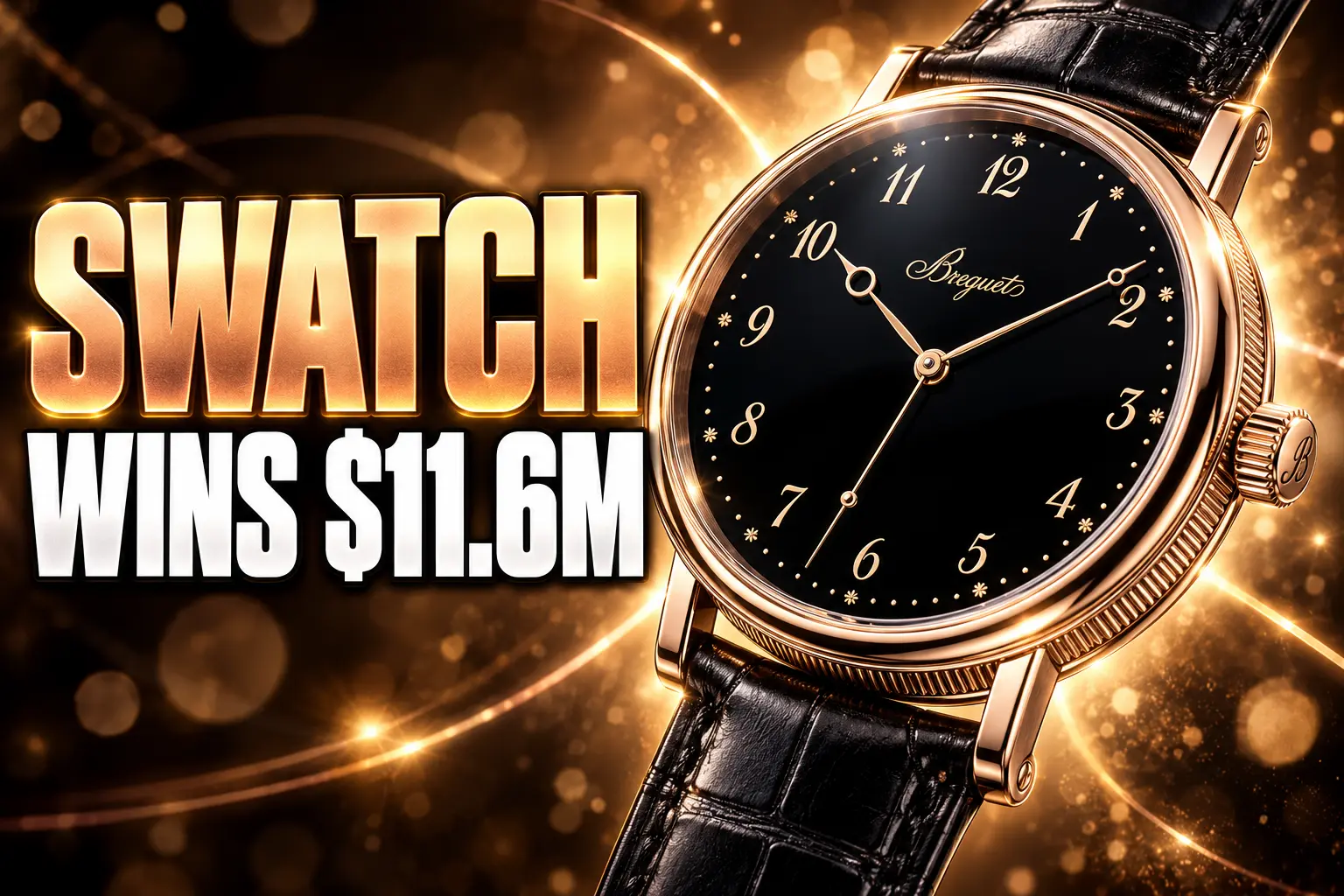
London priced Samsung’s cloned Omega and Breguet watch faces at $11.6 million, about 7 percent of Swatch’s $170 million claim.

A London judge on August 26 ordered Samsung Electronics to pay Swatch Group $11.6 million for cloned luxury watch faces on Galaxy smartwatches. Swatch had asked for $170 million. Samsung had told the court the damage was worth $300.
Mr Justice Marcus Smith found that listing digital copies of Omega, Breguet, Longines, Blancpain and Tissot in the Galaxy app store, free or nearly free, harmed the Swiss marks even when nobody tapped download. Samsung said on August 27 it was considering an appeal. A related U.S. claim remains stayed.
Most of the $11.6 Million Was for the Shelf
The bill is not a royalty on wrists. Mr Justice Smith compared the Galaxy store to a supermarket and awarded $10 million for what he called store display infringements, the harm from putting Swatch names on Samsung’s shelves whether or not a customer took an app home.
The use of the Swatch Group brands on Samsung’s supermarket shelves (to use the physical analogy), downloadable for nothing or for little money, is to my mind very damaging to the Swatch Group’s property interests. The low price is demeaning of the brands the Swatch Group seek to promulgate.
Mr Justice Marcus Smith, High Court, August 26 2026
That display theory is why a case about 30 third-party apps became a nine-figure argument. Swatch’s June 19 filing priced the wrong as hypothetical licence fees across 10 brands, a figure it said matched the prestige and drawing power of the portfolio. Samsung’s leading counsel, Daniel Alexander KC, called the demand extraordinary and said it departed from reality, because almost every app was free, total download revenue was just over $1,000, and Samsung’s own cut was $300.
THE THREE NUMBERS BEFORE THE COURT
| Who named it | Amount | What it measured |
|---|---|---|
| Swatch Group | $170 million | Hypothetical licences across 10 brands |
| Samsung Electronics | $300 | Its commission on the apps |
| High Court award | $11.6 million | $10 million of it for store display |
The award is about 7 percent of the claim and many times the $300 Samsung offered. A Swatch spokesperson said Samsung had tried to play down the infringements by belittling what the brands were owed. For a group that spends more than CHF 1 billion a year on marketing, 11 to 12 percent of turnover, $11.6 million is a legal marker, not a hole in the accounts.
Why Samsung Paid for Apps It Did Not Write
Independent developers built the faces. Samsung still lost, because the High Court treated the Galaxy store as Samsung’s shop window rather than a noticeboard it merely hosted. Mrs Justice Falk held in the 2022 High Court liability ruling that Samsung was primarily liable for most of the 30 apps, which Swatch said infringed 23 of its marks. She did not need to decide the backup case that Samsung was a joint wrongdoer with the developers.
Loi Le, who ran a visual content-review team that signed apps off, told the court it had been a mistake to let the disputed faces through. His reviewers, he said, had little knowledge of luxury brands at the time. Until February 2019 the check was a manual look against internal guidelines. An automated pre-review arrived only after the fight had started, and it was not run backwards over apps already live.
HOW SAMSUNG TOUCHED THE FACES
- Seller terms: Developers had to register, accept Samsung’s conditions, and submit every app for certification before it could go on sale.
- Watch Studio: Samsung offered a desktop kit, Galaxy Watch Studio, so outsiders could build Tizen watch faces that ran on its hardware.
- Two-hour listing: Once a face passed review it could appear in the store in about two hours, at a price the developer set, including free.
- Watch-like ads: Samsung sold the hardware as truly watch-like, with a rich watch-face design, a round case, a bezel and a strap.
- Blurred origin: The Court of Appeal found the store did not adequately separate Samsung’s own apps from third-party listings.
Samsung argued it should not be punished for screening apps, and that a hosting safe harbour under the UK e-Commerce Regulations should block a money claim. Lord Justice Arnold held that Samsung’s role was active, with knowledge and control, so the harbour did not open. The company had already taken the named apps down after Swatch’s December 2018 letter. The court still treated the earlier listings as Samsung’s use of the marks.
A December Letter and a Seven-Year Docket
The clones sat in the store from October 2015 to February 2019. Swatch started watching the catalogue in December 2018. Samsung admitted the 30 apps were downloaded 157,715 times in the European Union as it then stood. Some were free, which is why the download count ran so far ahead of the $1,000 of revenue.
Only 26 percent of UK Galaxy Watch owners had used the store at all, and those who did took 4.6 watch-face apps on average. Samsung shipped about 20 faces of its own on the watch. The average UK replacement cycle was about 27 months, a figure Falk J set against the longevity Swatch sells with a mechanical piece.
THE PATH TO THE BILL
- October 2015: Third-party watch-face apps that copy Swatch dial branding appear in the Galaxy store.
- December 21, 2018: Swatch’s Swiss subsidiary writes to Samsung, demands takedowns, and asks for developer names and download counts.
- January 9, 2019: Samsung has removed the apps Swatch named.
- February 19, 2019: Ten Swatch companies issue the claim in London, before the Brexit transition ends, so the case can cover the EU as well as the UK.
- May 20, 2022: Mrs Justice Falk finds Samsung primarily liable for most of the apps and grants an injunction.
- December 15, 2023: The Court of Appeal dismissed Samsung’s 2023 appeal on use, on use in relation to smartwatches, and on the hosting defence.
- June 26, 2026: Closing arguments end on the size of the bill. Mr Justice Smith hands down the $11.6 million figure on August 26.
Carole Aubert, Swatch’s in-house counsel for online brand protection, told the 2022 trial the group had not sued the developers because Samsung’s disclosure made them hard to chase, and that the group had finite resources. She said the decision to sue Samsung came in part from a view that its store was not meeting the industry standard for stopping copies. Samsung had taken no action against those developers either, despite holding their bank details under the seller terms.
Swatch Priced Licenses It Will Not Grant
The $170 million was never a lost royalty in the ordinary sense. Tissot chief executive Sylvain Dolla told the court the group does not license its marks to other watch companies, and even less to smartwatch companies. He said a deal with a gadget brand would kill the value of the fine Swiss watch, even if co-branded products might sell in the millions. In a later filing he added that licensing the designs for commodity smartwatches would destroy value the group had spent decades building.
A deliberate decision had been made not to enter the smartwatch market, in the sense generally understood of a limited life product.
Sylvain Dolla, chief executive of Tissot, evidence summarised by Mrs Justice Falk, May 2022
Tissot did ship a connected watch, the T-Touch Connect, on its own software, built to run for months on solar power as a beautiful watch rather than a short-life gadget. Dolla said major technology companies had asked to collaborate and had been turned down. Peter Steiger, Swatch’s chief controlling officer, told the same trial that buyers in the luxury and prestige ranges wanted a brand they could trust, with a reputation that would reflect well on them, and that about 25 percent of group sales, and a similar share of the marketing budget, sat in Europe.
That is the knot inside the claim. Swatch’s damages model asked the court to imagine licence fees for rights Dolla said the group would never sell. Samsung’s model asked the court to look at $300 of actual commission and stop there. Mr Justice Smith accepted that the cheap listing demeaned the marks, then declined to price that insult on Swatch’s licence sheet.
THE PRICE LADDER IN THE JUDGMENT
| Range | Brands in the claim | Retail prices in the judgment |
|---|---|---|
| Basic | Swatch | Below CHF 200 |
| Middle | Tissot, Mido, Hamilton | CHF 300 to 1,000 |
| High | Longines | CHF 1,000 to 5,000 |
| Luxury | Omega | CHF 3,000 to 10,000 |
| Prestige | Breguet, Blancpain, Glashütte Original, Jaquet Droz | Into the hundreds of thousands of francs, and more |
Falk J said a Galaxy Watch was a commoditised gadget with a short life, in a different league from exclusive Swiss pieces sold on heritage and longevity, and that the harm to the high, luxury and prestige marks was a form of dilution or tarnishment. She pointed to a 2018 Samsung forum thread in which a user who loved Omega Speedmaster Moonphase watches, and could not buy one, built a replica with the Galaxy design tool and was asked to share it, and to a 2020 Instagram post of an Omega-branded face with the caption that this would do for now.
Falk’s 2022 Findings Survived the Appeal
Samsung’s appeal, heard on December 5 and 6 2023, attacked three holdings: that the use of the signs was Samsung’s use, that the use was in relation to smartwatches, and that the hosting defence failed. Lord Justice Arnold, with Lord Justice Lewison and Lady Justice Elisabeth Laing, dismissed all three. The injunction granted in 2022 was not under appeal once the first ground failed.
The post-sale problem sat at the centre of the second ground. A stranger looking at a wrist sees a Tissot or Omega dial, not a settings menu. Arnold LJ put the risk in a short scene.
Imagine that someone is wearing a Samsung smartwatch with a Tissot watch face app. Suppose that a friend says I like your watch, I see it’s a Tissot and the wearer replies No, it’s a Samsung watch with a Tissot face I got from Samsung. If the wearer thinks that Samsung is the origin of the app, or at least has some responsibility for its quality, they may well convey that impression to their friend.
Lord Justice Arnold, Court of Appeal, December 15 2023
He also rejected the idea that screening apps should protect the store. Many platforms review content for their own commercial reasons, he wrote, and if they do so they accept the risk that the Article 14 harbour may not apply. The Digital Services Act, which tries to ease that bind in the EU, does not apply to the United Kingdom and would not have covered these facts in any event.
The claimants were Montres Breguet, Blancpain, Montres Jaquet Droz, Omega, Longines, Tissot, Mido, Hamilton, Swatch SA and Glashütter Uhrenbetrieb, the German company behind Glashütte Original. Together they sit among the 16 watch brands the group makes, a line that runs from plastic Swatch up through Omega to the Breguet workshop dating to 1775. Harry Winston, Rado, Certina, Balmain, Union and Flik Flak sit in the group as well and were not claimants.
London’s Number Now Travels to the U.S.
$11.6 million will not move Samsung’s phone division. It is a cheap price for seven and a half years of litigation if the only question is cash, and a painful one if the question is whether an app store can still treat a Breguet-class dial as a free extra. Other watch-face shops, including those attached to phones Samsung does not make, now have a London figure for what a judge will charge for putting someone else’s prestige on a shelf.
Samsung’s statement on August 27 said it was carefully considering the judgment and would consider all possible countermeasures, including an appeal. Proceedings already filed in the United States, brought against a Samsung subsidiary, were stayed to wait for the English result. The English claim ran because it was issued in 2019, while the United Kingdom still sat inside the EU system, which is why Mr Justice Smith could quantify harm across the bloc and not only in Britain.
The faces themselves have been gone since January 2019. The argument that remains is what a clone on a shop screen is worth when the brand owner says it would never have licensed the dial, the store owner says it made $300, and a judge splits the difference by charging $10 million for the shelf.
Disclaimer: This article is news reporting on a High Court damages judgment and related appeals, and it is for information only. It is not legal advice, is not a forecast of any appeal or of the stayed U.S. claim, and should not be used to make litigation, licensing or commercial decisions. Readers with a live trademark, app-store or damages question should consult a qualified intellectual property solicitor in the relevant country before acting. Figures and case status reflect the court records and company statements cited here and can change if an appeal is filed or if the U.S. stay is lifted.

Saks Kept 15 Stores While Rivals Took the Shoppers

Fallout Season 3 Spend Hits California’s $42 Million Cap

Ebola Outran Congo’s Contact Lists and Reached Nairobi

Jagex Builds RuneScape 4 Beside the Games Players Already Have

SimpL Bets €1.2 Million on Meetings Paid When Held

Boston Scientific Cyberattack Leaves Hospitals Waiting on Implants

Guizhou Cave Cafes Spread When Each Cavern Fills

The Second Ned Stark Kit Lands When a Banner Dies

Satellites Saw Nepal’s Ice Slope Move Before the Flood

OpenAI’s Jalapeño Chip Turns Watts Into Faster Agent Steps
-
 NEWS2 months ago
Boston Scientific Cyberattack Leaves Hospitals Waiting on Implants
-
 NEWS2 months ago
Guizhou Cave Cafes Spread When Each Cavern Fills
-
 GAMING2 months ago
The Second Ned Stark Kit Lands When a Banner Dies
-
 NEWS1 month ago
Satellites Saw Nepal’s Ice Slope Move Before the Flood
-
 NEWS2 months ago
OpenAI’s Jalapeño Chip Turns Watts Into Faster Agent Steps
-

 NEWS2 months ago
Roman Space Telescope Launches After a Decade-Long Budget Bet
-

 NEWS2 months ago
MLB Quiet Periods Copy a Freeze Other Leagues Use
-

 NEWS2 months ago
Pere Marquette Freezes Data Centers on a Power-Rich Shore