
NEWS
Roman Space Telescope Launches After a Decade-Long Budget Bet
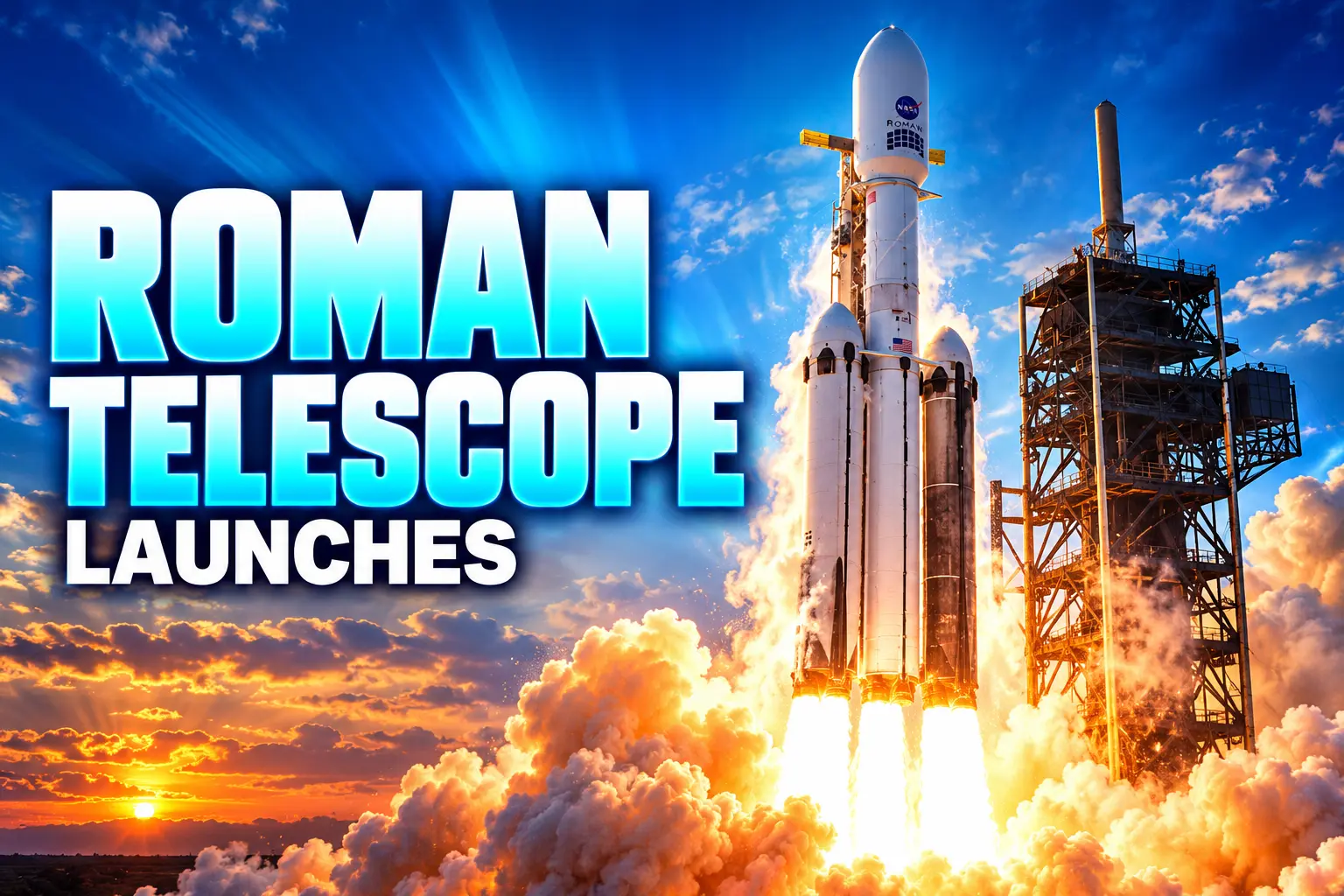
NASA’s Roman Space Telescope launched Aug. 30 on Falcon Heavy, nine months early and inside its $4.3 billion cap after four White House cut attempts.

NASA’s Nancy Grace Roman Space Telescope lifted off at 7:26 a.m. EDT on August 30 aboard a SpaceX Falcon Heavy from Kennedy Space Center. The 2.4-meter infrared survey telescope is now on a three-month cruise to Sun-Earth Lagrange point 2, about 1.5 million km (roughly a million miles) from Earth.
The launch closes a decade-long bet that a cost-capped Hubble-class survey camera, built around a surplus spy-agency mirror and nearly cancelled in four White House budgets, could still fly early. The unpaid half of that bet starts now: a 1.4-terabyte daily flood of sky maps, planet hunts, and supernova movies that the ground system has never had to swallow.
Falcon Heavy Put Roman on the Road to L2
Liftoff came from Launch Complex 39A, the same pad that sent Apollo crews off the planet. NASA called this the agency’s fourth primary Falcon Heavy mission. SpaceNews counted the rocket as the 13th Heavy overall. The 27 Merlin engines on the three first-stage cores made more than 5 million pounds of thrust, and the upper stage released the telescope 31 minutes after launch.
Goddard’s control team locked onto telemetry seven minutes after liftoff. About 70 minutes in, the spacecraft handed off from near-Earth tracking to NASA’s Deep Space Network, first through Canberra in Australia, then Madrid, then Goldstone in California. Solar arrays and the lower instrument sun shade opened an hour and 23 minutes after launch.
THE FIRST 83 MINUTES
- 7:26 a.m. EDT, August 30, 2026: Falcon Heavy lifts off from Launch Complex 39A at Kennedy Space Center.
- T+7 minutes: Goddard acquires spacecraft telemetry.
- T+31 minutes: The upper stage separates from the observatory.
- T+70 minutes: Communications shift to the Deep Space Network.
- T+1 hour 23 minutes: Solar panels and the lower instrument sun shade deploy.
The two side boosters shut down at about T+2 minutes 24 seconds, flipped, and flew back to Cape Canaveral Space Force Station. NASA said they returned safely for refurbishment. SpaceX had billed the cores as the first and third flight for the side boosters, after the GOES-U and Viasat-3 F3 missions, with landings planned at Landing Zones 2 and 40. The center core was expended, the usual Heavy pattern on a high-energy run to L2.
Falcon Heavy launches @NASA’s Nancy Grace Roman Space Telescope from pad 39A in Florida, beginning its more than three-month journey to its destination where it will generate never-before-seen photos of the universe pic.twitter.com/L3gHrBiQ08
— SpaceX (@SpaceX) August 30, 2026
Jackie Townsend, Roman’s project manager at Goddard, told the post-launch briefing that the team synced S-band telemetry as soon as the fairing came off, the first chance they had. A course-correction burn is due in the coming days, the first of two mid-course maneuvers NASA still has on the books. Falcon Heavy now makes a NASA flagship look like a scheduled flight. The hardware on top is the part that still has to prove the decade of arguing was worth it.
Four Budget Fights and a Surplus Spy Mirror
Roman began as WFIRST, the Wide Field Infrared Survey Telescope, the top-ranked large space mission in the 2010 astrophysics decadal survey. In 2012 the National Reconnaissance Office transferred two unused 2.4-meter telescope assemblies that had been built to look down at Earth. NASA wrapped a survey observatory around one of those mirrors. L3Harris finished the optics in Rochester. BAE Systems, Teledyne Scientific & Imaging, NASA Goddard, and JPL built the rest, with contributions from ESA, JAXA, France’s CNES, and the Max Planck Institute for Astronomy.
The gift did not make the mission cheap. The Trump White House proposed zero dollars for WFIRST in the fiscal 2019, 2020, and 2021 budget requests, arguing that James Webb’s overruns left no room for another giant telescope. Congress put the money back each time, including $312.2 million, $510 million, and $505.2 million in those three years, and kept a development cost cap in the law. NASA renamed the project for Nancy Grace Roman, its first chief astronomer and the official often called the mother of Hubble, on May 20, 2020. She had died in 2018. A later fiscal 2026 request tried a deep late-stage cut rather than a full kill. Congress again funded completion.
Administrator Jared Isaacman used the launch to claim the project had been delivered ahead of schedule and on budget.
Roman is exactly the kind of success story we want to see across NASA. Delivered ahead of schedule and on budget, this mission reflects more than a decade of dedication from the NASA workforce and our industry partners. Now, Roman will give us a new atlas of the universe, push the boundaries of discovery, and demonstrate what is possible when America’s space program pairs bold ambition with disciplined execution.
Jared Isaacman, NASA Administrator, Release 26-071
The dollars that sentence refers to are the June 2021 replan, not the first number NASA wrote down. The Government Accountability Office’s July 2026 review lists a committed life-cycle cost of $4.316 billion and a launch-readiness date of May 2027. The original 2020 baseline was $3.934 billion and October 2026. COVID-19 added $382 million and seven months. Against that replan, Sunday’s launch is about nine months early. Against the older October 2026 target it is two months early. GAO also logged a $1.0 million cost underrun in the last reporting year, which the office declined to book until NASA signs the paperwork.
COST AND SCHEDULE BASELINES
| Baseline | Launch target | Life-cycle cost |
|---|---|---|
| Original confirmation (2020) | October 2026 | $3.934 billion |
| COVID replan (June 2021) | May 2027 | $4.316 billion |
| Actual liftoff | August 30, 2026 | Held inside the $4.316 billion cap |
Nicky Fox, associate administrator for the Science Mission Directorate, has been saying for months that a cost cap plus forward-phased funding let the team make the ugly trades early. During the 2025 lapse in appropriations, integration and test work was listed as excepted, so the early schedule survived a shutdown. The observatory finished environmental testing in the spring, shipped to Kennedy in June, and flew in August. That is the wager NASA just cashed: a flagship that stayed inside the number Congress would defend.
The Camera Is 300 Megapixels Across 18 Detectors
The telescope’s primary mirror is 2.4 meters across, the same diameter as Hubble’s, held at about 265 K. The science engine is the Wide Field Instrument, a 300-megapixel visible-to-near-infrared camera. Eighteen Teledyne H4RG-10 detectors, each 4,096 by 4,096 pixels and about the size of a saltine cracker, sit in a 6-by-3 mosaic. NASA says that array will survey the universe a thousand times faster than Hubble.
STScI lists a field of view of 0.28 square degrees, a 45-by-23-arcminute patch at 0.11 arcseconds per pixel, covering 0.5 to 2.3 microns. NASA’s public line is a field at least 100 times Hubble’s. Eight imaging filters plus a grism and a low-resolution prism turn the same focal plane into a spectrograph. Detectors run near 89.5 K on a passive radiator. Pointing jitter is specified at 8 milliarcseconds. The spacecraft can be refueled in flight by a robot, a rare line in an astrophysics spec sheet, and the prime mission is five years with a 10-year goal.
Because the structure is stiff, Roman can hop from field to field without long waits for the optics to settle. A 0.4-degree slew, about the short side of the camera’s view, is budgeted at 39.3 seconds including settle. That is how a Hubble-sharp image becomes a survey machine instead of a portrait studio. The Wide Field Instrument stays off for a few more weeks. When it wakes, the bet shifts from metal to maps.
Three Surveys Will Use 75 Percent of Prime Time
Roman will not run like Hubble, with astronomers bidding for pointed visits. Community committees spent two years, drawing on more than 1,000 scientists at over 350 institutions, to lock the three core surveys the mission will conduct. Those programs take no more than 75 percent of the five-year prime mission. The rest is left for later community proposals. Every processed frame goes public at once. There is no exclusive-use window.
THE THREE CORE SURVEYS
- High-Latitude Wide-Area Survey: Imaging plus spectroscopy over more than 5,000 square degrees, about 12 percent of the sky, in under a year and a half, with a main 2,500-square-degree layer aimed at more than a billion galaxies, dark energy, and dark matter.
- High-Latitude Time-Domain Survey: Repeat visits covering more than 18 square degrees, a patch as large as 90 full moons, with 30-hour stares every five days for two years in mid-mission, built to catch Type Ia supernovae that map cosmic expansion.
- Galactic Bulge Time-Domain Survey: Six inner-Milky Way fields totaling 1.7 square degrees, imaged about every 12 minutes in six high-cadence seasons, hunting microlensing planets, rogue worlds, and about 100,000 transiting planets NASA has already put on the scoreboard as a working forecast.
Gail Zasowski, an associate professor at the University of Utah and co-chair of the Roman Observations Time Allocation Committee, said the surveys were written so the same pixels serve dark energy, planet demographics, and a long list of extra questions. The bulge program looks inward through the dust in infrared, watching hundreds of millions of stars for brief gravitational brightenings. Those events can reveal cold planets on wide orbits, including analogs of every Solar System planet except Mercury, plus free-floating worlds with no star at all. The same frames can pick up starquakes on a million giant stars and isolated stellar-mass black holes that lens background light for years.
The high-latitude time-domain movie is also a supernova factory. Type Ia explosions are the standard candles that turned dark energy from a suspicion into a research field. Roman’s version stares long enough to catch them when the universe was several billion years younger, and the same cadence will see neutron-star mergers and stars torn apart by black holes. If the cost-cap bet was about building the telescope, this is the science case Congress kept funding: a census, not a gallery.
Why the Coronagraph Is Only a Technology Demo
The Coronagraph Instrument is a technology demonstration, not the survey camera. NASA will power it on in the coming days so it can try to photograph Jupiter-like planets around nearby stars and prove hardware that a later Habitable Worlds Observatory would need to image Earth-size worlds. JPL built it with deformable mirrors and thousands of tiny actuators that reshape the optics in real time, knocking down starlight so a faint companion can be seen.
NASA’s launch release says the device will take a giant step by snapping pictures of Jupiter-like planets. The contrast target is in the 10^-7 to 10^-8 range after processing, hundreds of millions of times fainter than the host star, on bright targets around magnitude 5. That is a short target list, which is the point. Roman’s planet numbers will come from the bulge camera, from transits and microlensing. The coronagraph is a dress rehearsal for the mission that is supposed to take a spectrum of an Earth analog. If it works, the bet pays a second dividend NASA did not have when WFIRST was a dark-energy proposal on paper.
1.4 Terabytes a Day Will Test the Ground System
Once science starts, Roman will send back 1.4 terabytes of data every day, the highest rate of any NASA astrophysics mission so far. The technical sheet behind that round number is a 250 to 500 Mbps downlink and about 11 terabits a day. Machine learning, other AI tools, and citizen scientists are written into the operations plan as the first filter, flagging oddities for astronomers to study. STScI in Baltimore and Caltech/IPAC will host the public archive.
THE DAILY DATA LOAD
- Volume: 1.4 terabytes a day, about 11 terabits on the engineering sheet.
- Access: 100 percent of processed survey data is public as soon as it is ready, with no exclusive period.
- Triage: AI classifiers and volunteer hunters will mark transients, lenses, and planet candidates before most professional papers are drafted.
- Risk: GAO noted that the project asked the Deep Space Network to move a planned downtime so it would not land on launch and early orbit, a reminder that the pipe is part of the mission.
A Hubble portrait is a night’s work. A Roman field is a firehose. The same wide view that sold the telescope as a dark-energy machine will bury small teams unless the archive tools actually work. That is the remaining wager, and it is quieter than a Falcon Heavy liftoff. Sunday’s social feed replayed the dual booster landing and treated the rocket as routine. The NRO origin story, the $4.316 billion cap, and the 1.4-terabyte problem barely showed up. Those are the parts that decide whether the atlas Isaacman promised is a catalog or a backlog.
When Will NASA Release Roman’s First Images?
NASA expects to publish Roman’s first public images in early 2027, after a three-month commissioning cruise to Sun-Earth L2. The Wide Field Instrument turns on a few weeks from now. Engineers still have to deploy the high-gain antenna and a visor-like aperture cover, run the first mid-course burn, and power the coronagraph. GAO, writing in July, said the team was still working a plan to keep humidity down at the pad and to clear microscopic ice off the detectors in space.
Julie McEnery, Roman’s senior project scientist at Goddard, put the next year in one line after launch. “We’ve never been able to view the universe with eyes like Roman’s before,” she said. “There’s no telling what more we’ll know and have seen by this time next year.” First light is a press product. The bet that Congress kept alive is a five-year survey that either measures dark energy and a galaxy’s worth of planets, or proves that a cheap-by-Webb flagship can still drown in its own pixels.

Saks Kept 15 Stores While Rivals Took the Shoppers

Fallout Season 3 Spend Hits California’s $42 Million Cap

Ebola Outran Congo’s Contact Lists and Reached Nairobi

Jagex Builds RuneScape 4 Beside the Games Players Already Have

SimpL Bets €1.2 Million on Meetings Paid When Held

Boston Scientific Cyberattack Leaves Hospitals Waiting on Implants

Guizhou Cave Cafes Spread When Each Cavern Fills

The Second Ned Stark Kit Lands When a Banner Dies

Satellites Saw Nepal’s Ice Slope Move Before the Flood

OpenAI’s Jalapeño Chip Turns Watts Into Faster Agent Steps
-
 NEWS1 month ago
Boston Scientific Cyberattack Leaves Hospitals Waiting on Implants
-
 NEWS2 months ago
Guizhou Cave Cafes Spread When Each Cavern Fills
-
 GAMING1 month ago
The Second Ned Stark Kit Lands When a Banner Dies
-
 NEWS4 weeks ago
Satellites Saw Nepal’s Ice Slope Move Before the Flood
-
 NEWS1 month ago
OpenAI’s Jalapeño Chip Turns Watts Into Faster Agent Steps
-

 NEWS1 month ago
MLB Quiet Periods Copy a Freeze Other Leagues Use
-

 NEWS2 months ago
Pere Marquette Freezes Data Centers on a Power-Rich Shore
-

 NEWS1 month ago
X Finds a Chinese Bot Farm Cartooning AI Power Bills