
BUSINESS
Yemen Attacks al-Waziiya to Hold the Road to Mocha
Yemen’s Homeland Shield Forces pushed into al-Waziiya on Tuesday because Mocha cannot be held from the port.

Homeland Shield Forces opened a large assault on al-Waziiya in Taiz on Tuesday, the mountain district between the city and the Red Sea port of Mocha. Yemen’s army media centre said troops had taken hills overlooking al-Mansoura as Houthi fighters fell back. The Houthis said they had thrown the attack back.
The ridges are the prize because Mocha cannot be held from the waterfront. Government commanders said they entered the port on Monday, 25 days after the Houthis seized it. The high ground that opened the city in September still looks down on the coastal road.
The Ridges That Decide Mocha
Al-Waziiya sits west of Taiz and east of Mocha, about 75 km north of the Bab al-Mandeb strait. Yousef Mawry, reporting from Sanaa, said the Houthis took those mountains before they took the port, and that a serious push on Mocha has to take the district first.
The September sequence matches that reading. Houthi spokesman Yahya Saree said a west-coast operation began on 3 September. On 9 September, fighters broke through al-Waziiya, then Jabal al-Nar east of Mocha and Khalid bin Al-Walid Camp. Mocha fell on 10 September as government-aligned National Resistance Forces withdrew south toward Dhubab.
The next day the Houthis pushed onto Perim Island in the strait and the Hanish Islands. Colonel Majid Abdullah Al-Nuzaili, spokesman for the Yemeni Armed Forces, declared a “kill box” around Mocha and told civilians to stay off the main road. Some residents who remained later said leaving became almost impossible once that zone was set.
THE ROAD FROM THE RIDGES TO THE PORT
- September 3, 2026: Saree says a west-coast operation has begun against forces the Houthis call a Saudi mobilisation.
- September 9, 2026: Fighters break through al-Waziiya, then the heights east of Mocha.
- September 10, 2026: Mocha falls; the army declares a kill box around the city.
- September 11, 2026: Perim Island and the Hanish Islands are taken, tightening the hold on the strait.
- October 5, 2026: The Defence Ministry says government forces have entered Mocha again.
- October 6, 2026: Homeland Shield Forces open the al-Waziiya assault.
That loop is the whole point of Tuesday’s fight. The Houthis did not take Mocha from the sea. They took it from the hills, and the government is now trying to reverse the same path under air cover.
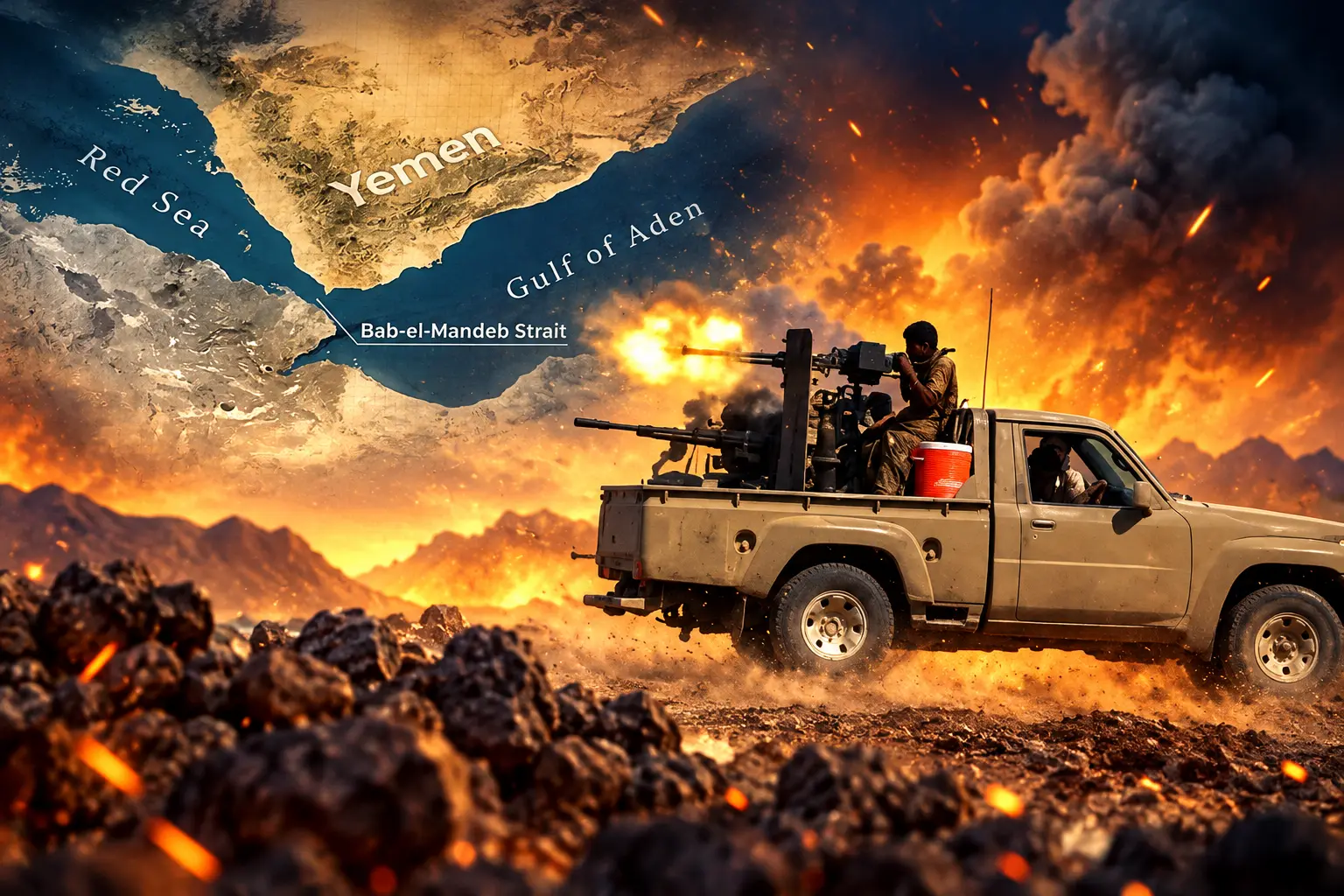
Government Forces Claimed the Port on Monday
Rashad al-Alimi, chairman of Yemen’s Presidential Leadership Council, announced the Dawn of Yemen operation on Monday, a day after he said the state was moving from preparation to liberation. The stated aims are to restore state institutions, retake Sanaa, and end Houthi rule in the capital, which the group has held since 2014.
With God’s help, the will of our people, the valor of our armed forces and all military formations, and the support of our brothers and friends, Yemen will move forward toward a new dawn of freedom, peace, and stability.
— د/ رشاد محمد العليمي (@PresidentRashad) October 5, 2026
On the coast, the Giants Brigades, Homeland Shield Forces (also called Nation’s Shield), and the Tihama Resistance said they had taken Dhubab airfield, about 45 km south of Mocha, and cut the road toward the strait. The Defence Ministry then said Mocha itself had fallen, with Houthi fighters pulling into the highlands.
Four government sources later described troops only at the city’s outskirts. Military sources who would not confirm the capture did say the Dhubab airstrip and the Dhubab-Mocha road were in government hands. A Houthi military spokesman on Tuesday called the opposing reports “fabricated heroics” and said the group still held its September gains, including Dhubab, the strait approaches, and the Kahboub mountains.
WHAT WE KNOW
- The operation: Dawn of Yemen began on Monday, 5 October, with Saudi-led air support claimed from the first hours.
- The coastal claims: Government forces say they hold Dhubab airfield and have cut the road toward Mocha and Bab al-Mandeb.
- The highland fight: Homeland Shield Forces say they took hills over al-Mansoura in al-Waziiya on Tuesday.
WHAT IS UNCONFIRMED
- Mocha city: The Defence Ministry’s capture claim has not been independently verified, and Houthi media rejected it as propaganda.
- Al-Waziiya: The army’s “mass retreat” account is denied by the Houthis, who say they repelled the advance.
- The strait: Information Minister Moammar al-Eryani spoke of “effective control” of Bab al-Mandeb; Perim Island has not been shown to have changed hands.
A port that is entered but still shot at from three inland sides is a staging claim, not a settled line. That is why the next day’s orders pointed at al-Waziiya rather than a victory parade on the quay.
Why Al-Waziiya Is the Fight After the City
Fernando Carvajal, a former United Nations Security Council adviser on Yemen, said the next phase turns on whether government forces, led by the Southern Giants and other southern units, can actually hold Mocha.
This will be a vital sign for us if the Yemeni government forces, led by the Southern Giants and other southern forces, can hold this city. Because, at the moment, when you look at the battle plan, Mocha is surrounded by Houthis from all three sides, and you have the Red Sea.
Fernando Carvajal, former UN Security Council adviser on Yemen
He said the city would have to be held first if it is to become a base for other fronts. Mawry’s point from Sanaa is the same geography in plainer terms. If the government wants Mocha, it has to take al-Waziiya.
The strait below those hills is 18 miles wide at its narrowest point, with tanker traffic squeezed into two 2-mile-wide channels, according to the U.S. Energy Information Administration. Shore guns on the Yemeni coast are only one threat. Missiles and drones launched from inland ridges still reach ships after a beach changes hands, which is why a Monday claim on Mocha did not end the argument about the waterway.
Houthi-aligned accounts answered the recapture reports with video they said showed fighters still inside the two coastal towns, mocking the announcement. The sharper military reading is simpler. Columns on the flats are easy to hit. The ridges are not.
One Hundred Jets and a Coastal Flank
Maj. Gen. Turki al-Maliki, spokesman for the Saudi-led coalition, said 100 fighter jets flew in the opening hours and that 324 high-value targets had been destroyed. He said air forces were covering Yemeni troops around the clock and still engaging moving targets near Bab al-Mandeb.
COALITION AIR AND THE COASTAL PUSH
- Air package: Maliki said 100 fighter jets joined the first hours of Dawn of Yemen.
- Targets: The coalition put the opening tally at 324 high-value sites, including weapons stores.
- Navy: Maliki said coalition ships struck depots, explosive boats, and naval mines in Hodeidah and stopped a planned attack on southern Red Sea lanes.
- Taiz Monday: The Taiz military axis said about 100 Houthi fighters were killed and 150 wounded, with 5 drones downed and 6 vehicles and a tank destroyed or disabled.
Those Taiz figures are government counts from five attacks on Monday, including Al-Arbaeen north of the city, Al-Aqroudh to the south, Al-Anin and Jabal Habashi to the west, and Al-Bireen on the Al-Kadha outskirts. They are not a confirmed battlefield ledger, and the Houthis have not answered them in detail.
On the coast, Col. Majed Al-Nazili said the Giants Brigades and Nation’s Shield had taken Bab al-Mandeb positions, placed the Dhubab-Mocha road under fire, and surrounded fighters in Dhubab, with some fleeing by sea. Analyst Fatima Alasrar said the Giants had taken Dhubab and the Kahboub heights but that Perim Island had not yet been retaken. Open-source clips of Apache helicopters over the strait circulated with the flanking claims. None of that settles who holds the town centres overnight.
Saudi Oil Now Runs Past Those Hills
The reason a Taiz ridge war draws 100 jets is not the district’s census. After Iran’s closure of the Strait of Hormuz, Saudi crude that once left the Gulf shifted west to Yanbu and then south through Bab al-Mandeb. Kpler recorded Yanbu loadings of 4.14 million barrels a day in June, against a 2025 baseline of 0.75 million barrels a day, an extra 3.39 million barrels a day on the Red Sea route.
The EIA’s chokepoint series puts oil flows through Bab el-Mandeb at 4.2 million barrels a day in 1H 2025, already about half the 9.3 million barrels a day recorded in 2023 after years of Houthi attacks on shipping. June’s rerouted Saudi barrels then pushed volumes back up, which is why a highland fight in Taiz now sits on a live export line.
RED SEA OIL AT THE STRAIT
| Measure | Figure | Period |
|---|---|---|
| Bab el-Mandeb oil flows (EIA) | 4.2 million barrels a day | First half of 2025 |
| Bab el-Mandeb oil flows (EIA) | 9.3 million barrels a day | 2023 |
| Yanbu crude exports (Kpler) | 4.14 million barrels a day | June 2026 |
| Yanbu baseline (Kpler) | 0.75 million barrels a day | 2025 average |
| Strait width at narrowest (EIA) | 18 miles, two 2-mile channels | Geography |
On 20 July the Houthis declared a maritime embargo on vessels serving Saudi ports. Kpler later found Saudi-loaded crude still moving through the strait, at lower volume. Egypt’s SUMED line can shift some barrels north to the Mediterranean, but the long way around to Asia doubles voyage time and does not replace the short hop past Mocha.
Taking a quay does not stop a missile crew on a ridge. That is the second-order fact under Tuesday’s orders. The government can claim Mocha and still watch insurance desks treat Bab al-Mandeb as a war zone until the hills are quiet.
Return Fire on Jazan and Najran Airports
The Houthis answered the coastal push by firing at Saudi cities. The General Authority of Civil Aviation said King Abdullah bin Abdulaziz Airport in Jazan and Najran Airport were hit on Monday evening, leaving three people with minor injuries and some damage. Maliki said a ballistic missile aimed at Khamis Mushait was intercepted on Tuesday, with launch points in Sanaa, Saada, and Amran.
Houthi statements also claimed strikes on King Khalid International Airport in Riyadh, an Aramco site in Rabigh, Abha Airport, and the Khamis Mushait base. Riyadh has not confirmed that full list. GACA has confirmed Jazan and Najran.
Pakistan and Turkiye moved the same day. At an emergency meeting in Riyadh on Monday, the Mecca Joint Defence Agreement, signed in August, was activated for the first time. The three governments said they would put agreed forces and kit on rapid deployment inside Saudi Arabia. An attack on one is to be treated as an attack on all.
WHAT THE PACT PUT ON THE TABLE
- The trigger: The first activation of the August Mecca pact, after Houthi fire on Saudi cities and holy-site infrastructure.
- The mission: Rapid deployment of agreed Pakistani and Turkish forces and capabilities inside the kingdom, under each country’s law.
- The combat line: Pakistani Defence Minister Khawaja Asif, speaking from Riyadh, said Turkiye and Pakistan are in a supporting role, including reconnaissance, and that Saudi forces are the ones fighting.
- The U.S. line: Secretary of State Marco Rubio said Saudi Arabia and the Yemeni government have a right to defend themselves and that Yemeni forces will try to retake ground they lost.
Asif’s split of labour is the practical limit. The pact internationalises Saudi air defence. It does not, on his account, put Pakistani or Turkish infantry on al-Waziiya. The mountain war remains a Yemeni ground fight with Saudi jets overhead and two new partners on the kingdom’s side of the border.
Sanaa Remains the Prize al-Alimi Named
Al-Alimi has said the operation is not a war against the people of Sanaa, Saada, Hodeidah, Amran, Dhamar, Ibb, or any other province, and not a war against a sect or tribe. He has also said it continues until Sanaa is taken, a city the Houthis have held for 12 years. Government statements added a southern Marib advance and a “strategic offensive” toward the capital. Those claims sit even further from independent check than Mocha.
The people already in the path are in Taiz and on the west coast. The International Organization for Migration said on Monday that more than 184,000 people have been displaced since the war resumed. The World Health Organization has counted at least 959 people killed and more than 4,200 wounded in the latest fighting. Annette Heinzelmann, WHO emergency director for the eastern Mediterranean, said the escalation is pushing a weak health system toward breaking point.
On Wednesday, government forces said they had tightened control over the highest peak in Jabal Habashi district, another Taiz height in the same belt as al-Waziiya. That claim, like the hills over al-Mansoura, is still a statement from one side of a live front. Mocha’s fate will be read from those ridges, not from the Monday communiqué that said the port was already back in government hands.

Saks Kept 15 Stores While Rivals Took the Shoppers

Fallout Season 3 Spend Hits California’s $42 Million Cap

Ebola Outran Congo’s Contact Lists and Reached Nairobi

Jagex Builds RuneScape 4 Beside the Games Players Already Have

SimpL Bets €1.2 Million on Meetings Paid When Held

Boston Scientific Cyberattack Leaves Hospitals Waiting on Implants

Guizhou Cave Cafes Spread When Each Cavern Fills

The Second Ned Stark Kit Lands When a Banner Dies

Satellites Saw Nepal’s Ice Slope Move Before the Flood

OpenAI’s Jalapeño Chip Turns Watts Into Faster Agent Steps
-
 NEWS1 month ago
Boston Scientific Cyberattack Leaves Hospitals Waiting on Implants
-
 NEWS2 months ago
Guizhou Cave Cafes Spread When Each Cavern Fills
-
 GAMING1 month ago
The Second Ned Stark Kit Lands When a Banner Dies
-
 NEWS4 weeks ago
Satellites Saw Nepal’s Ice Slope Move Before the Flood
-
 NEWS1 month ago
OpenAI’s Jalapeño Chip Turns Watts Into Faster Agent Steps
-

 NEWS1 month ago
Roman Space Telescope Launches After a Decade-Long Budget Bet
-

 NEWS1 month ago
MLB Quiet Periods Copy a Freeze Other Leagues Use
-

 NEWS1 month ago
X Finds a Chinese Bot Farm Cartooning AI Power Bills