
NEWS
Congo’s 4,018 Ebola Deaths Rest on a Breaking Count
Congo’s Health Ministry logged 4,018 Ebola deaths among 8,300 cases as unpaid tracers, a burned camp, and a mismatched vaccine leave later deaths uncounted.

Congo’s Health Ministry has recorded 4,018 Ebola deaths among 8,300 confirmed cases since May 15. The Bundibugyo outbreak is now the deadliest Ebola epidemic the country has logged, and it still has no licensed vaccine.
Those figures landed as surveillance workers in Bunia protested months without pay and as soldiers burned a transit centre built to isolate the sick. Africa CDC has already warned that a drop in newly confirmed cases can reflect closed roads and closed doors, not a virus in retreat.
Unpaid Tracers Are the Ones Who Produce the Count
In Bunia, the capital of Ituri province and the heart of the outbreak, surveillance team members gathered to demand wages. They waved placards reading “No money, no data!” and “No payment for months.”
Biongi Beiza, one of the protesters, said some colleagues had not been paid for August and September. “There is no explanation from the administration,” he said. Congolese authorities did not immediately answer the complaint. Front-line staff have walked out several times since May, which cuts the very lists the ministry later reads out as a death toll.
There is no explanation from the administration.
Biongi Beiza, surveillance protester, Bunia
The payroll fight is older than this week’s 4,018. In July, Health Minister Roger Kamba said the government was checking lists after names of people not involved in the response were added. WHO official Dr. Amadou Bailo Ancia put the operational cost in plain terms in September, saying treatment centres were going up without the people to run them, and that the health workers must be paid.
Africa CDC has put health-worker infections at about 254, with 50 deaths. Médecins Sans Frontières, known in English as Doctors Without Borders, says health workers sit among those at greatest risk. A count that depends on unpaid tracers, and on staff who are themselves dying, is a count with holes in it.
19,000 People Fled After Soldiers Burned a Transit Center
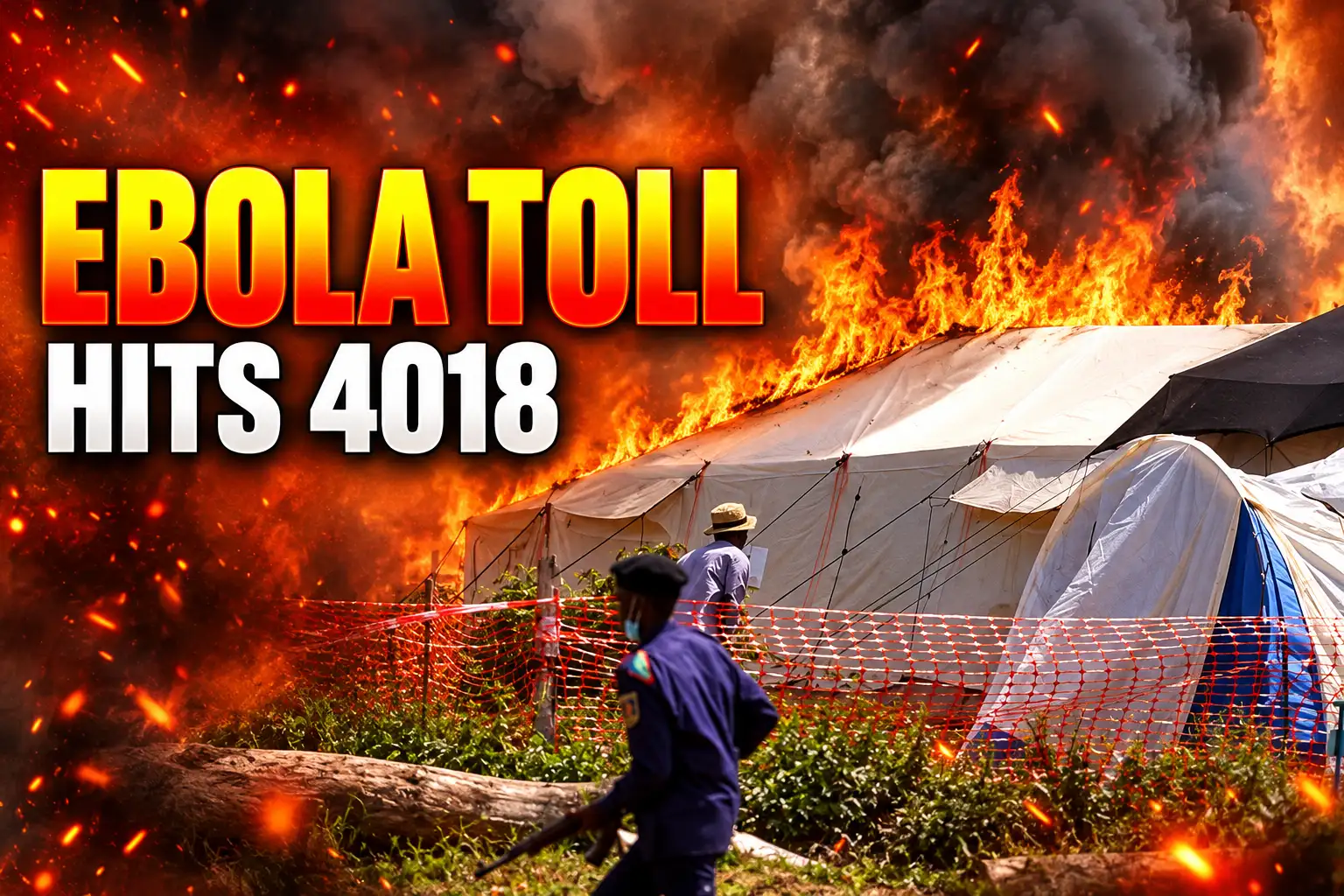
Julien Harneis, the United Nations senior Ebola coordinator, said soldiers searching for weapons burned an Ebola-hit displacement camp in Kigonze, on the outskirts of Bunia, that housed a transit centre for infected patients. About 19,000 people in the camp fled.
Building those centres has already been a fight for money and staff, both of which are short. Losing one does not only wipe a building off a map. It wipes isolation beds, trained teams, and a place where a fever can still be separated from a family.
When we lose a center, that means we lose capacity, we lose investment, and we have to start again. And above all, it means that people do not get access to the care that they really need.
Julien Harneis, UN senior Ebola coordinator
Dr. Janet Diaz of WHO’s Health Emergencies Programme, back from treatment centres in Bunia, told reporters in Geneva on September 29 that many people are still dying at home or in their communities because they cannot reach facilities in time. WHO and partners have lifted treatment capacity from a handful of beds at the start of the outbreak to more than 1,600 beds across 50 centres, with plans to pass 2,000, and have trained nearly 400 health workers. A burned transit centre in a camp of 19,000 people runs against that expansion in the place where patients actually arrive.
Why the Weekly Case Count Dropped in September
Confirmed cases fell from around 850 a week and 470 deaths a week in mid-July to an average of 490 cases and 230 deaths a week in September. On paper that is a 42 percent drop in reported cases and a 51 percent drop in reported deaths. Africa CDC said the fall could be down to insecurity and trouble getting communities to cooperate in some hot spots.
WHO’s Marie Roseline Belizaire, regional emergency director for Africa, said around one in three new infections are identified only after people have died outside treatment centres. Those deaths still spread the virus through family care and funerals. They also never sit in a weekly “new cases” column until someone is willing, and paid, to write them down.
WHAT WE KNOW
- The ministry tally: 4,018 deaths among 8,300 confirmed cases, with 2,162 recovered and a 48.4 percent death rate.
- The weekly drop: reported cases moved from about 850 a week in mid-July to 490 in September, and reported deaths from about 470 a week to 230.
- Community deaths: WHO says about one in three new cases are found only after the person has already died outside a treatment centre.
WHAT IS UNCONFIRMED
- A real slowdown: Africa CDC says the lower weekly numbers may reflect blocked access and weak cooperation, not less virus.
- The full community toll: MSF says the true toll likely higher due to gaps in surveillance and case detection.
- Ervebo’s protection: the only licensed Ebola shot is still unproven against this strain in people.
The same week the ministry crossed 4,000 deaths, several failures stacked on the people who keep that ledger.
WHAT IS BREAKING THE COUNT
- Unpaid surveillance: tracers in Bunia have gone without August and September wages and have struck before, which stops contact lists at the source.
- A burned transit centre: the Kigonze fire forced about 19,000 displaced people to run, including patients who had been staged for isolation.
- Deaths at home: when a third of new cases are found only after burial, the weekly curve understates live chains of spread.
- Local violence: a ruling-party official in Butembo was beaten after defending the response, which deepens the fear that already keeps families from teams.
- No matching shot: Bundibugyo has no approved vaccine, so the tools that cut Zaire Ebola in 2018 to 2020 are not on the shelf here.
Save the Children said on October 3 that the outbreak has killed close to 1,000 children. That is a childhood death count large enough to sit beside the adult ledger, and it is still only the deaths that agencies could see.
North Kivu’s Fatality Rate Has Hit 59.7 Percent
WHO’s September 25 Disease Outbreak News, using data through September 23, is the last detailed geographic snapshot beneath the ministry’s newer national total. It logged 7,890 confirmed cases and 3,799 deaths, a 48.1 percent death rate, in 63 health zones across seven provinces: Ituri, North Kivu, Tshopo, Haut-Uele, Bas-Uele, South Kivu, and Sud Ubangi. Forty-eight of those zones had reported at least one case in the prior 21 days.
Ituri remained the epicentre, with 6,032 confirmed cases, though incidence there had been easing from a mid-August peak. North Kivu, with 1,480 confirmed cases, including 567 in those 21 days, had the outbreak’s highest provincial death rate at 59.7 percent. WHO said it was still investigating why so many diagnosed people in North Kivu die. The other five provinces together had 378 confirmed cases as of that date. South Kivu had reported no new case since May 29. Sud Ubangi entered the list after a traveller from eastern Congo died.
| Province (as of Sept. 23) | Confirmed cases | What WHO described |
|---|---|---|
| Ituri | 6,032 | Epicentre; 28 of 36 health zones hit; incidence easing from mid-August |
| North Kivu | 1,480 | Second-worst caseload; 59.7 percent death rate; mid-September peak |
| Five other provinces | 378 | Includes a single Sud Ubangi case and no South Kivu cases after May 29 |
Between August 31 and September 20, cases fell 26 percent in Ituri and 15 percent in Haut-Uele, while North Kivu recorded a 73 percent rise. Belizaire said those patterns show the outbreak is still not under control. On September 23, WHO counted 26,980 of 32,342 identified contacts seen in the previous 24 hours, or 83.4 percent. That is a large follow-up machine. It is also a machine that stops when tracers are unpaid or when a camp of 19,000 people scatters.
Tedros Adhanom Ghebreyesus, WHO’s director-general, said conflict and displacement make it hard to reach communities and trace contacts, and that Ebola cannot be treated as a stand-alone problem while those access gaps last. WHO has assessed risk inside Congo as very high and risk in countries that share its land borders as high.
The Licensed Shot Does Not Cover Bundibugyo Virus
This epidemic is Bundibugyo virus disease, a rare Ebola species. WHO says no approved vaccines or specific treatments currently exist for it. Outbreak control still rests on finding cases, isolating the sick, tracing contacts, safe burials, and community work. Historical death rates from the only two prior Bundibugyo outbreaks sat at 30 percent in Uganda in 2007 and 50 percent in Congo in 2012. The present crude death rate of 48.4 percent sits on the high end of that short record.
Ervebo, made by Merck, is the only licensed Ebola vaccine, and it is licensed for Zaire virus in people aged one year and older. WHO’s Strategic Advisory Group of Experts on Immunization reviewed animal, lab, and observational data and found hints of possible cross-protection, then said the evidence is still too thin to know whether Ervebo protects people against Bundibugyo in a way that matters clinically. Updated emergency guidance on August 31 says the shot should be used only within research protocols.
A ring randomized trial is planned so half the contacts around a case receive Ervebo and half receive a placebo, the same basic design that showed Ervebo worked against Zaire in Guinea in 2015. About 20,000 doses have been set aside for a research vaccination programme among front-line workers in Ituri. MSF and its epidemiology arm Epicentre have opened BRAVO, a study following 20,000 of those workers. Until that trial reads out, a vaccinated nurse in Bunia still cannot be told, as a fact, that the shot will stop this virus.
Candidate treatments under WHO review for trials include the monoclonal antibodies MBP134 and maftivimab, plus the antiviral remdesivir. None of those is licensed for Bundibugyo either. In Butembo, mobile laboratories have cut test turnaround from 72 hours to six hours, said Dr. Lota Kalubi, a doctor at a treatment centre. Michel Ngimba of the National Institute of Biomedical Research said a lab can be driven to a town such as Katwa the same day an emergency lands. Faster tests do not replace a vaccine, and they do not pay a tracer.
How This Outbreak Compares With West Africa
Congo’s health ministry declared the 17th Ebola outbreak on May 15 in Ituri health zones including Rwampara, Mongwalu, and Bunia. WHO determined a public health emergency of international concern on May 17. Health authorities have called the rise the fastest-growing Ebola outbreak on record. WHO has said it is on track to pass the West African epidemic of 2014 to 2016, which killed more than 11,000 people.
| Outbreak | Confirmed picture | Deaths | Virus |
|---|---|---|---|
| West Africa, 2014-2016 | 28,616 cases | 11,310 | Zaire |
| Eastern Congo, 2018-2020 | 3,481 cases | 2,299 | Zaire |
| Congo, 2026 (ministry tally) | 8,300 confirmed cases | 4,018 | Bundibugyo |
The current toll is already 1,719 deaths above the 2018 to 2020 eastern Congo epidemic, which had been the country’s worst. It remains well below West Africa’s 11,310 dead. In May, Africa CDC briefed ministers on a failed-control range that topped out at 7,500 cases by day 100. The ministry’s 8,300 confirmed cases have already moved past that upper bound.
THE DATES BEHIND THE 4,018
- May 15, 2026: Congo declares its 17th Ebola outbreak in Ituri.
- May 17, 2026: WHO declares a public health emergency of international concern.
- July 2026: Front-line workers in Ituri strike over unpaid wages as cases climb through the first months.
- August 31, 2026: WHO says Ervebo should be used against Bundibugyo only inside research protocols.
- September 23, 2026: WHO records 7,890 confirmed cases and 3,799 deaths across 63 health zones.
- September 27, 2026: Marie-Celestin Karondwa is attacked at his home in Butembo after speaking on local radio.
- October 1, 2026: An MSF worker arrives in isolation in Leiden; the Health Ministry’s tally reaches 4,018 deaths among 8,300 cases.
Karondwa, a local official of the ruling Union for Democracy and Social Progress, died of his injuries in hospital. His house was set on fire. His granddaughter, Sagesse Kavira, said at the funeral on October 1, “They beat him up and then set the house on fire.” The party called him an innocent victim for defending its position that Ebola exists and threatens the population. Dr. Kalima Nzanzu, chief medical officer at Matanda General Referral Hospital, said some residents believe health teams talk about Ebola because they have been paid to do so, which he rejected. Authorities launched a village-centred approach in September that leans on local leaders. Some residents still call the disease a hoax.
An MSF Worker Is Now in Isolation in Leiden
MSF said on October 1 that a staff member working on the Congo response had tested positive for Bundibugyo virus disease and was being evacuated under a strict protocol with health authorities in Congo and the Netherlands. The group withheld name, gender, and nationality. “The human cost of this crisis is unprecedented in the DRC, with communities facing the largest Ebola disease outbreak ever recorded in the country,” MSF said. It is responding in Ituri, North Kivu, Tshopo, and Haut-Uele.
Leiden University Medical Center said the patient was admitted to its high-level isolation unit at 22:00 on October 1. The hospital said the worker had fallen ill in Congo, arrived on a special flight, and would be nursed in strict isolation in a unit built for dangerous infections, including rooms with double-door airlocks and two rooms equipped as intensive care. Dr. Anna Roukens, an infectious-disease specialist at the hospital, said there is no specific treatment and that care is supportive, fluids and oxygen if needed, and that visitors and other patients in Leiden are not at risk because of that isolation.
MSF said it trains staff and issues the highest protection it can, and that the risk of exposure can never be completely eliminated. That sentence sits next to 50 dead Congolese health workers who do not get a night flight to a Dutch isolation bay. Incubation runs from two to 21 days. WHO still advises against travel or trade bans with affected countries.
The 4,018 deaths are the cases that reached a ledger. The tracers who fill that ledger have gone unpaid, a transit centre that was meant to catch the next case has been burned, and the only licensed Ebola vaccine was built for a different virus. The next deaths will arrive whether anyone is still counting them.
Disclaimer: This article is news reporting on an active outbreak and is for information only. It is not medical advice, a diagnosis, or guidance on vaccines, travel, or treatment for Ebola or any other illness. Readers who have symptoms, travel plans, or clinical questions should consult a qualified physician or local public-health authority before acting. Case counts, death totals, and response status are those published by the Congolese Health Ministry, WHO, MSF, Africa CDC, and named officials in the sources above, and they can change as surveillance is updated.

Congo’s 4,018 Ebola Deaths Rest on a Breaking Count

Lancaster County Bears Three of Pennsylvania’s Five Measles Deaths

Australopithecus Sediba Arrived After Homo Already Lived

The Hormuz Rebound Is Why Physical Brent Stays High

Google Holds Gemini 4 Argon for Vetted Cyber Defenders

Boston Scientific Cyberattack Leaves Hospitals Waiting on Implants

Guizhou Cave Cafes Spread When Each Cavern Fills

Satellites Saw Nepal’s Ice Slope Move Before the Flood

The Second Ned Stark Kit Lands When a Banner Dies

OpenAI’s Jalapeño Chip Turns Watts Into Faster Agent Steps
-
 NEWS1 month ago
Boston Scientific Cyberattack Leaves Hospitals Waiting on Implants
-
 NEWS2 months ago
Guizhou Cave Cafes Spread When Each Cavern Fills
-
 NEWS4 weeks ago
Satellites Saw Nepal’s Ice Slope Move Before the Flood
-
 GAMING1 month ago
The Second Ned Stark Kit Lands When a Banner Dies
-
 NEWS1 month ago
OpenAI’s Jalapeño Chip Turns Watts Into Faster Agent Steps
-

 NEWS1 month ago
Roman Space Telescope Launches After a Decade-Long Budget Bet
-

 NEWS1 month ago
MLB Quiet Periods Copy a Freeze Other Leagues Use
-

 NEWS2 months ago
Pere Marquette Freezes Data Centers on a Power-Rich Shore