
ENTERTAINMENT
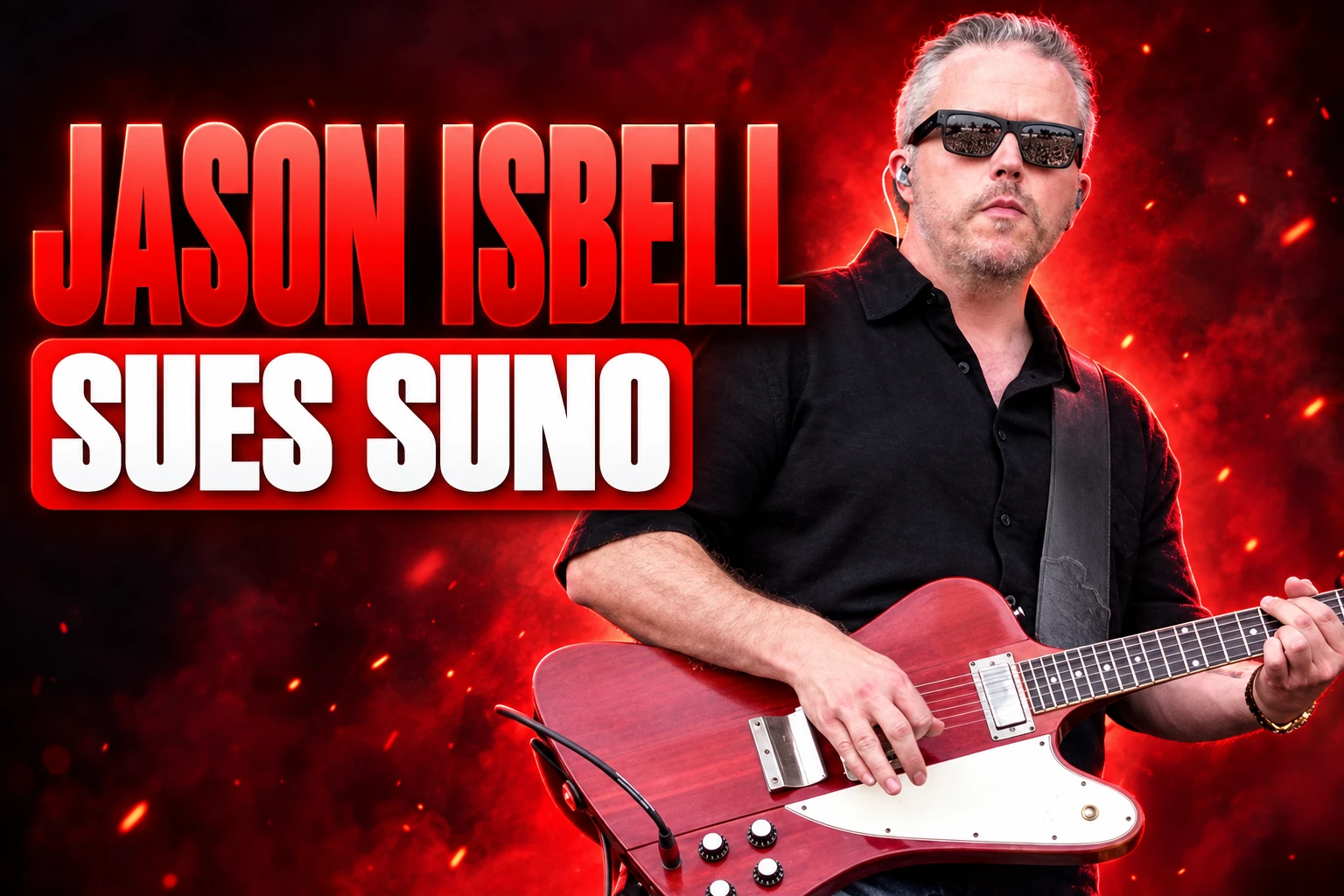
Jason Isbell Sues Suno Over Identities Labels Cannot License
Jason Isbell sued Suno over artist names and voices that copyright deals never sold, after Warner already wrote a separate identity opt-in.

Jason Isbell and three fellow musicians sued Suno on August 31 over the commercial use of their names and voices. They filed an 84-page class action in Boston federal court under right-of-publicity laws, a claim the complaint says stays with the performer after a recording is sold.
Warner Music Group already built an artist opt-in for names, images, likenesses and voices when it settled with Suno last November. The live product, the musicians say, still answers to a typed name.
Four Musicians File in Boston Over Identity Rights
The case is 1:26-cv-14005 in the U.S. District Court for the District of Massachusetts. Isbell, a six-time Grammy winner from Tennessee, is joined by David Lowery of Camper Van Beethoven and Cracker, who lives in Georgia. Guy Forsyth is a Texas blues musician. Eduardo Calle is a Grammy-winning saxophonist who lives in Florida.
They sued Suno, Inc., a Delaware company with its main office at 17 Dunster Street in Cambridge, and unnamed others. They asked the court to let the case proceed for a class of more than 100 musicians, to award damages, to stop the use of their identities, and to give them a jury. The filing puts more than $5,000,000 in controversy, the threshold that lets a class action sit in federal court.
The complaint is blunt about what it is not claiming. The musicians say they do not own Americana, blues, or any other style, and they do not ask a court to stop a person or a machine from making those kinds of songs. The claim, they write, is older and narrower: no one may commercially exploit another person’s name and identity.
Many musicians sell their rights to specific recordings. However, the identity right belongs to the performer regardless of who owns any copyright in an underlying recording unless the identity right is separately licensed, typically for merchandise under the artist’s control.
Class-action complaint, Isbell v. Suno Inc., U.S. District Court for the District of Massachusetts
That split is why this filing exists beside the copyright war already running in the same courthouse. Labels can sell a master. They cannot, on the complaint’s telling, sell the person who sang it.
Warner’s Own Deal Already Treats a Voice as Separate Property
Major labels sued Suno in June 2024 over training data. Warner walked out of that fight on November 25, 2025, with a licensing pact, a plan for new licensed models, and a rule that participating artists would control how their names and voices get used. Universal and Sony are still in the copyright case. Suno announced a global deal with BMG on August 12 as part of the same licensed-model launch.
FROM COPYRIGHT FIGHT TO IDENTITY INVOICE
- June 2024: Major labels sue Suno in Boston, claiming the model trained on copyrighted recordings without a license.
- November 25, 2025: Warner settles, sells Suno its concert site Songkick, and writes an artist opt-in for names, images, likenesses, voices and compositions.
- August 6, 2026: Suno chief executive Mikey Shulman publishes a company post saying the app blocks artist-name prompts and strips those names when they appear.
- August 12, 2026: Suno announces a global partnership with BMG tied to the first music model built with the industry.
- August 31, 2026: Isbell, Lowery, Forsyth and Calle file the publicity-rights class action.
- September 1, 2026: Suno says the claims lack merit and points to those same name filters.
Warner’s own announcement already treated identity as a permission the label could not simply bundle into a catalog license. CEO Robert Kyncl said the pact would give artists an opt-in for name, image, likeness and voice in new AI songs, alongside licensed models and a promise that current models would be retired once the new ones launch in 2026.
AI becomes pro-artist when it adheres to our principles: committing to licensed models, reflecting the value of music on and off platform, and providing artists and songwriters with an opt-in for the use of their name, image, likeness, voice and compositions in new AI songs.
Robert Kyncl, CEO, Warner Music Group, November 25, 2025 partnership announcement
The complaint says those protections cover participating rightsholders, not musicians such as Isbell. It also says a rival has tried to license publicity rights, and that Suno “forged ahead without consent.” The live app, on that telling, is still selling a name-indexed experience while the licensed future is listed as upcoming.
What Happens When You Type Jason Isbell’s Name?
Enter a musician’s name, the suit says, and Suno builds a “musician-based channel” with a song, a description and a graphic that invoke that person. Counsel ran the test on the four plaintiffs and on a wider list of known acts. The complaint says many of those outputs, including the Isbell example, were still on the service when the paper was filed.
OUTPUTS THE COMPLAINT TIED TO A TYPED NAME
| Name entered | Track the suit describes | What came with it |
|---|---|---|
| Jason Isbell | Paper Bell | Clear male vocals and country twang; “contemporary Americana singer-songwriter with fingerpicked acoustic guitar”; art of a paper bell, a church and trees |
| Buddy Guy | Stone Blues in My Shoes | A description that included “vintage electric Chicago blues” |
| Carly Simon | Unspecified title | “Soft 70s confessional pop” |
| Less Than Jake | Parking Lot Anthem | “Ska-punk with fast offbeat guitar chops”; art the suit says invokes the band’s comic-book covers |
| m i c h a e l j a c k s o n | Two songs titled Glovebox Moonwalk | “1980s pop-funk dance” tracks, a photo of a white glove, and lyrics that use the moonwalk and the glove |
Forsyth’s name returned a blues-rock track titled after him. Calle’s name returned two Latin jazz songs titled after him. The filing says counsel has dozens more on file, among them Mavis Staples, Tom Waits, The Chicks, Israel Kamakawiwoʻole, Common and Chief Keef. The heart of the claim, the musicians write, is Suno’s design, “not any act by a user.”
A Space Between Letters Opens Superstar Names
Shulman wrote in August that Suno has never allowed prompts for specific artists or copyrighted songs, and that a named prompt is stripped and steered toward musical traits. The same post says the company works with Audible Magic, Musixmatch and other vendors to screen uploads and lyrics. Suno’s public rules also bar using someone’s voice or likeness without permission.
The complaint calls the block a false claim. “In reality, Suno not only accepts names but also responds to the name with an output based on that musician’s identity,” it says. The workarounds it lists are simple, and they are already obvious to people who use these tools. Within hours of the filing, replies to Lowery were spelling names with a gap between every letter, the same dodge the suit says unlocks some of the biggest catalogs on earth.
HOW THE COMPLAINT SAYS USERS GET PAST THE FILTER
- The stage name: Prompts for Isbell, Buddy Guy, Carly Simon and Less Than Jake allegedly returned identity-tied songs, copy and art.
- The legal name: Typing Common’s birth name, Lonnie Rashid Lynn, allegedly produced tracks in his “more poetic, reflective, socially conscious” register, built on jazz and soul samples.
- The spaced letters: Entering Taylor Swift, Bad Bunny, Bruno Mars or Michael Jackson with a space between each letter allegedly bypassed the block; the Jackson prompt produced the two Glovebox Moonwalk tracks and the white-glove image.
The suit’s theory is that even the “redirect” to descriptive traits is the identity, encoded as tokens, then sold. A filter that drops a name but keeps the voice, the twang and the glove still delivers the person, it argues. Suno’s answer is that it sells original music, not a trade in anyone’s name.
Bette Midler Won This Fight Against a Ford Sound-Alike
In 1988 the Ninth Circuit held that when a distinctive, widely known professional singer’s voice is deliberately imitated to sell a product, the seller has taken what is not theirs. Ford’s agency had asked Bette Midler to sing for a commercial. She refused. The agency hired a sound-alike, played Midler’s record for her, and told her to match it. Friends told Midler the ad sounded like her. The court said a voice is as personal as a face, and that the claim sat outside copyright because a voice is not a work of authorship.
Tom Waits later won a similar case against Frito-Lay over a Doritos radio spot that used a raspy impersonator after Waits had refused to do ads. The court kept the Midler rule: the voice has to be distinctive and widely known, and the imitation has to be deliberate and commercial. It also said the tort is about voice, not a musical style in the abstract.
That limit is the opening Suno will try to walk through. Generating “fingerpicked acoustic guitar” after a name is stripped may look to a court like genre, not a person. Generating Paper Bell with Isbell’s twang, then labeling it contemporary Americana, looks to the plaintiffs like the Ford ad without the session singer. The complaint puts the point in one line: Isbell’s musical identity does not stop being his property because the tool is sophisticated.
Tennessee, where Isbell lives, is among the publicity statutes listed, along with Illinois, California common law, New York, Florida, Texas, Massachusetts, Georgia and several other jurisdictions. There is no single federal right of publicity. The musicians are asking one Boston judge to apply that patchwork to a product that can be prompted from anywhere.
Each Reckless Voiceprint Claim Carries $5,000 in Illinois
Stacked under the publicity counts is a biometric claim aimed at Illinois residents. The complaint says Suno name-indexed a large volume of voice data, measured pitch, formant structure and breath, and stored those measurements as identifiers that can tie an unlabeled voice back to a singer. It calls those measurements voiceprints.
The Illinois Biometric Information Privacy Act lists a voiceprint as a biometric identifier. Before a private company may collect one, it has to tell the person in writing, spell out the purpose and the retention period, and get a written release. The complaint says Suno “never asked, never disclosed, never published a retention policy, and never obtained the written consent BIPA requires.”
WHAT THE ILLINOIS STATUTE PUTS ON THE TABLE
- The identifier: A voiceprint is named in the same list as a fingerprint, an iris scan and a face geometry scan.
- The consent rule: Collection without a written release is a violation, and a company that holds the data must publish a destruction schedule.
- Negligent violation: Liquidated damages of $1,000, or actual damages if they are higher.
- Reckless violation: Liquidated damages of $5,000, or actual damages if they are higher, plus fees and an injunction.
A proposed subclass would cover living Illinois musicians whose vocal identifiers Suno collected. Independent musicians have already tried a similar BIPA theory against Suno and other AI music firms. Whether a court will treat a music-model embedding as the “voiceprint” the 2008 statute had in mind is an open question, and it is one Suno will fight. If the label sticks, the damages math is per person and does not depend on proving a hit song was copied.
Suno’s Current Models Are Still the Product Users Get
Suno said the claims are without merit and that it will defend the case. “Suno exists to help people create new, original music, not to trade on anyone’s name,” the company said on September 1. It pointed to prompt blocks, song-title blocks, and third-party screening of uploads and lyrics. Shulman’s August post used the same lines, and added that the company chose not to use artist names as training metadata.
The commercial stakes are not small. Suno announced a $400 million Series D at $5.4 billion on June 3. Shulman said in February the company had passed 2 million paid subscribers and was on pace for $300 million in annual revenue. Warner’s November announcement described a service 100 million creators already used. The complaint, citing Suno’s own projection, says the company is aiming at $1 billion in revenue by 2028, and that the musicians whose identities underpin that number will see none of it without a court order.
WHAT WE KNOW
- The filing: Four named musicians sued in Boston on August 31 on publicity and biometric theories, and asked for class treatment, damages, an injunction and a jury.
- The company line: Suno denies the claims, says it blocks artist-name prompts, and says it does not trade on anyone’s name.
- The leftover permission: Warner’s 2025 deal already treated names and voices as an artist opt-in separate from a recording license.
- The live product: Licensed models are still described as upcoming, and the complaint says name-prompted tracks remained on the service.
WHAT IS UNCONFIRMED
- The legal fit: No court has yet said a generated “style plus name” output is the same tort as a Ford sound-alike ad.
- The voiceprint label: It is untested in this case whether Suno’s stored voice measurements meet BIPA’s definition.
- The class: Certification has not been briefed, and damages are unspecified.
- The model swap: Warner was told current models would be retired when licensed ones launch in 2026; that launch has not been dated past “upcoming.”
Suno told Warner last November that the models now in users’ hands would come off the board once the licensed ones arrive. Those licensed models are still listed as a next chapter. Until they ship, the product the complaint tested is the product that is live, the one that turned a typed name into Paper Bell.
Disclaimer: This article is news reporting on a newly filed civil complaint and related company statements. It is for information only and is not legal advice, nor is it a prediction of how any court will rule on right-of-publicity, biometric-privacy or copyright claims. Readers who think their name, voice or recordings may be at issue should consult a licensed attorney who practices in the relevant state before taking any action. Figures, docket details and product behavior reflect the complaint, the cited statutes and the companies’ public statements as of September 2, 2026, and all of those can change as the case is served, answered and litigated.

Saks Kept 15 Stores While Rivals Took the Shoppers

Fallout Season 3 Spend Hits California’s $42 Million Cap

Ebola Outran Congo’s Contact Lists and Reached Nairobi

Jagex Builds RuneScape 4 Beside the Games Players Already Have

SimpL Bets €1.2 Million on Meetings Paid When Held

Boston Scientific Cyberattack Leaves Hospitals Waiting on Implants

Guizhou Cave Cafes Spread When Each Cavern Fills

The Second Ned Stark Kit Lands When a Banner Dies

Satellites Saw Nepal’s Ice Slope Move Before the Flood

OpenAI’s Jalapeño Chip Turns Watts Into Faster Agent Steps
-
 NEWS2 months ago
Boston Scientific Cyberattack Leaves Hospitals Waiting on Implants
-
 NEWS2 months ago
Guizhou Cave Cafes Spread When Each Cavern Fills
-
 GAMING2 months ago
The Second Ned Stark Kit Lands When a Banner Dies
-
 NEWS1 month ago
Satellites Saw Nepal’s Ice Slope Move Before the Flood
-
 NEWS2 months ago
OpenAI’s Jalapeño Chip Turns Watts Into Faster Agent Steps
-

 NEWS2 months ago
Roman Space Telescope Launches After a Decade-Long Budget Bet
-

 NEWS2 months ago
MLB Quiet Periods Copy a Freeze Other Leagues Use
-
 NEWS2 months ago
Pere Marquette Freezes Data Centers on a Power-Rich Shore