
NEWS
Isembyld Clears FDA as First Myostatin Drug for SMA
Isembyld, the first myostatin SMA add-on, won FDA approval with a 2.2-point motor gain and a $310,000 yearly net cost.

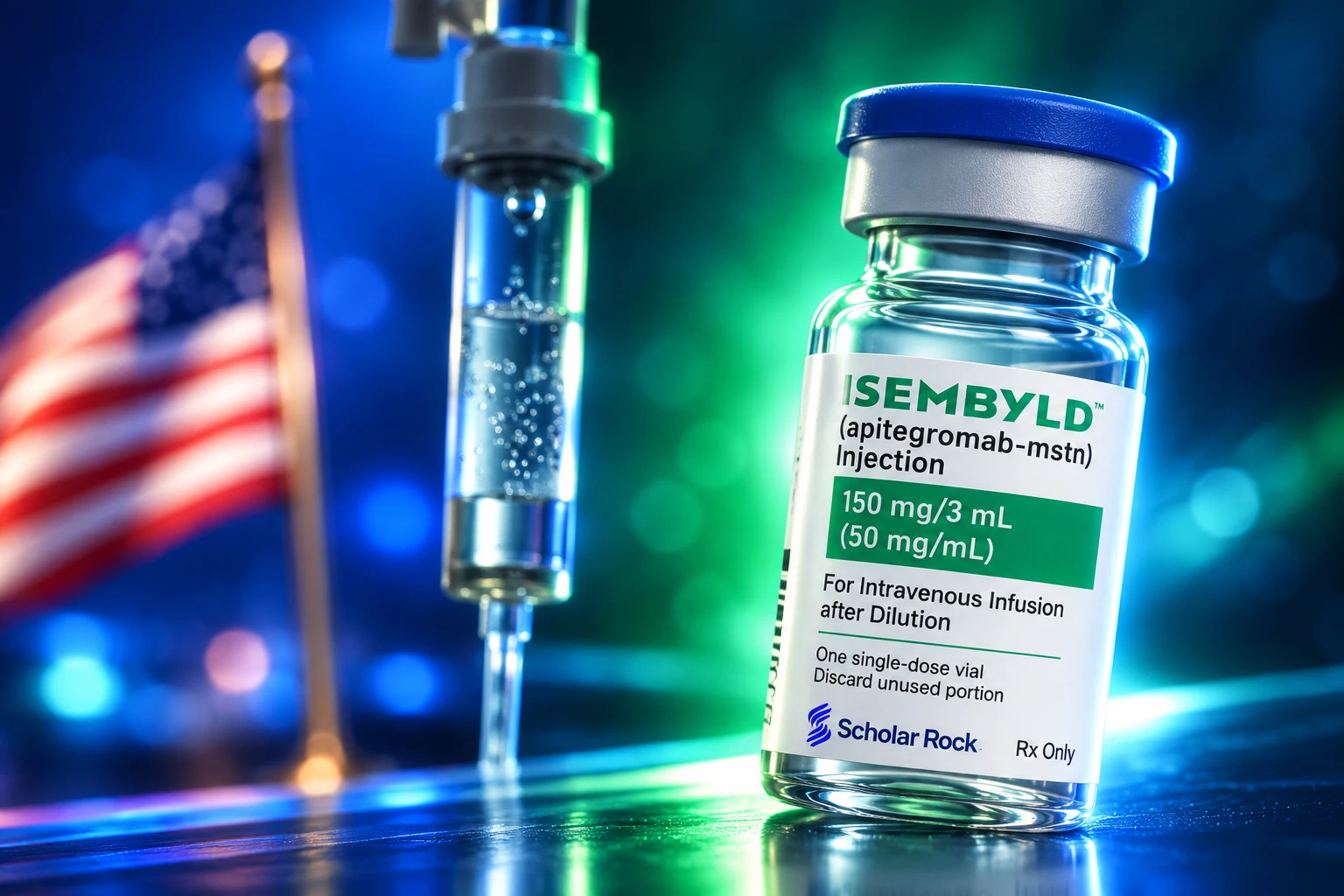
The FDA approved Isembyld on September 11, 2026, as the first spinal muscular atrophy drug that acts on muscle rather than motor neurons. The antibody, apitegromab-mstn from Cambridge, Massachusetts-based Scholar Rock, is cleared for adults and children 2 years and older who are already on an SMN2-targeted treatment.
It is an add-on, not a replacement for Spinraza or Evrysdi, and it arrives with a 2.2-point motor-score gain, a fracture warning, and a typical net yearly cost of about $310,000. Scholar Rock is already running the same antibody in other muscle diseases.
An Add-On for Patients Already on Spinraza or Evrysdi
The agency called Isembyld the first therapy to target SMA muscle loss, and it licensed the drug to work beside existing SMN2 medicines rather than instead of them. SMA, which appears in about 1 in 10,000 live births, is among the leading genetic causes of infant death. A faulty SMN1 gene starves motor neurons of a protein they need, and the backup gene SMN2 makes only a truncated version of that protein.
Nusinersen (Spinraza) and risdiplam (Evrysdi) raise SMN protein from SMN2 and have changed survival. They do not rebuild muscle that has already wasted. Isembyld is a fully human IgG4 antibody that binds promyostatin and latent myostatin, the inactive precursors, and blocks the signal that holds skeletal muscle in check. Motor neurons still need the SMN drugs. The muscle now has its own shot.
Scholar Rock’s FDA approval of Isembyld for SMA covers a broad group on paper: all adults and children 2 and older who are currently receiving an SMN2-targeted treatment. The company estimates about 35,000 people worldwide have already received an SMN-targeted therapy. The pivotal study, though, enrolled only nonambulatory type 2 and type 3 patients who could not walk independently.
WHO THE LABEL COVERS
- Age floor: Adults and children 2 years and older; the FDA says it is not known whether the drug is safe or effective under age 2.
- Required background: A current SMN2-targeted treatment, which in the trial meant nusinersen or risdiplam.
- Trial group: 188 people ages 2 to 21 with 5q SMA who were not able to move or walk on their own.
- Outside the indicated use: People whose only disease-modifying treatment is SMN1 gene therapy, and infants younger than 2.
Onasemnogene abeparvovec (Zolgensma) delivers a working SMN1 gene and is not an SMN2-targeted drug, so gene therapy alone does not satisfy the labeled background. Basil T. Darras, associate neurologist-in-chief and director of the neuromuscular center and SMA program at Boston Children’s Hospital, and a SAPPHIRE investigator, said families tell neurologists that gaining motor function is their top priority, and that doctors can now target the muscle as well as the motor neuron.
BREAKING: Scholar Rock receives FDA approval for the first and only muscle-targeted treatment for all adults and children aged 2 and older living with spinal muscular atrophy (SMA) who are currently receiving a SMN2-targeted treatment. https://t.co/t2GPb29Bhx pic.twitter.com/wQ79tPRqdM
— Scholar Rock (@ScholarRock) September 11, 2026
2.2 Points on a 66-Point Motor Scale
Approval rests on the Phase 3 SAPPHIRE trial in SMA, a 52-week, randomized, double-blind, placebo-controlled study in nine countries. All 188 participants were already on nusinersen or risdiplam. They were assigned to Isembyld 10 mg/kg, the approved dose, Isembyld 20 mg/kg, or placebo, given as an intravenous infusion every four weeks.
The primary analysis ran in 156 children ages 2 to 12. Motor function was scored on the Hammersmith Functional Motor Scale Expanded, 33 tasks such as sitting, standing, and walking, for a maximum of 66 points. At one year, the 10 mg/kg dose produced a 2.2-point advantage over placebo (nominal p=0.0121), with treated children gaining function while the placebo group, still on SMN2 therapy, declined.
The combined 10 mg/kg and 20 mg/kg groups were 1.8 points better than placebo (p=0.019). The 20 mg/kg arm, twice the approved dose, was 1.4 points better and did not separate from placebo at the usual statistical line (p=0.11). Scholar Rock and the FDA both highlight the 10 mg/kg result, and that is the dose on the label.
SAPPHIRE AT THE APPROVED DOSE
| Measure | Isembyld 10 mg/kg | Placebo |
|---|---|---|
| HFMSE difference vs placebo at 1 year, ages 2 to 12 | 2.2 points higher | Reference |
| Share with a 3-point or greater HFMSE gain | 34.2% | 13.5% |
| Fractures | 9% | 2% |
A 3-point Hammersmith rise is the threshold many SMA clinics treat as a real change in daily function. 34.2% of patients on the 10 mg/kg dose reached it, versus 13.5% on placebo (odds ratio 3.8, nominal p=0.0125), more than twice the placebo rate. The scale still tops out at 66, and a 2.2-point mean gap is a shift on sitting, rolling, and transfers, not a new walking population. The trial never claimed independent walking.
Ninety-eight percent of SAPPHIRE participants chose to continue in ONYX, the long-term extension. Scholar Rock said its safety database includes more than 500 people across apitegromab studies, some treated for more than 7 years.
The Bloomington Fill Line That Cost a Year
The clinical file was not the delay. On September 23, 2025, the FDA issued a complete response letter on Catalent Indiana, the third-party fill-finish plant in Bloomington that Novo Nordisk acquired in December 2024. The observations came from a routine site inspection and were not specific to apitegromab. The letter cited no efficacy or safety problem, and it did not fault the drug-substance manufacturer.
Catalent Indiana later drew an Official Action Indicated classification. Scholar Rock removed the site from the U.S. application, added a second U.S. fill-finish plant already in good standing with the FDA and the European Medicines Agency, and resubmitted. The new action date was September 30, 2026. The agency signed off 19 days early, on September 11.
FROM REJECTION TO A U.S. LABEL
- September 23, 2025: FDA issues a complete response letter tied only to Catalent Indiana fill-finish observations.
- March 2026: Scholar Rock resubmits the biologics license application with a second fill-finish plant on the file.
- August 7, 2026: Catalent Indiana’s April inspection is classified Official Action Indicated.
- August 21, 2026: Scholar Rock withdraws the European marketing application so it can refile with the alternate plant.
- September 11, 2026: FDA approves Isembyld, with a rare pediatric disease priority review voucher attached.
Europe is not a few weeks behind the United States. Because the original EU file listed only Catalent Indiana, Scholar Rock pulled that application in August and will resubmit. Kenneth Hobby, president of Cure SMA, had already told families in 2025 that muscle strength and motor function remain unmet needs and that a gain in function can decide whether someone manages self-care, work, and social life. Cure SMA said it has put more than $92 million into SMA research over 30 years.
What Patients Pay for Isembyld and How It Is Given
The recommended dose is 10 mg/kg by IV infusion every 4 weeks, run over about 1 to 2 hours. Infusions can be given in a hospital, an infusion center, or at home if the patient qualifies. Product was due to ship within days of approval, and Scholar Rock Supports is live to handle benefits checks, financial aid for eligible families, and site-of-care logistics.
On a September 14, 2026 investor call, executives said the net yearly cost for a typical patient will be about $310,000, varying with weight and insurance. Wholesale acquisition cost is $11,659 for a single-use vial. A typical patient in the 35 kg to 45 kg range is expected to use about three vials every four weeks. Keith Woods, chief operating officer, said the company expects a steady, consistent pace of patient starts rather than a spike.
ISEMBYLD LAUNCH MATH
- Net yearly cost: About $310,000 for a typical U.S. patient, after discounts, with the bill rising or falling with body weight.
- Vial list price: $11,659 wholesale acquisition cost per single-use vial.
- Typical draw: About three vials every four weeks for a patient weighing 35 kg to 45 kg.
- Infusion: 10 mg/kg every 4 weeks, about 1 to 2 hours, in a hospital, infusion center, or at home.
That check stacks on top of an SMN2 drug the patient must keep taking. Payers that already cover Spinraza or Evrysdi now face a second specialty biologic for the same rare disease, and coverage fights will turn on whether a 2.2-point Hammersmith change is worth another six-figure invoice. Scholar Rock said it is talking with large commercial and government payers to set up access. The company also received a rare pediatric disease priority review voucher, which it can use on a later application or sell.
The Label Warns of Fractures and Fetal Harm
The most common adverse reactions were upper respiratory tract infections, vomiting, cough, other viral infections, headache, gastroenteritis, pharyngitis, and hypersensitivity. The warning that will follow patients into clinic is bone. Fractures, including serious fractures, were more frequent on Isembyld, 9% at 10 mg/kg versus 2% on placebo, and they can happen with or without a fall. Prescribers may stop the drug after a fracture. The label also says Isembyld may harm a fetus and may affect reproductive function.
People with SMA often have low bone density because they move less. If motor scores rise even a little, new load can meet bone that has not caught up, which is a plausible way to read the fracture imbalance, and it is also why the warning sits on the label. On September 14, Scholar Rock filed an 8-K correcting its own call: management had said the FDA required no post-marketing bone or reproductive work. The agency did require a pregnancy safety study of exposed pregnancies, and it asked the company to file all serious and non-serious fracture cases as 15-day alert reports.
FSHD and Tirzepatide Trials Carry the Same Antibody
David L. Hallal, Scholar Rock’s chairman and chief executive, tied the SMA decision to a longer industrial failure, not only to one rare-disease label.
Today’s FDA approval of ISEMBYLD marks a defining moment for the SMA community as we now launch the world’s first-ever muscle targeted treatment for children and adults living with SMA in the U.S. After decades of failed industry-wide efforts to unlock the potential of myostatin inhibition, Scholar Rock has delivered a therapeutic breakthrough with ISEMBYLD.
David L. Hallal, Chairman and Chief Executive Officer, Scholar Rock press release
Other myostatin and activin programs, including antibodies that block mature myostatin or the ActRII receptors, spent years in sarcopenia, inclusion-body myositis, and Duchenne without a U.S. approval. Apitegromab’s bet is narrower: it binds the pro- and latent forms and leaves mature myostatin and related TGFβ family members alone. That selectivity is the company’s explanation for getting a label where broader blockers did not.
The same molecule is already in other diseases. On September 2, 2026, nine days before the SMA decision, the FDA granted Fast Track and Orphan Drug designations for apitegromab in facioscapulohumeral muscular dystrophy, and dosing began in FORGE, a Phase 2 trial of about 60 adults randomized to 10 mg/kg or placebo for 52 weeks, with lean muscle volume on MRI as the primary endpoint. FSHD, a hereditary wasting disease of the face, shoulders, and upper arms, affects about 30,000 people in the United States and Europe, and FORGE tests the antibody as a single agent, not as an add-on.
In obesity, a 102-person Phase 2 trial found lean mass preserved with tirzepatide when apitegromab was added for 24 weeks: 1.9 kg less lean mass lost than with tirzepatide plus placebo (p=0.001), a 54.9% retention of lean mass, with similar total weight loss. Scholar Rock is looking for partners for that use rather than building an obesity sales force. An IV monoclonal antibody priced for SMA is a poor mass-market product, and that is the constraint the SMA stamp does not remove. A labeled myostatin drug still gives every later muscle-preservation study a regulatory reference point it did not have in August.
U.S. vials are moving. Europe has to be filed again. Infants under 2 remain off the label while a separate study proceeds. The first commercial myostatin antibody is an add-on infusion for people who already take an SMN2 drug, and the next tests of that antibody are in FSHD and in the muscle lost on GLP-1 medicines.
Frequently Asked Questions
How Does Isembyld Work in Spinal Muscular Atrophy?
Isembyld is a fully human IgG4 antibody that binds promyostatin and latent myostatin, the inactive precursor forms, and does not bind mature myostatin. By stopping those precursors from converting, it blocks myostatin signaling through muscle-cell receptors and leaves SMN protein production to the background SMN2 drug. It does not restore motor neurons or replace gene therapy.
Can Children Younger Than 2 Years Receive Isembyld?
No. The FDA approved Isembyld only for patients 2 years and older, and the label states it is not known whether the drug is safe or effective under that age. Scholar Rock is running a separate Phase 2 study, OPAL, in SMA patients younger than 2, which is not part of the current U.S. indication.
Does Isembyld Replace Spinraza, Evrysdi, or Zolgensma?
No. The indication requires that the patient currently receive an SMN2-targeted treatment, and SAPPHIRE enrolled only people on nusinersen or risdiplam. Zolgensma replaces SMN1 and is not an SMN2-targeted therapy, so gene therapy by itself does not meet the labeled background. Isembyld is added to an SMN2 drug, not swapped in for one.
What Should Happen if an Isembyld Dose Is Missed?
The missed infusion can be given as soon as possible, with the schedule then restarting four weeks after that make-up dose, or the missed dose can be skipped and the next infusion given on the original date. Patients should not stop Isembyld unless their clinician tells them to, and the dose is always set by current body weight.
What Is the Approved Dose and Vial Strength?
The approved dose is 10 mg/kg intravenously every four weeks. Each single-use vial holds 150 mg in 3 mL. SAPPHIRE also tested 20 mg/kg, twice the labeled dose, and that arm did not beat placebo on the primary motor scale at the usual statistical threshold, so 20 mg/kg is not recommended.
Disclaimer: This article is news reporting and analysis of an FDA drug approval and related clinical programs, and it is for information only. It is not medical advice, a treatment recommendation, or a substitute for a prescribing decision by a licensed clinician. Readers who have SMA, or who care for someone who does, should talk with a neurologist or other qualified physician before starting, stopping, or combining any SMA therapy, including Isembyld and SMN2-targeted drugs. Figures, labeled uses, prices, and study statuses reflect the company, FDA, and trial sources cited here as of the dates in those documents and may change as labeling, coverage, and further trials are updated.

Saks Kept 15 Stores While Rivals Took the Shoppers

Fallout Season 3 Spend Hits California’s $42 Million Cap

Ebola Outran Congo’s Contact Lists and Reached Nairobi

Jagex Builds RuneScape 4 Beside the Games Players Already Have

SimpL Bets €1.2 Million on Meetings Paid When Held

Boston Scientific Cyberattack Leaves Hospitals Waiting on Implants

Guizhou Cave Cafes Spread When Each Cavern Fills

The Second Ned Stark Kit Lands When a Banner Dies

OpenAI’s Jalapeño Chip Turns Watts Into Faster Agent Steps

Satellites Saw Nepal’s Ice Slope Move Before the Flood
-
 NEWS2 months ago
Boston Scientific Cyberattack Leaves Hospitals Waiting on Implants
-
 NEWS2 months ago
Guizhou Cave Cafes Spread When Each Cavern Fills
-
 GAMING2 months ago
The Second Ned Stark Kit Lands When a Banner Dies
-
 NEWS2 months ago
OpenAI’s Jalapeño Chip Turns Watts Into Faster Agent Steps
-
 NEWS1 month ago
Satellites Saw Nepal’s Ice Slope Move Before the Flood
-

 NEWS2 months ago
MLB Quiet Periods Copy a Freeze Other Leagues Use
-

 NEWS2 months ago
Roman Space Telescope Launches After a Decade-Long Budget Bet
-

 NEWS2 months ago
Pere Marquette Freezes Data Centers on a Power-Rich Shore