
NEWS
Lancaster County Bears Three of Pennsylvania’s Five Measles Deaths
Three of five Pennsylvania measles deaths are in Lancaster County, where school measles shots sit well below the 95% line and infants cannot be vaccinated.

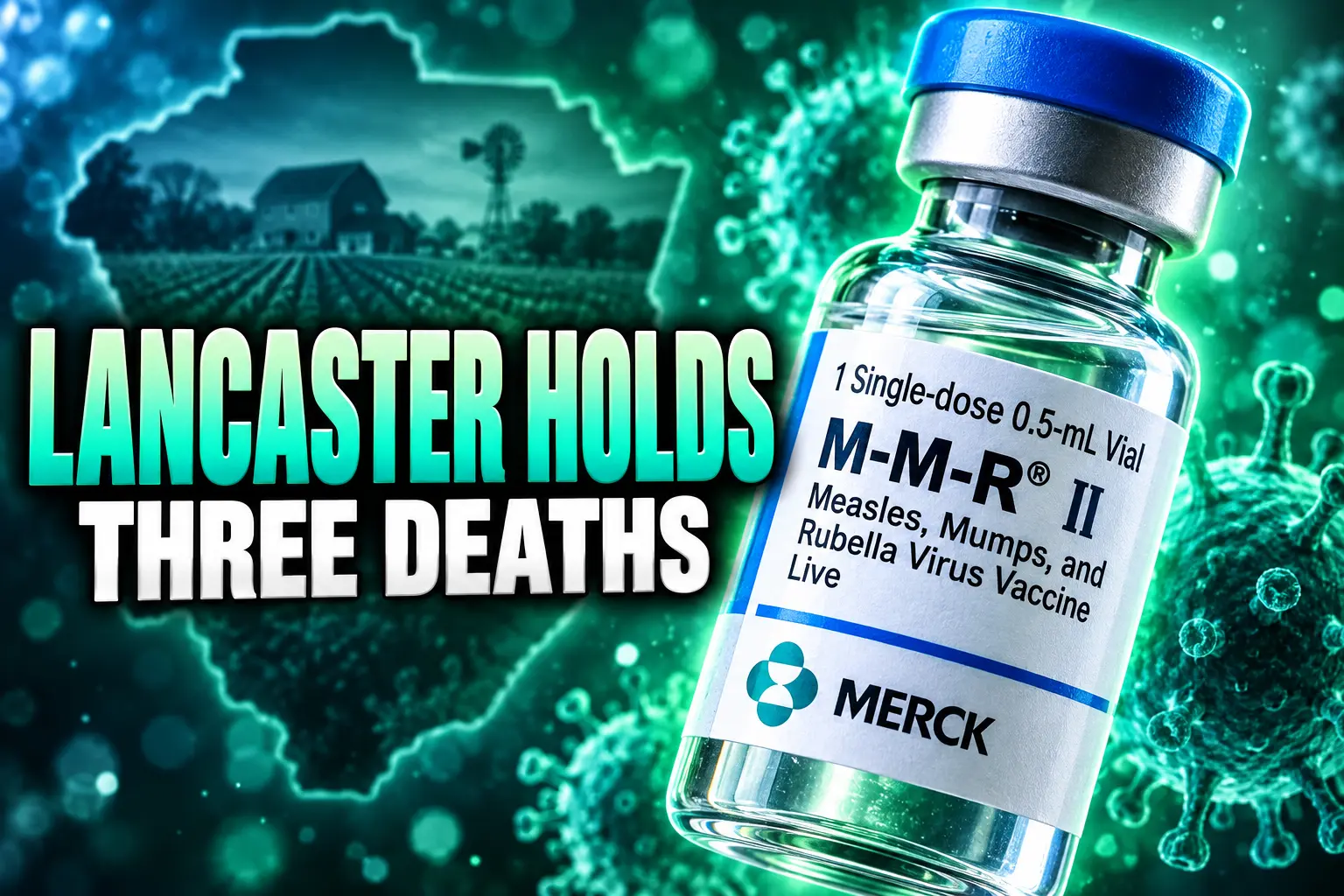
Pennsylvania reported a fifth measles-associated death on September 30, an unvaccinated Lancaster County resident, as confirmed cases in the state reached 977. Lancaster County now holds three of those five deaths and 391 of the infections.
The people dying are not a random slice of Pennsylvania. They are infants too young for measles shots, a young woman whose cancer treatment blocked the vaccine, and neighbors in counties where school coverage sits well under the 95% line that stops measles from chaining.
Lancaster County Holds Three of Five Deaths
The Pennsylvania Department of Health told the Centers for Disease Control and Prevention on September 30 that an unvaccinated Lancaster County resident with a confirmed measles infection had died. The department released no age, no date of death, and no name, citing privacy law. Lancaster County Coroner Dr. Stephen Diamantoni said his office had not handled the case and had been given no details.
That notice was the third measles-linked death the state has placed in Lancaster County since August, and the first measles-associated deaths Pennsylvania has recorded in 35 years. Mifflin County, in the center of the state, and Jefferson County, in the west, each recorded one. All five people were unvaccinated, the health department said, including two infants who were too young for the shots under current recommendations.
THE FIVE DEATHS PENNSYLVANIA HAS LOGGED
- August 14, 2026: Newborn Ivan Miller of Quarryville is born and dies the same day of a ruptured spleen and tests positive for measles; Diamantoni does not list measles as the cause, while the state still counts a measles-associated death.
- August 18, 2026: Six-week-old Mary Stoltzfus of Peach Bottom, who had Amish lethal microcephaly, dies at home; Diamantoni later says measles was the cause.
- September 11, 2026: An 18-year-old Amish woman in Mifflin County dies at home of acute disseminated encephalomyelitis, a brain and spinal-cord complication of measles, her county coroner said.
- Mid-September 2026: A 40-year-old woman in Jefferson County with chronic obstructive pulmonary disease, already on oxygen, dies of respiratory failure that her county coroner tied to measles.
- September 30, 2026: The state reports a fifth measles-associated death in an unvaccinated Lancaster County resident and withholds further identifying facts.
On the day of that fifth notice, the state listed 943 confirmed cases across 39 counties and 176 hospital stays. By the afternoon of October 2, those figures had moved to 977 cases and 195 people in hospital, with 102 of the infections recorded in the prior week. About 20% of the October 2 case list had been hospitalized. Measles still kills about one to three patients per 1,000 cases, the department said, and the virus can hang in air and on surfaces for two hours after a sick person leaves a room.
The People Who Could Not Get the Shot
Two of the Lancaster deaths were babies. Diamantoni said Amish lethal microcephaly, the condition Mary Stoltzfus had, occurs in about one in 500 Amish births and is rare outside those families. Children with it are often on palliative care from birth and usually die within months, often after a respiratory infection, because the brain is small and fights viruses poorly. He still listed measles as her cause of death.
The newborn boy is the case that later fed a national argument about counting. Diamantoni said a lacerated spleen killed Ivan Miller. State health officials have described a measles-associated death anyway, noting that measles can enlarge the spleen and make it easier to rupture. Nobody has disputed that the infant tested positive.
A Lancaster County family described a third kind of victim after the September 30 notice. A grandmother said her 20-year-old granddaughter, newly married and in treatment for leukemia, was the last of nine siblings to fall ill when measles moved through their unvaccinated house on a one-lane road. The young woman asked for the measles, mumps, and rubella vaccine. Her doctor said she could not have it because the cancer treatment had weakened her immune system.
Home remedies that helped her siblings, bath soaks for fever, oil on the rash, a dark room for light sensitivity, did not hold. The family does not drive, so they hired a driver to Hershey Medical Center, about an hour away. She developed double pneumonia, spent about two weeks in intensive care, and died after the family stopped the ventilator.
Her immune system wasn’t built up. She just couldn’t take it with the measles.
Maternal grandmother of a 20-year-old Lancaster County woman, speaking on her farmhouse porch
The health department has not identified the fifth death as that young woman. The grandmother’s account matches the state’s only public facts, an unvaccinated Lancaster County resident, in time and place. The 18-year-old in Mifflin County was, her father said, “a perfectly healthy, fun-loving girl.” He brought her home from the hospital, and she died in the farmhouse where she grew up.
What Lancaster County’s Measles Vaccine Rates Show
Measles needs about 95% coverage to stop sustained spread. Lancaster County’s schools are not near that line in the grades that matter most. In the 2025-26 school year, kindergarten measles coverage in the county was 87.6%, 7.4 points under the threshold. Seventh graders sat at 83.3%. Twelfth graders reached 94.9%, a tenth of a point short.
Across the three grades Pennsylvania requires schools to report, 15,709 of 17,794 Lancaster County students, 88.3%, were vaccinated for measles. Only rural Mifflin County, at 86.1%, and Fulton County, at 87.4%, posted lower metro-comparable rates. Mifflin is also the county that recorded the 18-year-old’s death.
MEASLES SHOT RATES AGAINST THE 95% LINE
| Place | Group | Coverage |
|---|---|---|
| Lancaster County | Kindergarten, 2025-26 | 87.6% |
| Lancaster County | Seventh grade | 83.3% |
| Lancaster County | Twelfth grade | 94.9% |
| United States | Kindergarten MMR | 92.4% |
| Herd-immunity line | Measles | 95% |
National kindergarten MMR coverage for 2025-26 was 92.4%, down a tenth of a point from the year before and down from about 95% in 2019-20. About 280,000 kindergarteners lacked documented completion of the two-dose series. Exemptions from one or more school shots rose to 4.2% from 3.6%, about 155,000 children. Andrew D. Racine, president of the American Academy of Pediatrics, said more than a quarter of a million children started kindergarten last year without protection from the MMR vaccine.
The county average hides schools that are far lower. Weavertown Mennonite School reported just over one-quarter of a 23-student kindergarten class vaccinated for measles. Ephrata Mennonite School’s kindergarten rate was 33.3% last year, and two of its students later became sick. Kathy Pringle, with Lancaster General Health’s community clinics that have served Plain families for 30 years, said the idea that Amish and Mennonite households never vaccinate is false, and that about 80% of patients in those clinics come from the Plain community. Demand at those clinics has risen as the outbreak has grown.
Clinics Doubled September’s Usual MMR Doses
The state’s own numbers show a scramble for shots after the outbreak took hold in late April. In a typical month, Pennsylvania providers give about 25,000 MMR doses. They gave more than 49,000 in August and more than 53,000 in September, more than double the usual monthly load. Two doses still give 97% lifetime protection, the department said, and people with two documented doses do not need another.
THE STATE’S SHOT SURGE
- Pop-up clinics: Staff have given more than 5,500 MMR doses at 180 pop-up clinics in affected communities since late April.
- State nurses: Pop-up sites and state health centers together have given more than 8,500 MMR doses in 2026.
- September volume: Providers statewide gave more than 53,000 MMR doses, against about 25,000 in a typical month.
- Vaccinated cases: Only 4 of 943 infections on the September 30 update were in vaccinated people, less than 1%.
On October 2, 31% of Pennsylvania’s cases were in people under 18, and Lancaster County added 32 infections in a week, taking its total to 391. That is 40% of the state’s 977 cases in one county. The department’s public cases, hospital stays, and deaths board is the running tally, and daily figures still move.
The national picture is larger and still unfinished. CDC, updating on October 2 with data as of October 1, listed 3,887 confirmed measles cases in 2026, already 1,598 above the 2,289 recorded in all of 2025, which itself had been the recent high. Of this year’s cases, 3,700, or 95%, are tied to outbreaks, 2,316 from chains that started in 2026 and 1,384 from outbreaks that began in 2025. Forty-two outbreaks have been counted this year. In 2024 the country had 16 outbreaks and 285 cases.
Age splits on the CDC list show 683 patients under 5 (18%), 1,652 ages 5 to 19 (43%), and 1,533 ages 20 and older (39%). Vaccination status is 95% unvaccinated or unknown, 2% with one MMR dose, and 3% with two. Hospital stays are 9% nationally, 352 of 3,887, lower than Pennsylvania’s share. South Carolina (670) and Utah (535) are the next-largest state counts on the CDC table after Pennsylvania.
How Pennsylvania and CDC Count Measles Deaths
The louder problem now is that Harrisburg and Atlanta are publishing two death totals for the same outbreak. Pennsylvania says five residents meet its measles-associated definition. CDC’s public table still lists two U.S. measles deaths in 2026 and three in 2025. Those are not figures to add together. They are different tests applied to overlapping tragedies.
Pennsylvania treats a death as measles-associated when lab or outbreak evidence of measles is present, even if a coroner does not call measles the immediate cause, and when a person with a confirmed infection dies within 30 days of symptoms from something other than an unrelated event such as a crash. CDC shifted this year toward National Center for Health Statistics records that list measles as the underlying cause on a death certificate, and it is working with the Council of State and Territorial Epidemiologists on a single definition.
WHAT WE KNOW
- State count: Pennsylvania has reported five measles-associated deaths since August, all in unvaccinated people, three of them in Lancaster County.
- Federal count: CDC’s table shows two measles deaths in 2026, with a note that the number can change as reviews finish.
- Coroner split: Diamantoni has confirmed measles as the cause for the six-week-old girl and has not assigned measles as the cause for the newborn with a ruptured spleen.
WHAT IS UNCONFIRMED
- Fifth death: The September 30 Lancaster County resident has not been publicly identified by the state, and the local coroner says he does not have the case.
- Certificate lag: Whether NCHS will list measles as the underlying cause on each Pennsylvania certificate is still open.
- National overlap: CDC has not said whether either of its two 2026 deaths is a Pennsylvania resident.
HHS Secretary Robert F. Kennedy Jr. first called Pennsylvania’s August notices premature and suggested the deaths might have been fabricated, then later recognized measles in the second infant’s death. Gov. Josh Shapiro accused Kennedy of sowing doubt and of pressing CDC not to post the deaths. Emily Hilliard, an HHS spokesperson, said after the fifth death, “We are deeply saddened to hear of another death in Pennsylvania,” and that Kennedy and CDC Director Erica Schwartz “continue to recommend the MMR vaccine as the most effective way to prevent measles infection.”
A parent who opens the federal page still sees two U.S. measles deaths. A parent who opens the Pennsylvania board sees five. The newborn spleen case is why that gap exists, and why “measles-associated” and “underlying cause” are not interchangeable labels.
The November Elimination Test After Canada
The United States eliminated endemic measles in 2000 by keeping coverage high. That designation is now on a calendar. The Pan American Health Organization said on March 2 that the November review of measles elimination for the United States and Mexico will take place at the regular meeting of the Regional Verification Commission. The analysis window for possible re-established endemic transmission runs one year from outbreak onset, January 20, 2025, in the United States and February 1, 2025, in Mexico.
Endemic transmission, under the commission’s rules, means uninterrupted circulation of the same virus genotype for 12 months or more in a defined area. In November 2025 the Americas already lost regional measles-free status after the commission found that endemic transmission had been re-established in Canada. Under that framework, one country is enough to take the regional mark down.
Noel T. Brewer, who chairs the U.S. committee that reviews CDC’s annual measles report before it goes to PAHO, has said the public case counts look like a runaway train and that a Utah chain apparently lasting more than 12 months is among the facts the November meeting will have to weigh. Genome sequencing and whether 2025 and 2026 are one domestic lineage or a stack of separate importations will decide the technical question. Lancaster County’s deaths will not, by themselves, decide it. They show what a coverage hole does while that file is being built.
On a farm at the edge of suburban Philadelphia, a grandmother said the headstone had not yet been placed on a fresh grave in the clover. Nine siblings in one unvaccinated house got measles. The one who asked for the shot, and could not have it, is the one who did not come home.
Disclaimer: This article is news reporting on a measles outbreak and related public-health data, and it is for information only. It is not medical advice, a diagnosis, or a personal recommendation about vaccines, exposure, or treatment. Anyone who may have been exposed to measles, who is unsure about MMR doses, or who is making decisions for a child or a person with a weakened immune system should speak with a licensed physician or a local health department before acting. Case counts, death classifications, school coverage figures, and elimination-status reviews change as Pennsylvania, CDC, and PAHO update their records.

Congo’s 4,018 Ebola Deaths Rest on a Breaking Count

Lancaster County Bears Three of Pennsylvania’s Five Measles Deaths

Australopithecus Sediba Arrived After Homo Already Lived

The Hormuz Rebound Is Why Physical Brent Stays High

Google Holds Gemini 4 Argon for Vetted Cyber Defenders

Boston Scientific Cyberattack Leaves Hospitals Waiting on Implants

Guizhou Cave Cafes Spread When Each Cavern Fills

Satellites Saw Nepal’s Ice Slope Move Before the Flood

The Second Ned Stark Kit Lands When a Banner Dies

OpenAI’s Jalapeño Chip Turns Watts Into Faster Agent Steps
-
 NEWS1 month ago
Boston Scientific Cyberattack Leaves Hospitals Waiting on Implants
-
 NEWS2 months ago
Guizhou Cave Cafes Spread When Each Cavern Fills
-
 NEWS4 weeks ago
Satellites Saw Nepal’s Ice Slope Move Before the Flood
-
 GAMING1 month ago
The Second Ned Stark Kit Lands When a Banner Dies
-
 NEWS1 month ago
OpenAI’s Jalapeño Chip Turns Watts Into Faster Agent Steps
-

 NEWS1 month ago
Roman Space Telescope Launches After a Decade-Long Budget Bet
-

 NEWS1 month ago
MLB Quiet Periods Copy a Freeze Other Leagues Use
-

 NEWS2 months ago
Pere Marquette Freezes Data Centers on a Power-Rich Shore