
BUSINESS
Nestlé’s KitKat Wheat Deal Leaves Pesticide Cuts Behind
Nestlé now runs 51% regenerative wheat through York KitKats, while FAIRR finds no pesticide-cut targets and farmer pay stuck at 0.01% to 0.05% of revenue.

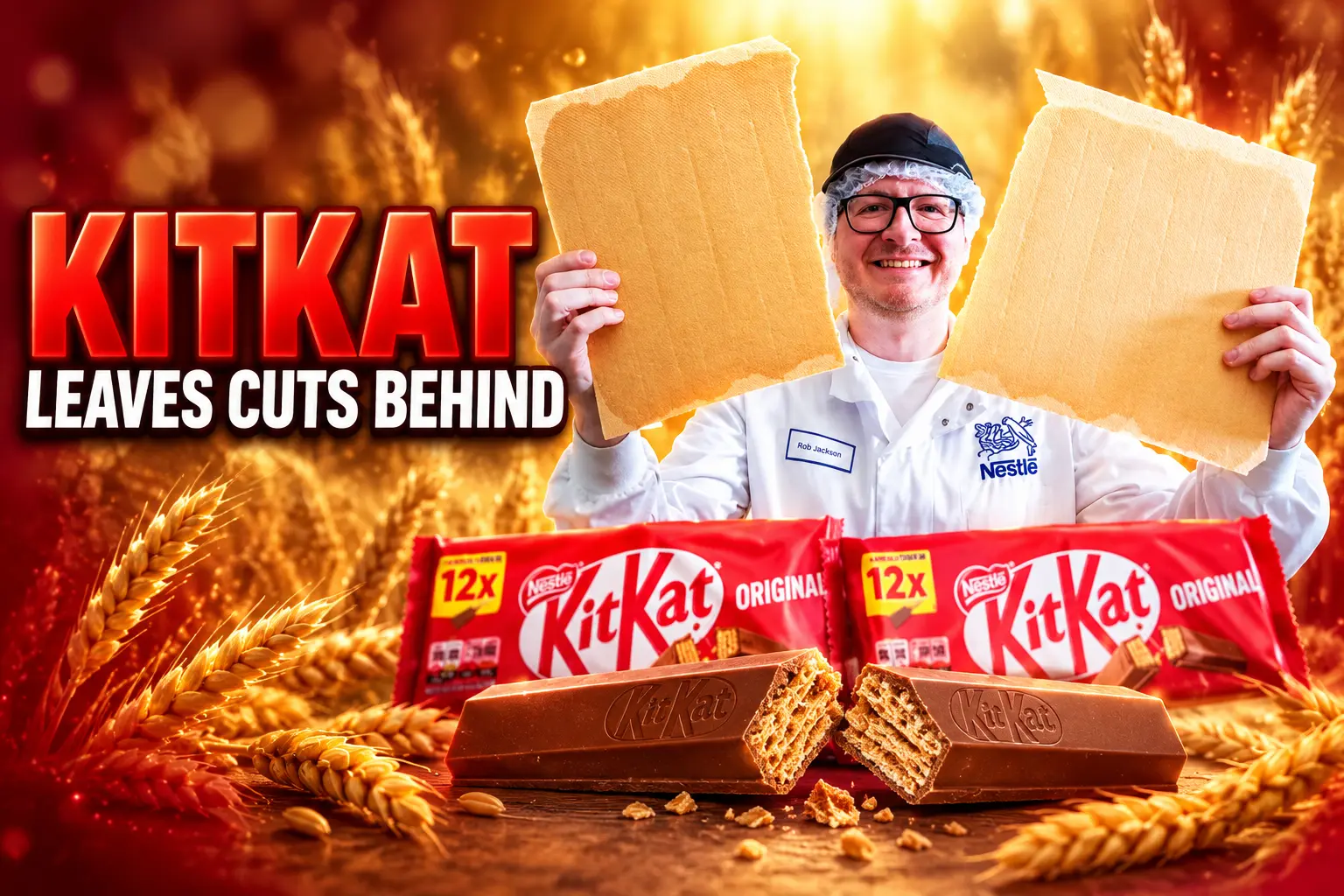
Nestlé is running regenerative wheat through 51% of the grain in the 1.5 billion KitKat bars made each year in York. The bars keep the same snap, the same red wrapper, and no new farming claim on pack.
The wheat comes from Wildfarmed’s British growers after factory trials in 2025. That is real volume on a real line, not a 2030 slide. The harder question is what that volume actually changes, because the practices food companies are scaling still lean on herbicides, farmer pay is tiny, and the KitKat will not tell anyone in the aisle.
Food Companies Cut Quantified Regenerative Targets to 28%
The FAIRR investor network, which says it speaks for members with $95 trillion in assets, published Regenerative Agriculture: Moving from Ambition to Credibility on June 29, 2026. It scored 78 listed agri-food companies with $3.3 trillion in combined revenue and a $5.7 trillion market cap, using disclosures available as of April 30, 2026, and comparing them with FAIRR’s 2023 study.
Fifty of those 78 firms, or 64%, now mention regenerative agriculture, up from 63% in 2023. Talk held. The share with quantified targets did not. That figure fell from 35% in 2023 to 28% in 2026. Compass and JBS dropped or heavily revised earlier targets. Six companies, among them Sodexo and Yum! Brands, no longer mention regenerative agriculture in public disclosures.
THE FAIRR SCOREBOARD, 2023 TO 2026
| Measure | 2023 | 2026 |
|---|---|---|
| Firms that mention regenerative agriculture | 63% | 64% (50 of 78) |
| Quantified regenerative targets | 35% | 28% |
| Say they measure outcomes | 16% | 54% |
| Outcome-based targets | n/a | 4% |
| Link regenerative farming to Scope 3 goals | 24% | 52% |
| Report greenhouse gas progress on the programmes | n/a | 24% |
| Pesticide-cut target inside regen programmes | n/a | 0 |
Measurement looks better on paper. Fifty-four percent now say they measure outcomes, up from 16%. Fifty-two percent tie regenerative farming to Scope 3 emissions goals, up from 24%. Only 4% have set outcome-based targets, meaning a goal for soil, water, wildlife, or chemicals rather than a count of acres or tonnes. Even on greenhouse gases, the easiest outcome to report, only 24% publish progress.
FAIRR flags Carrefour for treating soil, wildlife, water, climate resilience, and wages as financially material, General Mills for saying clearly what its programme covers, and PepsiCo for paying farmers against outcomes. Those are the exceptions the network itself names. María Montosa Ródenas, a FAIRR technical specialist on nature, put the gap in one brief.
Regenerative agriculture has real potential to help agri-food companies build resilience against climate and nature-related risks. But potential is not the same as progress. Our research shows that corporate strategies remain fragmented and under-resourced. The pesticide contradiction at the heart of many programmes is particularly striking: companies cannot credibly claim to be restoring nature while deploying practices that undermine that goal.
María Montosa Ródenas, technical specialist, FAIRR
The Herbicide Trap Inside Cover Crops and No-Till
Fifty-two percent of the companies list cutting agrochemicals as a goal. None has set a no pesticide reduction target at all inside its regenerative programme. Only Conagra Brands, Danone, Nestlé, and Sysco even measure herbicide use in those programmes.
The practices they are rolling out still need the spray gun if they are used alone. Cover crops show up at 68% of companies. Reduced or no-till farming shows up at 58%. Both can depend on herbicides to kill the cover or to handle weeds once the plough stays in the shed. Arthur van Mansvelt, senior engagement specialist at Achmea Investment Management, said investors are still struggling to judge whether the initiatives are credible, and that farmers need fair pay for the extra work and risk.
Programmes also cluster on the easy crops. Seventy percent of companies aim to roll regenerative farming through vegetables, fruit, and other crops. Only 10% say they will take it into pork and poultry. Ninety-six percent of firms that mention regenerative agriculture already treat climate as a financial risk, and 68% say the same of water. The missing piece is not another soil slide. It is a chemical number they are willing to own.
Wildfarmed Allowed a Targeted Spray for the 2026 Harvest
Wildfarmed is the strict end of the corporate supply, which is why the KitKat contract landed there. Growers follow a published standard: limit soil disturbance, keep the ground covered all year, mix plant types, keep living roots in the soil, and cap nitrogen at 80 kg per hectare. Insecticides are banned. Fungicides are banned except for a derogation when there is a proven risk of losing the whole crop. Franco Manca, Marks and Spencer, Ask Italian, and East Pizzas sit among about 1,000 customers. KitKat is the largest break.
The 2026 harvest standard moved. Wildfarmed says mechanical weeding means heavy kit, broken soil, and bare earth, so it now allows a targeted herbicide early in the growing season instead. The company declined to share outcome data on that choice. That is the same chemical hole FAIRR found across the 78-firm set, appearing inside a mill that otherwise bans insecticides and fungicides.
WILDFARMED RULES GROWERS HAD TO MEET
- Nitrogen cap: Nutrition is based on plant tests, with a maximum of 80 kg of nitrogen per hectare.
- Insecticides: None, because the system is built around insects as the base of the field food web.
- Fungicides: None, unless a grower can prove a risk of total crop loss and wins a derogation.
- Herbicides: A targeted early-season pass was added for the 2026 harvest as an alternative to mechanical weeding.
- Field cover: Year-round cover, plant diversity, living roots, and less soil disturbance remain the core.
Andy Cato, a Wildfarmed co-founder, was asked at Groundswell whether any business could use the grain. He said yes. The first line on the office wall, he said, was “The Long Road to Greggs.” The point was landscape change at scale, whether the wheat ended in a loaf, a pint, or a biscuit. Edd Lees, the other co-founder, said nature has been priced at zero for too long, and that farmers were pushed to chase yield at the expense of soil, wildlife, and resilience.
Dr Emma Keller, head of sustainability at Nestlé UK and Ireland, said the taste and snap would not change and that the work was about supporting British growers through practices meant to cut carbon and lift wildlife. Nestlé told buyers it wants the blend to rise over time, and that 51% lets it hold supply, quality, and quantity while it tests the line. The other 49% of the wheat still comes from existing suppliers.
A Drop in New Regenerative Farmers After 2021
Forty percent of the FAIRR companies that mention regenerative agriculture give farmers some money, including price premiums. The spend sits at 0.01% to 0.05% of revenue. Transparency on what actually reaches the farm is poor. On October 1, FAIRR added that among companies reporting on these programmes, only 36% disclose climate metrics, 16% track farmer income, and 14% measure effects on wildlife.
WHERE THE CASH AND THE PEOPLE ARE
- Corporate spend: Farmer support, where it exists, is 0.01% to 0.05% of revenue.
- Who talks about regen: Farmers were 31% of 849 European actors mapped by Wageningen researchers; processors and city HQs take a large share of the rest.
- Who stopped arriving: After a surge from 2016, growth slowed after 2021 and fell in 2023, driven by fewer new farmers.
- Harmful subsidies still dwarf this: FAIRR cites almost $500 billion a year in agricultural support it calls environmentally or socially harmful.
Researchers including Loekie Schreefel of Wageningen University, writing in npj Sustainable Agriculture on November 5, 2025, reviewed 849 websites and interviewed 131 farmers in Germany, the Netherlands, France, Spain, and Portugal. They found a grassroots farming idea that non-farming actors took over around 2020. After 2021, new regenerative farmers declined. Cover crops and crop diversity dominated nearly 5,000 cited practices. Spain had more than 250 of the actors. Capitals packed in company HQs, banks, and NGOs, including names such as Cargill and Unilever.
Charlie Angelakos, vice president for sustainability at McCain Foods, has described that firm’s support as an assured-supply plan, not only a climate plan, with almost 50% of its growers eligible for finance, guarantees, incentives, or longer contracts. That is a clearer offer than most of the FAIRR set publishes. It still leaves the typical grower funding a yield dip, new kit, and a learning year on a corporate rounding error.
Shoppers Want Fewer Chemicals, Not a New Farming Word
Kiss the Ground, a U.S. nonprofit, surveyed more than 2,000 American adults and found working understanding of regenerative agriculture at 4% in 2023, 7% in 2025, and 13% in its 2026 poll. One in four had heard “regenerative farming.” Among those who knew the term, 37% called themselves very or extremely familiar. Health benefits at 72% and freshness at 76% beat environmental concern at 32% for three years running. Forty-five percent said they do not buy because they do not know enough; 12% blamed price. Thirty percent named extra nutrients as a top shopping aim.
EIT Food’s Consumer Observatory, working with Dutch retailer Jumbo and Ibiza’s Juntos Farm, published Making Agriculture Matter on July 6, 2026. Seventy people sat in the first round, then three groups of 15 tested product stories. Shoppers thought farming should improve. “Resilient” and “regenerative” did not move them on their own. They responded to health, taste, naturalness, fewer synthetic inputs, and proof they could check. Cutting or dropping synthetic pesticides and fertilisers was the piece that hit closest to home.
That is why an unlabeled KitKat is a weak consumer test. Ivo Degn, founder of Re:source, argues the word regenerative should stay off packs even if the definition tightens, because it muddies the wider sustainability aisle. Gill Wilson, an adjunct professor of sustainable marketing at IE Business School in Madrid, said firms of Nestlé’s size are needed for scale, then asked how the change would be told. Nestlé chose not to tell it on the bar. The factory change is real. The shopper still meets the same wrapper.
Alice English and Rebecca Tobi, in a November paper, described a health halo when regenerative ingredients land in chocolate bars and pizzas. One farmer-facing question follows the wheat into the wafer: what is the point of rebuilding soil to grow a denser grain, then putting it in a product people already file under treats? Cato’s answer is that how a crop is grown and what it becomes are separate jobs. Plenty of growers do not buy that split.
Green Claims Rules Keep Regenerative Off the Wrapper
Chris Hilson, professor of environmental law at the University of Reading, warned of a large legal risk if Nestlé printed a regenerative claim on KitKat. Only 51% of the wheat is in the programme. The bar would have to say so, which he called a marketing own-goal, because buyers would ask about the rest. New green-claims rules in Europe make that caution rational. Experts who chewed over the silence noted Nestlé leaned on press coverage instead of the pack.
Friends of the Earth U.S. reviewed ten labeling schemes on May 5, 2026, and found a patchwork. Sarah Starman, a senior campaigner there, said shoppers may assume regenerative means no toxic pesticides, and that some programmes still allow synthetics tied to cancer, hormone disruption, infertility, and nerve harm. USDA Organic, Regenerative Organic Certified, and Real Organic Project scored best on chemicals, soil rules, and checks. Organic bars more than 900 synthetic pesticides. Regenified’s grain rule, by contrast, is that chemical pesticides cannot be applied within 21 days of harvest.
WHAT THE STRICTER LABELS REQUIRE
- USDA Organic: Bans synthetic fertilisers and more than 900 synthetic pesticides, with federal enforcement.
- Regenerative Organic Certified and Real Organic Project: Build on organic, then add extra soil and livestock rules.
- Weaker regen seals: Several still allow broad agrochemical use, so the word on a pack does not mean the spray boom is gone.
Nestlé’s own score moved in two directions at once. Its 2025 non-financial statement put key ingredients from farmers using regenerative practices at 27.6%, up from 6.8% in 2022, after the word appeared 208 times in a 59-page 2021 sustainability report and almost 100 times in the 2025 statement. In the first half of 2026 the company changed method, converting volumes back to a fresh state and tightening the ingredient list. The nature page now states 20.7% for 2025 under that method. Both figures describe 2025. They are not the same ruler.
The company still aims to source 50% of key ingredient volumes by 2030 from farmers adopting regenerative practices. In late September it backed the Sustainable Agriculture Initiative Platform’s Regenerating Together Programme with more than 40 other businesses, after pilots in 23 farming systems across 25 countries. Pascal Chapot, Nestlé’s vice president for agriculture, called it a way to apply one practical frame across the chain. A shared protocol can close the definition fight. It does not, by itself, put a pesticide number or a farm cheque on the page.
FAIRR’s October 1 note, written ahead of COP17 in Yerevan, put the private effort against a much larger public ledger: about 34% of the world’s farmland already degraded, $23 trillion in losses possible by 2050 if that holds, and a World Economic Forum estimate of $1.4 trillion in business and 62 million jobs by 2030 if productive regenerative farming scales. The UK’s Environmental Land Management scheme, worth £2 billion, covered 6.1 million hectares, about 69% of England’s utilised agricultural area, as of December 2025. That is the kind of cheque a 0.01% corporate line item cannot match.
York is already running the wheat. The 1.5 billion bars will not say so. Until the firms that copied the language copy the chemical target and the farm payment, regenerative agriculture will keep growing as a sourced tonne and stall as a result you can audit.

AI Ghost Authors Carry Real DOIs Into Scholarly Databases

Unpaid Ebola Tracers Leave Congo’s Case Count Half Blind

Verity Recoups While Digger Becomes Skydance’s First Invoice

Nestlé’s KitKat Wheat Deal Leaves Pesticide Cuts Behind

Congo’s 4,018 Ebola Deaths Rest on a Breaking Count

Boston Scientific Cyberattack Leaves Hospitals Waiting on Implants

Guizhou Cave Cafes Spread When Each Cavern Fills

Satellites Saw Nepal’s Ice Slope Move Before the Flood

The Second Ned Stark Kit Lands When a Banner Dies

OpenAI’s Jalapeño Chip Turns Watts Into Faster Agent Steps
-
 NEWS1 month ago
Boston Scientific Cyberattack Leaves Hospitals Waiting on Implants
-
 NEWS2 months ago
Guizhou Cave Cafes Spread When Each Cavern Fills
-
 NEWS4 weeks ago
Satellites Saw Nepal’s Ice Slope Move Before the Flood
-
 GAMING1 month ago
The Second Ned Stark Kit Lands When a Banner Dies
-
 NEWS1 month ago
OpenAI’s Jalapeño Chip Turns Watts Into Faster Agent Steps
-

 NEWS1 month ago
Roman Space Telescope Launches After a Decade-Long Budget Bet
-

 NEWS1 month ago
MLB Quiet Periods Copy a Freeze Other Leagues Use
-

 BUSINESS1 month ago
The Bank of Korea Bets Chips Can Carry 3% Rates