
BUSINESS
The Bank of Korea Bets Chips Can Carry 3% Rates
Bank of Korea rate hike to 3% rests on a 3.3% growth bet as chip exports soar and household credit hits 2.02 quadrillion won.

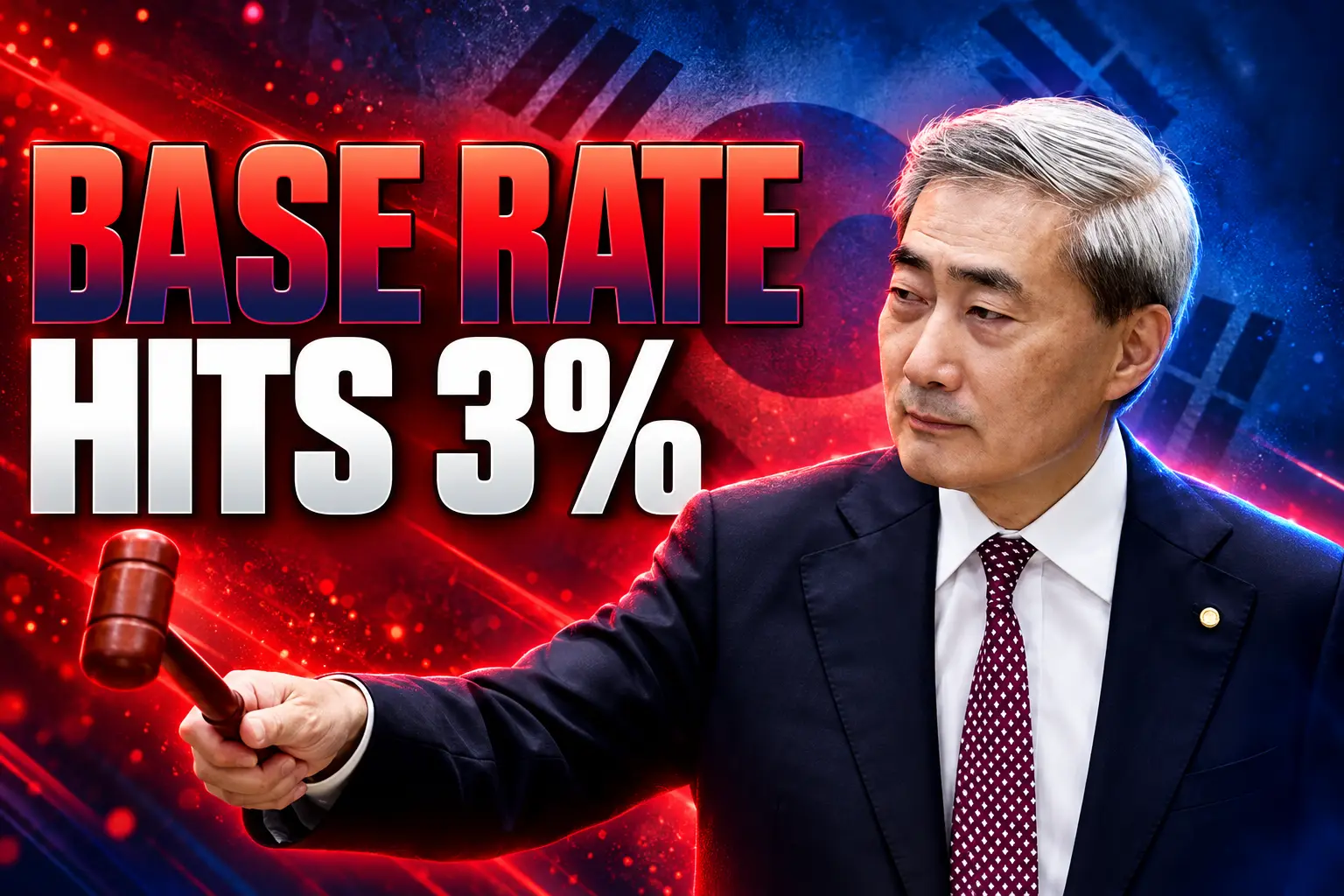
The Bank of Korea lifted its base rate to 3% on Aug. 27, a second straight 25-basis-point increase funded by a chip-led jump in its 2026 growth forecast to 3.3%. Governor Shin Hyun-song is wagering that semiconductor income will keep demand alive while he tries to slow Seoul housing and household borrowing.
Six of seven board members backed him. Hwang Kunil voted to hold at 2.75%. Six days later, August consumer prices printed at 3.1% and core inflation at 3.4%, the first hard test of that wager.
The Bank of Korea’s Wager on a 3.3% Economy
The board’s the Aug. 27 policy decision raised the base rate from 2.75% to 3.00%, the highest since January 2025 and the first consecutive hikes since January 2023. In July the bank had delivered its first increase in three and a half years after cutting a full percentage point between October 2024 and May 2025 and then sitting at 2.50%.
The same meeting lifted the 2026 growth forecast to 3.3% from 2.6% in May, a May number that had already been raised from 2.0%. Next year’s forecast went to 2.9% from 2.1%. First-half growth ran at 3.8%. Shin told reporters the domestic economy is growing faster than expected on strong exports and a recovery in domestic demand, and that inflation will stay above the 2% target for a considerable time.
Most studies show that a proactive policy response can stabilize inflation expectations more quickly than a belated one, thereby reducing the intensity and duration of monetary tightening and ultimately easing the burden on growth.
Shin Hyun-song, Bank of Korea governor, Aug. 27 press conference
He called the consecutive move unprecedented and said it sent a strong signal. Consumer-price forecasts were left at 2.7% this year and 2.3% next year. Core inflation, which strips out food and energy, was raised to 2.5% for both years from 2.4% and 2.3%. July core had already printed at 2.6%, the highest since 2.8% in December 2023.
Of 21 dots on the six-month chart, 10 sat at 3.25%, six at 3.50%, and five at a hold on 3.00%. Shin said board members estimate another rise to 3.25%. He will look at second-quarter nominal GDP and at August and September inflation before the October meeting, which he described as live. The bank left the rate on its SME lending facility unchanged at 1.25%, a narrow valve for smaller firms while the policy rate goes up.
Eighteen of 35 economists had expected the hike, so the call was close. Shin is treating the AI memory cycle as strong enough to hike into, not as a sugar high that fades in a quarter.
August Chip Exports Hit $46.65 Billion
The collateral for that call arrived on Sept. 1. The Ministry of Trade, Industry and Energy and the Korea Customs Service put August exports at $98.255 billion, up 68.7% from a year earlier and the 15th straight month of growth. Semiconductor shipments reached a record $46.65 billion, up 209.0%, and stayed above $40 billion for a third month. Chips were 47.5% of the month’s export bill.
AUGUST TRADE AT A GLANCE
| Item | August 2026 | Change from a year earlier |
|---|---|---|
| Total exports | $98.255 billion | +68.7% |
| Semiconductors | $46.65 billion | +209.0% |
| Computers | $6.24 billion | +419.5% |
| Automobiles | $3.85 billion | -29.8% |
| Trade surplus | $34.748 billion | Up $28.345 billion from a year earlier |
Computers jumped on NAND used in enterprise SSDs. Cars fell 29.8% to $3.85 billion on summer shutdowns and partial strikes, a reminder that the boom is narrow. Cumulative exports from January to August reached $693.318 billion, or 97.7% of last year’s $709.47 billion full-year total. The government still talks about a $1 trillion year.
Trade Minister Kim Jeong-kwan said protectionism, including U.S. tariff policy and the EU’s low-tariff quota on steel, makes the business climate more uncertain than ever, and that Seoul will not get complacent. Analysts asking how far the export rally can run keep coming back to the same concentration: memory prices and hyperscaler capex, not a broad factory upswing. July customs figures showed large-firm chip shipments up 228.3% while mid-sized chip shipments fell 13.4%.
Households Now Owe 2.02 Quadrillion Won
The people who pay for a 3% rate already borrowed through the boom. Preliminary Bank of Korea figures put household credit at 2.02 quadrillion won (about $1.4 trillion) at the end of June, the first time the stock has crossed that line. The balance rose 25.9 trillion won in the second quarter, the largest quarterly jump since the third quarter of 2021.
HOW Q2 HOUSEHOLD CREDIT MOVED
- Household loans: Up 24.9 trillion won to 1.89 quadrillion won, also the biggest quarterly rise since the third quarter of 2021.
- Housing-related loans: Up 12.2 trillion won, faster than the 8.1 trillion won increase in the first quarter, as more homes changed hands.
- Other loans: Up 12.8 trillion won, more than double the 5.4 trillion won first-quarter rise, including unsecured credit and stock-backed borrowing.
- Merchandise credit: Up 900 billion won, with personal card spending at 208.3 trillion won.
Kim Seong-jun, who heads the bank’s financial statistics team, said the housing jump came as transactions rose before a capital-gains tax exemption expired, and as group loans on already-sold homes increased. Other loans outpaced housing loans for the first time since the second quarter of 2021, a burst of debt-financed stock buying known locally as bit-tu. The bank expects that channel to slow after the July market drop.
The household debt-to-GDP ratio still fell to 85.3% in the first quarter from 88.1% at the end of last year, because nominal GDP grew faster than the debt stock. That is the chip boom doing denominator work, not families paying down principal. The government’s aim is a ratio below 80% by 2030. End-2025 BIS figures put the United States at 68.1%, the United Kingdom at 73.6%, Japan at 61.1%, and France at 59.7%. New bank mortgages averaged 4.36% in June, the highest since 4.48% in November 2023. On Aug. 13 the Financial Services Commission raised its household-loan growth cap to 3% from 1.5%, a looser supervisory target sitting next to a tighter policy rate. The bank’s own borrower-level household debt statistics are the series officials use to watch who is carrying that load.
Why Hwang Kunil Voted to Keep 2.75%
Hwang was the only member who wanted the rate left at 2.75%. It was the first dissent for a hold on a hike since January 2023. The official statement does not spell out his argument, but the board itself listed the uncertainties he would have been staring at: how far the semiconductor sector expands, how much of that income spills into domestic demand, the Middle East, and the trade environment.
THE RATE PATH BACK TO 3%
- October 2024 to May 2025: The bank cuts the base rate by a full percentage point, ending at 2.50%.
- May 2025 to May 2026: The rate stays at 2.50% through eight meetings.
- July 2026: A unanimous 25-basis-point rise to 2.75%, the first hike in three and a half years.
- August 27, 2026: A 6-1 rise to 3.00%, with Hwang Kunil voting to hold.
- October 2026: The next live meeting, after Shin said the board must first judge the two consecutive moves.
Shin said a gradual pace is expected over the next six months and that the path is not preset. The SME facility held at 1.25% is the board’s concession to firms that do not ship high-bandwidth memory. If the chip spillover into wages is slower than the growth forecast implies, Hwang’s hold is the vote that ages better.
Shin Says the Won Is Still Very Weak
The won had already done a lot of the bank’s work before the gavel. It had sunk to about 1,550 per dollar in late June, a 17-year low, as foreign investors sold Korean stocks. By the week of the decision it was around 1,380, with the dollar-won rate moving from 1,424.0 at the end of July to 1,380.9 on Thursday. Shin still wanted more.
The won-dollar rate has stabilized to a large extent, but historically, the won is still very weak. A stronger won is desirable as it would help curb mounting inflation through lowering import prices.
Shin Hyun-song, Bank of Korea governor, Aug. 27 press conference
The upper bound on the U.S. federal funds rate is 3.75%, so the Korea-U.S. gap narrowed to 0.75 percentage point from 1 point. That 25-basis-point squeeze is aimed as much at keeping the won from sliding back toward 1,550 as it is at a Seoul mortgage. A cheaper won would push imported oil back through the CPI, which is the channel Shin is trying to close.
The KOSPI had already shown how violent the chip trade can be. The index fell 22.2% in July, its worst month since October 2008, and the KOSDAQ dropped 21.4%. Some 1,859 of 2,645 listed stocks finished the month lower. On July 31 the KOSPI jumped 17.91% to 6,595.45, its largest one-day gain on record, after an overnight rebound in U.S. tech. By early September the index was still up more than 60% for the year. Leveraged chip funds had shed close to $1 billion around the July washout. Shin is hiking into that whiplash, not into a quiet market.
Seoul Apartment Prices Keep Climbing
Housing is the financial-stability half of the bet, and it had not rolled over when the board met. The Korea Real Estate Board’s transaction index for Seoul apartments rose 2.50% in June from May, the steepest monthly gain since June 2021’s 2.44%, and was up 13.79% from a year earlier. The official statement said prices in Seoul and its surrounding areas continued to increase at a high pace and that household loans also increased substantially.
SEOUL HOUSING INTO THE HIKE
- June transactions: Seoul apartment prices up 2.50% on the month and 13.79% on the year, per the city’s reading of the Korea Real Estate Board index.
- KB August survey: Seoul apartments up 1.14% on the month, with the average sale price at 1.61 billion won for the first time.
- Week to Aug. 24: Seoul sale prices up 0.29%, led by northern districts, while Gangnam-gu fell 0.11% and Seocho-gu slipped 0.05%.
Jungnang-gu led the KB August gain at 2.25%. Shin said a preemptive rise would help moderate the recent increases in Seoul-area housing and the growth in household debt. Chip bonuses and a tight jeonse market have been feeding the same bid. The weekly figures out on the day of the decision still showed Seoul rising. The rate move is trying to get in front of a market that has not yet taken the hint.
What the 3.1% August Print Does to the Bet
The first data after the hike did not give Shin a clean win. The Ministry of Data and Statistics said consumer prices rose 3.1% in August from a year earlier, up from 2.8% in July, though that was short of a 3.2% economist forecast. The monthly index rose 0.2% after a 0.2% fall in July. Core inflation, the series the bank watches for the future path, jumped to 3.4%, the highest since 3.8% in May 2023.
PRICES BEFORE AND AFTER THE HIKE
- Headline CPI: 2.8% in July, then 3.1% in August, against a 2% target and a 2.7% full-year forecast.
- Core CPI: 2.6% in July, then 3.4% in August, against a 2.5% forecast for this year and next.
- Fuel: Oil prices up 14.2% on the year in August, diesel up 19.6%, gasoline up 11.5%, contributing 0.54 percentage point to the headline.
- Mobile fees: Phone service charges up 26.7% on a low base from SK Telecom discounts after last year’s data breach.
May and June headlines had been 3.1% and 3.2%. July’s dip to 2.8% was the reading the board had in hand on Aug. 27. August put prices back above 3% before Shin’s October meeting, and the core jump is larger than the mobile-fee base effect alone would suggest. Fresh food fell 6.7%; services rose 3.7%. Demand from chip-sector incomes is the piece of that print the bank cannot blame on Iran or on a one-off telecom discount.
Shin said he needs to see whether two consecutive hikes are biting. August chips just set another record, so the growth side of the wager is still intact. The price side is running hotter than the 2.5% core path the board published the day it voted. Households sitting on 2.02 quadrillion won of credit will feel 3% money on the mortgage before they feel a semiconductor bonus in the pay packet. October is live because that gap is the bet.
Disclaimer: This article is news reporting and analysis of Bank of Korea policy, trade figures and household-credit data, and it is for information only. It is not investment, banking, mortgage or foreign-exchange advice and should not be used to decide on deposits, loans, housing purchases or securities. Readers who may change borrowing, saving or investment plans after a rate move should consult a licensed financial adviser, mortgage broker or certified public accountant who can review their own contracts and income. The rates, forecasts, prices and debt stocks cited here reflect official and market sources as of Sept. 2, 2026, and will change with later prints and with the October policy meeting.

Saks Kept 15 Stores While Rivals Took the Shoppers

Fallout Season 3 Spend Hits California’s $42 Million Cap

Ebola Outran Congo’s Contact Lists and Reached Nairobi

Jagex Builds RuneScape 4 Beside the Games Players Already Have

SimpL Bets €1.2 Million on Meetings Paid When Held

Boston Scientific Cyberattack Leaves Hospitals Waiting on Implants

Guizhou Cave Cafes Spread When Each Cavern Fills

The Second Ned Stark Kit Lands When a Banner Dies

Satellites Saw Nepal’s Ice Slope Move Before the Flood

OpenAI’s Jalapeño Chip Turns Watts Into Faster Agent Steps
-
 NEWS1 month ago
Boston Scientific Cyberattack Leaves Hospitals Waiting on Implants
-
 NEWS2 months ago
Guizhou Cave Cafes Spread When Each Cavern Fills
-
 GAMING1 month ago
The Second Ned Stark Kit Lands When a Banner Dies
-
 NEWS4 weeks ago
Satellites Saw Nepal’s Ice Slope Move Before the Flood
-
 NEWS1 month ago
OpenAI’s Jalapeño Chip Turns Watts Into Faster Agent Steps
-

 NEWS1 month ago
Roman Space Telescope Launches After a Decade-Long Budget Bet
-

 NEWS1 month ago
MLB Quiet Periods Copy a Freeze Other Leagues Use
-

 NEWS2 months ago
Pere Marquette Freezes Data Centers on a Power-Rich Shore