
BUSINESS
Oil Approaches $100 as Goldman Holds an $85 Call
Goldman Sachs raised December Brent to $85 even as futures neared $99, and said $120 oil needs Gulf output 4 million barrels short.

Brent crude jumped about 2.3% to near $98.50 a barrel on Tuesday, briefly crossing $99, as Houthi strikes halted energy sites in southern Saudi Arabia. U.S. crude, WTI, rose 2.7% to $94. It was Brent’s strongest print since July 23.
Goldman Sachs, in a Monday note led by commodities research head Daan Struyven, lifted December Brent only to $85 and WTI to $80, $5 above its prior targets and still well below the Tuesday tape. The same desk said Brent might exceed $120 in 2027 if average Gulf output stays 4 million barrels a day below pre-war levels.
Fires and a Halt at Southern Saudi Energy Sites
Saudi Arabia’s Ministry of Energy said several energy facilities in the south were hit Tuesday morning. Fires broke out at more than one site, some operations stopped for a time, and specialized teams moved in to contain the blazes, secure the grounds, and judge the damage.
The ministry did not name the plants. The Ministry of Foreign Affairs, in a separate statement, condemned Houthi attacks on civilian and economic sites in four southern cities and said 73 civilians were wounded, including women and children. The kingdom said it would take the steps it judged necessary to defend its territory and would not tolerate strikes on its land or resources.
THE FOUR CITIES NAMED BY SAUDI AUTHORITIES
- Abha: Houthis said they fired ballistic missiles and drones at Saudi Aramco sites here.
- Najran: The same Houthi claim listed Aramco facilities in this border city.
- Jazan: Claimed as an Aramco target; the city hosts a 400,000-barrel-a-day refinery, among the kingdom’s largest.
- Khamis Mushait: The Saudi-led coalition said civilian and economic sites were hit; Houthis also claimed an air base.
The energy ministry said injured citizens and residents were in medical care and that work would continue under existing operating plans. Until Riyadh publishes a damage list, the market is pricing a halt it cannot yet size. Jazan’s refinery capacity is a known figure; a confirmed loss of those barrels is not.
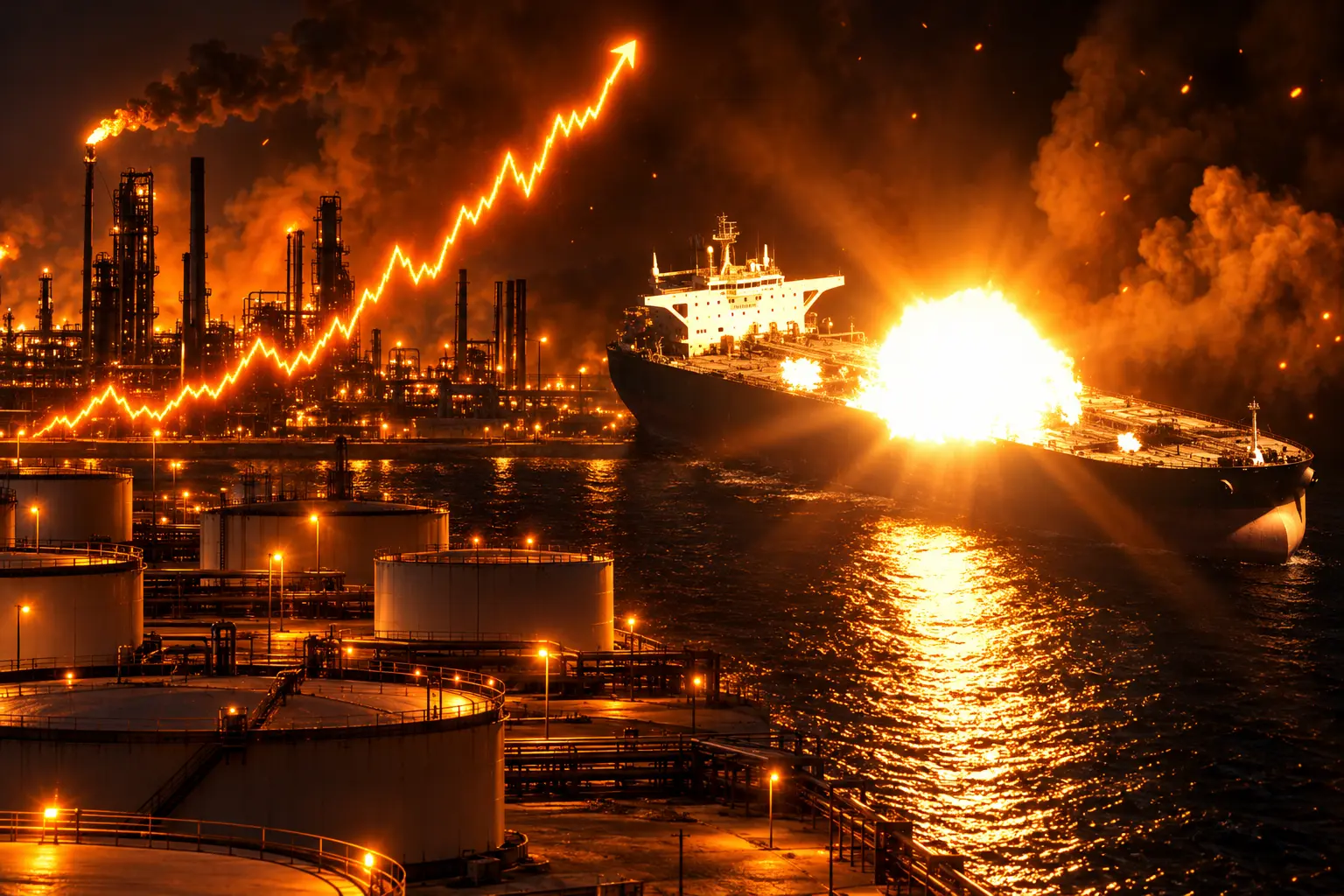
U.S. Forces Disabled Two Tankers and Sank a Third
The Saudi fires landed on a market already jumpy from the weekend. On Sept. 5, after Iran’s Islamic Revolutionary Guard Corps fired ballistic missiles at a U.S. aircraft carrier and a guided-missile destroyer, U.S. Central Command said both Navy ships evaded the attack and no American personnel were harmed.
CENTCOM then permanently disabled two carriers and destroyed a third, naming the ships and the waters. Air Force and Navy fighters and drones carried out the hits, U.S. officials said. Crews on the third ship were told to abandon it before the strike. That hull, the M/T Kylo, later sank in the Gulf of Oman.
THE THREE IRANIAN CARRIERS CENTCOM NAMED
| Ship | Location | CENTCOM result |
|---|---|---|
| M/T Downy | Off Kharg Island | Permanently disabled |
| M/T Stark 1 | Near Jask | Permanently disabled |
| M/T Kylo (Noxen) | Gulf of Oman, unladen | Destroyed; later sank |
CENTCOM called the three ships part of a multibillion-dollar shadow network that funds the IRGC and its regional proxies, and said Iran had no way to defend them. The strikes fit a shift toward hitting oil hulls after earlier U.S. waves had focused on radars, air defenses, and other military kit. Iran’s foreign ministry called the tanker attacks a war crime and an economic war on the homeland.
We will not hesitate to defend American forces, and if necessary, destroy Iran’s limited and exposed oil fleet.
Adm. Brad Cooper, CENTCOM commander, Sept. 5 statement
The command posted the same account on X the day of the strikes.
— U.S. Central Command (@CENTCOM) September 5, 2026
How the Strait Stayed Half-Closed
The war that opened on Feb. 28 has already taken Brent through $100 and back. A summer memorandum of understanding between Washington and Tehran briefly raised hopes the Strait of Hormuz would normalize, and Goldman cut its price targets on that hope. Hostilities did not stay quiet. Shipping through the strait has remained below pre-war volumes, and Goldman now treats Middle East shipping trouble as a problem that runs into next year.
HOW THE WAR REPRICED THE BARREL
- Feb. 28, 2026: The United States and Israel strike Iran, opening a war that throttles the Strait of Hormuz.
- April 2026: U.S. Energy Information Administration monthly averages show the spike; April Brent averaged $117.29 a barrel and April WTI $100.32, with May WTI at $102.13.
- June 2026: Washington and Tehran sign a memorandum of understanding; Goldman later cuts forecasts as the strait looks closer to normal.
- July 23, 2026: Brent’s last high before Tuesday’s retest, after which prices eased into the $80s and low $90s.
- Sept. 5, 2026: U.S. forces disable two Iranian crude carriers and destroy a third after IRGC missiles miss Navy ships.
- Sept. 8, 2026: Houthi strikes halt some southern Saudi energy operations; Brent trades near $98.50 and crosses $99.
June Brent, on the same EIA table, averaged $85.40, almost exactly the December number Goldman just wrote back in. The tape has already shown what a closed-up Gulf can do to the price, and what a lull can undo.
Goldman’s $85 December Call Versus a $99 Barrel
Struyven’s desk spent the summer talking down prices after that memorandum. Monday’s note reversed the direction of the call without matching the heat of the tape. December Brent goes to $85 and WTI to $80. For 2027 the house now sees $80 and $75. Those are $5 raises. They are also a forecast that the front of the curve pays back a large piece of Tuesday’s war premium before year-end.
GOLDMAN’S OIL MAP AFTER THE MONDAY NOTE
| Case | Brent | WTI | What it assumes |
|---|---|---|---|
| Tuesday session | Near $98.50, tagged $99 | $94 | Saudi halt plus weekend tanker strikes |
| December 2026 base | $85 | $80 | Raised $5; shipping trouble lasts into 2027 |
| 2027 base | $80 | $75 | Raised $5; non-Gulf supply keeps growing |
| Upside | Above $120 | Not specified | 2027 Gulf output 4 million barrels a day below pre-war |
| Downside | Toward $80 | Not specified | Gulf exports return to normal |
President Donald Trump, in a Monday social-media post, said oil prices would fall sharply and that gasoline, averaging $4.15 a gallon, would drop first to $3 and then to $2. Goldman’s note does not underwrite that path. It also does not underwrite a $120 winter. The $120 line is a 2027 output case, not a quote for the next session.
Brent might exceed $120 per barrel if 2027 average Gulf output remains 4 million barrels per day below pre-war levels.
Goldman Sachs commodities research note led by Daan Struyven, Sept. 7
Struyven has told clients to express the shipping risk in global natural gas and refined products rather than in crude alone, on the view that those markets take a harder hit when hulls stop moving. That is a hedge instruction, not a $120 base case.
Why $100 Oil Has Not Stuck
Oil traders have argued for months that a Hormuz war should have put the barrel much higher. Goldman’s answer is that the barrels missing from the Gulf have not come out of the stocks that set the clearing price in public OECD data. Commercial land inventories in those economies have barely fallen since the fighting began. The draws have shown up instead in government strategic reserves, in oil that was already on the water when the war started, and in an implied draw inside China.
THE BUFFERS HOLDING THE PRICE
- OECD commercial stocks: Barely reduced since the war began, and still 16% above the all-time low set in 2003.
- Global landed stocks: Down from 9.1 billion barrels to 8.6 billion, which Goldman still calls above operating storage minimums.
- China’s crude imports: About 60% of last year’s levels, and described by the desk as very price-sensitive.
- The balance: A deficit of about 1 million barrels a day, with Gulf supply recovered to about two-thirds of pre-war levels through pipelines and other workarounds.
Struyven also counts on “dark,” unrecorded flows through the strait and on oil moved by redirected pipelines. Alarmist forecasts, the note says, overstate the tightness while those buffers hold. Chinese buying that can slow when the price jumps is a demand valve as much as a supply story. Government reserve releases do the same job on the supply side, with less visibility than a Cushing inventory print.
That is why a $99 handle can look loud on a screen and still sit above the house’s own year-end number. The crude barrel is the headline. The quieter work is in stocks that do not show up cleanly in OECD commercial data, and in fuels that already ran hotter than crude through the summer.
Pumps Are Already Charging War Prices
Drivers did not need Brent at $100 to feel the war. AAA put the U.S. national average of $4.15 a gallon for regular on Tuesday, against $3.20 a year earlier. Diesel printed $5.90, against $3.70 a year earlier, after a record $5.90 average on Sept. 7.
Trump’s $3-then-$2 map starts from that $4.15 pump price. Getting there would take a collapse in crude and in refining stress that Goldman’s base case does not describe. A $85 December Brent still leaves the complex well above the pre-war tape, when WTI was near the mid-$60s and Brent near the low $70s on the eve of Feb. 28.
Diesel is the cleaner read on how little slack is left in the fuel system. Refineries can run hard and still fail to refill product tanks when crude arrives late, in smaller lots, or by longer routes. Goldman’s preference for gas and middle distillates over a naked crude long is a way of saying the war is already inside the crack, even when the crude benchmark hesitates under $100.
A $120 Barrel Needs Gulf Output Stuck 4 Million Short
The $120 case is specific. Average Gulf output in 2027 has to stay 4 million barrels a day below pre-war levels. Intensified attacks on shipping in the Strait of Hormuz and the Red Sea are the catalyst the desk names. The opposite case is also on the page: crude toward $80 if Gulf exports return to normal.
Tuesday’s Saudi halt is a new input, not yet a 4-million-barrel hole. The ministry called the stop temporary. The Houthi claim list includes a 400,000-barrel-a-day refinery city, which would matter if those runs stay offline, and would not rewrite 2027 supply if they do not. Pipeline workarounds and unrecorded Hormuz flows are the reason Goldman kept the December raise to $5 after a summer of reversing itself.
Non-Gulf barrels are the other half of that restraint. The bank says growing supply from the United States and other producers outside the Middle East can offset some of the Gulf disruption in the base case. That offset is also what fails in the $120 case, because a 4-million-barrel Gulf gap is larger than the adaptation the desk is willing to bank on.
Brent can tag $99 on a Houthi morning and still be a market that Goldman thinks is $85 oil by December, unless the Gulf’s two-thirds recovery breaks and stays broken. The $120 number lives in that break, not in Tuesday’s last trade.
Disclaimer: This article is news reporting and analysis of oil prices, a bank research note, and related military events. It is for information only and does not constitute investment, trading, or fuel-purchasing advice. Anyone considering a position in crude, refined products, energy equities, or related contracts should consult a licensed financial adviser or commodities professional before acting. Prices, injury counts, facility statuses, and forecasts reflect the cited sources on the dates given and can change with the next session, a revised note, or a further strike.

Saks Kept 15 Stores While Rivals Took the Shoppers

Fallout Season 3 Spend Hits California’s $42 Million Cap

Ebola Outran Congo’s Contact Lists and Reached Nairobi

Jagex Builds RuneScape 4 Beside the Games Players Already Have

SimpL Bets €1.2 Million on Meetings Paid When Held

Boston Scientific Cyberattack Leaves Hospitals Waiting on Implants

Guizhou Cave Cafes Spread When Each Cavern Fills

The Second Ned Stark Kit Lands When a Banner Dies

OpenAI’s Jalapeño Chip Turns Watts Into Faster Agent Steps

Satellites Saw Nepal’s Ice Slope Move Before the Flood
-
 NEWS2 months ago
Boston Scientific Cyberattack Leaves Hospitals Waiting on Implants
-
 NEWS2 months ago
Guizhou Cave Cafes Spread When Each Cavern Fills
-
 GAMING2 months ago
The Second Ned Stark Kit Lands When a Banner Dies
-
 NEWS2 months ago
OpenAI’s Jalapeño Chip Turns Watts Into Faster Agent Steps
-
 NEWS1 month ago
Satellites Saw Nepal’s Ice Slope Move Before the Flood
-

 NEWS2 months ago
MLB Quiet Periods Copy a Freeze Other Leagues Use
-

 NEWS2 months ago
Roman Space Telescope Launches After a Decade-Long Budget Bet
-

 NEWS2 months ago
Pere Marquette Freezes Data Centers on a Power-Rich Shore