
NEWS
Cassidy Blocks O’Neill and Leaves NSF Without a Director
Bill Cassidy halted Jim O’Neill’s NSF nomination over his CDC record, leaving the science agency without a confirmed director as its caretaker prepares to retire.

Sen. Bill Cassidy on November 18 canceled the committee vote on Jim O’Neill to lead the National Science Foundation. The Louisiana Republican, chair of the Senate Health, Education, Labor, and Pensions Committee, said O’Neill failed as acting CDC director to push back on Health Secretary Robert F. Kennedy Jr.
The White House left the nomination in place. NSF has had no Senate-confirmed director since April 2025, and the staff member doing that job retires December 31, before a Democratic Senate is seated in January 2027.
Cassidy Cancels the NSF Vote Without a Hearing
O’Neill was on the agenda for a HELP Committee business meeting on Wednesday, November 18, after months with no public confirmation hearing. Cassidy opened the session by taking him off the list. He said several members already had concerns and that the nomination lacked the support to move.
The White House did not pull the name. A spokesperson, Allison Schuster, said NSF “needs the leadership of Jim O’Neill, who has spent over a decade in the private sector helping to identify and finance cutting-edge technologies of the future.” Cassidy still refused to hold a roll call.
In remarks before the nominations vote, he tied the NSF job to the year O’Neill spent under Kennedy at Health and Human Services and at CDC.
As Acting CDC Director, Mr. O’Neill did not do enough to stand up for science and against irresponsible decisions and statements from Secretary Kennedy. His role in the firing of Dr. Susan Monarez raises further concerns about the independent judgment he would bring to NSF. Several members of the committee had concerns regarding this. I like Jim personally, but this time requires leadership and fortitude in standing up for what is right.
Sen. Bill Cassidy, HELP Committee chairman, November 18, 2026 business meeting
The night before, the White House had withdrawn Heidi Overton, the nominee for Food and Drug Administration commissioner. Cassidy said he thought Overton had the votes and that anti-abortion senators had wanted last assurances on abortion policy. The administration, he said, would not give those assurances. He called the pull “odd.” Two science-adjacent nominations fell in two days, and neither chair is filled.
On the right, the complaint is simpler and louder: a Republican chair sat on a presidential pick for months, then killed it on the way out of the majority rather than send it to the floor. That argument treats Cassidy’s science brief as cover for a last fight with the White House. It does not change the math inside HELP. He said the votes were not there.
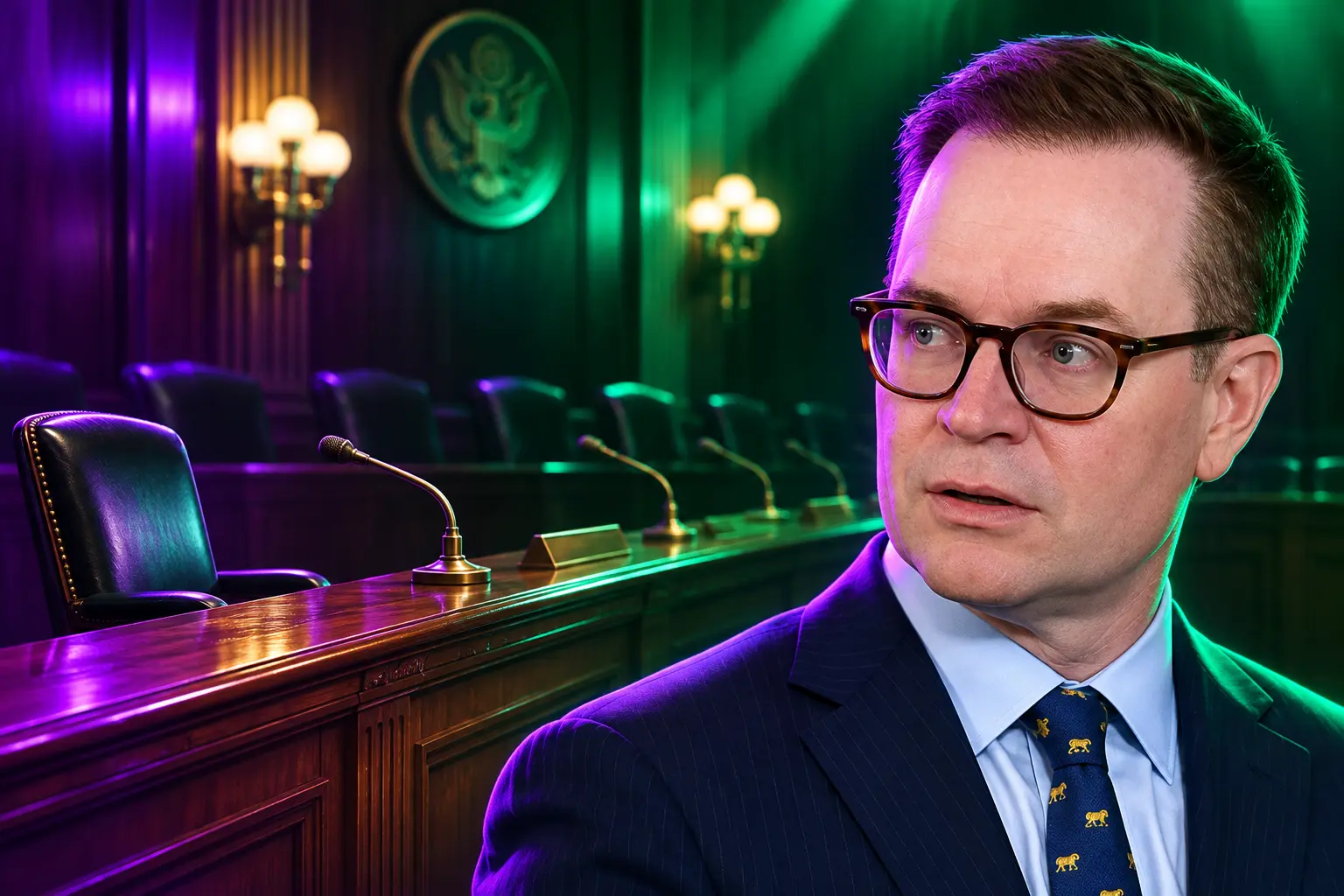
An Empty Director’s Office Since April 2025
Killing the nomination does not put a confirmed director in Alexandria. Sethuraman Panchanathan, NSF’s last Senate-confirmed director, resigned in April 2025 as the new Trump administration canceled grants and pressed for a much smaller budget. Brian Stone, the agency’s longtime chief of staff, has performed the director’s duties since.
NSF later said Stone had served 26 years, including 18 months in that acting role, when he told staff in October that he would retire at year end. His exit date is December 31. In the same period the White House dismissed the National Science Board and left the deputy director’s post empty, so the statutory leadership bench is gone.
NSF LEADERSHIP CLOCK
- April 2025: Panchanathan resigns as NSF director amid grant cancellations and budget pressure from the White House.
- June 9, 2025: O’Neill is sworn in as deputy secretary of Health and Human Services.
- August 2025: Susan Monarez is fired as CDC director; O’Neill becomes acting CDC director while remaining HHS deputy.
- February 2026: O’Neill leaves HHS and CDC.
- March 2026: President Trump nominates O’Neill to run NSF for a six-year term.
- October 21, 2026: Stone tells NSF staff he will retire December 31 and will work with the White House on who performs the director’s duties on January 1, 2027.
- November 18, 2026: Cassidy cancels the committee vote; the White House does not withdraw the nomination.
Stone wrote that the agency would work with the White House on who performs the director’s duties as of January 1, 2027, if O’Neill’s nomination were still pending. It is still pending. It is not going to a vote in this Senate.
What Cassidy Cited From the CDC Tenure
Cassidy did not argue that O’Neill lacked private-sector polish. He argued that O’Neill would not resist Kennedy. That is a charge about NSF’s independence, built on a public-health fight Cassidy had already watched from the same dais.
Monarez, a microbiologist, was confirmed as CDC director in July 2025 and removed in August, less than a month later. She told the HELP Committee she had been ordered to pre-approve vaccine recommendations from a rebuilt advisory panel and to dismiss career vaccine officials without cause, and that she refused. Kennedy has said he ousted her because she was not trustworthy. Three senior CDC officials resigned after she was fired. O’Neill, already Kennedy’s deputy, took the acting CDC job.
He held it from August 2025 to February 2026. In that window HHS rolled back routine childhood immunization recommendations, a shift Cassidy has attacked as unsafe. The Union of Concerned Scientists later said O’Neill “played a key role in implementing a reckless overhaul of childhood vaccine recommendations.” Cassidy’s November 18 brief was shorter. He said O’Neill did not stand up for science, and that the Monarez firing raised doubts about the judgment he would bring to NSF.
NSF is not CDC. It does not set vaccine schedules. It does fund the basic research pipeline at U.S. universities, and it was built as an independent agency. Cassidy’s test was whether O’Neill would say no to the White House if the White House asked him to move money or kill work for political reasons. Cassidy’s answer, after sitting on the file from March to November, was that he would not bet the agency on that.
From Mithril Capital to Acting CDC Director
If confirmed, O’Neill would have run NSF for six years. He would also have been the first director who is not a scientist or an engineer. That fact, more than the Thiel connection, is what research groups used against him when HELP finally put him on a markup.
He is a science and technology investor who first served at HHS in the George W. Bush years. Kennedy sworn in as HHS deputy secretary on June 9, 2025, after a party-line confirmation. The department’s own release walked through the résumé the White House likes to advertise.
O’NEILL’S PATH TO THE NSF FILE
- Bush-era HHS: He served at the department from 2002 to 2008 and was principal associate deputy secretary in 2007 and 2008, working on FDA food, drug, and device rules.
- Thiel network: He later ran the Thiel Foundation, co-founded the Thiel Fellowship, and was a managing director at Mithril Capital, Peter Thiel’s long-term venture fund.
- Longevity research: He was CEO of the SENS Research Foundation, which works on aging and regenerative medicine, after years on its board.
- Kennedy’s deputy: He was HHS deputy secretary from June 2025 to February 2026 and acting CDC director for most of that stretch.
- NSF nominee: Trump named him in March 2026; HELP never held a hearing and never took a vote.
Gretchen Goldman, president of the Union of Concerned Scientists, urged Congress to vote no two days before the markup. She went at the résumé Cassidy only implied.
It should go without saying that the head of the nation’s premier science agency should be a scientist or an engineer in their own right. Instead, the Trump administration has nominated Jim O’Neill, someone known for his hedge fund and venture capital background, promoting disinformation over evidence-based policies, and running political interference in scientific decisions.
Gretchen Goldman, president and CEO, Union of Concerned Scientists, November 16, 2026
O’Neill’s own pitch, posted when he was nominated, was the opposite of Goldman’s test. He said many institutions had “weakened academic freedom and lost the trust they once enjoyed,” that government “should take bigger financial risks to pose and answer deeper questions,” and that “Entropy is on the march and China is not waiting.”
I’m extremely honored to be nominated by President Trump to serve as Director of the National Science Foundation.
Heroic scientists have always challenged consensus to advance the frontiers of knowledge. Recently, many institutions have weakened academic freedom and lost the… pic.twitter.com/zJLSWgYHiz— Jim O’Neill (@regardthefrost) March 4, 2026
That is a venture investor’s brief for NSF: fewer bottlenecks, more bets, less consensus. It is also why science groups treated a six-year term as a lock-in, not a trial run. Cassidy never said Goldman was his guide. He did not need her. He had the CDC year, and he had a committee that would not vote yes.
The $1.4 Billion NSF Did Not Spend
The director fight sits on top of a budget fight NSF already lost and won in the same year. The White House asked Congress for $3.90 billion for fiscal 2026, less than half of what lawmakers then enacted. On February 3 the president signed the Consolidated Appropriations Act, 2026, which provides $8.75 billion for NSF, down $76.0 million, or 0.9%, from the prior year.
Congress kept the agency far above the White House request. The split still shows where the administration wanted to go, and where the money actually landed.
NSF FY2026 REQUEST VERSUS ENACTED FUNDING
| Account | White House request ($ millions) | Enacted ($ millions) |
|---|---|---|
| Agency total | 3,903.15 | 8,750.00 |
| Research and Related Activities | 2,987.72 | 7,176.50 |
| STEM Education | 288.43 | 938.25 |
| Mathematical and Physical Sciences | 515.28 | 1,458.45 |
| Social, Behavioral, and Economic Sciences | 94.00 | 173.14 |
| Technology, Innovation, and Partnerships | 350.00 | 901.30 |
Enacting the money did not mean NSF spent it the way the report language described. In a letter to Stone dated October 27, House Science Committee Ranking Member Zoe Lofgren accused the agency of refusing to spend $1.4 billion in congressionally appropriated funds in fiscal 2026, “or nearly 20 percent of the agency’s research budget.” Fiscal 2026 ended September 30.
Lofgren wrote that the withheld sum is “broadly similar to the amount of funding that will reportedly be diverted to the OSTP-backed frontier initiatives agenda,” and that her committee “has already obtained evidence that the Trump White House has routinely influenced decision-making at NSF.” An NSF spokesperson said the agency “has carried over funds to invest in agency priorities that are aligned with broader Administration initiatives.”
That is the second-order problem Cassidy’s veto does not touch. A confirmed director can be hauled in and asked why a directorate was cut. An acting chief of staff taking orders from the Office of Science and Technology Policy and the Office of Management and Budget is already doing the work a loyal NSF director would be asked to do. Blocking O’Neill keeps Kennedy’s former deputy out of the building. It does not, by itself, pull OSTP out of the grant book.
Stone Retires on December 31 With No Successor Named
Stone’s retirement turns a long vacancy into a second handoff with no confirmed official on either side of it. NSF said he would keep performing the director’s duties until he leaves. Rebecca Keiser, who had been acting chief of staff, retired October 31 after 11 years at the agency. Rob Moller, head of legislative and public affairs, stepped in as acting chief of staff.
Stone holds an MBA and no advanced science degree, a biographical detail his critics used when they said NSF was already being run as a White House shop. He had been chief of staff for a decade before Panchanathan quit. For 18 months he was the face of grant cancellations, proposed cuts, and the shift of money toward artificial intelligence and quantum work. Then he set a last day.
His memo did not name a successor. It said NSF would work “closely with the White House” to identify who performs the director’s duties on January 1, 2027, if the O’Neill nomination were still pending. Cassidy’s November 18 decision made that clause operative. The White House now picks another caretaker, and it does so 37 days before Democrats take the Senate.
The Next NSF Director Goes to a Democratic Senate
Republicans used November to clear nominees before the majority flips in January 2027. Cassidy used it to stop one. Because he never sent O’Neill to the floor, the next NSF director will need a Democratic Senate, and a Democratic HELP chair, unless the White House leaves the post in acting status and stops trying.
Cassidy said the same thing about FDA that morning. With Overton withdrawn and little time left, he said, “confirming a permanent FDA Commissioner will fall to Senate Democrats.” NSF is now on that list too. The nomination paper for O’Neill can sit in the file. It cannot get a hearing through this committee in the days that remain, and it will not get a friendly one after January.
WHAT WE KNOW
- The vote: Cassidy canceled the November 18 HELP markup on O’Neill and did not schedule a public hearing.
- The paperwork: The White House did not withdraw the nomination, unlike Overton’s FDA file the day before.
- The calendar: Stone retires December 31; a new acting official is due to be identified for January 1, 2027.
- The Senate: Democrats take control in January 2027, so the next confirmed NSF director faces that majority.
WHAT IS UNCONFIRMED
- The January 1 acting director: Stone said NSF would work with the White House on a name; none has been announced.
- A replacement nominee: No new NSF candidate has been sent to the Senate.
- O’Neill’s paper status: The nomination remains, with no path through this committee and no White House withdrawal.
Cassidy’s test for NSF was whether its director would resist the White House. He decided O’Neill would not, and he used the last Republican markup window to say so. The agency that comes out of that decision is the same one that went in: no confirmed director since April 2025, a caretaker leaving on December 31, and research money already moving under White House direction. The next person who wants the job will have to make that case to Democrats.

DK Metcalf’s Eye Poke Hits a Thin Steelers Season

The Canadiens Bet a Top Prospect on Dylan Larkin

Cassidy Blocks O’Neill and Leaves NSF Without a Director

Alpöge Posts a Riemann Hypothesis Proof Nobody Can Read

TSMC Pauses China Chips That SMIC Cannot Replace

Boston Scientific Cyberattack Leaves Hospitals Waiting on Implants

Xbox Sells Cloud Playtime Packs Ahead of November Caps

Guizhou Cave Cafes Spread When Each Cavern Fills

The Second Ned Stark Kit Lands When a Banner Dies

Satellites Saw Nepal’s Ice Slope Move Before the Flood
-
 NEWS3 months ago
Boston Scientific Cyberattack Leaves Hospitals Waiting on Implants
-
 GAMING4 weeks ago
Xbox Sells Cloud Playtime Packs Ahead of November Caps
-
 NEWS3 months ago
Guizhou Cave Cafes Spread When Each Cavern Fills
-
 GAMING3 months ago
The Second Ned Stark Kit Lands When a Banner Dies
-
 NEWS3 months ago
Satellites Saw Nepal’s Ice Slope Move Before the Flood
-

 NEWS3 months ago
OpenAI’s Jalapeño Chip Turns Watts Into Faster Agent Steps
-

 NEWS3 months ago
MLB Quiet Periods Copy a Freeze Other Leagues Use
-

 NEWS3 months ago
Roman Space Telescope Launches After a Decade-Long Budget Bet