
NEWS
The FAA Unveiled SMART as a Cut Fiber Grounded Newark
On SMART’s first morning, a failed circuit and a cut backup fiber at Philadelphia TRACON stopped flights at Newark, JFK, LaGuardia, and Philadelphia.

The FAA issued ground stops at five Northeast airports on September 21 after Philadelphia TRACON lost its radios and radar feeds. Newark, Teterboro, and Philadelphia stopped first. JFK and LaGuardia joined around 1 p.m.
That same morning in Washington, Transportation Secretary Sean P. Duffy and FAA Administrator Bryan Bedford unveiled SMART, an AI tool that centralizes 200 data streams and is meant to spot congestion before it becomes a delay. The software opened in limited mode around the capital. It was not running the New Jersey line a construction crew cut before lunch.
A Failed Circuit Met a Cut Fiber Before Noon
Philadelphia TRACON is the radar room that sequences arrivals for Philadelphia, Newark, and Teterboro. Bedford said an older Verizon circuit at that facility failed Monday morning. When the system switched to backup, crews found the spare fiber already cut at a construction site in New Jersey.
New Jersey Transit said a crew on its Delco Lead project between New Brunswick and North Brunswick accidentally severed the cable at about 9:45 a.m. The crew was about 10 feet from the utility markings, the agency said, and staff were still sorting out whether Verizon or the contractor had painted those marks. Verizon said contractors dug up and cut its cable, which runs beside an Amtrak rail line, and that its plant had been working until then.
Duffy first wrote that an Amtrak crew made the cut. Amtrak said the work was on New Jersey Transit property and involved a New Jersey Transit contractor. Bedford told reporters the splice would take about 13 hours and that a replacement circuit was ready to install. The FAA later said that swap did not take, so the delay dragged into the evening.
In audio from ATC.com, a controller at Philadelphia International told a pilot the room was crawling.
Yeah, man, nothing works. People are getting out, but it’s slow going.
Philadelphia International air traffic controller, ATC.com audio
THE MORNING THE RADAR ROOM WENT DARK
- About 9:40 a.m. Eastern: Last commercial landing at Newark before the stop, per Flightradar24.
- About 9:45 a.m.: New Jersey Transit crew cuts the backup fiber on the Delco Lead project.
- About 10:00 a.m.: Ground stops hit Newark, Teterboro, and Philadelphia.
- About 1:00 p.m.: The FAA adds JFK and LaGuardia as the problem spreads through New York airspace.
- Just after 5:20 p.m.: Commercial landings resume at Newark.
- Monday evening: Duffy says the telecom lines are repaired and operations are resuming, with delays still to clear.
A Boston Logan spokesperson said the airport was getting a lot of diversions from the stopped fields. Canadian Prime Minister Mark Carney’s arrival in New York was delayed, and his office said he would miss a scheduled summit as leaders gathered for the United Nations General Assembly the next day.
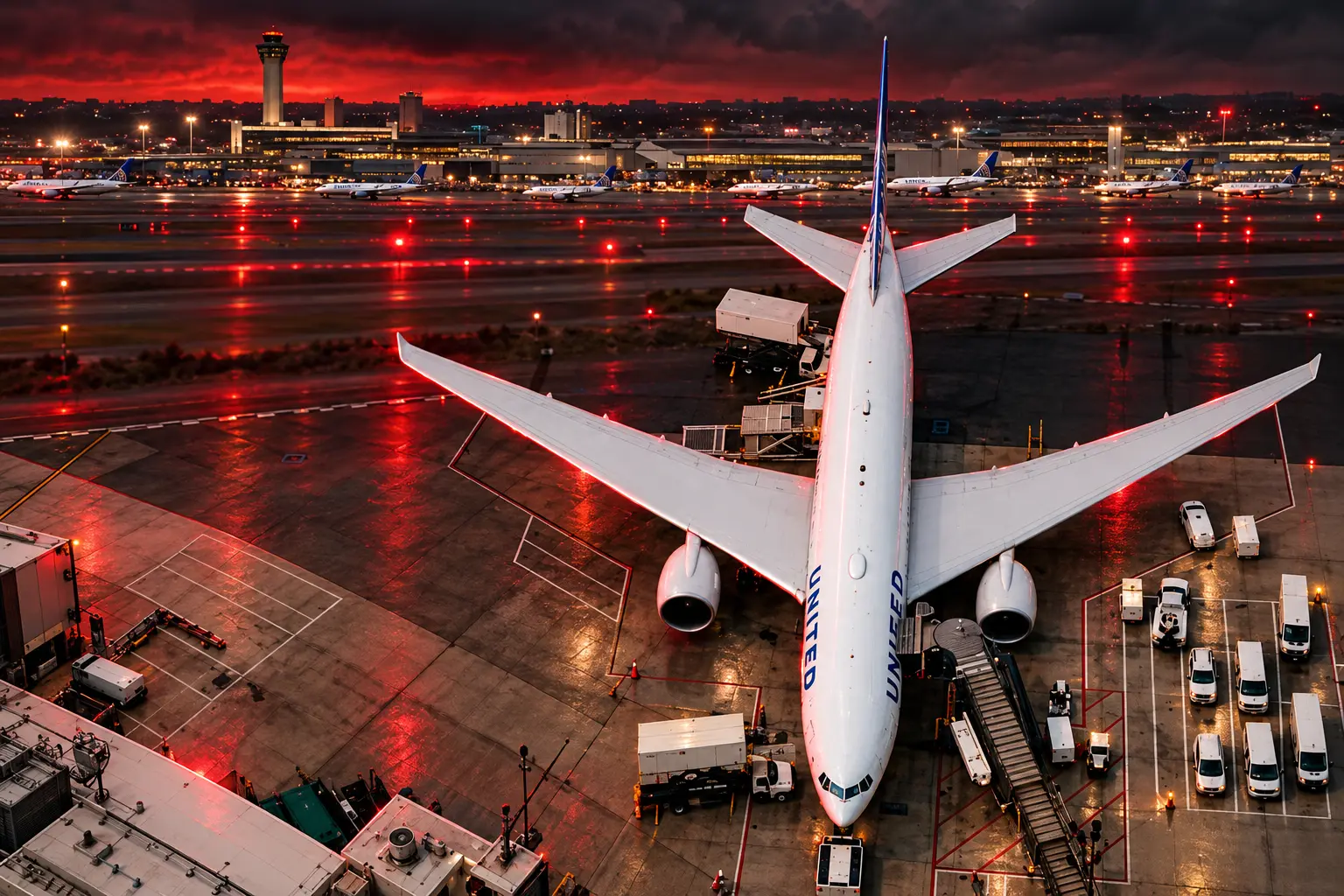
Newark Went Quiet for Most of the Day
No commercial flights landed at Newark from about 9:40 a.m. until just after 5:20 p.m. FlightAware showed Newark with more cancellations than any other airport in the world that Monday, with more than 300 flights canceled by evening, over half of the airport’s scheduled departures.
United Airlines, which hubs at Newark, issued a waiver for travel to, from, or through Newark and Philadelphia and said the outage was a significant disruption for its customers. Delta’s Northeast ATC outage waiver covered Boston, Newark, and Philadelphia for tickets issued on or before September 21.
WHERE THE CLOCK STOPPED
| Airport | First FAA restriction | Average delay around 6:40 p.m. |
|---|---|---|
| Newark (EWR) | Ground stop about 10 a.m. | 306 minutes |
| Philadelphia (PHL) | Ground stop about 10 a.m. | 212 minutes |
| Teterboro (TEB) | Ground stop about 10 a.m. | 159 minutes |
| JFK | Ground stop about 1 p.m. | 72 minutes |
| LaGuardia (LGA) | Ground stop about 1 p.m. | 67 minutes |
The FAA command center operations plan still listed automation and equipment trouble inside Philadelphia Area C after arrivals had restarted in a limited way. Residual cancellations ran into Tuesday as crews and aircraft sat in the wrong cities.
Philadelphia Already Owned Newark’s Approach
The failure hit a facility that has been a single point of trouble for Newark since 2024. In July 2024 the FAA moved approach control for Newark’s airspace from New York TRACON, known as N90, to Philadelphia, saying N90 was chronically short-staffed. Newark carried more than 24 million passengers in 2024.
Radar processing for that traffic still sits in New York. Telecom lines carry the picture to controllers in Philadelphia, more than 100 miles from the runways they are working. When those lines die, Newark’s tower can be fully staffed and still have nothing to land.
THE SAME ROOM, EARLIER FAILURES
- April 28, 2025: Controllers lost radar and radio contact for about 90 seconds after a copper wire burned.
- May 9, 2025: Another 90-second outage hit when both primary and backup communications failed.
- July 3, 2025: The FAA said it had moved Newark traffic onto a new fiber network with two separate paths so one cut would not kill the feed.
On July 28, 2025, the Transportation Department’s inspector general opened an audit of the Newark airspace transfer, looking at planning, redundancy, staffing, and the delays that followed. The FAA has kept Newark capped at 36 arrivals and 36 departures an hour while Philadelphia TRACON remains short of its controller target.
Monday showed that two paths still share a trench a rail contractor can open. Bedford put it in one line: the agency is pulling copper up and putting fiber down, but it is the same data architecture it has had for 50 years.
The FAA Unveiled SMART the Same Morning
While Newark’s arrivals sat, Duffy and Bedford were in Washington launching Strategic Management of Airspace, Routes and Trajectories. The FAA says SMART pulls weather, flight paths, traffic flow, and controller staffing into one screen, then uses an AI engine to show where demand will exceed what the sky can hold.
The agency started it in limited mode in Washington airspace and said it will expand later. SMART cannot replace controllers or fly an aircraft. Staff review every suggestion, and local facility chiefs can ignore it. The June contract went to Boston-based Air Space Intelligence for 12 years and $875 million, covering SMART and a new flow-management backbone called FMDS.
United Airlines CEO Scott Kirby endorsed the tool in the FAA’s own announcement, on a day his Newark hub had almost no arrivals.
United believes that using SMART to open airspace intelligently has the potential to significantly reduce delays and cancellations during weather events. If it works as we think it can, it will do more to reduce delays and cancellations than anything that’s happened in decades.
Scott Kirby, CEO, United Airlines, FAA SMART announcement
Rep. Don Beyer of Northern Virginia asked the FAA to suspend SMART at Washington-area airports until its safety is established, saying his constituents should not be guinea pigs. Duffy answered that humans still control the airspace and still make the calls.
A scheduling engine that looks at weather and demand two hours out cannot see a backhoe beside the Northeast Corridor. SMART was never plugged into Philadelphia TRACON that morning. The planes stopped because a primary circuit died and the spare fiber was already in two pieces.
Who Cut the Backup Line in New Jersey?
By evening the sequence was clear even if the blame was not. An aging Verizon circuit failed. The backup was a fiber cable along a rail line. A construction crew on the Delco Lead project cut it at about 9:45 a.m., about 10 feet from painted marks. Verizon says the marks and the digging were the contractors’ job. New Jersey Transit says it is still checking who painted the marks.
WHAT WE KNOW
- The two failures: The primary circuit failed, then the backup fiber was already cut when the system tried to fail over.
- The work site: New Jersey Transit placed the cut on its Delco Lead project between New Brunswick and North Brunswick at about 9:45 a.m.
- The first blame: Duffy named an Amtrak crew; Amtrak and New Jersey Transit said the contractor was New Jersey Transit’s.
- The restore: Duffy said Monday evening the telecom lines were repaired and flights were moving again, with a backlog still to clear.
WHAT IS UNCONFIRMED
- The markings: Whether Verizon or the contractor painted the utility marks the crew said it stayed 10 feet from.
- The fix: Which path actually brought the radios back, after the FAA said a replacement-circuit swap did not take.
- The July 2025 paths: Whether Monday’s primary and backup were the two fiber routes the FAA advertised after the 2025 blackouts.
Duffy used the outage to argue for more money, then pointed travelers to the live national airspace status page.
UPDATE: An Amtrak construction crew accidentally cut into a fiber line in New Jersey which caused a telecom outage and forced FAA to pause flights in the Northeast.
Right now:
– Flights are resuming at LGA and PHL
– Flights into EWR, JFK, and Teterboro Airport are pausedThis… https://t.co/3CDnTioMv0
— Secretary Sean Duffy (@SecDuffy) September 21, 2026
He wrote that flights were resuming at LaGuardia and Philadelphia while arrivals into Newark, JFK, and Teterboro were still paused, and that the incident showed why aging gear needs replacing. Bedford, speaking the same afternoon, said none of this was new. It was an old system they were stuck working with.
Duffy Says SMART Runs on 1990s Software
The department says it is already deploying $12.5 billion to upgrade telecom lines, radios, radars, and flight strips, with 13 workstreams due by the end of 2028. Duffy said the FAA has about 11,000 controllers in towers, the most in a decade, with 4,000 more in the pipeline after the first 18 months of the administration, and that hiring is five months faster than it was.
A week after the ground stops, he described the gap in plainer words than the SMART press release had used.
We have an old operating system from the 1990s. I can put a brand new app on an old operating system, but it won’t work as efficiently. My new app is SMART. I can operate SMART on that old operating system, but I want a new operating system so I can give new tools to the air traffic controllers and FAA staff. That’s the $10 billion we need from Congress.
Sean P. Duffy, U.S. Transportation Secretary, on X, September 28, 2026
SMART can rearrange trajectories around storms once it is in a region. It cannot splice a fiber in New Brunswick, and it cannot staff Philadelphia Area C. Newark is still held to 36 arrivals and 36 departures an hour. The new app is live around Washington. The line that feeds Newark still runs through a trench a rail crew can hit.
Frequently Asked Questions
What Is Philadelphia TRACON?
It is the FAA Terminal Radar Approach Control facility for the Philadelphia area. Area C in that building handles Newark and Teterboro, which is why a failure there stops New Jersey arrivals even when Newark’s tower is fully staffed. Radar processing for Newark traffic remains based in New York, so the picture on a Philadelphia controller’s screen depends on telecom lines between the two cities.
What Does the FAA SMART Tool Do?
SMART is a cloud scheduling aid, not a replacement for controllers. It began in limited mode around Washington at Reagan National, Dulles, and Baltimore-Washington. Local facility leaders can accept or reject its suggestions, and it cannot take control of an aircraft. The FAA says it will expand the tool to other parts of the country after the Washington trial.
How Did Airlines Handle Rebooking After the Outage?
Delta’s exception covered Boston, Newark, and Philadelphia on tickets issued on or before September 21, for travel on September 21 and 22, with new travel originating on or before September 25 and the ticket reissued by that date. United issued a separate waiver for Newark and Philadelphia. Travelers still had to keep the same cities and cabin, and they had to check whether a seat existed in the original fare class.
When Is the FAA Due to Finish Replacing Old Telecom Gear?
The department says the $12.5 billion already in motion runs across 13 modernization workstreams and is set to be completed by the end of 2028. Duffy on September 28 separately asked Congress for $10 billion for a new operating system so tools such as SMART are not sitting on 1990s software. Those are two different funding asks, not one combined bill.

Xbox Sells Cloud Playtime Packs Ahead of November Caps

Xbox Puts a $1,800 Helix Behind a 2027 Handheld

Brussels Asks If Bio-Based Plastic Can Replace Recycled Content

EU Organic Deal Gates the Leaf and Doubles Exemptions

Barilla Strike Exposes Who Gains the Italian Plants

Boston Scientific Cyberattack Leaves Hospitals Waiting on Implants

Guizhou Cave Cafes Spread When Each Cavern Fills

The Second Ned Stark Kit Lands When a Banner Dies

Satellites Saw Nepal’s Ice Slope Move Before the Flood

OpenAI’s Jalapeño Chip Turns Watts Into Faster Agent Steps
-
 NEWS2 months ago
Boston Scientific Cyberattack Leaves Hospitals Waiting on Implants
-
 NEWS2 months ago
Guizhou Cave Cafes Spread When Each Cavern Fills
-
 GAMING2 months ago
The Second Ned Stark Kit Lands When a Banner Dies
-
 NEWS2 months ago
Satellites Saw Nepal’s Ice Slope Move Before the Flood
-
 NEWS2 months ago
OpenAI’s Jalapeño Chip Turns Watts Into Faster Agent Steps
-

 NEWS2 months ago
MLB Quiet Periods Copy a Freeze Other Leagues Use
-

 NEWS2 months ago
Roman Space Telescope Launches After a Decade-Long Budget Bet
-

 BUSINESS2 weeks ago
Saks Kept 15 Stores While Rivals Took the Shoppers