
BUSINESS
Buying a Quarter Cow Does Not Beat Grocery Ground Beef
Grass-fed quarter-cow shares still price near $15 a pound, so they do not undercut the $6.76 grocery ground beef that set records in 2026.

U.S. grocery ground beef averaged $6.755 a pound in October 2026, just under August’s record $6.923. The usual workaround is to buy a slice of a whole animal from a ranch, freeze it, and stop paying steak-case prices one pack at a time.
Against the burger meat most households actually cook, that workaround is still a premium. A grass-fed quarter is a different product, sold at a different price, to a buyer who can float four-figure cash and spare freezer space.
Ground Beef Set a Record in August
The Bureau of Labor Statistics city-average series for 100% ground beef, excluding round, chuck, and sirloin, is the clean national yardstick. The Federal Reserve Bank of St. Louis publishes that series, and the October average of $6.755 a pound is the latest print, posted November 10. September was $6.792. August’s $6.923 is the high in records that start in 1984.
THE GROCERY PRINTS
- October 2026: 100% ground beef averaged $6.755 a pound in the U.S. city series.
- August peak: The same series hit $6.923, then slipped 2.4% by October.
- January 2014: That series sat at $3.467 a pound, so the October print is 94.8% higher.
- Steak class: Uncooked steaks as a group averaged about $12.85 a pound in October 2026.
From January 2020’s $3.886, the October ground-beef print is up 73.8%. Shoppers talking about local shelves still describe $6 to $7 meat, which matches the national average more closely than any ranch brochure. The next BLS average-price release is scheduled for December 10, 2026.
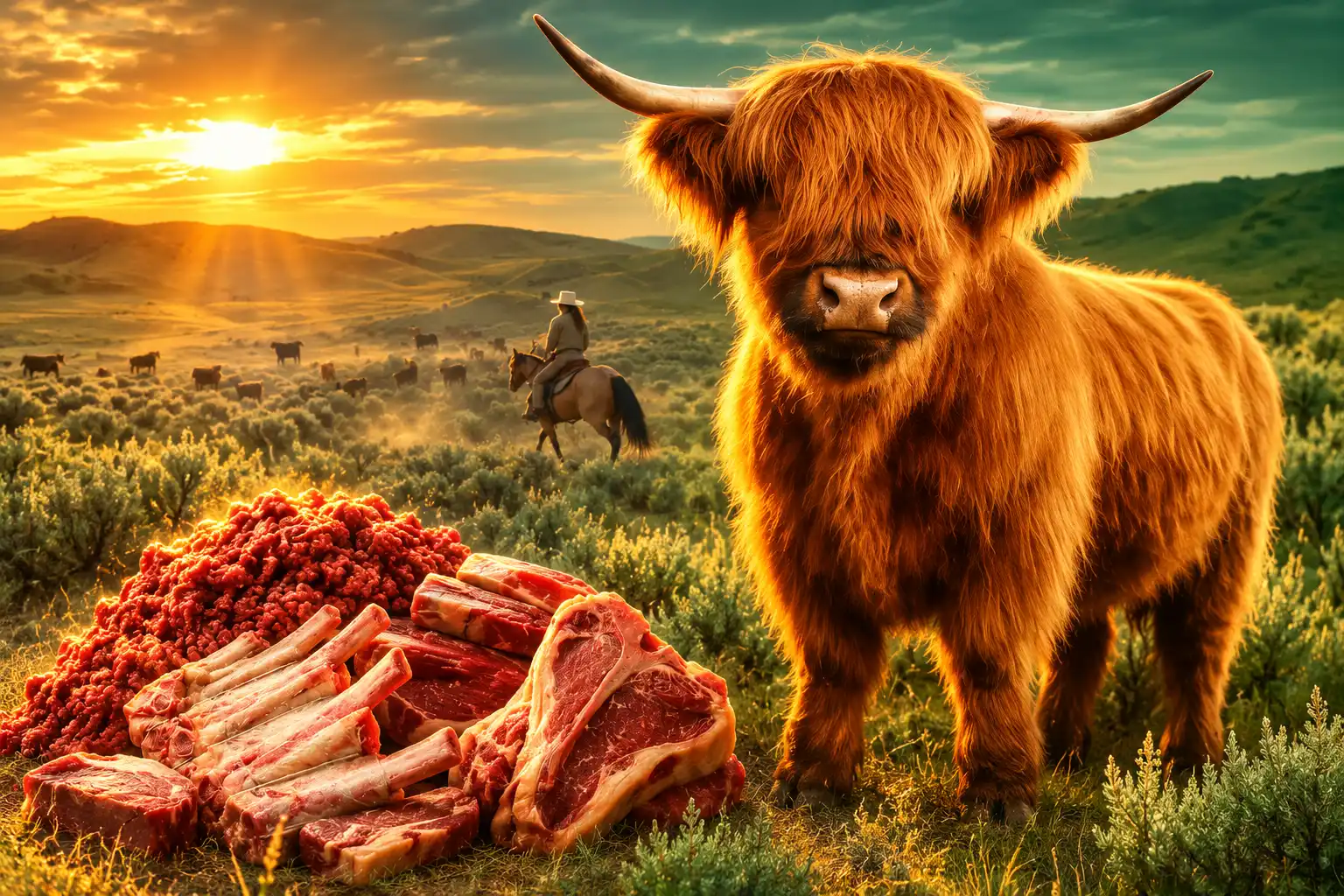
America’s Cattle Herd, at a 75-Year Low
The grocery number is the downstream result of a smaller U.S. herd, not a one-month glitch in the meat case. USDA’s National Agricultural Statistics Service counted 86.2 million cattle and calves on U.S. farms as of January 1, 2026, the smallest inventory since 1951.
HOW THE HERD GOT THIS SMALL
- 2020 to 2023: Drought across the Plains burned pasture and pushed ranchers to sell breeding cows rather than keep them.
- January 1, 2025: The inventory stood at 86.5 million head, already near a multi-decade low.
- January 1, 2026: The count slipped to 86.2 million, down 0.4%. Beef cows fell 1% to 27.6 million. The 2025 calf crop was 32.9 million, down 2%.
- 2028: The American Farm Bureau Federation has said a meaningful expansion may not show up until at least 2028, because heifers kept for breeding are meat that does not go to the store.
Beef replacement heifers ticked up 0.9% to 4.71 million, a faint holdback signal, not a rebuild. Cattle on feed were 13.8 million, down 3%. Julie Anna Potts, president and CEO of the Meat Institute, put the lag in plain terms: it takes a long time to go from a baby calf to the consumer, which is one reason the herd size will not change overnight.
Feedlots have been hanging animals longer to pull more pounds from each carcass. That pads production a little. It does not put more cows back on grass. Until more heifers are retained for two or three seasons, grocery beef stays scarce, and the ranch-share pitch gets louder.
What a Quarter Cow Costs Right Now
Carter Country Meats, a grass-fed ranch in Wyoming’s Big Horn Mountains, publishes a full share sheet. A quarter cow listed at $1,700 is the usual starting point for a household with a small chest freezer. That price is for at least 115 pounds of frozen beef, about $14.78 a pound, before shipping.
CARTER COUNTRY SHARE SHEET
| Share | Price | Beef (at least) | Per pound | Freezer space |
|---|---|---|---|---|
| Sixteenth | $590 | 35 lbs | $16.86 | about 1 cu ft |
| Eighth | $1,000 | 65 lbs | $15.38 | about 2 cu ft |
| Quarter | $1,700 | 115 lbs | $14.78 | about 3 cu ft |
| Half | $3,130 | 225 lbs | $13.91 | about 6 cu ft |
| Whole | $5,600 | 425 lbs | $13.18 | about 11-12 cu ft |
Ground shipping is extra, about $115 to $155 on a quarter and $425 to $575 on a whole animal. Add the low shipping estimate to the quarter and the all-in cost is about $15.78 a pound. The ranch’s own cut sheet for a quarter is roughly 61 pounds of ground beef, 24.6 pounds of premium cuts, 22.6 pounds of mid cuts, 3 pounds of organs, and 6 pounds of bones, a 117.2-pound mix against the 115-pound minimum.
That Wyoming sheet is not an outlier at the top of the market. A tracker that reads ranch storefronts daily logged quarter-cow listings from $949.49 to $1,900 on November 20, 2026, with a middle listing of $1,487.93 across 9 quotes. Halves ran from $2,391.50 to $3,600. Wholes ran from $5,267.99 to $6,800. Across 39 in-stock bulk listings from 12 U.S. ranches, the lowest stated pack price was $15.57 a pound on a 25-pound sixteenth from Shirttail Creek Farm in Texas.
The Blended Pound Versus Grocery Ground Beef
Ranch pages compare the share’s blended pound with a grocery cart that is heavy on ribeyes. That is a fair comparison only if you were already buying those steaks. Most of the beef that leaves a U.S. meat case is ground. On that product, the share loses in a straight line.
FOUR WAYS TO PRICE A POUND
| Where you buy | What you get | Price per pound |
|---|---|---|
| U.S. grocery, October 2026 | 100% ground beef | $6.755 |
| U.S. grocery, October 2026 | All uncooked steaks | $12.85 |
| Carter Country quarter | Blended grass-fed share | $14.78 |
| Carter Country whole animal | Blended grass-fed share | $13.18 |
The quarter’s $14.78 blended pound is 118.8% above grocery ground beef and about 15% above the grocery steak class. Even the whole-animal price, $13.18, still sits above $12.85 steaks and about double the burger meat. The sixteenth, sold as the fridge-freezer on-ramp, is the dearest of the set at $16.86.
Conventional grain-finished halves, sold hanging-weight from local processors, can land in a lower band after the kill fee and the cut-and-wrap bill. That is a different animal, finished on a different diet, and it is the product some bulk buyers describe when they say they packed a freezer near $5 a pound. Grass-fed shares do not print those numbers. They print $13 to $17, then add freight.
Carter’s own copy is honest about the trade. A share prices every cut, from ribeye and tenderloin to roasts and ground beef, at one blended per-pound price. You pay once, up front, and you need the freezer. What the copy does not say is that the blend still does not beat the $6.755 grocery grind.
You Still Need a Freezer and Four-Figure Cash
The share only works if the household can clear three gates at the same time. Miss one, and the “savings” never show up in the kitchen.
THE THREE GATES ON A COW SHARE
- Up-front cash: A quarter is $1,700 before shipping; a half is $3,130; the cheap-looking sixteenth is still $590 at the worst per-pound rate on the sheet.
- Frozen space: The ranch’s rule of thumb is about 1 cubic foot per 35 to 40 pounds, so a quarter wants about 3 cubic feet and a half wants a dedicated chest freezer.
- The odd cuts: A quarter arrives with organs, bones, and a pile of ground. Families that only cook steaks will either learn braises or leave bags uneaten.
Stored at 0°F, the ranch says frozen beef holds quality for 12 months or more, and most families work through a quarter in 6 to 12 months. That clock is the hidden cost. If the household cannot cook shanks, oxtail, liver, and 61 pounds of ground, the blended math collapses because the expensive steaks were carrying the average.
Alice Waters, the chef of Chez Panisse, has long argued that the point of these cuts is flavor, not a cheaper burger.
With grain-fed beef, you’re tasting a richness and tenderness, but it’s not the real flavor. It’s like cooking vegetables with a lot of butter: You can’t taste the vegetables.
Alice Waters, executive chef, Chez Panisse
That is a cooking argument, and it is a fair one if you wanted grass-fed beef anyway. It is not a price argument for a shopper trying to get under $6.755. The loud public fight over beef in 2026 has been imported grinding meat versus ranch cash flow. The quieter constraint is still in the garage: who owns a chest freezer, and who can write the check this month.
Grass-Fed Ribeyes Carry More Omega-3 on Average
The health pitch travels with the share. A 2026 Journal of Animal Science paper compared 253 grass-fed and 84 grain-fed commercial samples from 108 North American producers and retailers. Grass-fed beef had a lower omega-6 to omega-3 ratio of 2.14 versus 8.28 in grain-fed beef, with more ALA (0.99% versus 0.27%), more EPA (0.28% versus 0.07%), and more iron (2.29 versus 1.92 mg/100 g).
The same paper is the reason the label still needs a squint. Grass-fed omega-6:3 ratios ran from 0.62 to 11.45. Some retail-purchased “grass-fed” steaks looked a lot like grain-fed beef on the lab sheet. Animals finished on diverse pasture clustered toward more omega-3. Animals that only wore the claim did not. The authors called for labeling that reports measurable fat ratios, not just the words on the sticker.
Carter’s July 2026 ground beef tested at 1.82:1, a ranch figure on a different cut than the journal’s ribeyes, set against that 8.28 grain-fed average. Donald Link, the New Orleans chef, has said good grass-fed beef tastes cleaner and does not sit as heavy. Those are reasons to pay $14.78 if that is the meat you want. They are not a coupon against grocery ground beef.
The October grocery print is still $6.755. The grass-fed quarter is still $1,700 plus freight. Until the herd is larger than 86.2 million, both numbers have room to stay uncomfortable, and they are not substitutes for each other.
Disclaimer: This article is news reporting on retail prices, ranch share sheets, and published nutrition studies. It is informational only and is not medical, dietary, or financial advice. It does not tell readers to change what they eat, to buy or skip a cow share, or to treat grass-fed beef as a treatment for any condition. Talk with a registered dietitian or a physician before changing protein intake for health reasons, and with a household budget in hand before placing a bulk meat order. Prices, herd counts, and study findings reflect the cited sources as of the dates on those documents and will move when new BLS, USDA, or ranch figures are posted.

DK Metcalf’s Eye Poke Hits a Thin Steelers Season

The Canadiens Bet a Top Prospect on Dylan Larkin

Cassidy Blocks O’Neill and Leaves NSF Without a Director

Alpöge Posts a Riemann Hypothesis Proof Nobody Can Read

TSMC Pauses China Chips That SMIC Cannot Replace

Boston Scientific Cyberattack Leaves Hospitals Waiting on Implants

Xbox Sells Cloud Playtime Packs Ahead of November Caps

Guizhou Cave Cafes Spread When Each Cavern Fills

The Second Ned Stark Kit Lands When a Banner Dies

Satellites Saw Nepal’s Ice Slope Move Before the Flood
-
 NEWS3 months ago
Boston Scientific Cyberattack Leaves Hospitals Waiting on Implants
-
 GAMING4 weeks ago
Xbox Sells Cloud Playtime Packs Ahead of November Caps
-
 NEWS3 months ago
Guizhou Cave Cafes Spread When Each Cavern Fills
-
 GAMING3 months ago
The Second Ned Stark Kit Lands When a Banner Dies
-
 NEWS3 months ago
Satellites Saw Nepal’s Ice Slope Move Before the Flood
-

 NEWS3 months ago
OpenAI’s Jalapeño Chip Turns Watts Into Faster Agent Steps
-

 NEWS3 months ago
MLB Quiet Periods Copy a Freeze Other Leagues Use
-

 NEWS3 months ago
Roman Space Telescope Launches After a Decade-Long Budget Bet