
BUSINESS
GLP-1 Shoppers Shift £1bn From Crisps to Frozen Meals
Worldpanel finds GLP-1 households spent £1bn less on groceries, then loaded frozen ready meals, malt drinks and beauty as pills and male users sped uptake.

British households with a GLP-1 user spent £1bn ($1.31bn) less on groceries than similar homes in the year after they started the drugs, Worldpanel by Numerator found. The hole is real: 415 million fewer packs, equal to £389 a year from each of those trolleys.
Impulse lines are being dropped, and the money that remains is moving into frozen ready meals, hot chocolate and the beauty counter. Worldpanel released the fourth wave of that work on 19 November 2026, from an August survey of 9,629 households.
2.6 Million Adults Now Take GLP-1 Drugs in Britain
About 2.6 million adults were on the medicines in August, a rise of about 700,000 since February. That put a GLP-1 user in 8.5% of Great Britain households, up from 6.3% six months earlier, and almost four times the share Worldpanel recorded in 2024.
THE NEW DIET GROUP
- Homes: 8.5% of Great Britain households, in line with homes that buy Corona beer (8.4%) or Kellogg’s Rice Krispies (8.6%), and equal to vegetarians and pescatarians combined.
- Adults: 2.6 million users in August, after a six-month jump Worldpanel said nearly matched the whole of the previous year.
- Pills: 11.2% of users, two months after the Medicines and Healthcare products Regulatory Agency cleared tablet versions in June 2026.
- Men: 32% of users in August, up from 23% in February, or 830,000 men against 440,000.
Nishita Pattni, a senior consultant at Worldpanel by Numerator, said GLP-1 users now sit in as many British homes as some of the country’s best-known food brands, and that growth is accelerating. “For many people, a daily pill is far easier than an injection, and with the surge in male users, we only expect the appeal of these drugs to grow,” she said.
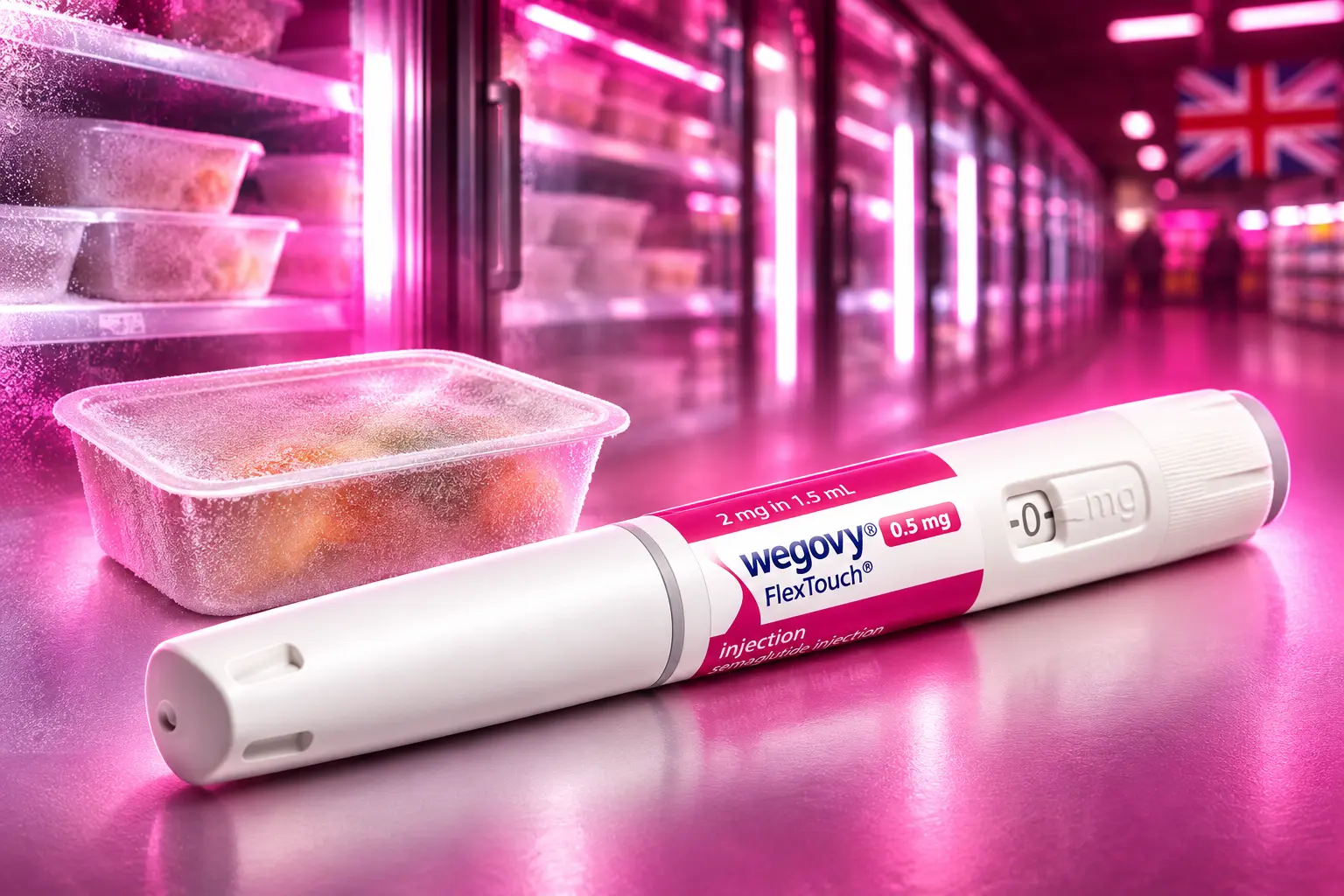
The £1bn Leaves Crisps for the Freezer
Worldpanel has tracked the effect on buying since March 2024. A June reading put the grocery gap at £780m. The August wave took it past £1bn. Spend and volume are falling at a similar rate overall, so this is not only a cheaper mix of the same shop. User households still spent £389 less than expected in the first year, a slightly smaller per-home gap than the £418 in the previous study, more than offset by the extra users.
WHERE THE BASKET MOVED
| Line | Worldpanel reading among user homes | What shifted |
|---|---|---|
| Crisps | Spend down 15% | Impulse snacking |
| Alcohol | Spend down 15% more than in non-user homes | Indulgence drinks |
| Frozen ready meals | Volume up 30% | Smaller, easier plates |
| Hot chocolate and malt drinks | Spend up 22%, volume up 16% | Soft everyday treats |
| Health and beauty | £78m more than expected in year one | Spend leaving grocery |
| Clothing and footwear | 30% of users said they spent more | Spend leaving grocery |
Crisp brands in England already face location limits on less-healthy promotions, and GLP-1 households are now buying 15% less of that aisle. Alcohol’s 15% figure is a gap against non-user homes, not the same cut as crisps, and it still points at the same end of the store: the treat that used to go in without a list.
Frozen Ready Meals Jump 30% Among Users
The specimen of the new shop is in the freezer. Volume of frozen ready meals among GLP-1 users is up 30%. That is portion control with the cooking already done, which matches a drug that makes a large, greasy plate sit badly and a small one easy to finish.
Hot chocolate and malt drinks are the stranger tell. Spend is up 22% and volume 16%, a rise Pattni has linked to people still wanting a small, easy treat. Treating in the old sense is down. A mug of malt is not a salad boom, and it is not a collapsed appetite either.
Too often, the GLP-1 impact is framed as a story about value or volume decline, but there’s a much more interesting story sitting behind this. From a grocery perspective, this new audience is being more mindful about what and how they eat. The key for retailers is how to support them, without isolating them.
Chantel Kennaugh, Head of Public Sector and Nutrition, Worldpanel by Numerator
Kennaugh’s practical list is blunt: clear labels for nutrients such as high protein, and ranges in smaller portion sizes. Protein is already a tight ingredient market, with whey protein prices already climbing as demand from people on the drugs collides with other uses of milk protein.
A Daily Pill Brought Men Into the Market
The grocery number jumped because the user base jumped, and the user base jumped because the product got easier for a group that had been slow to join. Pills were 11.2% of GLP-1 users in August, only weeks after the June 2026 clearance. Men nearly doubled, from 440,000 to 830,000, and now account for 32% of users.
THE UPTAKE CLOCK
- March 2024: Worldpanel begins tracking how GLP-1 drugs change grocery buying, the first of four waves.
- February 2026: 6.3% of Great Britain households contain a user; men are 23% of the group, or 440,000 people.
- June 2026: Tablet versions win MHRA approval; Worldpanel’s grocery-gap reading at this point is £780m.
- August 2026: The fourth-wave survey of 9,629 households finds 8.5% of homes, 2.6 million adults, 11.2% on pills and a grocery gap above £1bn.
- 19 November 2026: Worldpanel publishes the £1bn figure and forecasts that use will pass 10% of households in 2027.
Pattni’s line about a daily pill being easier than an injection is the mechanical fact behind that clock. A new male user is also a different shopper from the early cohort, which had been more female and more injection-led, and his snack and beer habits are the ones crisp and alcohol brands had treated as stable.
Morrisons Already Sells the Smaller Plate
The freezer jump did not wait for this survey. In January 2026, IGD recorded a trio of private-label ranges built for people eating less, with ready meals as the natural first bet because meal prep is hard when appetite first drops.
THE SMALLER PLATE ON SHELF
- Morrisons: A three-year Applied Nutrition licence for Morrisons Small and Balanced ready meals, sold with “GLP-1 friendly” flashes, at £3.75 and about 30% smaller than a standard meal, inside a 53-product high-protein set.
- Co-op: Good Fuel, with four mini meals aimed at GLP-1 users and five regular ready meals for a wider health shop, built around protein, slow-release carbs and vegetables.
- M&S: Nutrient Dense, 20 snacks, meals and salads at about £7, many around 400g, with fibre, protein and calories on the front, and no GLP-1 wording on pack.
Those Morrisons meals are about 30% smaller than the standard range, a pack-size cut, not the 30% extra frozen volume Worldpanel later measured among users. IGD also flagged Tesco grain bowls as part of the same convenient-health push. Applied Nutrition, the sports-nutrition firm behind the Morrisons licence, said revenue for the year to 31 July 2026 rose to £161.6m from £107.1m, with adjusted EBITDA of £43.3m against £30.9m, and it used the year to put a GLP-1-friendly high-protein food range into that supermarket.
One User Changes What the Whole House Eats
Worldpanel is counting British homes, which is the right unit. Tesco-owned dunnhumby, in a separate August 2026 survey of 8,500 adults across the United States, Canada, Mexico, Brazil, Colombia and Chile, found that each user influences 2.08 people, including themselves. That is why 10.2% of adults in those six markets who have ever used a GLP-1 drug become 21.3% of adults whose food and drink choices are shaped by the medicines.
The multiplier is largest in Brazil, where 14.4% have used the drugs and 33.3% say the medicines affect what they eat and drink, and it is almost as wide in the United States, at 16.7% ever-used and 31.7% influenced. Nearly half of ever-users, 45.6%, are no longer taking a GLP-1 drug, with drop-off highest in Chile at 66.7% and Mexico at 51%, against 39% in Canada and 40.2% in the United States. Current-user counts understate the grocery effect, because a lapsed user and a partner still living with the new plate keep buying differently.
Dunnhumby’s own summary is that a GLP-1 household shows up as a change across the whole basket, so the household is the unit to target. Britain’s 8.5% household figure is already in that logic. The 2.6 million adults are not 2.6 million isolated appetites.
Snack Makers Cannot Hedge a Smaller Appetite
The £389 a year that leaves the grocery trolley is not a windfall sitting in cash. Private GLP-1 courses cost more than that each month for many people who pay themselves, so the household budget is being rearranged twice: less food, a large new health bill, then extra in beauty and, for 30% of users, in clothes. Factories that booked potato, oil and sugar on last year’s snack volumes cannot hedge the appetite those volumes assumed.
Kennaugh’s 2027 working estimate is that GLP-1 use will pass 10% of Great Britain households. That is no longer a niche diet panel. It is a grocery planning assumption, and the crisp and alcohol volumes signed for that year already look large against the trolley Worldpanel measured in August.
Disclaimer: This article is news reporting on grocery and consumer research. It is for information only and is not medical advice, a recommendation to start or stop any medicine, or guidance on diet. Readers considering GLP-1 drugs such as Wegovy or Mounjaro, or changing how they eat while using them, should speak to a qualified doctor or pharmacist. Figures here come from Worldpanel by Numerator’s August 2026 survey, dunnhumby’s August 2026 Americas tracker and company statements, and later studies may revise them.

DK Metcalf’s Eye Poke Hits a Thin Steelers Season

The Canadiens Bet a Top Prospect on Dylan Larkin

Cassidy Blocks O’Neill and Leaves NSF Without a Director

Alpöge Posts a Riemann Hypothesis Proof Nobody Can Read

TSMC Pauses China Chips That SMIC Cannot Replace

Boston Scientific Cyberattack Leaves Hospitals Waiting on Implants

Xbox Sells Cloud Playtime Packs Ahead of November Caps

Guizhou Cave Cafes Spread When Each Cavern Fills

The Second Ned Stark Kit Lands When a Banner Dies

Satellites Saw Nepal’s Ice Slope Move Before the Flood
-
 NEWS3 months ago
Boston Scientific Cyberattack Leaves Hospitals Waiting on Implants
-
 GAMING4 weeks ago
Xbox Sells Cloud Playtime Packs Ahead of November Caps
-
 NEWS3 months ago
Guizhou Cave Cafes Spread When Each Cavern Fills
-
 GAMING3 months ago
The Second Ned Stark Kit Lands When a Banner Dies
-
 NEWS3 months ago
Satellites Saw Nepal’s Ice Slope Move Before the Flood
-

 NEWS3 months ago
OpenAI’s Jalapeño Chip Turns Watts Into Faster Agent Steps
-

 NEWS3 months ago
MLB Quiet Periods Copy a Freeze Other Leagues Use
-

 NEWS3 months ago
Roman Space Telescope Launches After a Decade-Long Budget Bet