
NEWS
Duffy Pins the FAA Ground Stop on a Contractor-Owned Network
A copper-to-fiber cutover on a contractor-owned analog network produced Friday’s nationwide FAA ground stop, then a $50.1 billion funding letter.

The FAA lifted a nationwide ground stop at 8:15 p.m. ET on Nov. 13 after a router flood hit 17 of 22 high-altitude centers. Every airborne flight landed. Passengers, airlines, and a funding fight that grew by $20 billion took the hit.
The trigger was a daytime copper-to-fiber cutover by L3Harris Technologies at a radio site in El Dorado, Arkansas, on the analog telecom layer the agency uses to talk to airplanes and see them on radar.
Seventeen Centers Went Unstable After a Router Flood
Transportation Secretary Sean Duffy said instability hit radar and communications at 3:36 p.m. ET on Nov. 13, at En Route Centers and at TRACONs, the facilities that handle arrivals. The FAA’s Air Traffic Control System Command Center then issued Advisory 111 at 3:54 p.m. ET, holding all U.S. departures for “extraordinary circumstances and for reasons of safety.” About 3,500 aircraft were already airborne. Inbound international flights were handled case by case. Military, medical, and law-enforcement flights kept moving.
The agency later said its old gear on the FAA Telecommunications Infrastructure, or FTI, became unstable when data flooded the network at a rate of 1,000 connection attempts every 4 to 5 seconds. That scramble disrupted controller-to-pilot radio and some radar feeds. It was not a full blackout. Some frequencies and radar pictures stayed usable, which is why the planes already up could still be talked down.
THE FLOOD IN NUMBERS
- Centers hit: Instability began at 17 of 22 Air Route Traffic Control Centers and spread into several TRACONs.
- The rate: More than 1,000 connection attempts every 4 to 5 seconds hit the FTI network.
- Aircraft up: About 3,500 flights were in the air when the stop was issued, and the FAA says every one landed.
- The sites: Investigators pointed at a radio site in El Dorado, Arkansas, and a radar site in Amarillo, Texas.
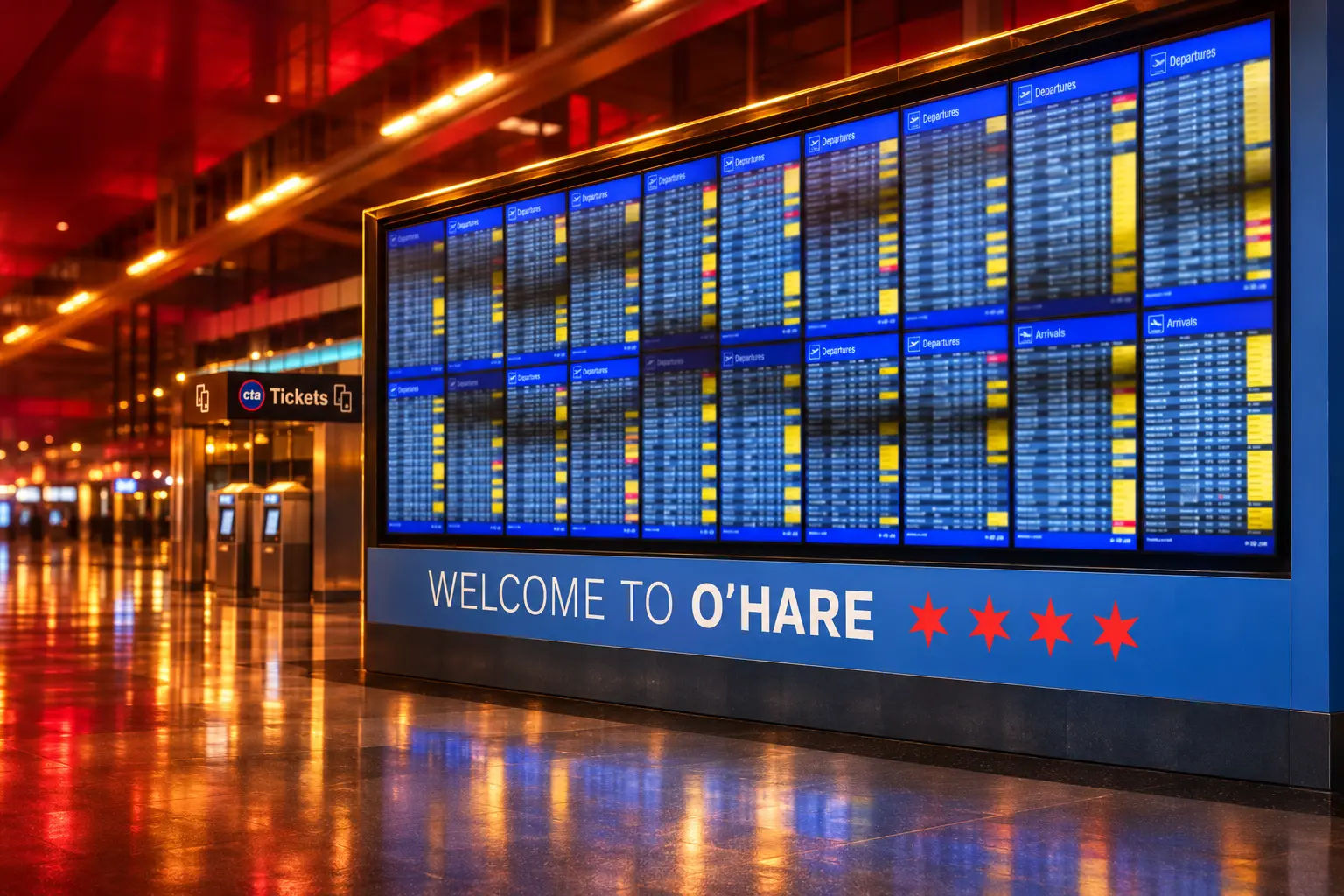
Chicago O’Hare and Midway had already posted equipment-outage ground stops in the mid-afternoon, about 50 minutes before the national order. Canada felt the U.S. flow control too: Toronto departures bound for U.S. centers were held from 5:08 p.m. to 6:15 p.m. ET even though Nav Canada’s own operation stayed up.
Homeland Security Secretary Markwayne Mullin said there was no indication of a cyberattack. The FAA’s Sunday Q&A repeated that finding, based on the evidence it had. Duffy said that once crews isolated the remote work, the rest of the system came back, which is why he does not believe a hacker did this. The FBI was later invited into the lab work in Florida so that conclusion can be checked, not so it can be treated as closed theater.
L3Harris Owns the Network the FAA Flies On
Duffy named the contractor the next day. L3Harris has been the FAA’s telecom provider for more than 20 years. The copper line being moved was so old it was being taken out of service, so the crew had to switch it from analog TDM to digital IP, copper to fiber, in daylight at a remote site.
In at least one of our remote FAA locations, a contractor was doing routine maintenance to switch telecommunication lines from old copper wire and they were bringing it over to fiber. That contractor that does the work for us is L3Harris. They’re our legacy provider. They’ve been working for the FAA for over 20 years, and the network that we use at the FAA to control the airspace, L3Harris actually owns that network.
Sean P. Duffy, U.S. transportation secretary, Nov. 14, 2026 briefing
On Saturday he said L3Harris actually owns that network the agency uses to control the airspace. That is the load-bearing fact under Friday’s mess. The FAA is a renter on the circuit that carries en-route voice and radar. FAA Administrator Bryan Bedford put a price on keeping the old layer alive. He said the agency spends $1 billion a year maintaining the 1980s TDM network he called 1G, and that crews have been swapping about 2,000 Cisco 600 routers for Juniper units as ordinary upkeep, not as part of the $12.5 billion modernization run with Peraton.
NOW: Air travel update from USDOT HQhttps://t.co/mbCWxKPm6O
— Secretary Sean Duffy (@SecDuffy) November 14, 2026
L3Harris said it is supporting the investigation and takes the stop and its effect on travelers, airlines, and controllers seriously. Hewlett Packard Enterprise, which owns Juniper Networks, said the device worked as the installer had configured it and did not fail on its own. Duffy has framed the remaining choice as installer error or a bad router. HPE’s line pushes the live question toward how the unit was set up, and toward how a single remote cutover was allowed to talk to so much of the analog backbone at once.
WHAT WE KNOW
- The flood: Old FTI gear became unstable after a data flood tied to work at El Dorado, with Amarillo also in the first look.
- The isolation: L3Harris blocked those two locations, the network steadied, and the FAA disabled the broadcasting function on the new routers.
- The pause: The same function was turned off on more than 60 other Juniper routers, and new installs were halted.
WHAT IS UNCONFIRMED
- The fault: Duffy has not said whether the crew, the configuration, or the box itself started the flood.
- The contract: Talk that L3Harris has already been dismissed is unverified; as of midweek the firm was still the contractor in the probe.
Bedford was blunt about what Friday was not. He said the El Dorado job should not be mixed up with the Peraton modernization funded by the 2025 down payment, and that none of the towers already upgraded under that money went down. The FAA’s Q&A said the same about SMART, the new prompt tool some people tried to blame on Friday night. Duffy said SMART is not even plugged into the control loop. A human still has to accept or reject any prompt it might one day offer.
From 3:54 p.m. Until the Airspace Reopened
The stop itself ran 4 hours and 21 minutes, from the 3:54 p.m. ET advisory to the 8:15 p.m. ET reopening. Duffy had already watched the airborne count fall from about 3,500 to fewer than 400 as crews used the procedures they train for when radio and radar go intermittent. Fort Lauderdale and Reagan National closed to diversions while recovery ate the leftover capacity. At Los Angeles and Austin, landed jets sat on taxiways waiting for gates that were still full.
FRIDAY, NOV. 13 ON THE CLOCK
- 3:36 p.m. ET: Duffy says radar and radio data go inconsistent at centers and TRACONs.
- 3:54 p.m. ET: The Command Center issues Advisory 111 and holds all U.S. departures.
- About 6 p.m. ET: The FAA begins staged releases through the Command Center as individual facilities steady.
- 8:15 p.m. ET: Duffy says the agency has opened the airspace at 8:15 p.m. ET, with crews and aircraft still out of place.
Reopening the sky did not reopen the schedule. Duffy told people stuck in terminals to check with their airline, because a legal crew and a legal airplane had to be in the same city before anyone pushed back. The department said more than 8,000 flight operations still got off the ground Friday night after the lift. The rest spilled into Saturday.
Airlines Canceled 12,462 Flights on Friday
The FAA’s own count is the one that should travel. Operators canceled approximately 12,462 flights on Friday, Nov. 13, including 9,082 cancellations by major airlines, and the agency said not every one of those was caused by the ground stop. FlightAware, on a separate tally, counted more than 4,000 U.S. cancellations as of Saturday morning, then 2,291 as of 3 p.m. ET Sunday as airlines kept ferrying aircraft and crews back onto the map.
Bedford said Saturday that the worst was behind the system and that airline partners expected full schedule integrity by the close of business Sunday, Nov. 15. Duffy, speaking Sunday, said things would look normal that day and probably be fully normal Monday. Those were recovery targets, not a finding that Friday had been cheap. Aircraft ended the night in the wrong cities. Pilots and flight attendants timed out. A passenger with a boarding pass on Friday evening often had no seat until Saturday, and sometimes Sunday.
Because the stop was an FAA safety order, not an airline mechanical, the usual hotel-and-meal courtesy many travelers expect after a carrier-caused cancel did not automatically apply. Cash refunds still follow a canceled ticket under the department’s passenger rules, but that money does not put someone in a hotel at midnight. The human cost sat in concourses, on hold with apps, and in the Duffy household too: he has said he would rather see his own family kept on the ground than sent up on uneven radio.
Three Nationwide Stops in 25 Years
Nationwide ground stops are the tool the FAA uses when it no longer trusts the common picture. The last time the whole country heard that order for a technical failure was Jan. 11, 2023, when the Notice to Air Missions database, the hazard feed pilots must check before takeoff, went bad overnight. The January 2023 NOTAM ground stop was lifted less than two hours after it was put in place, and more than 1,300 flights were canceled. The FAA later said contract staff at Spatial Front had unintentionally deleted files while trying to sync a live database with a backup. There was no finding of a cyberattack then either.
Friday’s stop was longer, hit a different layer, and arrived with 3,500 airplanes already up. The 2023 failure was a briefing product. The 2026 failure was the voice-and-radar pipe between controllers and those airplanes. The only other nationwide stop in that 25-year span is Sept. 11, 2001, which was not a tech outage.
THE THREE NATIONWIDE STOPS
| Date | What failed | Stop length | Cancellations |
|---|---|---|---|
| Sept. 11, 2001 | National airspace closed after the attacks | The original nationwide ground stop | Not a technical outage |
| Jan. 11, 2023 | NOTAM database files deleted in a backup sync | Less than two hours | More than 1,300 |
| Nov. 13, 2026 | FTI router flood on analog TDM gear | 4 hours and 21 minutes | 12,462 Friday (FAA; not all from the stop) |
The pattern underneath those rows is contractor work on a brittle common service. In 2023 it was a file on a backup. In 2026 it was a router on a network the FAA does not hold title to. Both times the safe move was also the expensive one: hold departures, land what is up, and accept a multi-day untangle.
Why Was the Cutover Done in Daylight?
That is the question the FAA put in its own Q&A, because everyone else asked it first. Maintenance at big centers is supposed to happen at night, when traffic is thin. Friday’s job was at a remote radio site, the kind of cutover the agency says has been done for decades in daylight without taking down the country. Duffy said that if the same work were happening at Newark or another large facility, it would have been a night job. He also said no one planned for a remote router to flood the rest of the analog plant, which is why it was not held for overnight.
After Friday, the agency said it will reevaluate when replacement work gets done. That is a scheduling change, not a new architecture. Bedford’s $1 billion-a-year TDM bill is the reason these cutovers keep happening at all. Phone companies retired copper. The FAA is still paying to keep pieces of it alive until a fiber pair is hot, and the remaining copper is being disconnected because it is too old to leave in place. The conversion is the modernization people can see. It is also, on Nov. 13, the thing that knocked 17 centers unstable.
Officials spent the weekend separating Friday from a cluster of other outages the same week, including a Microsoft 365 incident Mullin said he saw no reason to connect. The FAA’s evidence points at a router flood on old gear, not at a coordinated hit on American infrastructure. The harder operational fact is narrower. A remote cutover on a contractor-owned analog network was still able to saturate en-route communications. That is a design problem, and it is the one Duffy took to the Senate.
Congress Gets a $50.1 Billion Letter
Congress already gave the department a $12.5 billion down payment in 2025 for the Brand New Air Traffic Control System. Duffy said Saturday that, with that money, the FAA has replaced 69 percent of its copper communications with high-speed fiber, put surface-awareness displays in 143 towers, converted 469 radio sites, moved 25 towers off paper flight strips, installed 224 IP voice-switch systems, added 18 tower simulators, and fielded nine SMR4 surface-movement radars. He called that a partial payment. On Nov. 12, the day before the stop, Duffy and White House budget director Russell Vought had asked appropriators for $30.1 billion more, in line with a bill from Sen. Eric Schmitt, R-Mo.
After the airspace reopened, the number moved. On Nov. 17, Duffy, Bedford, and Vought sent House and Senate appropriators a letter asking for $50.1 billion.
THE $50.1 BILLION ASK
- Modernization: $10.1 billion, including $7.2 billion for a common automation platform and controller workstations, $2 billion for cloud computing and NAS telecom, $600 million for flow-management tools, and $300 million to consolidate terminal facilities.
- Airport grants: $10 billion for Airport Improvement Program and Airport Terminal Program awards.
- Terminals: $10 billion to rebuild aging terminals.
- En route centers: $10 billion toward as many as five new consolidated Air Route Traffic Control Centers.
- Towers: $10 billion for construction, replacement, or improvement of up to 140 FAA-owned towers.
That is a $20 billion jump from the Nov. 12 request, most of it in new centers and towers rather than in the telecom layer that failed on Friday. Senate Republicans who sat with Duffy on Nov. 17 said they would not write a blank check and asked for a breakdown they could defend. Duffy has said he wants a telecom network that is not owned by L3Harris, built with carriers such as AT&T, Verizon, and Lumen. He has also said the FAA will reevaluate daytime cutovers and that Juniper installs stay paused while the El Dorado router sits in an L3Harris lab in Florida, with FAA staff present and the FBI invited in.
The stop is over. The analog network that failed is still the one moving traffic, minus two blocked sites and more than 60 Juniper units with their broadcast function turned off. Thanksgiving falls on Nov. 26. The $50.1 billion letter is on the appropriators’ desk, and the router that flooded the sky is in Florida.

Duffy Pins the FAA Ground Stop on a Contractor-Owned Network

Microsoft Tested Its Gateway Fix on the Wrong Machines

Firaxis Cuts a Third of Its Staff as XCOM Slips

The New Chip Rule Favors US Cloud Parents in Asia

European Unions Ask Players to Police GenAI They Cannot See

Boston Scientific Cyberattack Leaves Hospitals Waiting on Implants

Xbox Sells Cloud Playtime Packs Ahead of November Caps

Guizhou Cave Cafes Spread When Each Cavern Fills

The Second Ned Stark Kit Lands When a Banner Dies

Satellites Saw Nepal’s Ice Slope Move Before the Flood
-
 NEWS3 months ago
Boston Scientific Cyberattack Leaves Hospitals Waiting on Implants
-
 GAMING4 weeks ago
Xbox Sells Cloud Playtime Packs Ahead of November Caps
-
 NEWS3 months ago
Guizhou Cave Cafes Spread When Each Cavern Fills
-
 GAMING3 months ago
The Second Ned Stark Kit Lands When a Banner Dies
-
 NEWS2 months ago
Satellites Saw Nepal’s Ice Slope Move Before the Flood
-

 NEWS3 months ago
OpenAI’s Jalapeño Chip Turns Watts Into Faster Agent Steps
-

 NEWS3 months ago
MLB Quiet Periods Copy a Freeze Other Leagues Use
-

 NEWS3 months ago
Roman Space Telescope Launches After a Decade-Long Budget Bet