
BUSINESS
Unilever Must Fix Mixes to Keep the McCormick Deal Moving
The CMA wants Unilever and McCormick to fix a UK dry-mix and sauce overlap the Colman’s sale does not cover.

Britain’s Competition and Markets Authority has told Unilever and McCormick to unwind a UK overlap in dry cooking mixes and dry sauces, or take the $44.8 billion food sale into a full probe. The companies had until 18 November to offer undertakings. The brand Unilever has already put on the block, Colman’s, belongs to mustard, a market the CMA has already cleared.
Mixes and Pour-Over Sauces Are the Problem
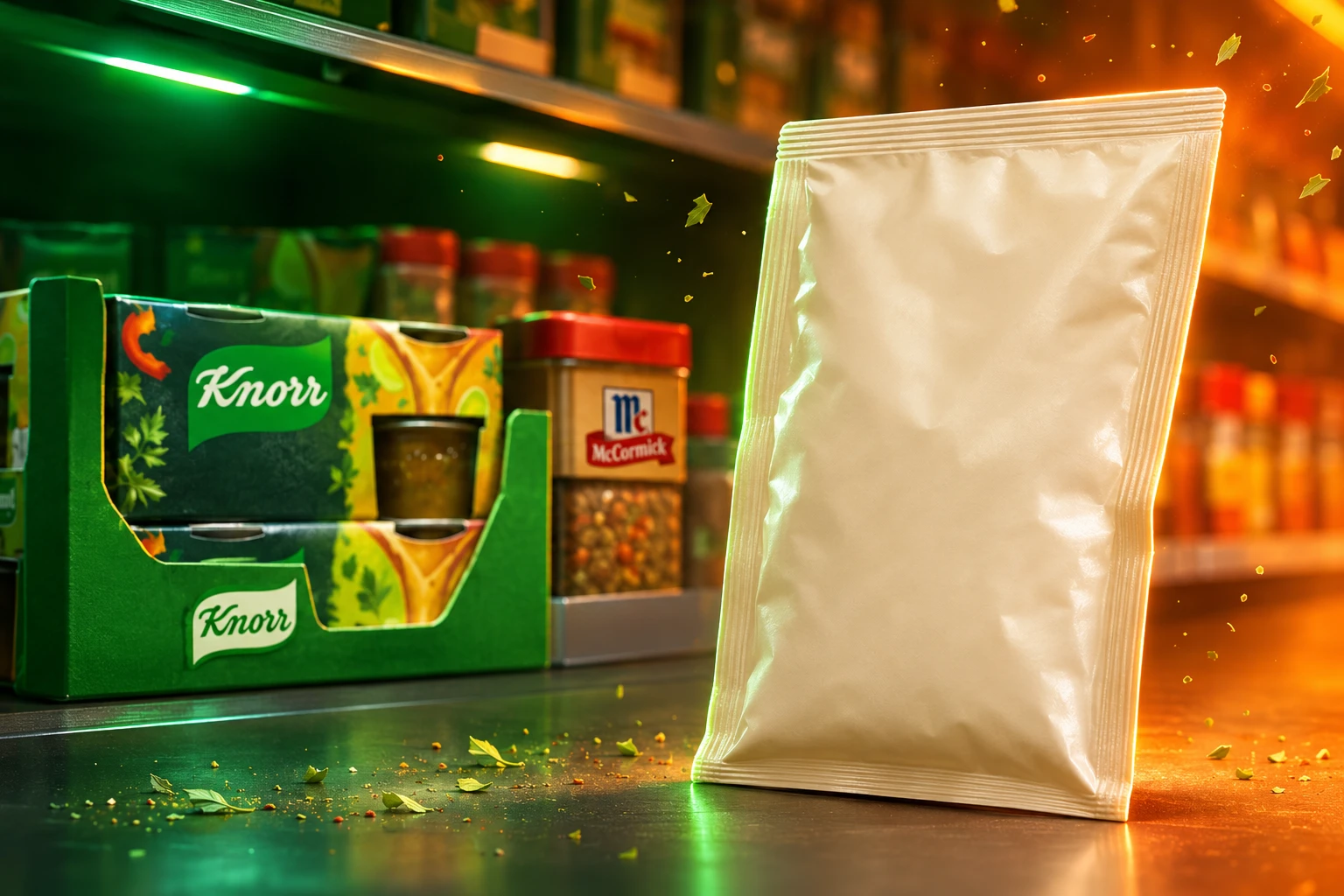
On 11 November the CMA published a Phase 1 finding that McCormick’s purchase of most of Unilever Foods creates a realistic prospect of a substantial lessening of competition in two UK grocery supplies: dry ingredient mixes, such as chilli con carne sachets, and dry sauces, such as parsley sauce, sold to retailers. McCormick sells those lines in Britain under Schwartz. Unilever Foods sells them under brands including Knorr.
The regulator said the deal would combine the two largest branded suppliers in both categories and that the merged group would be the largest in each “by far.” It also said the two firms compete closely in those aisles. The CMA holds jurisdiction because UK turnover at both McCormick and Unilever Foods exceeds £100 million ($132.6 million).
HOW THE CMA SPLIT THE UK SHELF
| UK supply to retailers | Unilever Foods | McCormick | Phase 1 finding |
|---|---|---|---|
| Dry ingredient mixes | Knorr and other Unilever mix lines | Schwartz | SLC risk; two largest branded suppliers |
| Dry sauces | Unilever dry pour-over sauces | Schwartz | SLC risk; two largest branded suppliers |
| Mustard | Colman’s (English), Maille (French) | French’s (American) | Cleared; separate product markets |
Those two live markets are narrow, which is why they can still delay a global food combination. Hellmann’s mayonnaise, Frank’s RedHot and the rest of the flavour portfolio were not the problem the CMA named.
The Merger will combine the two largest branded suppliers and the Merged Entity will be the largest supplier of dry ingredient mixes and dry sauces by far.
Competition and Markets Authority, Phase 1 decision summary, 11 November 2026
The Watchdog Already Cleared Mustard
Unilever put the Colman’s brand and assets on the market in August to head off competition objections. A spokesperson called the 11 November ruling “an expected step in the regulatory process” and said talks with potential Colman’s buyers were “progressing well.” People close to the talks said Unilever would offer that Colman’s sale as its only formal undertaking on 18 November.
The CMA had already taken mustard off the worry list. McCormick sells American-style mustard under French’s. Unilever sells Colman’s English mustard and Maille’s French style. Evidence from major supermarkets showed shoppers do not treat those three as substitutes, so each type is a separate product market and the parties do not overlap. Retailers told the CMA it is important to stock each type. No supermarket raised a concern that power in one mustard style would be used to harm rivals in another.
Selling Colman’s can still be a clean commercial exit. It does not, on the CMA’s own market map, separate Knorr from Schwartz in dry mixes or dry sauces. A Colman’s deal would still leave the combined group with Knorr, Schwartz, French’s and Maille.
WHAT WE KNOW
- The SLC finding: Phase 1 identified a realistic prospect of harm only in dry ingredient mixes and, separately, dry sauces.
- Mustard: The CMA found no realistic prospect of competition concerns in that category.
- The deadline: Undertakings in lieu of a reference were due by 18 November.
WHAT IS UNCONFIRMED
- The formal offer: The CMA has not posted whether it received, or accepted, undertakings that cover mixes and sauces.
- Phase 2: The case page still lists the inquiry as open, with a reference unless acceptable undertakings are in.
McCormick said it was working constructively with the watchdog and remained confident of a timely closing. The CMA declined to comment on the 18 November talks.
Maggi, Bisto and Own-Label Barely Count
The CMA looked at who else sits on those two fixtures and decided they would not hold the combined group in check. Nestlé’s Maggi competes in dry ingredient mixes. Premier Foods’ Bisto competes in dry sauces. Supermarket own-label ranges compete in both. The finding was that this group imposes “only a limited constraint.”
WHY THE CMA SAW LITTLE PUSHBACK
- Share of shelf: The merged firm would be the largest branded supplier in both categories by a wide margin.
- Close rivalry: Schwartz and Unilever’s mix and sauce lines already compete with each other, so the deal removes a direct branded alternative.
- Private label: Own-brand and Maggi or Bisto exist, but the CMA said they do not constrain the parties enough.
- New entry: Limited supermarket shelf space and the well-established position of the parties and private label make entry or expansion hard. The CMA saw no growth in these markets that would let a newcomer fill the gap.
That last point is what turns a small UK grocery overlap into a closing risk. If no new mix brand is likely to appear, the only Phase 1 exit is a sale or spin of the overlapping lines.
Who Would Buy the Overlap Brands?
A CMA-forced sale in UK dry mixes or dry sauces would be a small branded cooking-aids business peeled off a much larger food combination, the kind of asset a mid-size manufacturer or a private-label specialist rarely gets offered except under regulatory pressure. Hellmann’s, the core Knorr pantry range and McCormick’s global spice system would still go through. The leftover would be the Schwartz mix-and-sauce franchise, a Knorr dry-mix bundle, or some mix of the two that restores a branded rival on those fixtures.
Unilever is already running a sale process for Colman’s, which shows it will trade a UK icon to keep the wider deal moving. That auction does not answer the CMA’s mixes question unless the buyer also takes the dry-mix and dry-sauce volumes the watchdog treated as the close rivalry. The British issue is the seasoning aisle, not the size of the global combination. A chilli mix and a parsley sauce are cheap, repeat grocery items with little room for a new brand to force its way onto a crowded bay.
Premier Foods already owns Bisto. Nestlé already owns Maggi. Either could be a logical trade buyer in theory. So could a UK own-label supplier that wants a branded door into the same fixture. No bidder has been named for a mixes remedy, and the CMA has not said which legal entity would have to be sold. Until that perimeter is written down, McCormick cannot be sure what UK cooking-aids business it actually keeps.
Dutch Sausages Came Off the Package First
Unilever is already living with a national food regulator taking a beloved brand off a disposal. On 27 October the Netherlands Authority for Consumers and Markets gave no approval for the Unox takeover by Zwanenberg Food Group. The ACM said Zwanenberg would become almost the only large supplier of smoked and boiled sausages, including knackwurst, to Dutch supermarkets, and would be too strong in ambient soups, with shares of about 60 to 85 percent.
We wish to prevent individuals from being confronted with higher prices as a result of this planned acquisition. That is an undesirable prospect, especially in a time when the public already has many concerns about higher food prices.
Martijn Snoep, chair of the ACM board
Zwanenberg offered to sell production lines to seed a new rival. The ACM said the proposed buyer lacked enough boiled-sausage capacity, the plans were too vague, and the buyer would still depend on Zwanenberg for the first two years. Unilever said it was disappointed and would review next steps. The Unox sale had been agreed in late 2024 and sat outside the McCormick combination, which already excludes Lipton drinks, Unilever’s lifestyle nutrition business, Buavita, and operations in India, Nepal and Portugal.
The pattern is the same even though the products are not. A national watchdog picks a local staple, finds the buyer would be too strong in that staple, and rejects a remedy that does not recreate a real competitor. In the Netherlands that staple was rookworst and soup. In Britain it is dry mixes and pour-over sauces. Colman’s mustard is the brand Unilever prepared to sell, and it is not the staple the CMA named.
Cash, Equity and a Mid-2027 Close
Unilever and McCormick announced the combination on 31 March 2026. The companies put an enterprise value of $44.8 billion on Unilever Foods. Unilever is to receive $15.7 billion in cash, subject to closing adjustments. Unilever shareholders would own 55.1 percent of the enlarged group, McCormick shareholders 35.0 percent, and Unilever 9.9 percent. Combined fiscal 2025 revenue was put at $20 billion. The companies expect about $600 million of annual cost synergies by the end of year three. Completion is aimed at mid-2027, after McCormick shareholder approval, works-council consultation, and merger clearances.
McCormick chief executive Brendan Foley and chief financial officer Marcos Gabriel would lead the combined group from Hunt Valley, Maryland, with an international headquarters in the Netherlands and a planned secondary listing in Europe. Foley said the Unilever Foods portfolio complements McCormick’s flavour business and that together the firms would be “better positioned to accelerate growth in attractive categories.” Unilever chief executive Fernando Fernandez called the sale another step toward a pureplay home and personal care company, with about €39 billion of fiscal 2025 revenue after Foods leaves. Unilever also flagged €6 billion of share buy-backs between 2026 and 2029, funded in part by the cash.
The food arm Unilever wants off its books is not growing much. Unilever Foods made €3.1 billion ($3.4 billion) in the third quarter of 2026, with underlying sales growth of 0.1 percent. In 2025 the division made €12.9 billion, with underlying sales growth of 2.5 percent, about 26 percent of group turnover. McCormick reported net sales of $6.84 billion for the fiscal year ended 30 November 2025, up 2 percent. A long UK Phase 2 would keep that slow Foods line inside Unilever past the point Fernandez has sold to investors as a clean split.
THE REGULATORY CLOCK
- 31 March 2026: Unilever and McCormick announce the Foods combination.
- 21 July to 5 August 2026: The CMA invites comments on the UK impact.
- August 2026: Unilever markets Colman’s to address potential competition concerns.
- 16 September 2026: The CMA launches its formal inquiry.
- 5 October 2026: The US pre-merger waiting period ends by early termination.
- 27 October 2026: The ACM blocks the Unox sale to Zwanenberg.
- 11 November 2026: The CMA finds an SLC risk in dry mixes and dry sauces and clears mustard.
- 18 November 2026: Deadline for undertakings in lieu of a UK reference.
The Federal Trade Commission granted early termination of the Hart-Scott-Rodino waiting period on 5 October, so the US pre-merger filing is no longer the live gate. Britain is. The CMA opened its formal inquiry on 16 September after the summer comment window, which put the combination on the UK phase 1 inquiry clock that now turns on whether a mixes-and-sauces remedy is on the table. Its case page, last updated on 11 November, still says the merger will be referred for an in-depth phase 2 investigation unless the parties offer an acceptable undertaking. Unilever said it continues to make good progress on approvals globally and still expects a timely closing.
A Phase 2 inquiry would not kill the deal on its own. It would keep Knorr and Schwartz under examination in the two UK categories the CMA has already called too concentrated, while Colman’s, the brand Unilever was ready to sell, sits in a mustard market that is no longer in dispute.

DK Metcalf’s Eye Poke Hits a Thin Steelers Season

The Canadiens Bet a Top Prospect on Dylan Larkin

Cassidy Blocks O’Neill and Leaves NSF Without a Director

Alpöge Posts a Riemann Hypothesis Proof Nobody Can Read

TSMC Pauses China Chips That SMIC Cannot Replace

Boston Scientific Cyberattack Leaves Hospitals Waiting on Implants

Xbox Sells Cloud Playtime Packs Ahead of November Caps

Guizhou Cave Cafes Spread When Each Cavern Fills

The Second Ned Stark Kit Lands When a Banner Dies

Satellites Saw Nepal’s Ice Slope Move Before the Flood
-
 NEWS3 months ago
Boston Scientific Cyberattack Leaves Hospitals Waiting on Implants
-
 GAMING4 weeks ago
Xbox Sells Cloud Playtime Packs Ahead of November Caps
-
 NEWS3 months ago
Guizhou Cave Cafes Spread When Each Cavern Fills
-
 GAMING3 months ago
The Second Ned Stark Kit Lands When a Banner Dies
-
 NEWS3 months ago
Satellites Saw Nepal’s Ice Slope Move Before the Flood
-

 NEWS3 months ago
OpenAI’s Jalapeño Chip Turns Watts Into Faster Agent Steps
-

 NEWS3 months ago
MLB Quiet Periods Copy a Freeze Other Leagues Use
-

 NEWS3 months ago
Roman Space Telescope Launches After a Decade-Long Budget Bet