
NEWS
Ryanair Mayday Followed a Diversion Manchester Should Have Taken
A Ryanair 737 landed at Manchester with 363 kg after the airport it had chosen as its safe alternate first refused the diversion.

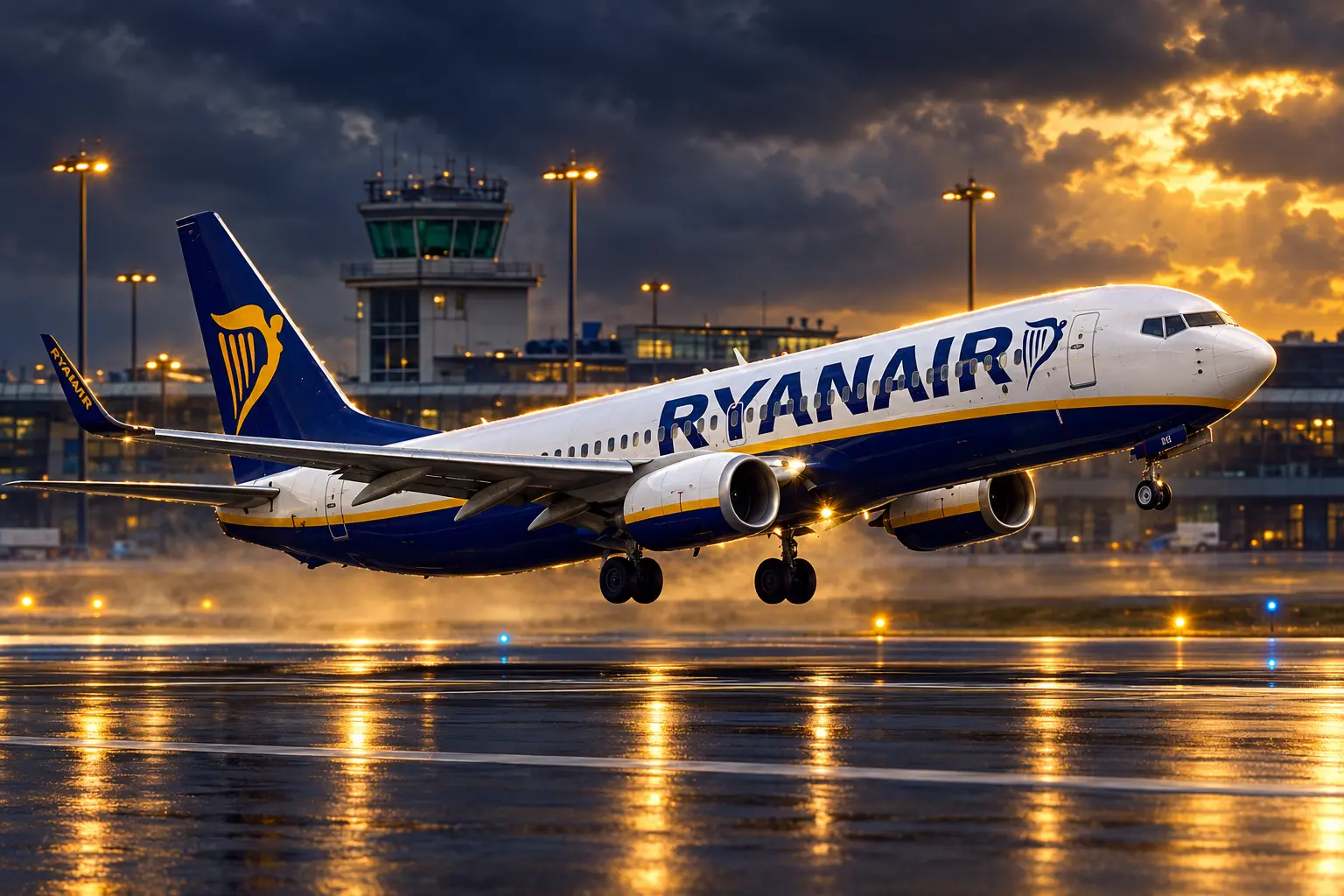
A Ryanair Boeing 737-800 landed at Manchester Airport with 363 kg of fuel after three windshear go-arounds and a refused diversion. The Air Accidents Investigation Branch published that finding on 24 September 2026. The jet, 9H-QBD, had been flying Malta Air’s FR3418 from Pisa to Prestwick on 3 October 2025 with 171 passengers and six crew, and nobody was hurt.
Manchester was the crew’s chosen weather backup from the start. It was also the airport that first said no, against its own rules, and the airport they still aimed for once the tanks were below the last half-hour of fuel.
Battered by Storm Amy and beset by miscommunication at Manchester Airport, this flight landed with just 363 kg of fuel remaining. Final reserve fuel should be 1,100 kg or greater. Read more: https://t.co/EbMZiKC6Ap https://t.co/q9z2W6j1Bk pic.twitter.com/RPAejvJm38
— Flightradar24 (@flightradar24) September 25, 2026
The Crew Loaded Extra Fuel and Still Ran Short
Storm Amy, the first named storm of the season, sat near Cape Wrath at 952 hPa by 1800 hrs. The operator had sent a storm pack of four safety bulletins the day before, then an email on the morning of the flight telling crews to take fuel for the furthest alternate and to add captain’s extra fuel. Both pilots planned at home, then compared notes at Pisa, and they swapped the company pick of Glasgow for Manchester because the weather there looked better.
The operational flight plan had shown 9,563 kg with 991 kg for Glasgow. Manchester needed 1,606 kg, another 615 kg, and the commander loaded 1,322 kg on top of that. Discretionary fuel came to 1,937 kg and the planned uplift to 11,500 kg, about 1 hour 12 mins of extra flying. Just before taxi the tanks actually held 11,671 kg. They still expected to use Prestwick’s shorter Runway 20, because the crosswind on the long runway sat outside limits, and that landing-weight cap is what stopped them taking more.
Departure was due at 1415 hrs UTC and slipped to 1528 hrs, with the 33-year-old commander flying. The first hours were quiet. Prestwick’s surface wind on the first approach was 240 degrees at 29 kt, gusting 45 kt, and both pilots talked about the turbulence. Autopilot and autothrottle came off at about 1,200 ft. At 264 ft a windshear siren and a “windshear, windshear, windshear” call fired, and they climbed away.
FUEL REMAINING ON 9H-QBD
| Stage of flight | Fuel on board |
|---|---|
| Start of first Prestwick approach | 4,725 kg |
| First go-around | 4,608 kg |
| Second go-around | 3,515 kg |
| Leaving the hold for Edinburgh | 2,900 kg |
| Third go-around at Edinburgh | 2,164 kg |
| Mayday, leaving Edinburgh | 2,036 kg |
| Touchdown at Manchester | 363 kg |
| Engine shutdown on stand | 240 kg |
The operator’s final reserve for the flight was 1,101 kg, equal to 30 minutes at holding speed. The field investigation bulletin on 9H-QBD puts every one of those tank readings against that floor.
Manchester Turned the Jet Away
They held at Turnberry at 6,000 ft and watched another 737 land, that crew reporting a 25 kt speed loss at 500 ft. Company rules said a second missed approach meant a diversion. They told Prestwick that if they went around again, “we go straightforward to manchester.”
The second approach felt smoother. Instant wind was 230 degrees at 34 kt, gusting 46 kt. Around 50 ft the warning fired again. During the climb, air traffic said Manchester could not take them, and nobody gave a reason.
THE MANCHESTER REFUSAL, MINUTE BY MINUTE
- 1822 hrs: The crew tell Prestwick they will go to Manchester if the second approach fails.
- 1829 hrs: Manchester air traffic calls Airfield Control for a decision.
- 1834 hrs: Airfield Control says the handling agent cannot accept the diversion.
- 1837 hrs: The refusal reaches the pilots, with no reason attached.
Manchester’s written rule was to take a divert if there was a parking stand, and to take every declared emergency. Airfield Control, not a handling agent, was supposed to make that call. The Excess Parking Plan was not in force, yet the airport had already taken 19 diversions because of Storm Amy. The handling agent later told investigators it was policy to accept this operator’s aircraft. There was no record of the call between Airfield Control and the agent, so the AAIB could not reconstruct the “no.”
Other crews flying that afternoon treated Manchester as the weather hole too. A veto that the airport’s own paperwork did not allow therefore mattered beyond this one 737, because it closed the field everyone else already saw as the safe turn south.
A Third Windshear Warning Forced the Mayday
Glasgow’s ATIS was reporting windshear on finals. They asked for Edinburgh six minutes after the Manchester refusal, then waited another five minutes for a yes. While they waited they talked about calling “fuel minimum” or a mayday to force Manchester open, and agreed the tanks did not yet meet the company test for an emergency. They did not tell the airline they were diverting, saying the workload was too high until they were on the ground, and they had no plan for a go-around at Edinburgh.
Edinburgh’s wind was 240 degrees at 34 kt, gusting 46 kt. Approach said no landing aircraft had reported windshear. On passing 745 ft the third warning fired. They climbed away with 2,164 kg. They now had about 2,100 kg, and they worked out that reaching Manchester with the 1,101 kg reserve still intact would take 2,800 kg. Their own sums said they would arrive with 500 to 700 kg. The co-pilot put Manchester in the flight computer, which predicted 300 kg on landing. That number is what triggered the distress call, at 1912:34 hrs.
we had another windshear also here, so we have er mayday mayday mayday fuel
Commander of 9H-QBD, radio to Edinburgh ATC, 3 October 2025
He added that they were afraid of another warning and wanted to go to Manchester at once, “it was denied before.” Edinburgh sent them south, climbing to FL230. Once the routing was in the computer the predicted arrival fuel rose to 900 to 1,000 kg, then fell again in the climb. They knew they would not have fuel for another go-around. A low-fuel alert on the left tank came on at 1924:26 hrs; they saw it, skipped the checklist because the cause was obvious, balanced the tanks, and then the right tank alerted too.
Newcastle Sat Closer With a 22 kt Wind
Newcastle was already in the 57-page briefing pack as an alternate, even though that pack had no forecast printed for it. At the moment they turned for Manchester, Newcastle’s wind was 290 degrees at 22 kt. They did not discuss it, and they did not discuss turning back to Edinburgh either. The AAIB said they were loaded with the approach and the wind, and that Manchester had been the preferred alternate from the outset, which “is possible” shaped the choice.
WINDS WHEN THE CREW HAD TO PICK A RUNWAY
| Airport | Wind the crew faced |
|---|---|
| Prestwick | Gusts to 56 kt; two windshear warnings |
| Edinburgh | Gusts to 54 kt; one windshear warning at 745 ft |
| Manchester | Maximum gust 37 kt on the evening |
| Newcastle | 290 degrees at 22 kt, unused |
Manchester’s calmer wind is why they wanted it in the first place, and why they still wanted it with the tanks already below reserve. The commander’s view, given later, was that another Edinburgh approach could leave them with no option except to fly through a windshear warning to get on the ground. Manchester, he judged, was the safer bet even if it meant landing under 1,101 kg. They touched down on Runway 23R at 1952 hrs with 363 kg. Taxi and shutdown took that to 240 kg.
During the earlier go-arounds, fuel flow at go-around power reached about 3,600 kg/hr per engine, 120 kg/min for both. At that rate the 363 kg on the wheels was about three minutes. The AAIB said it is unlikely there would have been enough for another go-around at Manchester. The whole diversion, from the first Prestwick warning to the Manchester landing, lasted 1 hour 45 minutes.
What Final Reserve Fuel Is Meant to Protect
UK and ICAO rules treat two radio calls as different tools. Minimum fuel tells the controller the crew is committed to one airfield and that any extra delay may eat the last reserve; it is not an emergency and it does not buy priority. A fuel emergency is the next step, used when the predicted fuel at the nearest place a safe landing can be made is already under that reserve. Controllers then work off the crew’s intentions and the traffic around them, which is why the CAA tells pilots to declare a fuel emergency with MAYDAY FUEL rather than a vague “fuel emergency” phrase that UK units do not treat as distress.
TWO FUEL CALLS, VERY DIFFERENT MEANINGS
- Minimum fuel: A statement of fact that the crew is tied to one airport and cannot take more delay without dipping into final reserve.
- MAYDAY FUEL: A distress call that the predicted landing fuel at the nearest safe field is already below that reserve, so the aircraft needs priority.
- Final reserve on this flight: 1,101 kg, planned as 30 minutes at holding speed, the floor the operator’s manual says must be protected until no safe option still does so.
The company manual told commanders to look first for a landing that keeps that floor, then, if it cannot be kept, to guidance for controllers on fuel emergencies aside and “any landing option explored,” including breaking normal procedures. The operator later told the AAIB that the wait for Edinburgh, and the crew’s fear that a landing there might not be assured, could already have justified an emergency under those rules. They did not make the call then. They made it after the third warning, when the computer said 300 kg at Manchester.
The three warnings were not ghosts. The enhanced ground proximity system stored each one, and the manufacturer told the AAIB the kit worked as designed, with the “total shear” value crossing the trip threshold every time. In the hold the pilots had even wondered whether the Prestwick alerts might have been spurious. The boxes said otherwise.
Airfield Control Now Makes the Call
After the landing Manchester went back to airlines and handlers and restated the rule that was already on paper: if there is a stand, Airfield Control accepts the divert, and the handling agent is told, not asked. Operators still need a handler to use Manchester as an alternate, but that handler does not get a veto. The AAIB recorded that restatement as the airport’s answer to a breakdown it could not fully reconstruct, because the calls were never logged.
The same bulletin is blunt about the cockpit side. Once the left-tank low-fuel light was on, Edinburgh was behind them and still closer than Manchester, and that was a moment to reopen the plan. They did not. They had picked Manchester as the safe weather field before they even started the engines at Pisa, and they rode that choice all the way to 363 kg.
The 737 arrived in one piece. The AAIB’s last line on the flying is that another go-around at Manchester was unlikely to have been possible. Manchester’s reminder about who is allowed to say no went out after the tanks had already made the same point.
Frequently Asked Questions
How much fuel did Ryanair FR3418 have left at Manchester?
The flight data recorder showed 363 kg at touchdown and 240 kg just before shutdown. Those readings were logged every 64 seconds. Just before taxi at Pisa the three tanks together held 11,671 kg, against a planned uplift of 11,500 kg.
Why did Manchester Airport refuse the first Ryanair diversion?
Airfield Control told air traffic at 1834 hrs that the handling agent could not take the flight, and that “no” was passed to the pilots at 1837 hrs with no reason. The handling agent told the AAIB its own policy was to accept this operator’s diversions, and there was no recording of the call, so investigators could not see how the refusal was made.
What does a MAYDAY FUEL call mean?
It is a distress message that the fuel predicted on landing at the nearest safe airport is already below final reserve, so the aircraft needs priority. A “minimum fuel” call is not an emergency and does not move the aircraft up the landing order; the crew of 9H-QBD discussed that weaker call while waiting for Edinburgh and did not use it.
Did the windshear warnings on FR3418 malfunction?
No. The enhanced ground proximity system recorded three detections, and the manufacturer told the AAIB the system functioned as designed with no failures logged. Some of the cockpit talk, including a discussion about whether the Prestwick alerts might have been false, was in Italian and was translated with help from Italy’s ANSV.
Was anyone injured on the Ryanair Storm Amy flight?
No. The AAIB recorded no injuries among the 171 passengers and six crew and no damage to the 2015-built Boeing 737-800, which is powered by two CFM56-7B engines. The event was classed as a serious incident and investigated in the field, not only from paperwork.

Xbox Sells Cloud Playtime Packs Ahead of November Caps

Xbox Puts a $1,800 Helix Behind a 2027 Handheld

Brussels Asks If Bio-Based Plastic Can Replace Recycled Content

EU Organic Deal Gates the Leaf and Doubles Exemptions

Barilla Strike Exposes Who Gains the Italian Plants

Boston Scientific Cyberattack Leaves Hospitals Waiting on Implants

Guizhou Cave Cafes Spread When Each Cavern Fills

The Second Ned Stark Kit Lands When a Banner Dies

Satellites Saw Nepal’s Ice Slope Move Before the Flood

OpenAI’s Jalapeño Chip Turns Watts Into Faster Agent Steps
-
 NEWS2 months ago
Boston Scientific Cyberattack Leaves Hospitals Waiting on Implants
-
 NEWS2 months ago
Guizhou Cave Cafes Spread When Each Cavern Fills
-
 GAMING2 months ago
The Second Ned Stark Kit Lands When a Banner Dies
-
 NEWS2 months ago
Satellites Saw Nepal’s Ice Slope Move Before the Flood
-
 NEWS2 months ago
OpenAI’s Jalapeño Chip Turns Watts Into Faster Agent Steps
-

 NEWS2 months ago
MLB Quiet Periods Copy a Freeze Other Leagues Use
-

 NEWS2 months ago
Roman Space Telescope Launches After a Decade-Long Budget Bet
-

 BUSINESS2 weeks ago
Saks Kept 15 Stores While Rivals Took the Shoppers