
BUSINESS
Dcoop and Acesur Buy Deoleo to Split Its Brands
Dcoop and Acesur are buying Deoleo for €520 million so they can split Carbonell and Bertolli around Pompeian, U.S. antitrust and a two-month Mizkan veto.

Dcoop and Acesur agreed on 5 November to buy Deoleo Holding at an enterprise value of €520 million ($584.5 million). The Andalusian buyers will each hold 50% at close, then pull the brands apart so they do not collide in Spain or the United States.
That carve-up is the deal. It is why U.S. antitrust sits in the Spanish filing, and why a Japanese sauce group can still take Bertolli off the table.
The Buyers Plan to Split Deoleo After They Close
Deoleo, S.A. told Spain’s market regulator it had signed a binding sale of about 91.99% of Deoleo Holding, the unit that owns the bottling business. Other Holding partners are expected to join, which could take the stake to 100%. The listed company owns 50.99% of that unit and will sell all of it.
Aceites del Sur Coosur and Dcoop, S. Coop. And. will own the Holding 50/50. Their own statement said the purchase will be followed by a reorganization of assets so the combination can clear competition tests. People familiar with that plan say Acesur is slated to take Bertolli and the U.S. business. Dcoop is slated to take the Spanish labels, including Carbonell, Koipe and Hojiblanca.
Deoleo UK Limited ran the auction under a 2020 shareholders’ pact. The board picked the Spanish pair on price, funding and a shorter list of conditions than other bids, and on a timetable it thought it could meet. A rival offer from Italy’s Coricelli Group and Seville’s Migasa was put at about €500 million. William Blair advised the sellers. Closing is still several gates away.
HOW THE BRANDS ARE SET TO BE DIVIDED
| Asset | Planned home | Competition problem it is meant to avoid |
|---|---|---|
| Bertolli and the U.S. business | Acesur | Dcoop already owns 50% of Pompeian, about 20% of U.S. extra virgin |
| Carbonell, Koipe, Hojiblanca and Spain | Dcoop | Acesur already sells one in five olive-oil bottles in Spain |
| Carapelli and Italy | Dcoop, per people familiar with the plan | Italian plants also trigger a foreign-investment screen |
| Seed oils (sunflower, corn, soy) | Acesur, per people familiar with the plan | Keeps the non-olive lines with the family bottler |
The 50/50 Holding is the legal close. The brand map is the later step the buyers say they will take once the agencies have spoken.
Pompeian Already Holds a Fifth of U.S. Extra Virgin
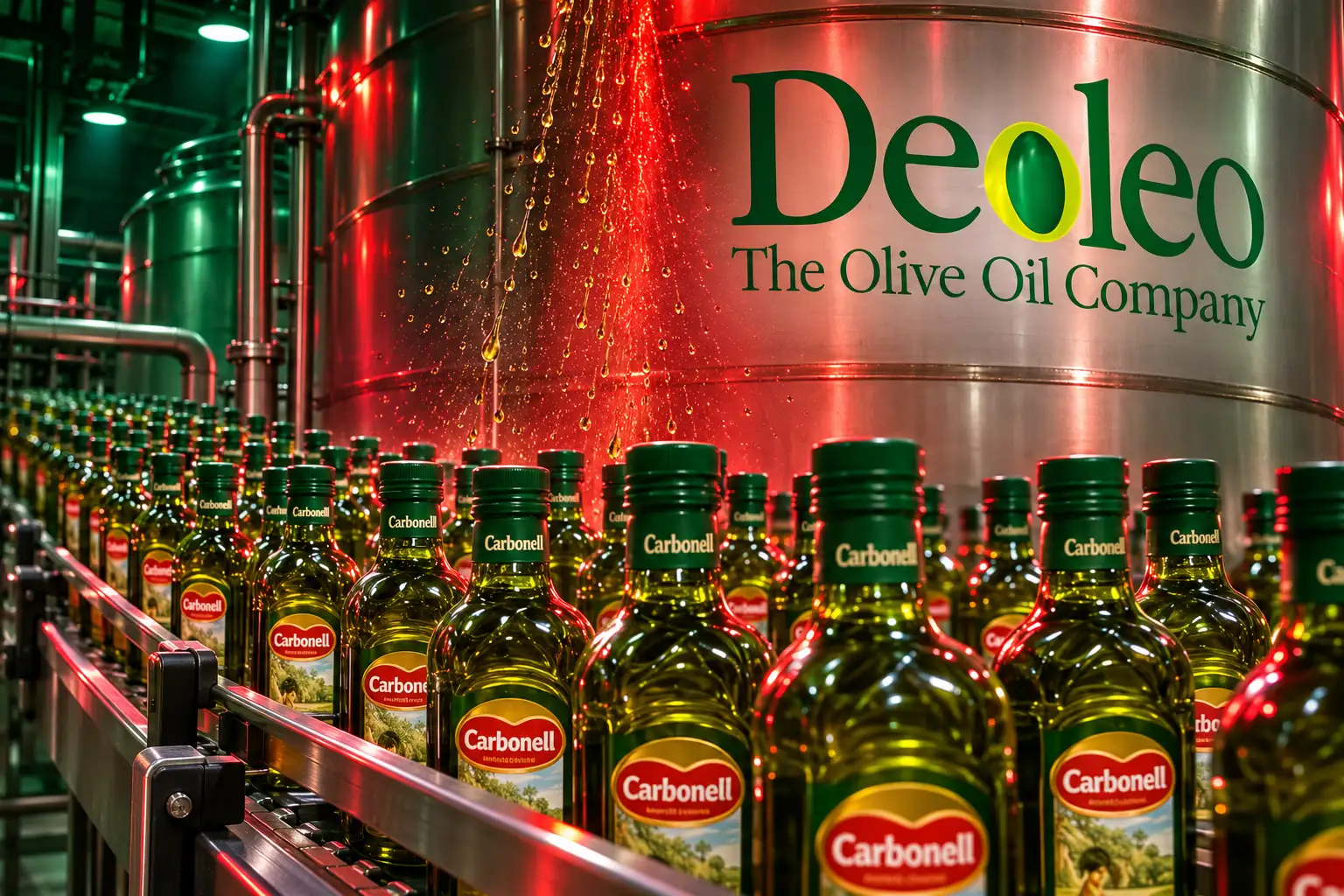
Dcoop has been in the United States since 2017 through Pompeian, the extra-virgin brand it owns 50/50 with the Devico family. Trade figures used around the auction put Pompeian at about 20% of U.S. extra virgin. Deoleo’s American position is about 14%, almost all of it Bertolli.
Stack those two books and Washington would be looking at a single Spanish group on roughly a third of a key shelf. That is the overlap the filing is built around. Dcoop had even studied selling its Pompeian half to Devico if it had to swallow Bertolli whole. Sending Bertolli to Acesur lets the co-op keep Pompeian.
The buy does not freeze that American file. Dcoop still wants to grow Pompeian, a plan that was paused earlier this year when U.S. tariff risk sat on Spanish oil. Bertolli accounted for about 41% of Deoleo’s ordinary income in the last full year, so the license behind that bottle is not a side letter. It is most of the profit story.
Acesur, the Guillén family’s Seville bottler, already sells La Española and Coosur and says it puts one in five olive-oil bottles consumed in Spain. Add Carbonell and Koipe to that share without a split and Madrid’s competition shop would have had a domestic problem that mirrored the American one. The two agencies are in the filing for matching reasons.
Twelve Years After Dcoop Sold to CVC
CVC Capital Partners has been in Deoleo since April 2014, when it bought 29.99% at €0.38 a share from Bankia, Banco Mare Nostrum and Dcoop. The co-op had tried to block that entry, then sold an 8.64% stake into it. Hojiblanca, which became Dcoop, had only a year earlier put its brand and Antequera plant into Deoleo for stock and two board seats.
Ole Investments B.V., CVC’s Dutch vehicle, now holds 56.96% of listed Deoleo and has given an irrevocable undertaking to vote the sale through. Alchemy Partners sits beside it at Holding level as a co-seller. Acesur already held about 5% of the listed company through Juan Ramón Guillén Prieto, so one of the buyers was already on the register.
This transaction recognises the work carried out in recent years and the constant support of our majority shareholders, highlighting the value of a portfolio of iconic brands that are part of our agri-food heritage. The partnership with Acesur and Dcoop decisively strengthens Deoleo’s leadership across the entire olive oil value chain and provides operational certainty for producers and the sector as a whole.
Ignacio Silva, Chairman of Deoleo, CVC announcement, 5 November 2026
Deoleo and its majority holders said they also valued the high certainty of execution. Cristóbal Valdés, the chief executive, called the staff “the true driving force behind the group” and pointed to the EVOO-lution plan that had just delivered a profitable year.
HOW DEOLEO GOT FROM HOJIBLANCA TO THIS SALE
- 2013: Hojiblanca puts its brand and Antequera bottling into Deoleo for stock and two board seats, then becomes Dcoop.
- April 2014: CVC buys 29.99% at €0.38 a share. Dcoop sells 8.64% after failing to stop the deal.
- June 2020: A Holding pact gives Deoleo UK the right to run any sale of the group.
- 2023: CVC studies an exit, then pulls the process when bids fade.
- August 2026: CVC and Alchemy say they are reviewing their holdings, including a sale of assets.
- 5 November 2026: The board signs the Dcoop-Acesur contract at an enterprise value of €520 million.
Dcoop president Antonio Luque put the bid in farmer language. “We want families who have been involved in olive growing for generations to be able to continue making a living from it and to offer a promising future to the next generations of farmers,” he said. The co-op calls itself the world’s largest olive-oil producer, with average output of 220,000 tons of virgin olive oil and olive-oil turnover of €600 million. William Blair, advising the sellers, counts 75,000 farming families in the co-op and more than 125 mills.
Independent mills do not read that as a gift. Two Andalusian groups would still sit on the main branded shelves even after a legal split, which smaller presses treat as fewer serious buyers for bulk oil. That argument is already loose in grower forums. It will follow the file into the Spanish competition review.
What Mizkan Can Still Do to Bertolli
Bertolli olive oil is not Deoleo’s to keep in the way Carbonell is. Unilever sold the oil line to Grupo SOS, later Deoleo, in 2008. The Bertolli name on U.S. pasta sauce went to Mizkan in 2014 with Ragú. Deoleo bottles the oil under a perpetual license. Mizkan still owns the mark.
The sale dies if Mizkan tells Deoleo in writing, within two months of 5 November, that it intends to end any Bertolli license because the buyers are taking control. That clock runs into early January 2027. No such notice had been made public by 10 November.
Acesur can only take the American jewel if that license travels with it. If Mizkan walks, the €520 million vehicle loses the brand that produced about 41% of ordinary income, and the U.S. map the buyers drew for the agencies has a hole in it. The filing treats that letter as a closing condition, not a footnote.
Listed Holders Get 190 Million Euros, Not 520
The €520 million figure is an enterprise value for 100% of Deoleo Holding. The listed company will not see that cheque. Its 50.99% is an equity claim after net debt, working capital and other closing adjustments. Deoleo put that claim, before escrow, at €190 million to €200 million.
Up to €80 million of the price, €40.8 million of it on the listed 50.99%, will sit in escrow against an Italian tax fight at Carapelli Firenze, first flagged to the market on 21 November 2024. Warrant holders from the May 2020 capital increase get no extra or preferred payment. After close, the quoted vehicle is a cash shell plus leftover claims, not Carbonell and Bertolli.
Shares fell nearly 22% on 5 November to €0.274, the worst session in more than six years. They had already run hard on sale talk: by 9 November the stock closed at €0.346, down 8.24% on the day, yet still up 92.22% in 2026. The tape treated €190 million to €200 million for the listed slice as less than the rumour price, not as a take-private premium.
WHAT LISTED HOLDERS ARE ACTUALLY SELLING
- Headline value: €520 million enterprise value for 100% of Deoleo Holding.
- Listed slice: 50.99% of Holding, guided at €190 million to €200 million of equity before escrow.
- Escrow drag: up to €40.8 million of that slice can be held back for the Carapelli tax case.
- Multiple: €520 million is 10.4 times 2025 EBITDA of €50 million.
Net financial debt was €86 million at the end of 2025, with leverage down from 3.5 times EBITDA to 1.7 times after a March 2025 refinancing. The Holding is a cleaner company than the one CVC walked into. The quoted wrapper is still the thing the market can sell today, and it is the thing being emptied.
Madrid, Washington and Rome Have Six to Eight Months
Deoleo estimates six to eight months for the remaining gates, which would put a close in the second quarter or early third quarter of 2027. William Blair, for the sellers, has said the second quarter of 2027. Either way, 5 November was a signature, not a handover.
The 2025 harvest is why a bid could be financed now. Spain’s 2024/2025 crop was up 64%. Deoleo moved 11% more volume, with Spain up 18%, Italy up 12% and the United States up 3.5% even with tariffs. Sales fell to €821 million as oil prices eased, but gross margin rose 30% to €129 million and unit gross margin rose 17%. The company posted EBITDA of €50 million, up 50%, and net profit of €20 million, helped by a €17 million reversal of brand impairments. Operating cash was €56 million, up 72%.
The first half of 2026 was thinner on the top line. Revenue was €393.2 million, down 8.7% from €430.5 million, while net profit rose to €19.4 million from €1.7 million. Some of that profit came from U.S. tariff refunds and a tax claim, so the run-rate into close is not the same as the 2025 rebound.
Deoleo still bottles in Spain and Italy, sells in 70-plus countries from 11 commercial offices, and runs more than 30 brands. Carbonell, Bertolli, Carapelli, Koipe and Maestros de Hojiblanca are the names the agencies will map. Acesur already bottles in Spain and in Suffolk, Virginia. Dcoop’s oil already moves through Pompeian. The file is a test of whether those maps can be redrawn without a forced sale.
WHAT STILL HAS TO HAPPEN BEFORE CLOSING
- Spanish antitrust: clearance for a deal that would put Acesur’s La Española and Coosur next to Carbonell unless the Spanish brands move to Dcoop.
- U.S. antitrust: clearance for Bertolli beside Pompeian unless Bertolli and the American business move to Acesur.
- Italian FDI: foreign-investment leave for the Italian plants and Carapelli.
- Shareholder vote: Deoleo’s general meeting, with Ole Investments’ 56.96% already locked in favour.
- Mizkan clock: no written notice, within two months of 5 November, that any Bertolli license will be ended for change of control.
If those conditions hold, Carbonell goes home to a co-op that once sold it, and Bertolli goes to a Seville family that already lives on the American shelf. If any of them fail, the €520 million contract stays a filing on the CNMV site, and the bottles stay where they are.
Disclaimer: This article is news reporting on a proposed sale of Deoleo Holding and is for information only. It is not investment advice, a solicitation to buy or sell Deoleo shares, or a view on whether the transaction will close at the stated value. Readers who hold the stock or are considering a position should consult a licensed financial adviser and review Deoleo’s own CNMV filings before acting. Deal terms, escrow amounts, share prices and regulatory status are those given by the companies and market data cited here and can change before closing.

Duffy Pins the FAA Ground Stop on a Contractor-Owned Network

Microsoft Tested Its Gateway Fix on the Wrong Machines

Firaxis Cuts a Third of Its Staff as XCOM Slips

The New Chip Rule Favors US Cloud Parents in Asia

European Unions Ask Players to Police GenAI They Cannot See

Boston Scientific Cyberattack Leaves Hospitals Waiting on Implants

Xbox Sells Cloud Playtime Packs Ahead of November Caps

Guizhou Cave Cafes Spread When Each Cavern Fills

The Second Ned Stark Kit Lands When a Banner Dies

Satellites Saw Nepal’s Ice Slope Move Before the Flood
-
 NEWS3 months ago
Boston Scientific Cyberattack Leaves Hospitals Waiting on Implants
-
 GAMING4 weeks ago
Xbox Sells Cloud Playtime Packs Ahead of November Caps
-
 NEWS3 months ago
Guizhou Cave Cafes Spread When Each Cavern Fills
-
 GAMING3 months ago
The Second Ned Stark Kit Lands When a Banner Dies
-
 NEWS2 months ago
Satellites Saw Nepal’s Ice Slope Move Before the Flood
-

 NEWS3 months ago
OpenAI’s Jalapeño Chip Turns Watts Into Faster Agent Steps
-
 NEWS3 months ago
MLB Quiet Periods Copy a Freeze Other Leagues Use
-

 NEWS3 months ago
Roman Space Telescope Launches After a Decade-Long Budget Bet