
NEWS
Fertilizer Ammonia Fed Delhi’s Worst Diwali Smog in Five Years
Delhi air pollution hit a five-year Diwali high even under Stage III, because fertilizer ammonia and coal sulphur still form the largest share of PM2.5.

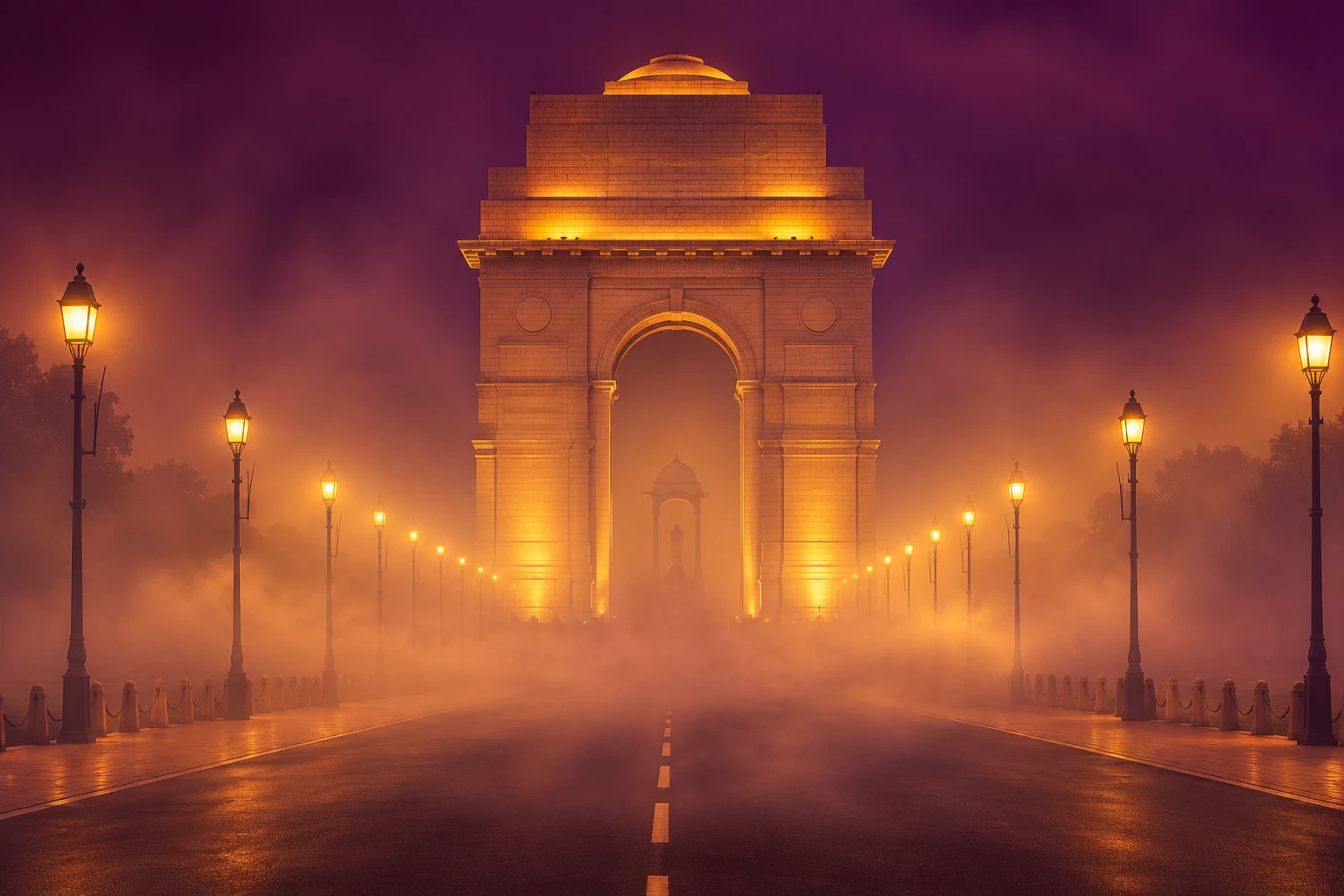
Delhi’s official Diwali air index hit 376 on 8 November, the highest festival-day reading since 2021, two days after Stage III curbs were already in force. The wider metro holds more than 30 million people. On 4 November, IQAir had already logged PM2.5 above 461 micrograms per cubic metre in parts of the city, more than 30 times the World Health Organization’s 24-hour mark of 15.
The emergency rules hit traffic, dust and certified crackers. They left the winter’s largest listed share, secondary particles, still forming in the dark.
The Smoke Kept Climbing Past the Legal Window
Hourly feeds from Central Pollution Control Board monitors, compiled overnight, show the median PM2.5 across Delhi stations already at 193 micrograms per cubic metre by 7:30 pm on 8 November, before the 8 to 10 pm window the Supreme Court had allowed for certified green crackers. An hour into that window the median was 322. It was 519 by 10:30 pm, after the window had closed, and 686 around 12:30 am on 9 November, when the matching US-scale median sat at 1,398.
By 7:30 am on 9 November the median had eased to 301 micrograms per cubic metre. Twenty-five of 37 reporting Delhi monitors still sat above 300 on the US scale. Fireworks produce a short spike in any city that sets them off. In a place that enters the night already in the Very Poor band, that burst has nowhere to fall by noon.
DIWALI NIGHT, DELHI MEDIAN PM2.5
| Time (IST) | Median PM2.5 (µg/m³) | Delhi monitors reporting |
|---|---|---|
| 3:30 pm, 8 Nov | 108 | 41 |
| 7:30 pm | 193 | 43 |
| 8:30 pm | 322 | 43 |
| 9:30 pm | 398 | 39 |
| 10:30 pm | 519 | 24 |
| 12:30 am, 9 Nov | 686 | 20 |
| 7:30 am, 9 Nov | 301 | 37 |
The 24-hour official number for the festival itself, Delhi’s Diwali-day bulletin of 376, averaged a cleaner afternoon into a filthy night. Of the Diwalis logged from 2018 to 2025, only 2020 and 2021 opened worse on that 24-hour scale. The 2021 festival day stood at 382.
A bench of Justices M.M. Sundresh and Prasanna B. Varale, in a 23-page order dated 29 October and released on 2 November, had called firecracker bursting a religious practice and still boxed it into two days. Certified CSIR-NEERI green crackers only, 6 to 7 am and 8 to 10 pm on 7 and 8 November, no series “ladis,” no barium, and a 300-metre quiet radius around hospitals, old-age homes and schools. The full ban returned on 9 November. The climb was under way before 8 pm.
Stage III Never Reached the Largest Pollution Share
The Commission for Air Quality Management invoked Stage III of the Graded Response Action Plan across Delhi-NCR on 6 November, with Delhi’s daily AQI at 382, still in the Very Poor band. Stage III is written for 401 to 450. The sub-committee moved early on IMD and IITM forecasts that the index would slip into Severe. Stage I had been on since 21 October and Stage II since 2 November, when the city first touched 324.
#CAQM Sub-Committee on GRAP decides to invoke GRAP III in Delhi NCR as a precautionary measure.
— Commission for Air Quality Management (@CAQM_Official) November 6, 2026
A CAQM synthesis of source studies, made public in January 2026 after the Supreme Court asked for a single account of winter causes, put secondary particulate matter first at 27 percent. Transport followed at 23 percent, biomass burning at 20 percent, dust at 15 percent and industry, including coal plants, at 9 percent. Those listed shares add to 94 percent. The missing slice is not named in the synthesis. Stage III is built for the visible jobs: dust, old engines, generators, schoolyards.
WINTER SHARES AND WHAT STAGE III CUTS
| Listed winter source | CAQM share | Direct Stage III lever |
|---|---|---|
| Secondary particles | 27% | None. Gases still react overnight |
| Transport | 23% | Older petrol and diesel cars restricted |
| Biomass burning | 20% | Mostly outside the city’s toolkit |
| Dust | 15% | Non-essential building work banned |
| Industry, including coal plants | 9% | Some unit curbs; sulphur gear still patchy |
Delhi minister Kapil Mishra said satellite counts showed Punjab stubble fires jumping from 125 locations on 7 November to 1,200 on Diwali, and he called that jump a plot. People answering him treated the line as an excuse. Fires sit inside the 20 percent biomass slice. They do not explain the 27 percent that forms after the smoke has already gone up.
STAGE III ON THE GROUND
- Building work: Non-essential digging, piling, demolition, brickwork and road laying stopped across the NCR.
- Mines and crushers: Stone crushers and mining shut.
- Older cars: BS-III petrol and BS-IV diesel four-wheelers restricted in Delhi, Gurugram, Faridabad, Sonipat, Ghaziabad and Gautam Buddh Nagar.
- Schools: Classes up to Class 5 shifted to hybrid mode in those cities.
- Generators: Diesel sets off except for emergency and essential supply.
Odd-even rationing sits on CAQM’s public checklist for the same stage. None of those steps binds ammonia on a field or sulphur at a stack outside the ring road.
What Secondary Particles Are
Secondary particles are not spat from a tailpipe. They assemble when gases already in the air react, mostly as ammonium sulfate and ammonium nitrate, tiny enough to ride deep into the lung and into blood. The acids are familiar: nitrogen oxides from engines and sulphur dioxide from coal. The base that lets those acids become salt is ammonia.
Srinidhi Balasubramanian teaches environmental science and engineering at IIT Bombay and has tracked ammonia from the American Midwest to the Indo-Gangetic Plain. In Jacob Koshy’s book The Nitrogen Bomb, she starts where a class-seven textbook starts.
Acid plus base forms a salt. It is as simple as that.
Srinidhi Balasubramanian, IIT Bombay, in The Nitrogen Bomb
She calls ammonia “the single most dominant” base, “by any stretch,” and puts the farming share in India at 80 to 85 percent, the rest leaking from fertilizer plants and industry. Koshy, who wrote the book, has said the sheer quantity of ammonia going into the atmosphere “creates a base layer for other pollutants to react with.” Her modelling puts ammonia acting alone at about a quarter of India’s PM2.5. Bundled with nitrogen oxides and coal sulphur, the inorganic secondary slice climbs to roughly 40 percent. Add organic secondaries and the national mix tilts to something like 45 percent primary against 55 percent secondary.
That is a different ledger from CAQM’s 27 percent winter figure for Delhi, which folds several secondary species into one bucket. Both point the same way. The largest piece of the haze is made in the air, not dumped as dust.
Ammonia From Farms Supplies the Missing Base
The Indo-Gangetic Plain runs about 2,500 kilometres from Pakistan to Bangladesh and holds nearly half a billion people. It is farmed hard. Urea and other nitrogen fertilizers throw off ammonia that does not stay on the field. Independent work has put roughly 80 percent of India’s ammonia on fertilizer and livestock waste.
Winter then traps the mix. Sachchida Nand Tripathi’s group at IIT Kanpur, working from the National Aerosol Facility he set up in 2003, has shown nitrogen oxides peaking in winter at the same moment cold air pushes the chemistry toward particles. The lid of air over the city, the planetary boundary layer, often compresses below 400 metres. Precursor gases sit there until they react. Balasubramanian’s line for that shift is blunt: as acid rain recedes, the particle problem grows. “This is the other face of acid rain.”
GRAP can park a BS-III car. It cannot recall ammonia already aloft from fields around the capital. Construction bans do not touch that base layer. Certified crackers, even when the window is kept, add a pulse on top of a salt that was forming before the first fuse.
Most Coal Plants Still Skip Sulphur Scrubbers
Ammonia needs an acid partner. The Centre for Research on Energy and Clean Air, using NASA MERRA-2 data for 2024, found ammonium sulfate, the salt of sulphur dioxide and ammonia, making about a third of Delhi’s annual PM2.5. In the post-monsoon weeks that share rose to 49 percent. In winter it was 41 percent, against about 21 percent in summer and the monsoon.
CREA’S DELHI AMMONIUM SULFATE SPLIT
- Annual load: About 33 percent of Delhi PM2.5 as ammonium sulfate.
- After the monsoon: 49 percent, the city’s worst stretch.
- Winter: 41 percent of fine particles.
- Scrubber gap: About 78 percent of coal-fired plants exempt from flue-gas desulphurisation.
Nationally the same analysis put ammonium sulfate at 17 to 42 percent of PM2.5 across states, with most clustered between 30 and 40 percent, and up to 42 percent of India’s PM2.5 chemically formed from precursor gases. Chhattisgarh led at 42 percent, Odisha at 41 percent. Coal-fired plants supply at least 60 percent of India’s sulphur dioxide. Manoj Kumar, CREA’s India analyst, said the country has to watch what the pollution is made of, not only the headline PM2.5 number, and that precursor controls and composition monitoring are essential while secondary ammonium sulfate accounts for as much as 42 percent, driven largely by sulphur from coal plants.
Stage III can idle a generator in Noida. It does not fit a scrubber on a stack in a coal state. The salt still arrives on the wind.
Why the Official 376 Hid a Midnight Peak
India’s National AQI averages 24 hours and stops at 500. A US-scale hourly reading does neither. That is why a Sameer reading of 368 at 7:05 am on 9 November could sit beside a night that had already gone through a median 686 micrograms of PM2.5. Fifty-six of 59 monitors that reported overnight in Delhi-NCR passed 500 on the US scale in at least one hour. Several of the highest hours sat on a PM2.5 of about 960 to 1,000, the common cap on the instruments, so the true peak may have been higher.
Stations also went quiet when the air was worst. Forty-three Delhi monitors reported at 7:30 pm; 14 reported at 1:30 am. Eight Delhi monitors reported every hour from 7:30 pm to 7:30 am, and their median still followed the same arc, 235 to 862 to 356 on the US scale. At 10 am on 9 November the official city AQI was 371, the highest reading for a day after Diwali since 2021, when the day-after figure was 462. On 10 November, around 9 am, CPCB put the city at 299, in the Poor band. Stage III was still listed as in force.
THE WEEK THE RULES TIGHTENED
- 29 October 2026: Supreme Court permits certified green crackers on 7 and 8 November, then restores the full ban from 9 November.
- 2 November 2026: CAQM invokes Stage II after Delhi reaches 324; the cracker order is made public.
- 6 November 2026: Stage III begins across the NCR at a daily AQI of 382, on a forecast of Severe air.
- 8 November 2026: Diwali. CPCB’s 24-hour index is 376. Hourly PM2.5 keeps rising past 10 pm.
- 9 November 2026: Cracker ban returns. Official AQI is 368 at 7 am and 371 at 10 am.
- 10 November 2026: City reading around 299 at 9 am. Stage III remains the stage on the board.
The court also told states to file figures on hospital admissions through 30 November by 14 December, with contempt held out if the affidavits do not arrive. That paper trail will describe the clinic load. It will not, by itself, name ammonia.
3.8 Million Deaths Track India’s Own Limit
A 2024 paper in The Lancet Planetary Health, led by Suganthi Jaganathan and using a difference-in-differences design across 655 districts, linked 3.8 million deaths from 2009 to 2019 to PM2.5 above India’s own annual standard of 40 micrograms per cubic metre, about 5.0 percent of deaths in the period (95 percent CI 2.9 to 4.9 million). Against the WHO annual guideline of 5 micrograms, the same method produced 16.6 million deaths, 24.9 percent of mortality. Petter Ljungman, at Karolinska Institutet’s Institute of Environmental Medicine, said every 10 microgram per cubic metre rise in annual PM2.5 led to an 8.6 percent rise in mortality (95 percent CI 6.4 to 10.8). The full population lived above the WHO annual mark. Some 1.1 billion of 1.4 billion people, 81.9 percent, lived above 40. The median population-weighted PM2.5 was 38.9 micrograms. WHO’s global air quality guidelines for PM2.5 set 15 micrograms for a 24-hour mean and 5 for the year.
Those deaths accumulated on ordinary winter chemistry, not on a single festival night. Diwali 2026 still put a five-year festival high on top of that baseline, under rules that treat engines, dust and a two-hour cracker slot as the levers that matter. The ammonia was in the air before the first fuse, and it was still there when the index slipped back toward 299.
Disclaimer: This article is news reporting and analysis of air-quality readings, court orders and published research. It is for information only and is not medical advice, a diagnosis, or a guide to treatment for asthma, heart disease or any other condition linked to dirty air. Readers who are worried about their own health, or about children, older adults or anyone with lung or heart disease, should speak with a qualified physician before changing masks, medicines, travel or outdoor plans. Figures and GRAP stages reflect the official bulletins, monitor feeds and studies cited here and will move as new 24-hour averages are issued.

Duffy Pins the FAA Ground Stop on a Contractor-Owned Network

Microsoft Tested Its Gateway Fix on the Wrong Machines

Firaxis Cuts a Third of Its Staff as XCOM Slips

The New Chip Rule Favors US Cloud Parents in Asia

European Unions Ask Players to Police GenAI They Cannot See

Boston Scientific Cyberattack Leaves Hospitals Waiting on Implants

Xbox Sells Cloud Playtime Packs Ahead of November Caps

Guizhou Cave Cafes Spread When Each Cavern Fills

The Second Ned Stark Kit Lands When a Banner Dies

Satellites Saw Nepal’s Ice Slope Move Before the Flood
-
 NEWS3 months ago
Boston Scientific Cyberattack Leaves Hospitals Waiting on Implants
-
 GAMING4 weeks ago
Xbox Sells Cloud Playtime Packs Ahead of November Caps
-
 NEWS3 months ago
Guizhou Cave Cafes Spread When Each Cavern Fills
-
 GAMING3 months ago
The Second Ned Stark Kit Lands When a Banner Dies
-
 NEWS2 months ago
Satellites Saw Nepal’s Ice Slope Move Before the Flood
-

 NEWS3 months ago
OpenAI’s Jalapeño Chip Turns Watts Into Faster Agent Steps
-

 NEWS3 months ago
MLB Quiet Periods Copy a Freeze Other Leagues Use
-

 NEWS3 months ago
Roman Space Telescope Launches After a Decade-Long Budget Bet