
NEWS
Spy Claims Push Three China Chip Bills Into the NDAA
Three China chip bills already written this year are riding the defense act after Jensen Huang’s spy-linked affair, boxing in Trump before he meets Xi.

U.S. lawmakers moved on Nov. 10 to lock three China chip bills into the annual defense act after Nvidia chief Jensen Huang admitted an affair with a suspected Chinese intelligence asset. Senate Democratic Leader Chuck Schumer named the AI Overwatch Act, the Chip Security Act and the MATCH Act, and said Congress also needs a full account of President Donald Trump’s defense of Huang.
The bills are not a weekend draft. They cleared the House Foreign Affairs Committee in January, March and April, and they already sit in the Senate’s fiscal 2027 defense package. The spy file is the lever for a House-Senate conference that still needs a president who has not endorsed them.
The Defense Bill Already Carries the Chip Clauses
The fiscal 2027 National Defense Authorization Act is the must-pass bill that sets troop pay, ship buys and how Washington treats military threats. It is also the vehicle China hawks have used all year for chip rules that would be harder to pass as stand-alone law.
Sen. Jim Banks, an Indiana Republican, announced on July 14 that his AI Overwatch Act was in the Senate text. The House bill never picked up the same trio, so the fight is now in conference, with a final bill due to Trump’s desk in December. House Democratic leader Hakeem Jeffries said he strongly supports the Senate chip clauses and will work to keep them in the finished act.
House Foreign Affairs had already passed their House committees by wide margins: the AI Overwatch Act 42-2 on Jan. 21, the Chip Security Act 42-0 on March 26, and the MATCH Act 36-8 on April 22. A coalition letter from the Foundation for American Innovation, American Compass and Heritage Action told House leaders in August to put all three in the final defense bill, arguing that China had trained a large model on restricted Nvidia Blackwell chips and that allied tool rules still leave gaps.
Nvidia is widely treated on the Hill as the main industry opponent of Overwatch and Chip Security. A former aide who worked the file said so after months of contact. The company has said it follows export law and declined to comment on the new push.
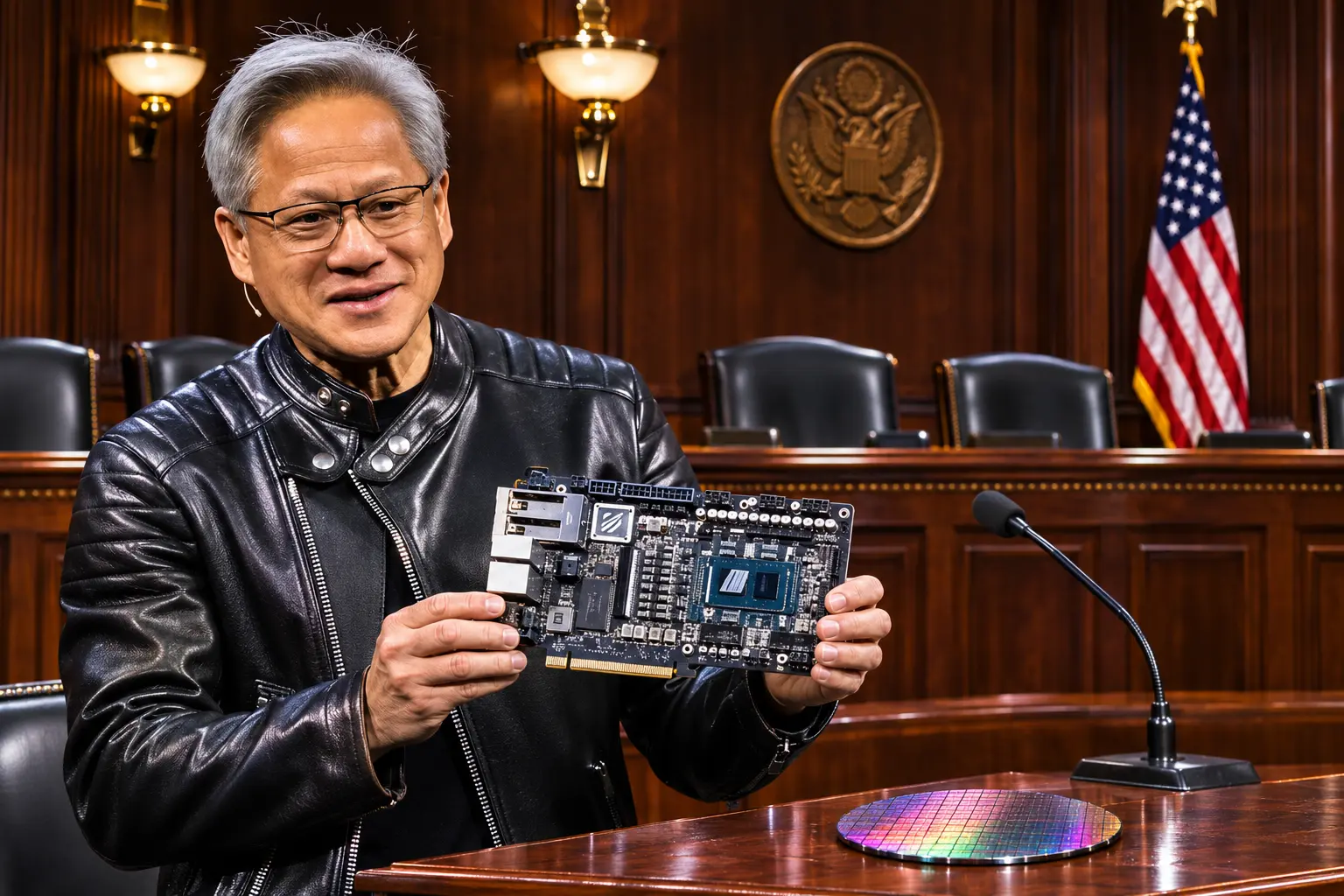
Hawks Treat the Spy File as a Conference Lever
Huang, 63, told staff on Nov. 8 that he had been unfaithful to his wife. “I was unfaithful to my wife. My actions hurt her and our children. There is no excuse for what I did. I am deeply sorry,” he wrote. He did not name the woman. U.S. intelligence officials have identified her as Alice Huang, also known as Huang Le, a Chinese citizen and former executive at Megaspeed, a Singapore data-center firm that is not related to him.
Officials assess that she was recruited by China’s Ministry of State Security and passed information to Beijing. Megaspeed bought more than $4.8 billion of Nvidia chips over two years, according to intelligence reporting described to lawmakers. Nvidia’s spokesman John Rizzo said earlier that Huang’s meetings with her were the kind of customer contact a chief executive has with thousands of executives a year, and that the firm does not share classified information with customers. China dismissed the spy claim. Foreign Ministry spokesman Guo Jiakun called it “a groundless accusation, slander, and a smear.”
Banks and Sen. Elizabeth Warren, a Massachusetts Democrat, had already asked Commerce in March to suspend or revisit Nvidia’s China licences. On Nov. 9 they used Huang’s admission to demand the Senate wrap their bill into the defense act.
NVIDIA CEO Jensen Huang’s confirmation of a relationship with a suspected spy for China’s intelligence service makes these national security concerns even more urgent and raises important questions NVIDIA must answer about the extent to which these activities were related. It is time for Congress to take decisive action to pass key bills like the AI Overwatch Act in the NDAA that will cut off the various pathways through which China accesses advanced chips.
Sens. Jim Banks and Elizabeth Warren, joint statement, Nov. 9, 2026
Schumer went further on Nov. 10. “He’s supposed to protect America, not China, not his friends. Trump has been busy trying to defend Jensen Huang when he ought to be defending our national security,” he said. He also cited accounts that Trump was briefed about a year ago and took no action. “One of our most important companies that is involved in national security, and the CEO might be having an affair with a Chinese spy, and Trump did nothing about it,” Schumer said.
Veda Partners analysts Henrietta Treyz and Dan McCarthy raised their passage odds after the affair news: the Chip Security Act to 80 percent from 60, Overwatch to 65 percent from 40, and MATCH to 60 percent from 35. Chris MacKenzie, a spokesman for Americans for Responsible Innovation, which backs the bills, put the remaining test in one line. The hurdle, he said, is getting the White House onboard.
What Congress Wants to Take From Commerce
The AI Overwatch Act is the clause that most directly clips the White House. The House text, introduced in December 2025 by Foreign Affairs Chairman Brian Mast, treats advanced AI chips like arms sales. The administration would have to notify Congress before approving exports of those chips to China, Cuba, Iran, North Korea, Russia and Venezuela, and lawmakers would have 30 days to review and may block a sale by joint resolution of disapproval. Mast said the bill “ensures Congress has oversight over the sale of advanced AI chips to adversary nations, just as it does with arms sales.”
The Senate text Banks folded into the defense bill in July is a close cousin with a different handle. It would lock Trump’s ban on the most advanced chips to countries of concern for 18 months, bar blanket licences, and force Commerce to certify to Congress, before licensing less advanced chips, that the sale will not drain U.S. supply, break end-user rules, or open remote access to the wrong parties. It also orders an “American Artificial Intelligence Victory Strategy.” House China Committee Chairman John Moolenaar, a cosponsor of the House bill, wants those curbs in the defense act and has said the country that controls the chips will control national and economic security.
Either version moves the last word on China chip sales out of a Commerce licence shop that has spent a year saying yes, case by case, to Nvidia’s H200. That is the power shift the spy file is being asked to finish.
THE THREE BILLS IN THE SENATE DEFENSE PACKAGE
| Bill | House committee vote | Core rule | Where it sits now |
|---|---|---|---|
| AI Overwatch Act | 42-2 on Jan. 21, 2026 | House: 30-day congressional block on advanced-chip exports. Senate: licences plus an 18-month ban on the most advanced chips | In the Senate FY2027 defense bill; not in the House text |
| Chip Security Act | 42-0 on March 26, 2026 | Location checks on advanced chips before export, plus diversion reports to Commerce | In the Senate defense package |
| MATCH Act | 36-8 on April 22, 2026 | Allied tool-export rules must match U.S. controls, with a 150-day clock on the House text | In the Senate package, in a stronger form than the House markup |
House Energy and Commerce Chairman Brett Guthrie, who is helping write the Republican AI agenda, said that when the FBI inquiry “moves forward, I’m sure our committee is going to have to act.” Sen. Ruben Gallego put the China-sales question in personal terms. “Nvidia has been asking permission to sell advanced chips to China. We need to know how much the Chinese spy influenced CEO Jensen’s decision,” he said.
The Match Act Puts a Clock on Allied Tool Sales
Chips are only half the control stack. MATCH, short for Multilateral Alignment of Technology Controls on Hardware, is the bill that goes after the machines that print them. Sens. Pete Ricketts, Andy Kim, Jim Risch and Schumer introduced the Senate version on April 13. It names Chinese firms including SMIC, Huawei, Hua Hong, ChangXin Memory and Yangtze Memory as targets and tells U.S. agencies to close gaps that let those plants buy or service tools America already withholds.
The House text is blunter toward friends. After a scaled-back April markup it still adds a countrywide curb on ASML’s deep-ultraviolet immersion lithography tools, extends controls to servicing machines already inside Chinese plants, and gives the Netherlands and Japan a 150-day window to match U.S. rules. If they do not, Commerce is directed to push U.S. jurisdiction over foreign tools that use American software or parts.
WHAT THE MATCH ACT WOULD FORCE
- Tool alignment: Allied suppliers would have to apply U.S.-equivalent bans on listed chipmaking gear bound for Chinese plants, not only on the most extreme machines already withheld.
- Servicing curb: Maintenance on tools already installed at named Chinese fabs would need licences, a clause foreign firms fought in the spring markup.
- The deadline: The House bill starts a 150-day diplomatic clock, then tells Commerce to act if The Hague and Tokyo do not match the rules.
- Named plants: SMIC, Huawei, Hua Hong, CXMT and YMTC sit at the center of the closed-facility list, along with affiliates.
Dutch, Japanese and Korean firms would feel that clock first. ASML still sells into China under Dutch licences on some older lines. Japanese toolmakers have run their own licensing list since 2023. Samsung and SK Hynix operate large memory plants on the mainland that need parts and service even when new-tool sales slow. Korean officials have already said the MATCH text could hit their chip industry if it becomes law. U.S. toolmakers have argued for years that they lose sales when Dutch and Japanese rivals fill the gap. MATCH answers them by threatening friends as well as Beijing.
The Chip Security Act is the smuggling bill sitting beside it. Reps. Bill Huizenga and Bill Foster, with Moolenaar and Raja Krishnamoorthi, wrote it to require location verification before chips are exported, using hardware or firmware that is feasible on the day of enactment, and to make licence holders report diversion or tampering to the Bureau of Industry and Security within a 180-day Commerce rulemaking. Huizenga said the text “directly supports the Trump Administration’s AI action plan.” Until Justice Department smuggling cases last year, Huang had argued that chip smuggling was not a real problem. Sponsors of location tracking now treat that line as the reason the bill exists.
Shenzhen Is Set for Nov. 18, and Huang Is Still the Channel
Trump is due in Shenzhen on Nov. 18 and 19 for the APEC leaders’ summit and his third meeting this year with Xi Jinping. Treasury Secretary Scott Bessent said the two sides should “de-risk, not decouple,” and that they will open a dialogue on “superintelligence” on the sidelines, plus a channel to warn each other about serious AI incidents. That is a commercial agenda. It is a poor fit with a defense bill that would let Congress veto the chip sales Trump has used as a bargaining chip.
Huang has been the private channel for those sales. He has been in and out of Washington for two years, backed the administration in public, and joined Trump on Air Force One for the May trip to Beijing, the first by a U.S. president in nearly a decade. He sat at the September state dinner for Xi. Nvidia committed $25 million to Trump’s White House ballroom project. On Oct. 8, Trump gave him the National Medal of Science.
The policy trail matches the access. On Dec. 8, 2025, Trump said approved Chinese customers could buy Nvidia’s H200, its second-best AI chip, with 25 percent of the revenue going to the U.S. government. In January, Commerce moved H200 licence applications from a presumption of denial to case-by-case review. Blackwell stayed out of the deal. About 600,000 H200 chips were reported waiting in Hong Kong in early November, with Beijing slow to clear large mainland shipments. Nvidia’s August outlook had assumed zero China data-center revenue. The next earnings call is Nov. 17, the day before Shenzhen.
Intelligence officials have said Trump was first told in October 2025 that Beijing was getting reports from someone with direct access to Huang, and that he sat on the file in part to protect Nvidia sales and the China trade truce. Secretary of State Marco Rubio briefed him again aboard Air Force One on the May trip, before Huang boarded. Trump told reporters this month he had been “hearing about it” and “reading a little bit about it over a period of time, but not too long ago.” On Nov. 9 he said he had called Huang. “I asked him that question: You have any idea that she was a spy? He said, I had no idea that she was a spy. And I really believe him.” He also said, “I know the FBI is looking into it. I think that he’ll be in good shape.” A day earlier he had said Huang should stay as chief executive. “He’s an honorable guy. I think he probably has an excuse for it.”
That is the bind for conference negotiators. A president who still wants Huang in the room is being asked to sign a defense bill that would make Huang’s China-sales pitch a matter for Congress. Bessent can talk about de-risking in Shenzhen. Overwatch would put a 30-day hold on the chips that talk is about.
Nvidia Fought These Rules Before the Affair Broke
Nvidia’s board moved on Nov. 8, the same day as Huang’s staff note. Shares then dropped more than $470 billion in market value over two sessions. The firm has 11 directors and no board chair, and several independent directors have served since the 1990s. Unlike some peers, it has no dual-class stock that would let Huang outvote a revolt. Independent directors later hired Wachtell, Lipton, Rosen & Katz and former acting U.S. Attorney Joon Kim. A shareholder class action was filed in California on Nov. 9, alleging investors were not told enough about the relationship and the security risk. Those claims are unproven.
The NVIDIA Board is initiating an independent investigation in light of recent reporting that founder and CEO Jensen Huang has been the target of a foreign intelligence effort. A committee of independent directors will oversee the inquiry, assisted by outside independent counsel. While the Board has no reason to believe that either national security or NVIDIA secrets were compromised, the Board’s inquiry will examine all available information. Jensen fully supports the review and has committed to cooperating with it. The Board has confidence in Jensen and his leadership team.
NVIDIA Board of Directors, newsroom statement, Nov. 8, 2026
Huang told staff he had “fallen short” of the duty to be worthy of their trust, that he loves the country and the company, and that he will cooperate. The company said he would keep running Nvidia “without interruption” and that “today’s news will not slow NVIDIA.” The board’s own words leave a gap the Hill is walking through: no proven leak, and still a review of “all available information,” including a customer who bought billions of dollars of chips while U.S. agencies called her an asset.
Huang’s public line on China was already on tape. He has called export controls a failure, said Nvidia’s share of that market fell from the Biden-era peak, and argued that Washington should keep American chips in Chinese data centers rather than push Beijing onto its own silicon. In the months before the board probe he was still saying China is a competitor, not an enemy, and that the restriction was a mistake that is hard to unwind. That argument is now the exhibit sitting next to a closed-door request from House chairs.
November 18 Now Holds a Hearing and a Summit
House Foreign Affairs, Intelligence and China committee chairs asked Huang for a closed-door joint briefing on Nov. 18, the first day of APEC in Shenzhen, and told him to accept or offer another date by Nov. 11. Mast told Capitol reporters he is prepared to subpoena Huang if that reply does not come. Trump has said he would still take Huang on the Asia trip. Nvidia has not said whether he will sit in either room.
THE MONTH THAT MOVED THE BILLS
- Oct. 29, 2026: Intelligence assessments become public, describing Alice Huang as a suspected Chinese asset close to Jensen Huang and saying Trump was briefed about a year earlier and did not act.
- Nov. 8, 2026: Huang admits an extramarital affair in a staff note. The Nvidia board opens an independent investigation and says it has no present reason to believe secrets were lost.
- Nov. 9, 2026: Trump says the FBI is looking into the matter and that he believes Huang. Banks and Warren demand Overwatch in the defense bill. A shareholder suit is filed in California.
- Nov. 10, 2026: Schumer presses all three bills. Mast says he will subpoena Huang if the Nov. 11 reply is missed. Officials describe Rubio’s in-flight briefing before Huang boarded Air Force One in May.
- Nov. 17, 2026: Nvidia reports quarterly results, the first numbers since the board probe, against an outlook that had assumed no China data-center sales.
- Nov. 18, 2026: House chairs want Huang in a closed room in Washington. Trump is due in Shenzhen to meet Xi. Conference on the defense bill continues toward a December signature.
The three bills will not write themselves into law on the back of an affair. They still need a conference report and a president who has spent a year treating Huang as the man who can sell H200s to “approved” Chinese customers and pay Washington a cut. Schumer, Banks, Warren, Mast and Moolenaar are betting the spy file makes that signature harder to refuse. Trump is still describing Huang as an honorable man he would take back to China. The White House did not answer questions about the bills. That silence is now the gate on China’s legal path to American AI chips.

Duffy Pins the FAA Ground Stop on a Contractor-Owned Network

Microsoft Tested Its Gateway Fix on the Wrong Machines

Firaxis Cuts a Third of Its Staff as XCOM Slips

The New Chip Rule Favors US Cloud Parents in Asia

European Unions Ask Players to Police GenAI They Cannot See

Boston Scientific Cyberattack Leaves Hospitals Waiting on Implants

Xbox Sells Cloud Playtime Packs Ahead of November Caps

Guizhou Cave Cafes Spread When Each Cavern Fills

The Second Ned Stark Kit Lands When a Banner Dies

Satellites Saw Nepal’s Ice Slope Move Before the Flood
-
 NEWS3 months ago
Boston Scientific Cyberattack Leaves Hospitals Waiting on Implants
-
 GAMING4 weeks ago
Xbox Sells Cloud Playtime Packs Ahead of November Caps
-
 NEWS3 months ago
Guizhou Cave Cafes Spread When Each Cavern Fills
-
 GAMING3 months ago
The Second Ned Stark Kit Lands When a Banner Dies
-
 NEWS2 months ago
Satellites Saw Nepal’s Ice Slope Move Before the Flood
-
 NEWS3 months ago
OpenAI’s Jalapeño Chip Turns Watts Into Faster Agent Steps
-

 NEWS3 months ago
MLB Quiet Periods Copy a Freeze Other Leagues Use
-

 NEWS3 months ago
Roman Space Telescope Launches After a Decade-Long Budget Bet