
BUSINESS
Markets Price a Political Freeze on AI Data Centers
A $2.5 trillion Nasdaq hit after the 2026 midterms priced a new AI cap: power, water and local permits, not fading chip demand.

Nasdaq companies lost about $2.5 trillion on November 5 as investors priced Democratic midterm wins as a brake on AI data centers. The Nasdaq Composite fell 5.52 percent to 24,315.00, its worst day since April 2025, and closed more than 10 percent below its October 6 record.
Chip demand did not vanish overnight. What changed is who now holds the permits, the rate cases and the subpoena power that sit between a GPU order and a live hall.
A $2.5 Trillion One-Day Hit on Nasdaq Names
The session punished the whole tape, not only the AI complex. The S&P 500 dropped 4.36 percent to 7,353.73, and S&P 500 firms shed $2.9 trillion in value, a separate tally from the Nasdaq wipeout. The Dow Jones Industrial Average lost 1,833.06 points, or 3.44 percent, to 51,523.06. All 11 S&P sectors finished lower.
The Nasdaq 100, packed with the largest tech names, sank 6.36 percent, its worst day since March 2020. The Philadelphia Semiconductor Index fell 12.3 percent, its weakest session in more than six years. Nvidia dropped 9.3 percent and erased its 2026 gain. Advanced Micro Devices and Micron each fell 17 percent. Tesla slid about 11 percent and SpaceX 9 percent. Amazon and Alphabet each lost 2.2 percent, Meta about 4 percent and Microsoft about 3.6 percent. The so-called Magnificent Seven lost more than $1 trillion together.
THURSDAY’S US CLOSES
| Index | Close | Change |
|---|---|---|
| Nasdaq Composite | 24,315.00 | -5.52% |
| Nasdaq 100 | – | -6.36% |
| S&P 500 | 7,353.73 | -4.36% |
| Dow Jones | 51,523.06 | -3.44% |
| Philadelphia Semiconductor | – | -12.3% |
The VIX fear gauge spiked to 28.09, and money moved into Treasuries. After the close the S&P 500 was still up 7.4 percent for 2026 and the Nasdaq 4.6 percent, which is why the day felt like a repricing of one trade rather than a full-cycle bust. Neocloud names that rent AI compute, including CoreWeave and Nebius, fell about 10 percent and 15 percent. IREN and Applied Digital dropped more than 14 percent.
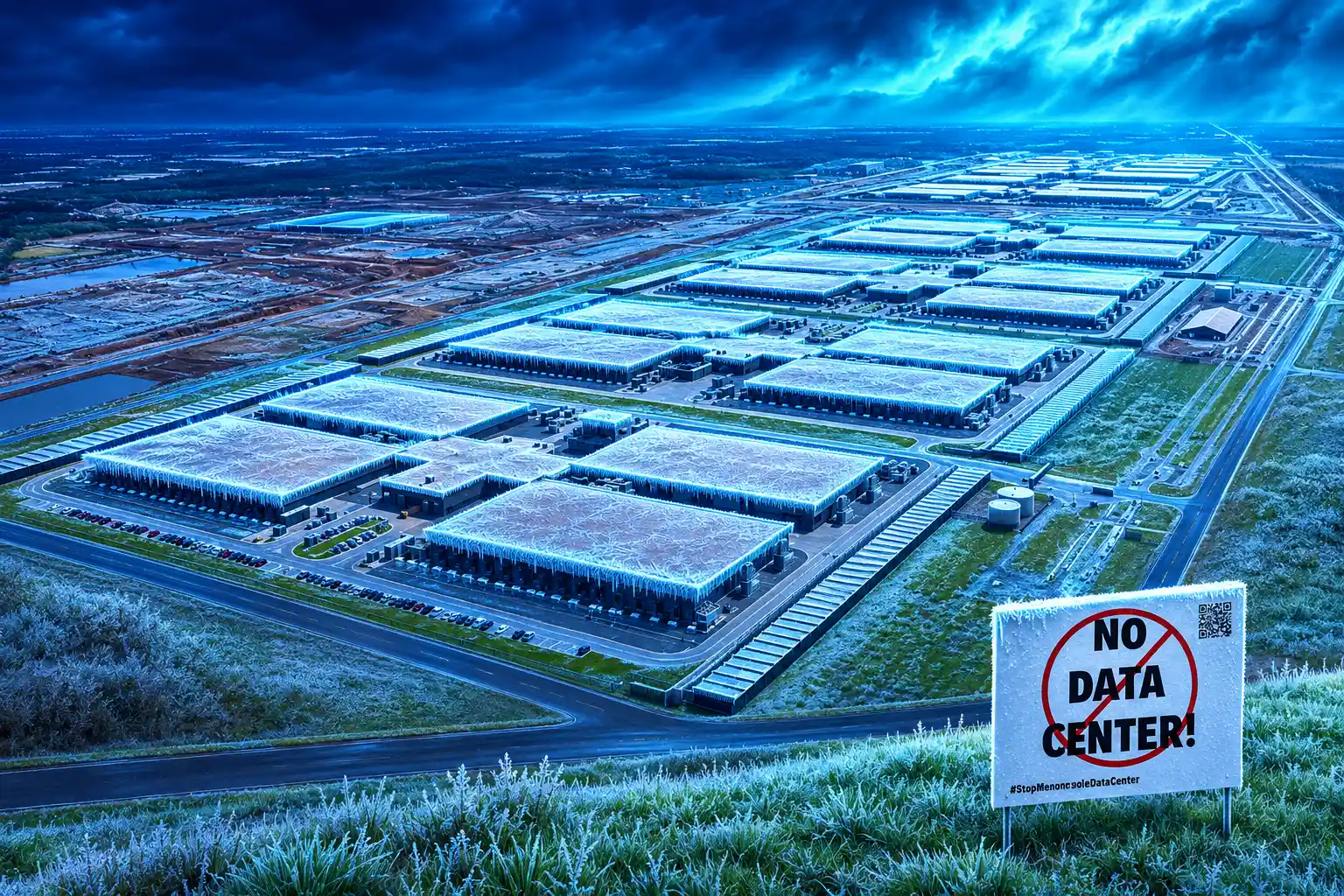
Data Centers Lost the Midterms Before Congress Sat
Democrats gained seven Senate seats and 25 House seats, taking both chambers for the back half of President Donald Trump’s term. Exit polling found that 56 percent of voters called AI and data centers a crucial or major factor in their congressional vote. Democratic campaigns spent more than $100 million on ads tying Republicans to the buildout.
The buildings were on the ballot in a literal sense. Voters faced 41 local measures across 10 states. All but one, in Harwood, North Dakota, moved to restrict, pause or ban new sites. Elon Musk spent $474 million backing Republicans and later wrote that data centers in space were looking appealing.
WHERE THE BUILDING PERMITS FLIPPED
- Texas: Governor-elect Gina Hinojosa unseated Greg Abbott in the world’s second-largest data-center market, with 6.5 gigawatts already under development, and campaigned for an immediate pause until the legislature writes protections.
- Ohio: Governor-elect Amy Acton beat Vivek Ramaswamy on a conditional pause that would make operators cover 100 percent of their utility costs and use union labor.
- Georgia: Governor-elect Keisha Lance Bottoms called for a statewide pause to weigh bills, water and neighborhood impact.
- New York and Pennsylvania: Kathy Hochul, who imposed a one-year statewide pause in July, and Josh Shapiro, who tightened rules over the summer, both won new terms.
Acton put the offer in one line on the trail.
Ohio is open for business, but we are not up for sale.
Amy Acton, Ohio governor-elect, on the 2026 campaign
Hinojosa treated Abbott’s summer halt, which let ERCOT audit large-load interconnects, as a stall. “The only way Texans are protected is when real laws are passed,” she said. On election night Senator Bernie Sanders called for a national data-center moratorium. Senator Ed Markey of Massachusetts said new probes were coming.
Why Power and Permits Now Cap AI Spending
The chip order book is not the constraint investors just marked down. Halls that already have power will still want accelerators. Halls that cannot interconnect, draw water or beat a town vote will not. That is a siting problem with a new federal majority behind it, and it is slower to reverse than a one-day index drop.
Lawrence Berkeley National Laboratory, in a June update for the Energy Department, put US data-center load at 192 terawatt-hours in 2024, or 4.7 percent of national electricity. Its reference case reaches 649 terawatt-hours in 2030, or 11.8 percent of U.S. electricity by 2030, with a band of 9.5 percent to 15.3 percent (521 to 843 terawatt-hours).
THE POWER MATH INVESTORS JUST REPRICED
- 2024 load: 192 terawatt-hours, 4.7 percent of US electricity, per the Berkeley lab’s 2025 update.
- 2030 reference: 649 terawatt-hours, 11.8 percent of forecast US power.
- Projects already stuck: Data Center Watch logged $198 billion of projects already delayed or blocked in the first half of 2026, across 120 sites.
Household bills, well noise and water use, not model-risk essays, drove the votes. A federal pause on US campuses also does not pause training runs in China, which is why a siting freeze can hit American suppliers harder than it hits the global compute race. Prepaid turbines and interconnect gear are already being written down when those campuses slip, which is the cash cost hiding under the index print.
The House has already moved on who pays. On September 16 it passed the Ratepayer Protection Act 417-3, a standard that would make loads of 100 megawatts or more cover new plants, lines and grid upgrades built for them. Environmental groups are fighting a separate permitting package they say would ease gas plants for the same campuses; 185 groups opposed a federal permitting bill in October on those grounds.
Seoul’s Circuit Breaker Lasted 20 Minutes
Asia opened into the New York close. The Kospi fell more than 8 percent within minutes of the Friday, November 6 open and hit 4,924.61 at 9:03 a.m., which tripped a Level 1 circuit breaker and halted the board for 20 minutes. It traded as low as 4,911.28, then closed at 5,059.69, down 324.11 points, or 6.02 percent. Foreign investors sold a net 2.74 trillion won.
Samsung Electronics closed at 188,700 won, down 6.35 percent, its first finish below 200,000 won since April 7. SK Hynix fell 10.44 percent to 1,132,000 won. Japan’s Nikkei 225 closed down 5.96 percent at 57,434.77. Taiwan’s Taiex fell 4.51 percent to 39,701.64 after a record 3,737.67-point drop during the session. Europe’s Stoxx 600 lost 1.1 percent.
Memory and foundry shares moved first because a delayed US hall is a delayed wafer start. TSMC, Samsung and SK Hynix sell into a build that assumed Texas, Ohio and Georgia would keep clearing large loads. Those states just voted otherwise. The Kosdaq, heavier in smaller tech names, fell 9.89 percent.
Four Tech Giants Guided More Than $720 Billion
The spending plans on the books still assume the halls get built. Amazon has guided about $220 billion of 2026 capital spending. Alphabet has kept a $195 billion to $205 billion band. Microsoft has pointed to about $175 billion on a calendar-year view. Meta narrowed 2026 capex, including finance-lease principal, to $135 billion to $145 billion. Added up, that is $725 billion to $745 billion, most of it AI halls, chips and power.
2026 CAPITAL GUIDANCE
| Company | 2026 capex guidance |
|---|---|
| Amazon | about $220 billion |
| Alphabet | $195 billion to $205 billion |
| Microsoft | about $175 billion |
| Meta | $135 billion to $145 billion |
Those dollars only turn into earnings if interconnects clear and towns do not vote the sites down. Amazon, Microsoft and Alphabet have already dropped multibillion-dollar campuses after local fights. Meta, Amazon and Google have each pledged on the order of $1 billion in community funds, a bid to buy back consent they used to get with tax abatements.
Gerry Sparrow, president of Sparrow Capital Management, told clients the buildout itself is likely to survive and that the shock is the handoff. “Most of the disruption of the AI build-out will not probably occur but it’s just the uncertainty of the change in government from Republican-led to Democratic-led, not only at the federal level but the state, local levels,” he said.
Monday’s Rally Did Not Reopen the Permit Queue
Friday, November 6, clawed some of it back. The Nasdaq Composite rose 1.1 percent to 24,579.43. The S&P 500 added 0.32 percent to 7,376.86. The Dow still fell 0.46 percent to 51,285.73. The semiconductor index rallied 4.2 percent. Nvidia gained 2.8 percent, AMD 11 percent, Tesla 4.2 percent and SpaceX 8.6 percent. The Nasdaq still booked a fourth straight weekly loss.
Monday, November 9, was broader. The S&P 500 jumped 2.35 percent to 7,549.94, the Nasdaq Composite 2.74 percent to 25,253.14 and the Dow 2.15 percent, or 1,104.02 points, to 52,389.75. The semiconductor index rose 6.9 percent. AMD gained 13.3 percent and Broadcom 8.8 percent. Nvidia fell 4.2 percent on a separate board investigation of chief executive Jensen Huang, and still the rest of the chip book bid. The VIX dropped back below 20.
That bounce prices the view that wafer demand holds. It does not restore a county rezoning, an ERCOT interconnect or a New York pause. Several large brokers called the November 5 move overdone. Overdone on multiples is compatible with a slower physical build. Tuesday, November 10, then handed the tape a hotter-than-forecast inflation print, which keeps a December rate rise in play and makes long-duration AI assets harder to hold even if every permit were green.
What a Democratic Congress Can Freeze by January
The new Congress convenes in January. Until then the binding rules are the ones towns and governors already passed. Trump has championed the buildout and can stall a federal ban. He cannot reopen a township vote or force ERCOT to clear a load.
WHAT WE KNOW
- Local law: Forty of 41 tracked ballots restricted new sites, and New York’s one-year pause is already in force.
- State executives: Incoming governors in Texas, Ohio and Georgia ran on pauses or “pay your own power” rules.
- House math: The Ratepayer Protection Act has already passed 417-3 and waits on the Senate.
WHAT IS UNCONFIRMED
- A national pause: Sanders called for one on election night; it has not been scheduled for a floor vote.
- Hyperscaler cuts: None of the four has withdrawn 2026 capex guidance since November 5.
- Who pays first: Rate cases and interconnect audits, not a single federal statute, will decide 2027 halls.
Hinojosa takes office with 6.5 gigawatts already in the Texas queue and a pledge to stop new ones until Austin writes rules. Acton’s Ohio test is whether “100 percent of utility costs” can be written into tariffs without sending the next campus to a red county that still wants the tax base. The index can rally on that delay. The transformer lead time cannot.
Incoming members take their seats in January. Texas, New York and the towns that voted on November 3 are not waiting for them.
Disclaimer: This article is news reporting and market analysis for information only. It is not investment advice, a recommendation to buy or sell any index, stock, bond or fund, or a forecast of returns. Readers should consult a licensed financial adviser or broker who can weigh their own holdings, time horizon and risk before acting on market moves. Figures and political statuses reflect the cited filings, exchange closes and public statements as of the dates named above and will change with later sessions, guidance and legislation.

Duffy Pins the FAA Ground Stop on a Contractor-Owned Network

Microsoft Tested Its Gateway Fix on the Wrong Machines

Firaxis Cuts a Third of Its Staff as XCOM Slips

The New Chip Rule Favors US Cloud Parents in Asia

European Unions Ask Players to Police GenAI They Cannot See

Boston Scientific Cyberattack Leaves Hospitals Waiting on Implants

Xbox Sells Cloud Playtime Packs Ahead of November Caps

Guizhou Cave Cafes Spread When Each Cavern Fills

The Second Ned Stark Kit Lands When a Banner Dies

Satellites Saw Nepal’s Ice Slope Move Before the Flood
-
 NEWS3 months ago
Boston Scientific Cyberattack Leaves Hospitals Waiting on Implants
-
 GAMING4 weeks ago
Xbox Sells Cloud Playtime Packs Ahead of November Caps
-
 NEWS3 months ago
Guizhou Cave Cafes Spread When Each Cavern Fills
-
 GAMING3 months ago
The Second Ned Stark Kit Lands When a Banner Dies
-
 NEWS2 months ago
Satellites Saw Nepal’s Ice Slope Move Before the Flood
-
 NEWS3 months ago
OpenAI’s Jalapeño Chip Turns Watts Into Faster Agent Steps
-

 NEWS3 months ago
MLB Quiet Periods Copy a Freeze Other Leagues Use
-

 NEWS3 months ago
Roman Space Telescope Launches After a Decade-Long Budget Bet