
NEWS
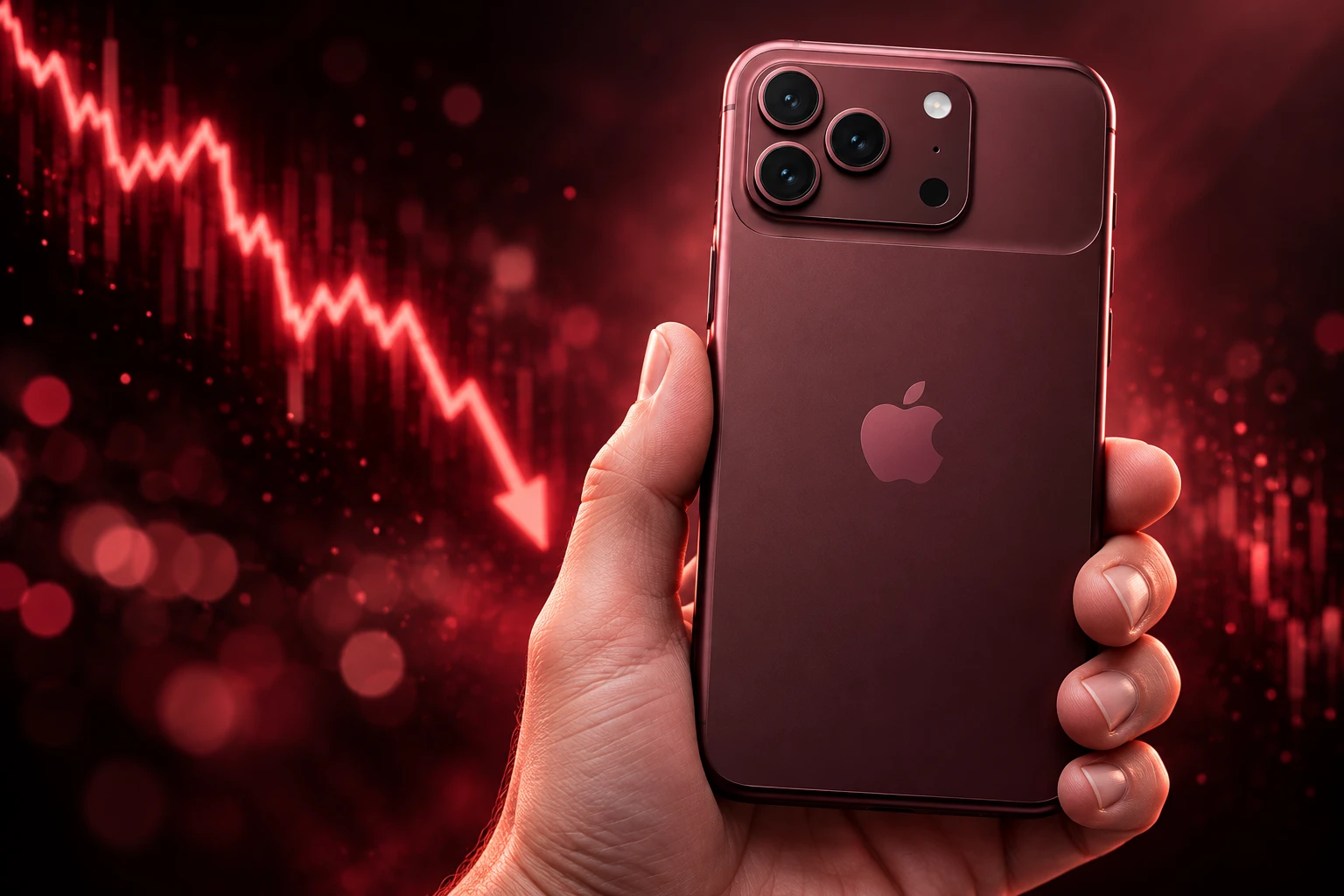
Apple’s Record 22% Share Rides a Shrinking Phone Market
Apple reached 22% of global smartphone shipments in Q3 2026 as a memory crunch erased cheap Android volume and the company skipped a base iPhone 18.

Apple took 22% of global smartphone shipments in the third quarter of 2026, its highest share for any July-to-September stretch, according to Counterpoint Research. The same tracker found the market itself fell 20% from a year earlier, the lowest third-quarter level since 2012.
Apple shipped fewer iPhones. Budget Android shrank faster, and that mix, plus a fall lineup with no base iPhone 18, produced the record.
A Bigger Slice of a Much Smaller Pie
Counterpoint’s Market Monitor, published on October 12, is a sell-in count of phones sent to carriers and retailers, not a tally of boxes people carried home. On that measure Samsung stayed first at 23% of shipments, with its own volume down 3%. Apple sat one point behind at 22%, up from 18% in Q3 2025, a four-point jump that still left the two brands at 45% of a much thinner market.
Xiaomi’s share was revised to 12% after an earlier 10% print. OPPO, counted with OnePlus and realme, took 9%. vivo took 8%. All three Chinese brands posted steeper shipment drops than Apple or Samsung.
Q3 2026 SHARE, TOP FIVE
| Brand | Q3 2026 share | Shipments vs Q3 2025 |
|---|---|---|
| Samsung | 23% | Down 3% |
| Apple | 22% | Down (no unit figure published) |
| Xiaomi | 12% | Down more than 30% |
| OPPO (with OnePlus, realme) | 9% | Down more than 20% |
| vivo | 8% | Down more than 20% |
Counterpoint posted the same cut on its official account two days after the note went out, with Samsung’s Z Fold8 and Apple’s first Q3 above 20% as the two headlines.
𝗠𝗲𝗺𝗼𝗿𝘆 𝗖𝗿𝘂𝗻𝗰𝗵 𝗛𝗶𝘁𝘀 𝗦𝗺𝗮𝗿𝘁𝗽𝗵𝗼𝗻𝗲𝘀: 𝗚𝗹𝗼𝗯𝗮𝗹 𝗦𝗵𝗶𝗽𝗺𝗲𝗻𝘁𝘀 𝗗𝗿𝗼𝗽 𝟮𝟬% 𝘁𝗼 𝗮 𝟭𝟰-𝗬𝗲𝗮𝗿 𝗟𝗼𝘄
𝖳𝗁𝖾 𝗀𝗅𝗈𝖻𝖺𝗅 𝗌𝗆𝖺𝗋𝗍𝗉𝗁𝗈𝗇𝖾 𝗆𝖺𝗋𝗄𝖾𝗍 𝖽𝖾𝖼𝗅𝗂𝗇𝖾𝖽 𝟤𝟢% 𝖸𝗈𝖸 𝗂𝗇 𝖰𝟥 𝟤𝟢𝟤𝟨, 𝗋𝖾𝖺𝖼𝗁𝗂𝗇𝗀 𝗂𝗍𝗌 𝗅𝗈𝗐𝖾𝗌𝗍… pic.twitter.com/BAcDkihLw4
— Counterpoint Research (@CounterPointTR) October 14, 2026
A separate preliminary tracker from IDC, dated October 14, put the same quarter at 255.3 million units, down from 327.3 million a year earlier, a 72 million-unit hole and a 22.0% drop on IDC’s own models. That is a different firm’s count, not Counterpoint’s 20%. IDC’s unit file is the one that sizes Apple’s decline: 57.3 million phones, down 4.0% from 59.7 million, while Samsung shipped 57.8 million, down 5.8% from 61.4 million.
Why Apple’s Share Rose as Volume Fell
Share is a fraction. When the denominator falls 20% and the numerator falls less, the percentage goes up. Counterpoint says Apple’s unit drop was driven largely by the absence of a base iPhone 18, which left a smaller launch-month fill than the full iPhone 17 lineup a year earlier. The iPhone 18 Pro models still opened stronger than their predecessors, with China and India the two markets Counterpoint flags, and older iPhone 17 stock kept moving.
Neil Shah, Counterpoint’s vice president of research, put the same point in plainer terms: Apple reached 22% even with lower shipments because the premium lineup held up. That is resilience of mix, not a surge in boxes. Sell-in can also run ahead of, or behind, what stores actually sell, so a share print in a crash is a weak proxy for how many people upgraded.
Apple did raise prices, Counterpoint says, though the hit was limited to the last weeks of the quarter. The firm’s own wording is that Apple joined an industry-wide shift toward hikes. The share gain was already in motion before those last weeks, because the cheap end of Android was being pulled back on purpose.
The Memory Bill Behind the 20% Drop
Q3 was the second straight quarter to take the full force of the memory crunch, Counterpoint says. DRAM and NAND prices kept climbing, bill-of-materials costs jumped, and supply of the chips phones actually use got tighter as wafer capacity moved toward high-bandwidth memory and server modules for AI data centers. Brands passed the cost on. Global smartphone retail prices are up 20% so far in 2026, a different 20% from the shipment drop, and average selling prices rose with them.
THE MEMORY SHOCK
- Shipments: Global Q3 volume fell 20% year on year on Counterpoint’s sell-in count, the weakest third quarter since 2012.
- Store prices: Global smartphone retail prices are up 20% so far in 2026 after brands passed chip costs through.
- Chip bills: IDC says memory costs have surged about 350% since last year and were still rising in Q3, though the sequential pace slowed to a low double-digit increase from 50% to 100% jumps in prior quarters.
- Next quarter: TrendForce, in a September 30 note, projects DRAM contract prices up 10 to 15% quarter on quarter in Q4 2026, with NAND flash up 15% to 20%.
Mobile DRAM allocations stay tight because suppliers keep shifting capacity to server products, TrendForce says, and smartphone brands are leaning on existing eMMC and UFS stock rather than buying much new NAND. That is the mechanism under Apple’s 22%: the chips that used to make a $200 Android phone viable are being sold, at higher margins, into racks.
Q3 was the second successive quarter to take the full brunt of the memory crisis. The extreme memory shortage is pushing the smartphone market into a more selective phase, reshaping OEM strategies and even consumer behavior. Consumers are holding on to their devices longer than estimated, increasingly considering refurbished devices and prioritizing higher-value devices, while OEMs are adjusting portfolios, pricing, and market strategies to protect profitability. This is creating greater pressure across the mass market, while premium demand remains comparatively resilient, widening the gap between premium and price-sensitive segments.
Shilpi Jain, Senior Analyst, Counterpoint Research
Nabila Popal, senior research director for worldwide devices at IDC, said the 22% unit drop on her firm’s tracker was the steepest year-on-year fall in its records, and that “the worst is yet to come.” She sees growth capped through 2027, with any recovery pushed to 2028 at the earliest.
September’s Lineup Left Out the Cheap iPhone
Apple’s September 9 newsroom post unveiled iPhone 18 Pro and iPhone 18 Pro Max. It did not unveil a base iPhone 18. Counterpoint ties most of Apple’s shipment decline to that hole: fewer new units went into the channel in launch month than when the full iPhone 17 range arrived a year earlier. The company still got a stronger Pro open, and it still lost volume.
THE FALL LAUNCH CALENDAR
- September 9, 2026: Apple debuts iPhone 18 Pro and iPhone 18 Pro Max; no base iPhone 18 is announced.
- September 12, 2026: Pre-orders open for the Pro models.
- September 18, 2026: The Pro models go on sale, in burgundy, glacier, silver and black, with 256GB as the starting storage.
- October 12, 2026: Counterpoint prints Apple at 22% of Q3 shipments, with the missing base model as the main volume drag.
- October 14, 2026: IDC’s unit tracker puts Apple at 57.3 million phones for the quarter, down 4.0%.
On Apple’s own pricing page, iPhone 18 Pro starts at $1,199 in the United States and iPhone 18 Pro Max starts at $1,299. The foldable iPhone Duo is listed from $1,999. Buyers who wanted a new iPhone below those rungs in September were pointed at last year’s 17-series phones. The fall event that left the company without a new $799 iPhone was a choice about mix, and Counterpoint’s 22% is what that choice looks like in a quarter when cheap Android was already being withdrawn.
How Xiaomi, OPPO and vivo Lost the Volume
The volume that vanished did not vanish evenly. Shah wrote that Xiaomi’s shipments fell more than 30% year on year, while OPPO and vivo each fell more than 20%. Counterpoint’s note says Xiaomi pulled back from lower price bands and from non-core overseas markets, raised average selling prices, and tightened shipment plans so it would not sell phones at uneconomical margins. The Xiaomi 18 series and its foldables got a better reading in China’s upper midrange and premium tiers, and the in-house XRING O3 chipset is the firm’s bid to stay in that band.
WHAT EACH BRAND CUT
- Xiaomi: Cut exposure to cheap segments and some overseas markets, then leaned on Xiaomi 18, foldables and XRING O3 in China.
- OPPO: Raised prices on entry and mid-range lines and folded OPPO, realme and OnePlus operations closer together to cut overlap.
- vivo: Put India and China first, pushed the Y series for value buyers and the X, V and S series upmarket, then watched price hikes knock budget models out of key bands while stock ran short.
Those are margin defenses. They also hand share to whoever can still get memory and still charge $1,199. Francisco Jeronimo, IDC’s vice president for worldwide devices, described the bind facing the Chinese volume brands as a choice they cannot win on both sides at once.
The third quarter shows the full impact and damage of the memory crisis. The pressure is now moving from vendors to consumers. As higher prices reach the shelf, many buyers are keeping their current devices longer. Chinese brands face a particularly difficult moment, as their exposure to low-end smartphones forces them to choose between protecting margins and defending volume just as demand weakens.
Francisco Jeronimo, Vice President for Worldwide Devices, IDC
IDC’s unit file, again a separate count, shows how steep that choice ran: Xiaomi 30.7 million phones, down 29.2%; OPPO 25.6 million, down 34.5%; vivo 19.1 million, down 31.5%. Others as a group fell 32.5% to 64.8 million. The brands that live on $200 phones did not have a Pro lineup to hide in.
First Place Still Belongs to Samsung
Samsung’s 23% was the largest share gain among the major brands, Counterpoint says, and it still came with a 3% shipment decline. The firm credits early demand for the Galaxy Z Fold8 series, a push toward higher average selling prices, and a steadier flow of parts for mid-range Galaxy A phones in emerging markets after some Chinese brands stepped back. That A-series supply is the unglamorous half of the story: Samsung can still put a mid-range phone on a shelf in markets where Xiaomi, OPPO and vivo are shipping less.
A share lead in a crashed quarter is also a weak cheer. Counterpoint is counting phones into the channel. It is not counting operating profit in Samsung’s mobile division, and a 3% unit drop on a 20% market drop is a relative win that still leaves fewer Galaxy phones in the world than a year ago. Foldable demand helped the mix. It did not refill the low end that Chinese brands abandoned.
The Sub-$200 Phone Is Being Designed Out
Counterpoint’s outlook for the rest of 2026 is blunt. Brands will keep cutting production, shrinking portfolios and steering supply toward higher-priced models. Price-sensitive segments face more pressure from higher device prices and tight component supply. A real recovery in overall volumes is unlikely until memory costs and supply get better.
WHAT OEMS ARE DOING NEXT
- Production: Build fewer phones rather than chase volume into a market that cannot absorb the chip bill.
- Portfolios: Drop overlapping cheap SKUs; OPPO’s three-brand trim is the template.
- Mix: Steer wafers and finished goods toward Pro, foldable and upper midrange lines that can carry a higher bill of materials.
- Buyers: Hold phones longer, look at refurbished units, or wait on holiday discounts that Kiranjeet Kaur, an IDC associate research director, says may be the better buy than hoping prices ease.
The same research house has already run the cheap-phone math past this quarter. It forecasts that more than 230 million cheap phones priced under $200 could disappear from annual shipments by 2030, with that tier about 40% smaller even if the overall market gets back near 1.20 billion units. Apple’s 22% is an early print of that map. The record Q3 share belongs to a company that skipped its cheapest new iPhone in the same quarter the rest of the industry started designing the $200 phone out of existence.

Xbox Sells Cloud Playtime Packs Ahead of November Caps

Xbox Puts a $1,800 Helix Behind a 2027 Handheld

Brussels Asks If Bio-Based Plastic Can Replace Recycled Content

EU Organic Deal Gates the Leaf and Doubles Exemptions

Barilla Strike Exposes Who Gains the Italian Plants

Boston Scientific Cyberattack Leaves Hospitals Waiting on Implants

Guizhou Cave Cafes Spread When Each Cavern Fills

The Second Ned Stark Kit Lands When a Banner Dies

Satellites Saw Nepal’s Ice Slope Move Before the Flood

OpenAI’s Jalapeño Chip Turns Watts Into Faster Agent Steps
-
 NEWS2 months ago
Boston Scientific Cyberattack Leaves Hospitals Waiting on Implants
-
 NEWS2 months ago
Guizhou Cave Cafes Spread When Each Cavern Fills
-
 GAMING2 months ago
The Second Ned Stark Kit Lands When a Banner Dies
-
 NEWS2 months ago
Satellites Saw Nepal’s Ice Slope Move Before the Flood
-
 NEWS2 months ago
OpenAI’s Jalapeño Chip Turns Watts Into Faster Agent Steps
-

 NEWS2 months ago
MLB Quiet Periods Copy a Freeze Other Leagues Use
-

 NEWS2 months ago
Roman Space Telescope Launches After a Decade-Long Budget Bet
-

 BUSINESS2 weeks ago
Saks Kept 15 Stores While Rivals Took the Shoppers