
BUSINESS
EU Organic Deal Gates the Leaf and Doubles Exemptions
Brussels doubles small-seller organic exemptions and extends 11-country trade to 2036, while putting extra checks on the EU leaf for imports.

EU lawmakers struck a provisional deal on 20 October that doubles small-seller organic exemptions and puts extra checks on the EU leaf logo for imports. The Irish presidency of the Council and the European Parliament agreed a provisional deal on organic production, labelling, certification and trade.
The same text also splits the right to sell food as organic from the right to print the EU leaf on imported packs. Endorsement, legal-linguistic checks and a formal vote still sit ahead, and both institutions want that work finished before the end of 2026, when recognition of 11 non-EU organic systems otherwise lapses.
What Changes for Small Organic Sellers?
Small operators who sell unpackaged organic goods, such as loose fruit and vegetables, straight to consumers can already skip certification if they stay under set caps. The deal raises the annual turnover cap from €20,000 to €40,000, counted as the average of the previous five years, and lifts the annual sales-volume cap from 5,000 kg to 10,000 kg.
Those two limits each double. They do not wipe out organic rules, origin checks or labelling duties, and a shop still has to fit the legal conditions in its member state. Price rises had been pushing some farm shops and market stalls over the old €20,000 line, so the new average is meant to bring them back inside the exemption without a full certificate.
CERTIFICATION CAPS IN THE DEAL
| Rule | Now | Under the deal |
|---|---|---|
| Annual turnover cap | €20,000 | €40,000, five-year average |
| Annual sales volume | 5,000 kg | 10,000 kg |
| Who is covered | Unpackaged goods sold direct to consumers | Same group, plus small online retailers of pre-packed organic goods, under conditions |
Negotiators also agreed, under conditions they have not yet published in full, to stretch that exemption to small online retailers selling pre-packed organic products. The volume cap is an annual figure, not a five-year average. Camilla Laureti, the S&D lawmaker who steered the file for Parliament, said her aim was “a stable, consistent and predictable regulatory framework” and argued that more small sellers of loose produce should be able to stay outside full certification.
The EU Leaf Now Needs Extra Checks
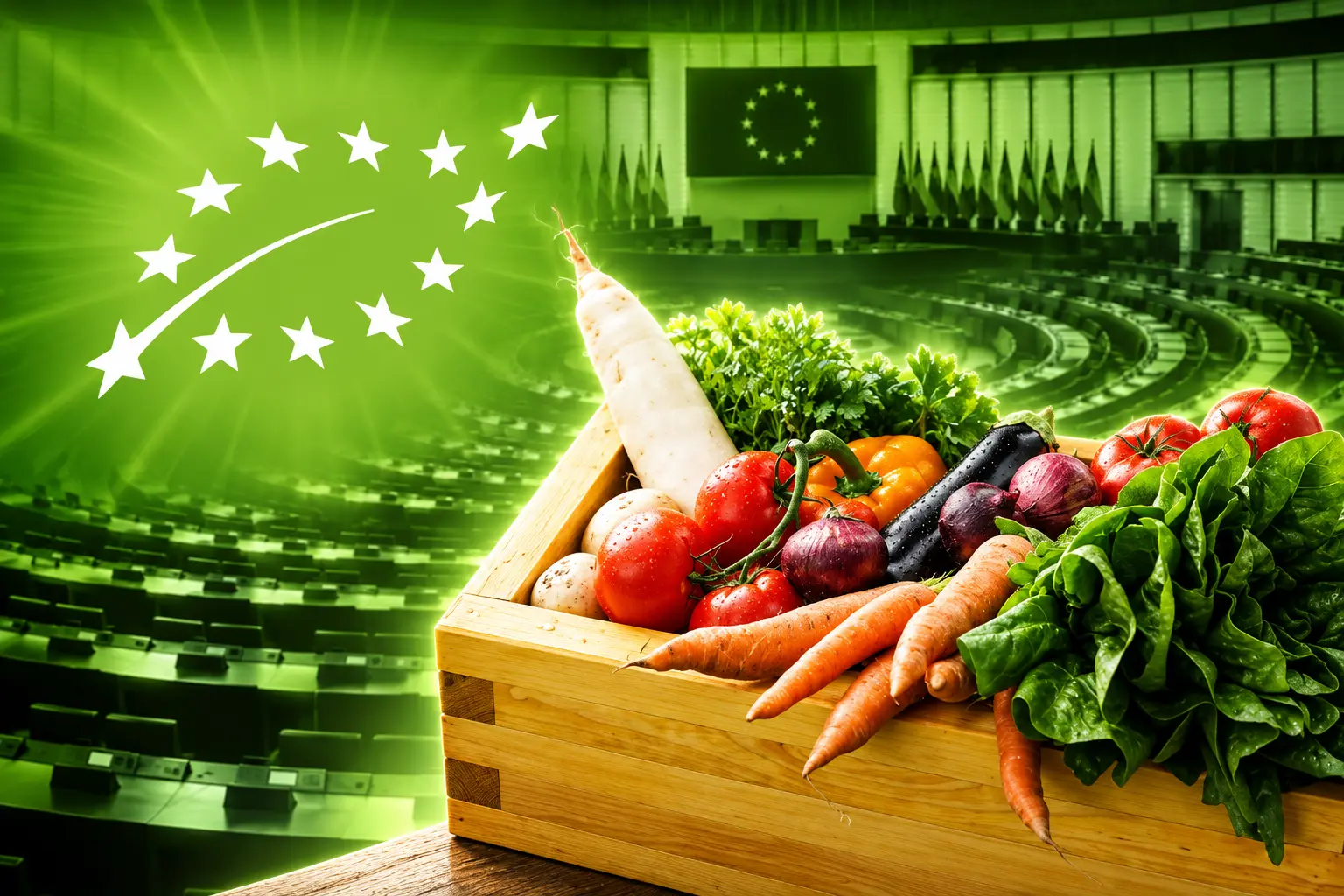
Imported goods from countries whose organic rules are recognised as equivalent may still be sold in the EU with words such as “organic” and may carry the organic logo of their country of origin. They may use the EU organic logo only if they meet extra production and monitoring requirements beyond equivalence, including living soil, animal welfare and processing methods.
That is the commercial core of the file. Equivalence keeps lorries moving and shelves stocked. The leaf, which the Commission calls the best-known food logo in Europe, becomes a tighter club. Martin Heydon, Ireland’s minister for agriculture, food and the marine, presented the package as a win for farms and shoppers alike.
Today, the Irish Presidency has delivered a strong result for farmers, consumers and the agri-food sector. Today’s agreement on the Targeted Amendments to the EU Organics Regulation demonstrates our commitment to supporting sustainable agriculture and creating the conditions for the organic sector to continue to thrive across the European Union.
Martin Heydon, Minister for Agriculture, Food and the Marine of Ireland, Council statement
Roberta Metsola, president of the European Parliament, called it “good news for Europe’s farmers and consumers” and said clearer rules mean fairer competition, less red tape for small operators, and stronger shopper confidence in organic food. The Council posted the same announcement the morning the talks closed.
🌱#DEAL to support the future of 🇪🇺 organic farming@EUCouncil & @EN_Parliament have agreed on simpler rules for farmers and businesses, greater certainty for international trade & safeguards for consumer trust in the EU organic label.#OrganicFarming
👇https://t.co/mxku8EO09w— EU Council Press (@EUCouncilPress) October 20, 2026
Lawmakers also killed a Commission idea that would have let the EU organic label appear on products containing less than 5% of ingredients from non-EU countries that fail the extra tests. IFOAM Organics Europe, the Brussels organic umbrella, said dropping that carve-out “helps protect the coherence and credibility of the EU organic logo.” Eduardo Cuoco, its director, still warned that the new logo rules will force operators to adjust traceability and extra controls, even if the trilogue text is simpler than the first draft.
Printers who treat 20 October as a packaging green light are early. Import route and logo eligibility are now two separate checks, and a political deal is not an adopted regulation.
A German Herb-Juice Case Forced the Split
The rewrite did not start as a farm-shop bill. It followed a Grand Chamber ruling on the EU logo of 4 October 2024 in case C-240/23, Herbaria Kräuterparadies GmbH v Freistaat Bayern.
Herbaria, a German herbal firm, wanted to sell a mix of fruit juice and herb extracts that also contained vitamins and ferrous gluconate not from organic farming. Bavaria blocked the EU organic logo and organic wording. The court held that a product imported under equivalence cannot use the EU organic logo, or in principle terms that refer to organic production, if it does not meet the production rules in Regulation (EU) 2018/848. The third country’s own organic logo can still appear, even when that mark contains the word organic.
In other words, “recognised as equivalent” was never the same as “made under EU rules.” The leaf tells a shopper the pack meets the Union rulebook, not a cousin of it. The 20 October text tries to reopen the word “organic” for equivalent imports while keeping the leaf behind the extra soil, welfare and processing tests the Council listed.
That matters because the leaf sits on a market that has already grown fast. Eurostat puts the EU’s organic area at 16.9 million hectares in 2022, or 10.5% of utilised farmland, up 7.4 million hectares, a 79% rise, from 9.5 million hectares in 2012. France alone had 2.9 million hectares that year, 17.0% of the EU total. The logo is the shorthand shoppers use for that expansion, which is why farm groups fought to stop a soft 5% back door.
Which Countries Keep Equivalence Until 2036?
Organic rules in 11 non-EU countries are recognised as equivalent to EU standards. That recognition was due to expire on 31 December 2026. The deal extends it to 31 December 2036, a 10-year lock-in. Parliament had voted for a five-year extension. Traders got the decade.
The Council named Argentina, Canada, New Zealand and the United States. The Commission’s recognised set, as listed by the AGRINFO service, is Argentina, Australia, Canada, Costa Rica, India, Israel, Japan, South Korea, New Zealand, Tunisia and the United States. Chile, Switzerland and the United Kingdom sit on separate organic trade agreements and were not on that 2026 cliff.
THE 11 EQUIVALENT SYSTEMS
- Americas: Argentina, Canada, Costa Rica and the United States.
- Asia-Pacific: Australia, India, Japan, South Korea and New Zealand.
- Mediterranean: Israel and Tunisia.
For U.S. exporters, the existing U.S. organic equivalence arrangement already limits eligible goods to USDA-certified products produced or finally processed in the United States, covering crops, wild crops, livestock and processed products, with extra stipulations. The new EU text does not rip that market open or shut it. It keeps the equivalence clock running while making the EU leaf a separate, harder permission.
Coffee, cocoa and tropical fruit were among the lines officials feared would snarl if the 2026 expiry hit with no successor. Cuoco said the decade “gives the European Commission and its trading partners more time to negotiate future arrangements” and “helps avoid disruption to international organic trade.” Copa and Cogeca, the EU farm and co-op groups, made the same point: the 2036 date is what stops a cliff for the supply chain.
Other Farm Rules Stay in the Fine Print
The targeted rewrite of Regulation (EU) 2018/848, in force since January 2022, also tweaks production practice. The Council granted temporary flexibility for non-organic protein feed for poultry and pigs, and for aquaculture juveniles, with those exceptions phased out over time. Copa and Cogeca said that protein-feed flexibility goes beyond what they had asked, which was to keep non-organic protein feed limited to young monogastric animals.
IFOAM said negotiators protected grazing requirements for ruminants and regretted that the file did not set more detailed rules for organic plant breeding. The Commission, welcoming the political deal, also pointed to changes on poultry, feed, conversion periods, veterinary treatments, greenhouse soil fertility, and certification conditions for groups of operators.
From 31 December 2031, the Commission is to publish information on best practice for stopping contamination between organic and conventional farming, a nod to rows over how member states police spray drift and shared equipment. Goods already labelled under the old rules may stay on sale until stocks run out. Extra transitional language is meant to cover imported organic products while the new rulebook starts.
WHAT WE KNOW
- The political deal: Irish presidency and Parliament closed a targeted rewrite on 20 October 2026.
- The two doubled caps: €20,000 becomes €40,000 on a five-year average, and 5,000 kg becomes 10,000 kg a year.
- The trade clock: 11 equivalent systems run to 31 December 2036 instead of 31 December 2026.
- The logo wall: equivalent imports may say organic and use their home logo; the EU leaf needs extra tests, and the 5% mix exception is out.
WHAT IS UNCONFIRMED
- Online-shop conditions: the extra tests small web retailers must meet have not been published in full.
- The extra production specs: living soil, animal welfare and processing methods still need secondary rules.
- The start date: the law enters into force the day after Official Journal publication, which has no calendar date yet.
Until those implementing rules exist, a packer cannot treat the leaf as a simple yes or no. The political text sets the gate. The gate’s measurements come later.
The Clock Runs to 31 December
The provisional deal must be endorsed by the Council and Parliament, then cleaned by lawyer-linguists and adopted as a regulation. The Commission said it would enter into force on the day after publication in the Official Journal. Both institutions want that sequence finished before the end of 2026, because that is when the current 11-country recognition expires.
THE PATH TO THE NEW RULEBOOK
- January 2022: Regulation (EU) 2018/848 takes effect across the EU.
- 4 October 2024: The Grand Chamber bars the EU organic logo on equivalent imports that do not meet the Union production rules.
- 11 May 2026: The Council agrees its negotiating mandate on simpler organic rules.
- 20 October 2026: Irish presidency and Parliament strike the provisional deal.
- End of 2026: Target date for formal adoption, and the day the current 11-country recognition otherwise ends.
IFOAM welcomes the 10-year equivalence extension and called for a fast endorsement plus a roadmap for secondary legislation, written with the sector. Cuoco said the deal is “an important step towards providing legal certainty for organic operators and avoiding disruption to international trade,” then added that the work is not over. The group posted the same line the day the talks closed.
🌱 EU Organic Regulation: Progress made, work ahead
We welcome the provisional agreement, including a 10-year extension of trade equivalence arrangements.
Next: swift adoption and practical rules that safeguard organic standards.Our PR: https://t.co/y4tWlkDCXO#OrganicFarming pic.twitter.com/fU6wVeh3Md
— IFOAM Organics Europe (@OrganicsEurope) October 20, 2026
Copa and Cogeca called the compromise timely given the end-2026 deadline and said the 2036 date gives operators something they can plan around. They still want the final legal text read line by line. If the votes slip past 31 December 2026, the 11-country recognition lapses before the new law exists, which is the date the whole file is actually racing.

Xbox Sells Cloud Playtime Packs Ahead of November Caps

Xbox Puts a $1,800 Helix Behind a 2027 Handheld

Brussels Asks If Bio-Based Plastic Can Replace Recycled Content

EU Organic Deal Gates the Leaf and Doubles Exemptions

Barilla Strike Exposes Who Gains the Italian Plants

Boston Scientific Cyberattack Leaves Hospitals Waiting on Implants

Guizhou Cave Cafes Spread When Each Cavern Fills

The Second Ned Stark Kit Lands When a Banner Dies

Satellites Saw Nepal’s Ice Slope Move Before the Flood

OpenAI’s Jalapeño Chip Turns Watts Into Faster Agent Steps
-
 NEWS2 months ago
Boston Scientific Cyberattack Leaves Hospitals Waiting on Implants
-
 NEWS2 months ago
Guizhou Cave Cafes Spread When Each Cavern Fills
-
 GAMING2 months ago
The Second Ned Stark Kit Lands When a Banner Dies
-
 NEWS2 months ago
Satellites Saw Nepal’s Ice Slope Move Before the Flood
-
 NEWS2 months ago
OpenAI’s Jalapeño Chip Turns Watts Into Faster Agent Steps
-
 NEWS2 months ago
MLB Quiet Periods Copy a Freeze Other Leagues Use
-

 NEWS2 months ago
Roman Space Telescope Launches After a Decade-Long Budget Bet
-

 BUSINESS2 weeks ago
Saks Kept 15 Stores While Rivals Took the Shoppers