
NEWS
Meta’s Camera-Free Ray-Bans Leave the Lens on Other Faces
Meta’s $349 Ray-Ban Meta Audio glasses drop the camera, but a 100-style camera lineup still leaves strangers unsure who can film them.

Meta on September 23 unveiled Ray-Ban Meta Audio, camera-free smart glasses that start at $349 and ship October 13. The frames weigh 43 grams and play music, take calls, and talk to Meta’s AI, with no lens that can photograph a stranger.
The same keynote put a thicker camera lineup on the table. Ray-Ban Meta Gen 3 went on sale the same day from $449 with a 12 MP camera, while Meta said it will offer more than 100 AI glasses styles by year-end. A passerby now has to guess which pair on the next face can film.
Ray-Ban Meta Audio Ships Without a Camera
Alex Himel, Meta’s vice president of wearables, says the audio frames were not a late privacy patch. “We’ve been working on them full force for two years, but we’ve been talking about it for longer than that,” he said ahead of Mark Zuckerberg’s Connect address. Audio, he added, has been the most-used feature on Meta’s smart glasses from day one: calls, music, podcasts, and an assistant that stays on the face.
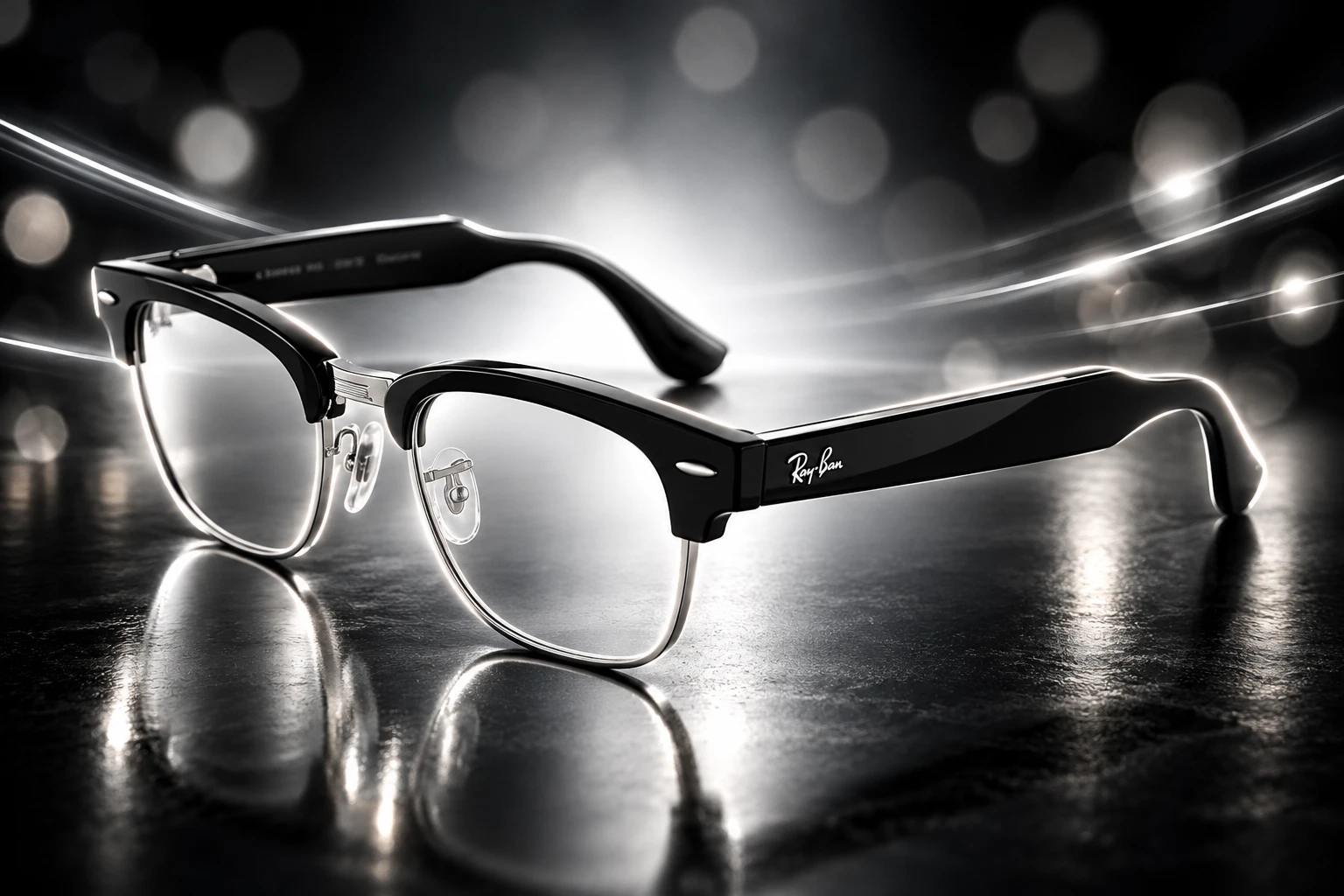
Pulling the camera let engineers empty the front of the frame. Meta says no battery pack, sensors, or other hardware now run through the nose, which is why the glasses can sit at 43 grams and still look like ordinary Ray-Bans. Clubmaster is the browline. Burbank is a rectangle from the archive. Together they ship in 23 color and lens combinations, and both take prescription lenses.
Meta opened a pre-order starting at $349 on September 23. The glasses are rated for up to 12 hours on a charge, plus up to 48 extra hours from the case, and they carry an IPX4 splash rating. Himel’s pitch is that they shrink a phone and a pair of earbuds into one object people will actually leave on.
AUDIO VERSUS GEN 3
| Spec | Ray-Ban Meta Audio | Ray-Ban Meta Gen 3 |
|---|---|---|
| Camera | None | 12 MP, 3K Ultra HD video |
| Starting price | $349 | $449 |
| Weight | 43 grams | Not stated |
| Battery, typical | Up to 12 hours | Up to 9 hours |
| Styles | Clubmaster, Burbank | Wayfarer, Aviator, Zena |
| Color and lens combos | 23 | 27 |
| Capture LED | None | Built in |
| Availability | Ships October 13 | On sale since September 23 |
Gen 3 adds an hour over Gen 2’s eight-hour rating, a six-microphone array Meta says cuts more than 90 percent of street noise, and a customizable action button for Meta AI. Dolby Atmos capture is promised later this year on the camera line. Audio buyers give all of that up on purpose.
The Same Faces Will Still Carry a Lens
Meta’s own store copy now splits the category in two: “Camera or no camera, there’s a pair that fits your lifestyle.” That sentence is the product plan, not a ceasefire. The company is not taking cameras off the street. It is adding a silent SKU next to louder ones that still shoot 3K video from eye height.
Clubmaster and Burbank were chosen because they already live in ordinary eyewear. Aviator and Zena, new on Gen 3, do the same job for the camera side. One is among the most copied silhouettes on earth. The other is a cat-eye. From a few meters, both read as fashion, which is the point Eva Chen, Meta’s vice president of fashion partnerships, keeps making when she compares the assortment to a house that has spent a century on frames.
The sidewalk test used to be crude and almost usable: a chunky temple, a black camera window, a white LED. Audio frames dump the window and the light. Gen 3 keeps both, then makes the rest of the glasses slimmer. Mix those on a train and the old tell does not hold. You can no longer treat “looks like Ray-Bans” as proof that nobody is recording.
Francesco Milleri, chairman and chief executive of EssilorLuxottica, called Ray-Ban Meta Audio one of the camera-free line of AI glasses the partners had “long been in the works.” The eyewear group wants volume across price and function, not a single moral setting for the category. Camera-free is a new drawer in the same cabinet.
The Recording Light Still Gets Taped Over
On camera models, Meta still leans on a white capture LED. The company says the light is meant to tell nearby people when photos or video are running, and Himel says accounts have been cut off when posted clips were made after someone tampered with it. The hardware fight around that lamp is why Audio’s missing light is not a small styling note.
HOW THE CAPTURE LED GOT POLICED
- July 7, 2026: Meta says a software update will shut the camera if the capture LED is physically broken or covered, after sellers advertised drill-outs that left the frames looking stock.
- August 2026: A further change stops a recording if the light is blocked after the clip has already started, closing a loophole Himel had acknowledged. Meta’s public line becomes “no light, no capture.”
- Early September 2026: Meta disables cameras on glasses where the LED was destroyed, a share it has described as fewer than one in a thousand sold. Covering the lamp with tape is treated as reversible. Drilling it out is not.
- September 23, 2026: Gen 3 ships with the same class of LED. Ray-Ban Meta Audio ships with none, because there is no camera to flag.
Cheap stickers sold as “privacy” kits still sit in that gap. Testers have found covers that leak just enough glow to keep the sensor happy while hiding the lamp from a person standing in front of the wearer. Meta can brick a drilled LED. It cannot make a stranger trust a dark frame in a crowd.
A proposed class-action complaint in federal court in California goes further than the lamp. It alleges that video and audio from the glasses moved to Meta’s servers and were reviewed by contractors, including intimate scenes a wearer never meant to capture. Those claims are unproven in court. They are already part of why some venues, including the British pub chain Wetherspoon, have told staff their instinct is to “turn the cameras off.”
Even Realities Built the Camera-Free Pitch First
The privacy backlash did not wait for Connect. Shenzhen’s Even Realities shipped G1 glasses without a camera in 2024 and followed with G2 in November 2025. The company was valued at $1 billion in July after a $150 million round, and its frames start at $599. Lucyd has sold audio-only glasses on the same fear, pitching workplaces that already ban recording devices.
Will Wang, Even Realities’ chief executive and a former Apple Watch engineer, has treated the camera as a legal and social problem, not a missing feature.
A camera for us is a no-go, until laws exist where we feel like the world has found a way to coexist with cameras on faces, which we very much don’t have now.
Will Wang, CEO, Even Realities
He has also said a camera on glasses still brings more downsides than upsides at today’s AI capability, once you count weight, battery, and the way strangers read the product. Meta’s $349 Clubmaster undercuts that pitch with Ray-Ban distribution and a charging case. It does not adopt Wang’s rule that the whole line should stay camera-free.
Even Realities still sells a heads-up display and, in Wang’s telling, keeps microphones but refuses voice recording that would give people a fresh reason to flinch. Meta’s Audio glasses take the opposite bet: open-ear speakers, wake-word AI, and a famous frame, with the camera parked on other models in the same family. The challenger brands now have to explain why a $599 privacy pair is worth more than a $349 Ray-Ban that also cannot take a picture.
One Hundred Styles, Most of Them Still Film
Zuckerberg’s other number was the one that undoes a simple privacy reading. By the end of the year Meta says there will be more than 100 styles of AI glasses across Ray-Ban, Oakley, and Meta’s own brand. Audio is two of those silhouettes. The rest of the expansion is still built around a camera.
We’re building AI glasses for everyone — by the end of the year, we’ll offer more than 100 different options. See the latest from Ray-Ban Meta Audio to new colorways for Meta Glasses, longer battery life and a more comfortable design on Ray-Ban Meta (Gen 3), and more.…
— Meta Newsroom (@MetaNewsroom) September 23, 2026
NEW FACES ON THE CAMERA SIDE
- Ray-Ban Meta Gen 3: Wayfarer plus new Aviator and Zena cat-eye frames, 27 combinations, on sale from $449 with the 12 MP camera.
- Meta Glasses by Kylie Jenner: a new Ivory Starfire colorway from $399, still a camera product dressed as a fashion drop.
- Meta Glasses by Lisa: Adventurer in Moonlit Sky with Blush lenses and Capri in Eclipse with grey lenses, both from $399, with star details, pet charms, and digital photocards.
- Meta Adventurer: a black frame with grey lenses from $249, on sale October 23, the cheapest on-ramp into the same camera family.
Chen calls the Lisa and Jenner work genuine design collabs, not names stuck on a temple. Lisa’s fan base, she said, runs from her twelve-year-old daughter to her mother in her 70s. That is how Meta wants the camera glasses to travel: as something you pick for the face, then happen to film with. Audio is the exception SKU. The celebrity frames are the rule.
Zuckerberg tied the whole pile to fit. “Glasses have to look right on your face, and every face is a slightly different shape,” he said. “We’ve been working to design the right pair of glasses for everyone.” The sentence is about noses and temples. It is also how a filming device leaves the gadget aisle.
Microphones Stay On After the Lens Comes Out
Dropping the camera closes one harm. It cannot make a still photo. It cannot feed a face search from the wearer’s point of view. Civil groups have spent a year warning about exactly those paths, including dormant face-ID code researchers found in Meta’s companion app. Audio glasses, as sold, do not take that picture.
They still wear microphones. Himel says the frames are not a hot mic dumping audio to the cloud all day, and that they wait for a wake word the way a home speaker does.
They don’t record. The only thing they do, which is the same thing as an Alexa device in your house or some other devices, they’re just listening for a specific wake word.
Alex Himel, VP of Wearables, Meta
A stranger cannot verify that from the next seat. There is no LED for listening, and Meta has not said whether a later software pass will add audio recording. The honest objection after Connect is not “these secretly shoot 3K.” It is that a camera-free Ray-Ban still looks like every other Ray-Ban, still hears, and still sits in a product family whose other members shoot.
WHAT WE KNOW
- No camera: Clubmaster and Burbank have no capture hardware and no capture LED.
- Wake word: Himel says the glasses listen for a trigger, then process the request, rather than streaming all sound.
- Private processing: Meta says it will start putting some glasses AI, beginning with live translation, through a path where Meta itself cannot read the data, later this year.
WHAT IS UNCONFIRMED
- Audio recording: Meta has not said whether a software update will let the frames save sound the way Gen 3 saves video.
- Street ID: There is no published mark that lets a bystander tell Audio from a slimmer camera model at a glance.
Private processing, built on the same idea Meta uses to keep WhatsApp AI private, is the company’s answer to the cloud-review fight. It does not change the mixed fleet. It also does not land on day one of the October 13 shipment.
What $349 Buys on October 13
For $349, the Audio pair is a full-day open-ear headset with Meta AI in a 43-gram Ray-Ban, $100 below Gen 3, with a case that Meta says can push the glasses to 50 percent in 20 minutes. Continuous playback is rated up to 6 hours inside that 12-hour general figure, which is the trade for leaving the camera out and stretching the battery.
WHAT THE AUDIO PAIR ACTUALLY DOES
- Open-ear sound: Music, podcasts, and calls without sealing the ear canal, so street noise stays in the mix.
- Hands-free AI: “Hey Meta” for the assistant now, with Muse, Meta’s newer agent, promised on glasses in the coming months.
- Fit hardware: Adjustable temple tips, swappable nose pads, and overextension hinges, plus prescription lenses.
- No capture: No photos, no 3K video, no recording lamp, no LED to tape.
That is a real product for people who wanted the soundtrack and the assistant and never trusted the lens. It is also a cover for a wider bet. Meta is still selling Gen 3, Jenner and Lisa camera frames, and a $249 Adventurer that keeps the sensor. Spring 2027 brings Meta VR Glasses at $1,299.99, about 100 grams, five times lighter than Quest 3, with the heavy compute on a puck. The company is not leaving faces. It is filling every slot on them.
On October 13 the camera-free Clubmasters start going out in cases. The Aviators that still film are already on sale. Until those two can be told apart from across a platform, the missing camera is a spec sheet, not a truce.

Xbox Sells Cloud Playtime Packs Ahead of November Caps

Xbox Puts a $1,800 Helix Behind a 2027 Handheld

Brussels Asks If Bio-Based Plastic Can Replace Recycled Content

EU Organic Deal Gates the Leaf and Doubles Exemptions

Barilla Strike Exposes Who Gains the Italian Plants

Boston Scientific Cyberattack Leaves Hospitals Waiting on Implants

Guizhou Cave Cafes Spread When Each Cavern Fills

The Second Ned Stark Kit Lands When a Banner Dies

Satellites Saw Nepal’s Ice Slope Move Before the Flood

OpenAI’s Jalapeño Chip Turns Watts Into Faster Agent Steps
-
 NEWS2 months ago
Boston Scientific Cyberattack Leaves Hospitals Waiting on Implants
-
 NEWS2 months ago
Guizhou Cave Cafes Spread When Each Cavern Fills
-
 GAMING2 months ago
The Second Ned Stark Kit Lands When a Banner Dies
-
 NEWS2 months ago
Satellites Saw Nepal’s Ice Slope Move Before the Flood
-
 NEWS2 months ago
OpenAI’s Jalapeño Chip Turns Watts Into Faster Agent Steps
-

 NEWS2 months ago
MLB Quiet Periods Copy a Freeze Other Leagues Use
-

 NEWS2 months ago
Roman Space Telescope Launches After a Decade-Long Budget Bet
-

 BUSINESS2 weeks ago
Saks Kept 15 Stores While Rivals Took the Shoppers