
GAMING
EA Shut BioWare to Fund an Unstarted Battlefront Game
EA cancelled Mass Effect and closed BioWare after sports bosses and buyout debt ranked an unstarted Star Wars Battlefront as the safer sci-fi bet.

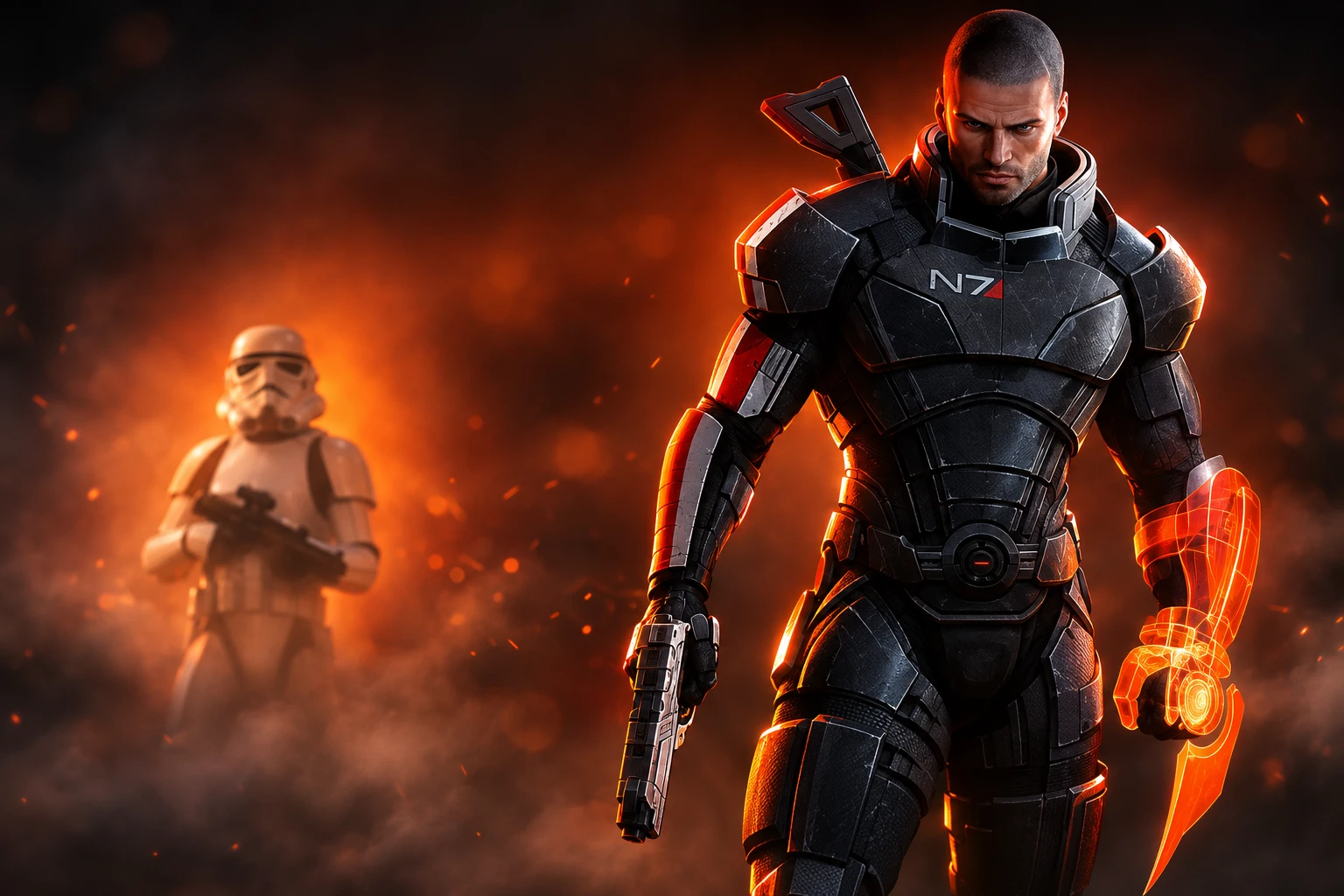
Electronic Arts closed BioWare on October 21 and cancelled the next Mass Effect so it could fund Star Wars Battlefront 3, people familiar with the plan said. The Canadian studio had spent more than 30 years making Baldur’s Gate, Dragon Age, and Mass Effect. Its last Mass Effect crew numbered about 50 people, still in early work, while Battlefront 3 had not started.
The names on the kill letter were not the executive who used to defend BioWare. They were sports-side bosses who had just taken the studio keys, at a company carrying $18 billion of buyout debt.
EA Picked Battlefront Before a Single Level Was Built
Jason Schreier, who spoke with people familiar with strategy at EA and at BioWare, said the main factor in the shutdown was a new opening with Lucasfilm for a third Battlefront game. EA had two expensive sci-fi projects on the books, each likely to cost hundreds of millions of dollars, and the buyout left no room to fund both.
Executives treated Battlefront as “a less risky, more predictable bet than a new Mass Effect,” those people said, and they were more at ease with shooters than with RPGs. DICE and Respawn were lined up to make it. Work had not begun. A game still on paper beat a game that already had a team in Edmonton.
BioWare confirmed the end in public the same day. “Now, after more than three decades of shared adventures, BioWare is closing and early development on the next Mass Effect project is ending,” the studio wrote.
— BioWare (@bioware) October 21, 2026
An EA spokesperson said the company “collectively reached this decision following months of planning, review, and analysis, including careful consideration of evolving business conditions, industry dynamics, and our long-term priorities.” The same statement added that EA had to “make tough decisions to focus our teams on the biggest opportunities for our future.” The opportunities that survived were shooters, sports, and licensed action games. The RPG studio did not.
$18 Billion in Debt Left Room for One Sci-Fi Bet
The squeeze did not start in the design meetings. It started with the largest all-cash sponsor take-private in history, the $55 billion take-private deal EA announced on September 29, 2025 with Saudi Arabia’s Public Investment Fund, Silver Lake, and Jared Kushner’s Affinity Partners.
THE BUYOUT THAT REPRICED RISK
- The price: Stockholders received $210 a share in cash, a 25% premium to the $168.32 close on September 25, 2025.
- The cash: The consortium put up about $36 billion of equity, with PIF rolling over its existing 9.9% stake.
- The debt: JPMorgan committed a $20 billion facility, and $18 billion of that was due to be funded at close.
- The carrying cost: Interest on that load runs at more than $1 billion a year.
The deal closed on August 4, 2026. Lucasfilm came to EA around the same month with a Battlefront offer, people familiar said, years after EA’s exclusive Star Wars games license ended in 2023. A licensed shooter with a global film brand attached looks, on a debt schedule, like a cleaner forecast than a single-player RPG that still needed a much larger team.
That is the boring reason a beloved studio dies. Coupon payments do not care that Commander Shepard is a household name. They care which project can be staffed, shipped, and recouped with the least surprise.
Sports Executives Now Control Which Studios Live
BioWare’s last advocate at the top of EA was Laura Miele, who had run the non-sports studios as president of entertainment. On June 9, 2026, while the buyout was still awaiting close, EA moved her.
The June 9 leadership memo named Miele president of enterprise development, “partnering with CEO Andrew Wilson to pursue strategic growth opportunities beyond EA’s core business.” Cam Weber, who had been president of EA Sports after joining the company in 2009, expanded as president and chief studios officer, with creative and development teams across the company. David Tinson, who started in EA Sports communications in 2003, became president and chief experiences officer, then chief operating officer once the sale closed.
People familiar with the politics said Miele’s shift left BioWare without a senior champion. EA presented the change as alignment. The October letter that actually closed Edmonton was signed by Tinson and Weber, not by the executive who had spent years arguing for the RPG slate.
Weber’s old world is FC, Madden, and College Football, games that reset every season and forecast with a straight face. Tinson came up selling those same leagues. A Mass Effect with branching timelines, a small team, and a six-year stumble from announcement to pre-production does not look like their kind of bet. A Battlefront that can sell armor packs on day one does.
Mass Effect Never Left Early Development
The next Mass Effect, known inside the company as Universe and first shown off around 2020, was still years from finished when the lights went out. Schreier said developers had spent roughly a year and a half to two years helping finish Dragon Age: The Veilguard, including work on its last mission, which is why a project announced in 2020 was still in early development in 2026.
Veilguard, released in 2024, sold 1.5 million copies in its first two months, half of what executives had expected. Andromeda in 2017 and Anthem in 2019 had already put the studio on a short leash. Completing Universe would have meant growing that 50-person group in a hurry or hiring outside help. EA chose not to write that check.
THE TWO SCI-FI BETS
| Project | Who would make it | Where it stood in October | What EA called the risk | |
|---|---|---|---|---|
| Mass Effect (Universe) | BioWare, Edmonton | Early development, about 50 people, years from finish | Costly RPG that still needed a much larger team | |
| Star Wars Battlefront 3 | DICE and Respawn | Assigned, development not started | Less risky, more predictable licensed shooter |
In the October letter to staff, Tinson and Weber put the decision in one blunt paragraph.
As we focus on these larger opportunities, we’ve had a small team at BioWare working on early-development for Mass Effect. We’ve made the decision not to move forward with this development, which means we’re closing the studio and our Edmonton workspace. BioWare is a legendary studio that helped define the role-playing genre, and we do not take this decision lightly.
David Tinson and Cam Weber, EA staff letter, October 21, 2026
About 400 people lost their jobs across EA, about 3% of the company, including those roughly 50 at BioWare. The Mass Effect brand stayed with EA. Schreier has noted the publisher is usually reluctant to sell dormant franchises. Former BioWare executive producer Mark Darrah warned that the company could also simply leave Mass Effect and Dragon Age on the shelf.
DICE and Respawn Inherit the Open Sci-Fi Slot
EA’s own October memo never printed the words Battlefront 3. It said Battlefield 6 had been “a great success,” that future Battlefield titles would continue, and that Respawn and DICE would “collaborate on a future project” in the shooter business. Multiple people later identified that project as Battlefront 3. Schreier, asked about a separate rumor that Bungie might make it, said DICE and Respawn would. He also said the next Star Wars Jedi game was “far in development,” while Battlefront 3 “hasn’t even started yet.”
That pairing is the part that is hard to defend as craft. Jedi 3 was already deep in production at Respawn. Universe had a staff, a working title, and years of (interrupted) pre-production. Battlefront 3 had a license conversation and a studio assignment. EA still spent the RPG’s budget slot on the game that did not exist.
Two years earlier, EA had already cancelled a Star Wars shooter inside Respawn. Battlefront II, the 2017 game whose loot-box launch became a public fight, is the reason the sequel waited so long, people familiar with the new talks said. The same publisher that once had to strip paid progression out of a Star Wars shooter now calls that series the safer sci-fi investment. People arguing about the closure on X kept landing on the same point: a licensed multiplayer game can ship thin and still sell cosmetics, and the debt desk will take that over a long RPG every time.
Composer Austin Wintory said he had spent a couple of years in talks with BioWare and EA about scoring the next Mass Effect and had written close to 20 minutes of music to see where the series could go. That work now sits on the same shelf as Universe.
What EA Is Still Building After BioWare
The October letter is a map of who won the same review that killed Edmonton. Action-adventure was cut back to two huge launches, Marvel’s Iron Man and the next Star Wars Jedi, with a promise to run fewer big projects at once. Shooters kept Battlefield, Apex Legends, and the unannounced DICE-Respawn game. Sports kept the whole EA SPORTS slate and added work.
WHAT SURVIVED THE REVIEW
- Still in production: Marvel’s Iron Man, the next Star Wars Jedi, Battlefield follow-ups, and heavy investment in Apex Legends, including new multiplayer modes.
- Sports bets: A social-first American football project code-named Project Gridiron, plus Fight Night back in pre-production.
- Lifestyle shuffle: The Sims project code-named Lotus was paused so a separate Sims project, Evergreen, could take the focus; the skate. team was made smaller.
- Gone: BioWare, the Edmonton workspace, and early work on Mass Effect.
EA even had Mass Effect weapon skins in Battlefield 6 in circulation around the shutdown, a detail that made the closure look even colder. The brand still had enough pull to dress a shooter. The studio that built the brand did not have enough pull to keep 50 jobs.
Comment-section fights about whether BioWare was too political miss the org chart. The people who closed it run football and live shooters. The person who used to argue for RPGs had been moved to a brief about growth “beyond EA’s core business.” Core, in that sentence, is the business that just won.
A BioWare Co-Founder Is Running New Spreadsheets
EA has not said it will sell Mass Effect. It has not announced Battlefront 3 either. The vacuum filled fast.
FROM THE BUYOUT TO THE SPREADSHEET
- June 9, 2026: EA moves Laura Miele off the studio brief and expands Cam Weber’s control of development.
- August 4, 2026: The $55 billion buyout closes and the $18 billion debt lands on the books.
- October 21, 2026: Tinson and Weber cancel Mass Effect, close BioWare, and point Respawn and DICE at a future shooter.
- October 30, 2026: People familiar with the strategy tell Jason Schreier that Battlefront 3 was the main reason.
- November 7, 2026: On N7 Day, original trilogy voice actors record a plea to keep the series alive, and a fan petition passes 320,000 signatures.
Trent Oster, who co-founded BioWare and now runs Beamdog, spent those November days in Excel. He put a rough AAA ballpark at more than $200 million up front, then added that a disciplined team could do a simpler game for less, “if you kept it simple and hit the big beats.” It would not be the Universe concept. The first job, he wrote, is getting the IP free, because “the fans deserve more than one game.”
His first recruit was James Ohlen, the designer who spent 22 years at BioWare. Ohlen said yes. “A chance to work on Dragon Age again is a dream of mine,” he wrote. Oster has talked about Canadian public money and outside investors. Beamdog is a small studio. That is not a deal. EA still owns the rights, and a publisher that will not fund Mass Effect may also refuse to sell it.
What are you doing this Saturday? I’m huddled in front of a computer running scenarios in Excel. I just passed rev 30.
Trent Oster, BioWare co-founder and Beamdog CEO, November 7, 2026
Battlefront 3, if EA and Lucasfilm actually start it, is a four-year job at the low end and another hundred-million-dollar sci-fi bet at a company that just said it could afford only one. Mass Effect’s next move is still a spreadsheet in someone else’s house, revision 30, waiting on a publisher that already spent the budget.

Duffy Pins the FAA Ground Stop on a Contractor-Owned Network

Microsoft Tested Its Gateway Fix on the Wrong Machines

Firaxis Cuts a Third of Its Staff as XCOM Slips

The New Chip Rule Favors US Cloud Parents in Asia

European Unions Ask Players to Police GenAI They Cannot See

Boston Scientific Cyberattack Leaves Hospitals Waiting on Implants

Xbox Sells Cloud Playtime Packs Ahead of November Caps

Guizhou Cave Cafes Spread When Each Cavern Fills

The Second Ned Stark Kit Lands When a Banner Dies

Satellites Saw Nepal’s Ice Slope Move Before the Flood
-
 NEWS3 months ago
Boston Scientific Cyberattack Leaves Hospitals Waiting on Implants
-
 GAMING4 weeks ago
Xbox Sells Cloud Playtime Packs Ahead of November Caps
-
 NEWS3 months ago
Guizhou Cave Cafes Spread When Each Cavern Fills
-
 GAMING3 months ago
The Second Ned Stark Kit Lands When a Banner Dies
-
 NEWS2 months ago
Satellites Saw Nepal’s Ice Slope Move Before the Flood
-

 NEWS3 months ago
OpenAI’s Jalapeño Chip Turns Watts Into Faster Agent Steps
-

 NEWS3 months ago
MLB Quiet Periods Copy a Freeze Other Leagues Use
-

 NEWS3 months ago
Roman Space Telescope Launches After a Decade-Long Budget Bet