
BUSINESS
Oatly’s Oat Drinks Still Move on Costly U.S. Diesel
Oatly cut 2026 adjusted EBITDA to $16 million to $20 million after U.S. diesel overran North America, while Europe still funded the group.

Oatly cut its 2026 adjusted EBITDA outlook to $16 million to $20 million on October 28, 2026, after U.S. diesel and freight costs overran its North American business.
The oat-drink maker, based in Malmö, Sweden, still expects constant-currency revenue to grow 8% to 10%. It also still ships chilled U.S. cartons on diesel trucks, and that is the bill that punched a hole in a year Europe had been funding.
A Thinner Profit Plan After the Diesel Spike
Oatly Group AB (Nasdaq: OTLY) reported third-quarter revenue of $243.1 million for the three months ended September 30, 2026, up 9.1% from $222.8 million a year earlier, or 8.9% in constant currency after a $0.5 million foreign-exchange tailwind. Gross margin rose 4.4 percentage points to 34.1%. Volumes increased 4.2% to 156.9 million litres from 150.6 million litres. Net losses attributable to parent shareholders narrowed to $27.5 million from $65.3 million. Adjusted EBITDA, profit before interest, tax, depreciation, amortization and listed one-off items, reached $9.4 million, or 3.9% of sales, up $6.3 million from $3.1 million.
That print was not enough to save the year. The company left its sales-growth range and its $20 million to $30 million capital-expenditure range unchanged, and it still expects currency to add about 200 to 250 basis points to reported revenue growth. It cut only the profit line, from a prior adjusted EBITDA range of $25 million to $35 million. The low end fell $9 million. The high end fell $15 million.
Nine-month adjusted EBITDA is already $14.8 million. The new full-year band therefore leaves about $1.2 million to $5.2 million for the fourth quarter, after a $9.4 million third quarter. Free cash flow in the third quarter was a $18.4 million outflow, wider than a $5.4 million outflow a year earlier, which Chief Financial Officer Marie-José David tied to timing. Flatin said the fuel hit lands in the fourth quarter because offsets will not arrive in time.
THE 2026 OUTLOOK OATLY LEFT ON THE TABLE
| Item | Prior outlook | Oct. 28 outlook |
|---|---|---|
| Constant-currency revenue growth | 8% to 10% | 8% to 10% |
| Adjusted EBITDA | $25 million to $35 million | $16 million to $20 million |
| Capital expenditure | $20 million to $30 million | $20 million to $30 million |
| FX tailwind to reported sales | 200 to 250 basis points | 200 to 250 basis points |
Flatin told analysts the cut is all cost. Demand, mix and the sales range were not rewritten. The factory and the product mix improved the gross margin by 4.4 points, then the trucks took the year back.
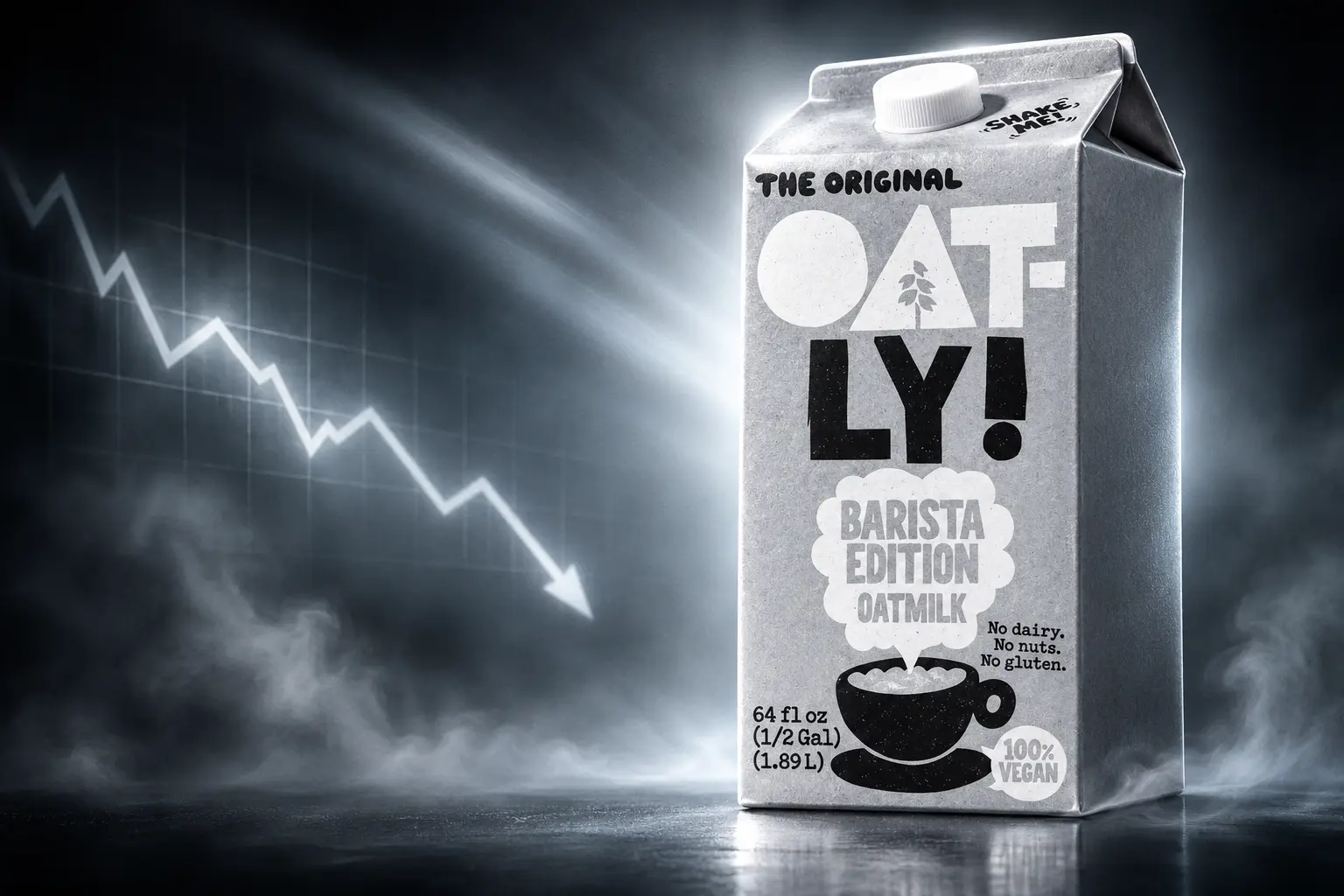
U.S. Diesel Has Not Come Back Down
In approximately 70% since the February conflict began in the Middle East, U.S. diesel has done the damage Flatin described, and about 40% of that climb has come since early July. On the call he added that the latest diesel price point sat 83% above January 5, with about two-thirds of the rise after July. He said U.S. freight to customers, measured per litre sold, is expected to run 12.5% higher in the fourth quarter than the first-half 2026 average.
Those company figures sit on a fuel market that was still elevated after the earnings call. The U.S. Energy Information Administration put the U.S. average on-highway diesel price at $6.352 a gallon in the week of October 26, 2026, the week of the call, and at $6.292 in the week of November 2. The same series peaked at $6.529 in the week of September 21.
THE DIESEL CALENDAR INSIDE THE CUT
- February 2026: The Middle East conflict begins. Flatin later measures an about 70% U.S. diesel rise from this point.
- Early July 2026: The start of the about 40% leg he cited as the surprise inside the third quarter.
- Week of September 21, 2026: EIA U.S. average diesel hits $6.529 a gallon, the high in the recent weekly set.
- October 28, 2026: Oatly cuts full-year adjusted EBITDA to $16 million to $20 million and says the fourth quarter takes the timing hit.
- Week of November 2, 2026: EIA U.S. average diesel is $6.292 a gallon, still near the earnings-week level.
Middle East costs also weigh on Europe and International, where Flatin said the conflict now represents more than 100 basis points of full-year group adjusted EBITDA margin. That is a separate squeeze from the U.S. post-August freight spike he named as the reason the guide moved. The sales outlook did not move with it.
Oatly’s Climate Files Flag the Truck Problem
Oatly calls itself a Climate Solutions company on its sustainability site. It estimates that people switching from cow’s milk to Oatly avoided about 285,896 metric tons of greenhouse gases in 2025, or 0.48 kg of CO2e per litre sold, and about 1,432,190 tons over seven years. The same pages record a miss on the thing that just hit the profit and loss account.
The latest wave of logistics and fuel inflation in North America has finally exceeded our capacity to offset. For perspective, in the U.S., diesel prices have increased approximately 70% since the beginning of the conflict in the Middle East in February and approximately 40% since early July.
Jean-Christophe Flatin, Chief Executive Officer, Oatly Q3 2026 prepared remarks
A Blonk Consultants life-cycle assessment of Oatly Original made in U.S. factories found that transport of the finished drink from the plant to the store was the highest contributing factor to climate change for those cartons, because of long hauls and refrigerated trucks. The Ogden, Utah production path also showed a fossil-resource score close to cow’s milk, from natural-gas heat and chilled diesel distribution. Oatly has said road transport is the main climate lever left in logistics, and it still aims for fully sustainable ground transport.
WHAT THE CLIMATE FILE ALREADY SAID
- The label: Oatly presents itself as a climate-solutions drinks company whose biggest climate effect is people dropping cow’s milk.
- The 2025 miss: Emissions from transportation rose about 9% in 2025, including more domestic trucking in the United States as production shifted between sites, plus longer hauls after the Singapore plant closed.
- The U.S. carton: For Oatly Original made in U.S. factories, finished-product trucking was the largest climate slice in the Blonk study, ahead of the farm and the plant.
- The cash echo: The same diesel that fills those refrigerated miles is the cost Flatin said the company could no longer offset in 2026.
The climate work and the earnings call are describing one physical system. A heavy, chilled liquid still has to move from a plant to a cooler, and in the United States that move is still a diesel job.
Who Makes Money Inside Oatly?
Europe and International is the company that works. North America is the company that just had its first thin profit month interrupted by fuel. Greater China is the company under review.
Europe and International took third-quarter revenue to $147.2 million, up 19.5%, on 17.6% volume growth that Flatin and Global President Daniel Ordoñez tied to Barista products and a wider drinks range. Adjusted EBITDA in the segment rose to $31.5 million from $21.9 million. That $31.5 million was more than three times the group’s $9.4 million, because corporate costs and China’s loss absorbed the rest. For the first nine months, the segment produced $88.1 million of adjusted EBITDA on $427.1 million of revenue, against $14.8 million for the whole group.
North America returned a positive $0.3 million of adjusted EBITDA, versus a $1.3 million loss a year earlier, on revenue of $63.8 million, up 2.8%, and volumes of 34.6 million litres, up 0.4%. Flatin said retail distribution points are at a record and that the region is still chasing category leadership in a hard market. Nine-month adjusted EBITDA there is $1.7 million on $193.0 million of sales. A $0.3 million quarterly profit does not absorb a $9 million to $15 million group cut.
THIRD-QUARTER 2026 BY SEGMENT
| Segment | Revenue | Change | Adjusted EBITDA | Year earlier |
|---|---|---|---|---|
| Europe and International | $147.2 million | +19.5% | $31.5 million | $21.9 million |
| North America | $63.8 million | +2.8% | $0.3 million | Loss of $1.3 million |
| Greater China | $32.0 million | -14.6% | Loss of $1.9 million | $1.6 million profit |
Greater China revenue fell 14.6% to $32.0 million, or 19.3% to $30.2 million excluding a $1.8 million foreign-exchange benefit. Foodservice competition drove the drop, with retail a partial offset. The segment swung to a $1.9 million adjusted EBITDA loss from a $1.6 million profit, on lower volumes and higher selling costs. Nine-month adjusted EBITDA is a $4.1 million loss on $91.4 million of sales.
The China File Stays Unfinished Into Year-End
Oatly is still running a strategic review of Greater China and says it expects to finish that work within 2026. The board has listed a range of options, including a potential carve-out. The full-year outlook still includes China’s results. The company says there is no assurance the process produces a deal or a change in structure, and it does not plan further updates until the board approves a path.
Ordoñez said third-quarter constant-currency revenue in the segment was down 19.3% against a 29% growth comparison from a year earlier, with the same split as recent quarters: pressure in foodservice, a better retail mix. Reported results include a $1.6 million non-cash impairment tied to an office exit, which is kept out of adjusted EBITDA. Flatin thanked the local team and said North America and other international markets are the growth priority.
WHAT WE KNOW
- The timetable: Oatly expects to complete the Greater China review within 2026.
- The options: The company is weighing a range of paths, including a potential carve-out.
- The quarter: Revenue was $32.0 million, down 14.6%, with an adjusted EBITDA loss of $1.9 million, mainly from foodservice competition.
- The books: The 2026 outlook still includes Greater China’s results.
WHAT IS UNCONFIRMED
- The outcome: No buyer, price, spin, or keep-and-fix decision has been approved.
- The 2027 shape: There is no assurance the group’s next-year numbers will exclude China.
- The cash return: Flatin’s goal of better consolidated cash returns from the file has no published terms.
Until that file closes, Europe is still paying for a U.S. trucking problem and a China review at the same time. The profit cut does not wait for either one to finish.
When Will Oatly Raise Prices in North America?
Selective North American price increases are due in the first quarter of 2027, not in the fourth quarter of 2026 that Flatin said will take the diesel hit. That lag is why a fuel move in late summer becomes a full-year profit cut. Offsets exist, he said, but they do not land on the same calendar as the trucks.
A U.S. price rise in early 2027 will meet a brand that already sells at a premium to dairy on the shelf. The carton is marketed on taste and climate. The cost that just moved the guide is diesel. Shoppers who already treat Oatly as the expensive oat drink will see that bill before the income statement does.
THE LEVERS AFTER THE DIESEL SPIKE
- The lag: Incremental North American pricing is set for the first quarter of 2027, after the fourth-quarter profit hit.
- The mix: Management is still using cost cuts and a richer mix of customers, channels, and products, the same mix it credited for the 34.1% gross margin.
- The new line: A Fiber range, 5 to 6 grams of fiber per about 250 ml, is in Europe and due in the United States in January 2027 in a 48-oz pack, across 11 European markets by year-end.
- The China option: A carve-out remains on the list, with no deal and no date inside the remaining weeks of 2026.
Ordoñez framed Fiber as a way into wellness and coffee occasions, including a no-sugar shake base and a low-sugar Barista, aimed in part at women and at drinkers already chasing gut-health trends. The U.S. pack arrives in the same month the company wants U.S. prices up. Europe already has the volume engine. North America still has to prove a $0.3 million profit can survive $6 diesel and a 2027 price list.
Flatin also warned that 2027 looks a little worse than 2026 on key cost-of-goods and logistics lines. The company is not treating the fourth-quarter hole as a one-month fuel blip. U.S. diesel in the week of November 2, 2026, was $6.292 a gallon. The price increases wait until the first quarter of 2027, and the China review is still open.
Disclaimer: This article is news reporting and analysis of Oatly Group’s third-quarter 2026 results and outlook, and it is for information only. It is not investment advice, a recommendation to buy or sell OTLY shares or any other security, or a forecast of future earnings or fuel prices. Readers should consult a licensed financial adviser or other qualified investment professional before making any decision that involves the company’s securities. Figures and statuses come from Oatly’s October 28, 2026 materials, its sustainability publications, and U.S. Energy Information Administration diesel prices as of the weeks named above, and they can change with later results, fuel markets, or a Greater China transaction.

Duffy Pins the FAA Ground Stop on a Contractor-Owned Network

Microsoft Tested Its Gateway Fix on the Wrong Machines

Firaxis Cuts a Third of Its Staff as XCOM Slips

The New Chip Rule Favors US Cloud Parents in Asia

European Unions Ask Players to Police GenAI They Cannot See

Boston Scientific Cyberattack Leaves Hospitals Waiting on Implants

Xbox Sells Cloud Playtime Packs Ahead of November Caps

Guizhou Cave Cafes Spread When Each Cavern Fills

The Second Ned Stark Kit Lands When a Banner Dies

Satellites Saw Nepal’s Ice Slope Move Before the Flood
-
 NEWS3 months ago
Boston Scientific Cyberattack Leaves Hospitals Waiting on Implants
-
 GAMING4 weeks ago
Xbox Sells Cloud Playtime Packs Ahead of November Caps
-
 NEWS3 months ago
Guizhou Cave Cafes Spread When Each Cavern Fills
-
 GAMING3 months ago
The Second Ned Stark Kit Lands When a Banner Dies
-
 NEWS2 months ago
Satellites Saw Nepal’s Ice Slope Move Before the Flood
-

 NEWS3 months ago
OpenAI’s Jalapeño Chip Turns Watts Into Faster Agent Steps
-

 NEWS3 months ago
MLB Quiet Periods Copy a Freeze Other Leagues Use
-

 NEWS3 months ago
Roman Space Telescope Launches After a Decade-Long Budget Bet