
BUSINESS
Nortera Still Packs Green Giant After Ottawa Blocks Sale
B&G Foods and Nortera ended the Green Giant Canada sale after Ottawa’s block, yet Nortera still packs the brand it was not allowed to own.

B&G Foods and Nortera Foods ended the Green Giant Canada sale on October 5 after Ottawa moved to block it. The Quebec processor that has packed the brand for 30 years will keep running the plants, and B&G will keep the labels.
Nortera will pay US$1.6 million in a contract break fee and a slice of legal costs. Parsippany-based B&G said it will look again at sales, partnerships, or other ways to get value from the leftover Canadian vegetable business.
Who Makes Green Giant Vegetables in Canada
Nortera has been the exclusive producer for 30 years of Green Giant and Le Sieur in Canada. That factory relationship is what made the sale look clean on a slide, and it is what survived the collapse.
When the companies announced the deal on October 27, 2025, then-CEO Hugo Boisvert said the brands, “long produced in Canada, are now also locally owned.” They never were. The asset purchase agreement, signed on October 24, 2025, died on October 5, 2026, after the parties missed a September 24 deadline for clearance under the Competition Act.
Production was always going to stay at Nortera’s plants in Tecumseh, Ontario; Lethbridge, Alberta; and Saint-Denis-sur-Richelieu, Quebec, where the company had just flagged a $28 million upgrade. After the walk-away, Erwan Hédiard, Nortera’s interim chief executive and finance chief, kept the same industrial pitch.
While this transaction will not move forward, Nortera remains fully committed to vegetable production and processing in Canada and to the long-term strength of our industry. We are proud of our longstanding relationship with B&G Foods and of our strategic partnership in the production of Green Giant in Canada.
Erwan Hédiard, Interim Chief Executive Officer and Chief Financial Officer, Nortera
B&G will still own Green Giant Canada. Nortera will still be the primary co-manufacturer. The cans and bags that reach Canadian grocers will come off the same lines they came off before the Bureau opened its file.
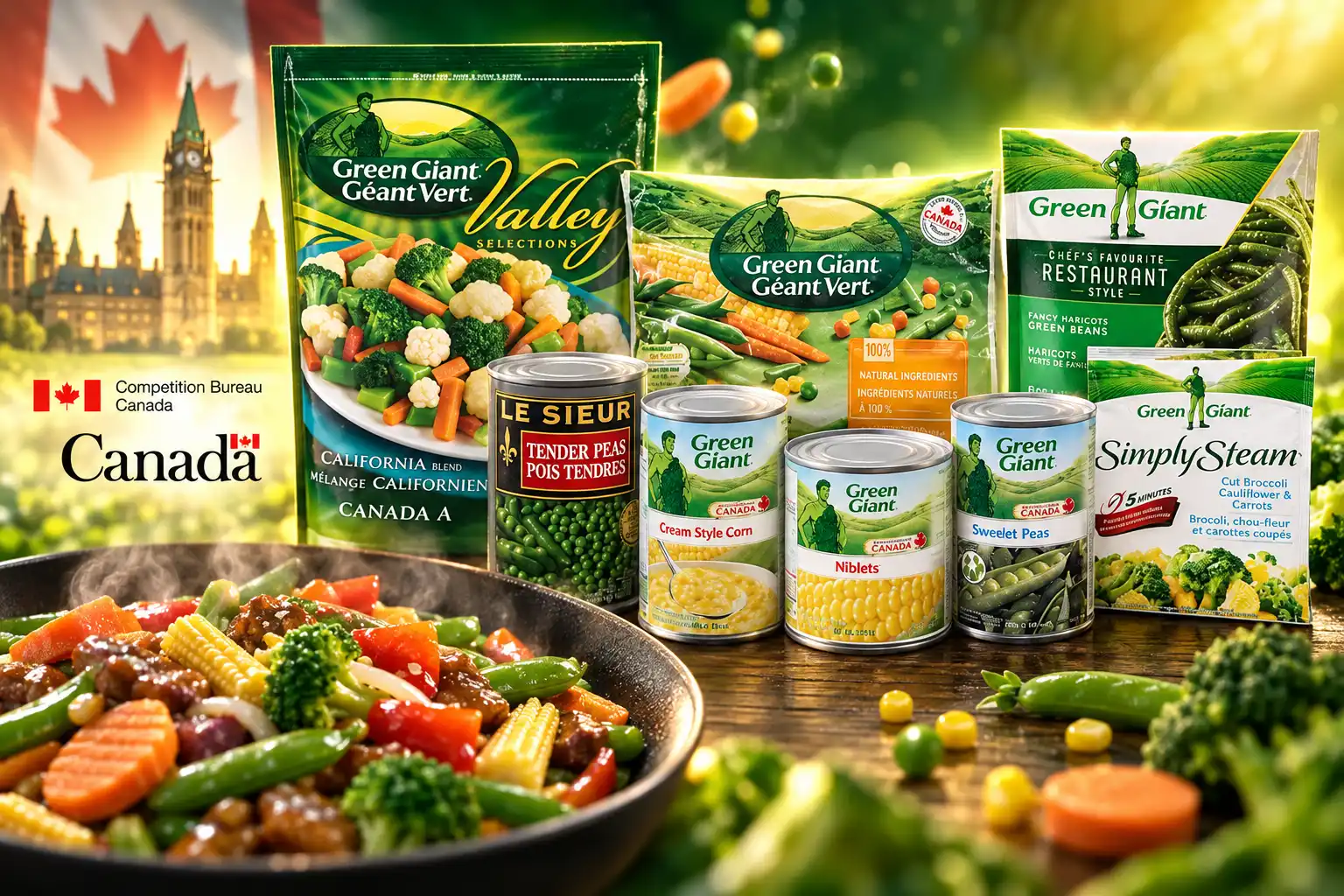
The Bureau Split the Factory From the Label
Canada’s Competition Bureau asked the Competition Tribunal on August 19, 2026, to stop Nortera Foods from buying B&G Foods Canada’s Green Giant and Le Sieur businesses. It also asked for a hold so the companies could not close while the case ran. The companies did not fight that hold. On September 21 the Tribunal ordered them not to complete the purchase until it ruled.
HOW THE CANADA DEAL UNRAVELLED
- October 24, 2025: B&G Foods Canada and Nortera sign an asset purchase agreement for Green Giant and Le Sieur in Canada.
- October 27, 2025: Both companies announce the sale, subject to Competition Act approval, with terms undisclosed.
- August 19, 2026: The Bureau asks the Competition Tribunal to block the deal and to freeze closing.
- September 21, 2026: The Tribunal bars completion while it reviews the Bureau’s case.
- September 24, 2026: The contract’s outside date for regulatory approval passes without clearance.
- October 5, 2026: The parties terminate the agreement. Nortera owes B&G US$1.6 million.
- October 6, 2026: B&G files an 8-K, and Jeanne Pratt, the interim commissioner of competition, welcomes the walk-away.
The Bureau’s worry was not who ran the blanchers. It was who sat across the table from grocers. Nortera already processes, markets, and sells canned and frozen vegetables in Canada under Del Monte and Arctic Gardens, and it packs private-label product for retailers. B&G markets Green Giant frozen and canned lines and Le Sieur canned vegetables, and it competes with Nortera for wholesale contracts even though Nortera processes most of B&G’s Canadian vegetable product.
Investigators concluded the purchase would fuse a dominant processor with its only major national brand rival in a market that was already tight. Foreign suppliers, they said, would not put enough pressure on the combined firm, and smaller retailers that lean on branded lines would have even fewer places to go. High barriers, including plants, crop access, and brand recognition, made a quick new entrant unlikely. The Bureau’s own write-up said the deal was likely to bring higher prices and fewer choices in the wholesale supply of certain canned and frozen vegetables.
We are pleased that a merger, which our investigation found was likely to harm competition, will not move forward.
Jeanne Pratt, Interim Commissioner of Competition, Competition Bureau statement, October 6, 2026
Pratt tied the outcome to grocery bills. Canned and frozen vegetables, she said, are everyday staples, and a merger found likely to harm competition would not proceed.
We welcome Nortera and B&G Foods’ joint decision not to proceed with their proposed transaction involving the Green Giant and Le Sieur brands. Our investigation found the deal was likely to lead to higher prices and fewer choices.https://t.co/FX5p3VtKbO pic.twitter.com/47ee5hOPUI
— Competition Bureau Canada (@CompBureau) October 6, 2026
Ottawa therefore saved a second brand owner on paper. It did not create a second factory.
Green Giant Canada Had One Logical Buyer
Nortera was the obvious purchaser because it already made the product. Casey Keller, then B&G’s president and chief executive, said so when the sale was announced, calling Nortera “the long-time, primary co-manufacturer for the brand in Canada” and “well-positioned to drive continued success.” Proceeds were earmarked for general corporate uses, including long-term debt, with the dollar figure left out of every public notice.
That industrial logic is also why the Bureau treated the deal as a merger of rivals rather than a tidy handoff. If the same company already cooks most of the vegetables, the remaining fight is over the label, the promotions, and the terms a grocer can extract by playing Green Giant against Arctic Gardens and Del Monte. Kill the independent owner and that fight ends, even if the plant gates never change.
Sylvain Charlebois, who posts as The Food Professor, put the other half of the argument in public after the collapse: it is hard to recall the last time the Bureau “pressured a Canadian company to abandon buying an American company’s assets over concerns about excessive market power.” “Canadian ownership matters,” he wrote. “So does competition.”
Both halves can be true at once. A Canadian packer would have owned a Canadian-made brand. Grocers would have faced one less national seller of branded peas and corn. The objection that the price-harm case is a stretch, because Nortera already packs most of B&G’s Canadian vegetables and Green Giant already leads the category, describes the factory. It does not erase the wholesale contest the Bureau said it was protecting.
A $1.6 Million Fee on Heavy Debt
The break payment is real money and small money. S&P Global Ratings, in a June 1, 2026 note on B&G’s refinancing, had assumed the Canadian sale would bring proceeds of at least $60 million if it closed. What arrived instead is the US$1.6 million termination package.
B&G’S DEBT AT APRIL 4, 2026
- Long-term debt: $2,021.9 million, including the current portion, on the first-quarter 10-Q.
- Cash on hand: $64.5 million, leaving net debt of $1,957.4 million.
- Leverage: net debt to pro forma adjusted EBITDA of 6.07 times, down from 6.57 times at the end of 2025, on the company’s own yardstick.
- The missed turn: management had said the Canadian sale would cut leverage by about 0.25 times once it closed.
That 0.25-times cut is now off the table. B&G had already used other tools on the same debt pile, including a 50 percent dividend cut that it said would free about $30 million a year. In the third quarter of 2025 it also booked a $27.8 million impairment on Green Giant Canada assets it had moved into held for sale, a write-down taken when the Nortera deal still looked like it would close.
The leftover business is not a stub that has stopped selling. In the first quarter of 2026, Green Giant Canada sales rose 16.4%, or $4.2 million, while the parent company posted a $32.5 million net loss, driven mainly by a $36.3 million loss on sales of assets after the U.S. frozen handoff.
THE GREEN GIANT BREAKUP
| Date | What B&G sold | Buyer | Result |
|---|---|---|---|
| November 2023 | U.S. Green Giant shelf-stable line | Seneca Foods | Closed |
| August 1, 2025 | U.S. Le Sueur shelf-stable line | McCall Farms | Closed |
| March 2, 2026 | U.S. Green Giant frozen line, including Yuma, Arizona | Seneca Foods | Closed |
| October 24, 2025 / October 5, 2026 | Canada Green Giant and Le Sieur frozen and shelf-stable lines | Nortera Foods | Terminated |
Canada was the last named piece of that vegetable teardown. It is also the piece that still sits on B&G’s books.
B&G Already Sold Green Giant in the U.S.
Keller’s October 2025 notice framed the Canadian sale as one more step in shedding lines that were “non-core” so the company could “sharpen our focus and reduce long-term debt.” By then the U.S. shelf-stable Green Giant business was already gone to Seneca Foods, and the U.S. Le Sueur canned line had gone to McCall Farms. The U.S. frozen line followed on March 2, 2026, with the Yuma plant included and a co-pack left in place at B&G’s Irapuato, Mexico site.
On the first-quarter 2026 call, management called Green Giant Canada “the final component of the Green Giant divestitures.” Guidance for 2026 left that sale out and treated it as EBITDA-neutral if it closed. Robert D. Mills, who was president and chief executive by the time the agreement died, now has to run a Canadian brand his predecessor had already parked in the non-core column.
The U.S. spelling is Le Sueur. The Canadian canned brand is Le Sieur. They were never one P&L, and they did not find one buyer. Seneca could take U.S. Green Giant without becoming Canada’s dominant canned-and-frozen processor. Nortera could not take the Canadian labels without combining them with Del Monte, Arctic Gardens, and a private-label book the Bureau called too large to swallow.
What Grocers Still Need From a Second Brand
The Bureau wrote the harm in grocery-aisle language. Suppliers compete for retailer contracts on price, promotions, and shelf space. Take away an independent Green Giant owner and retailers lose a counterparty, even if the same plant still fills the bags. Those extra wholesale costs, the Bureau said, can show up as higher sticker prices and a thinner freezer door.
WHAT THE BUREAU SAID THE MERGER WOULD COST
- A close rival gone: Nortera and B&G would stop bidding against each other for grocery supply.
- A tighter market: a dominant processor would add its largest remaining national vegetable brand.
- Fewer outs for retailers: foreign suppliers would not replace the lost pressure, and smaller grocers that rely on branded lines would feel it first.
- Slow new entry: plants, crop contracts, and brand recognition make a fast substitute unlikely.
Growers sit one step further back. Who owns the retail brands can change who books acres and who sets pack plans, which is why the failed sale still matters in Canadian vegetable country even though no plant changed hands on October 5. Nortera remains the packer. B&G remains the seller of Green Giant and Le Sieur. Grocers still have two national brand owners to play, at least until B&G finds someone Ottawa will accept.
That is a thinner kind of competition than two independent factories. It is thicker than one company owning Del Monte, Arctic Gardens, Green Giant, and Le Sieur at once.
B&G Will Look for Another Buyer
Mills did not pretend he wanted the deal to die. He said he was disappointed it missed the outside date, then pointed at the brand he still has to run.
Green Giant is the number one brand in both frozen and shelf-stable vegetables in Canada, with strong consumer loyalty, longstanding customer relationships and, we believe, significant opportunities for growth and margin improvement.
Robert D. Mills, President and Chief Executive Officer, B&G Foods
He also said B&G will keep looking at sales, partnerships, or other moves for Green Giant Canada. Any new buyer has to live with a fact the Nortera file made public: the packer of record is the dominant Canadian processor of these vegetables, and Ottawa will treat a combination with that packer’s own brands as a problem. A financial buyer, a grocer, or a foreign packer without a matching Canadian brand book would face a different review. Nortera would not.
Until then the arrangement the Bureau refused to let harden into ownership stays in place as a contract. B&G owns the Canadian giant. Nortera still fills the bag.
Disclaimer: This article is news reporting and analysis of a completed corporate sale and a Canadian merger review. It is for information only and is not investment advice, a recommendation to buy or sell any security, or legal advice on the Competition Act. Readers who may act on B&G Foods’ debt, earnings, or brand sales should consult a licensed financial adviser and, where needed, a competition lawyer. Debt figures, sales numbers, and deal statuses are those published by the companies, the Competition Bureau, and S&P Global Ratings in the documents cited, and they can change with later filings.

Xbox Sells Cloud Playtime Packs Ahead of November Caps

Xbox Puts a $1,800 Helix Behind a 2027 Handheld

Brussels Asks If Bio-Based Plastic Can Replace Recycled Content

EU Organic Deal Gates the Leaf and Doubles Exemptions

Barilla Strike Exposes Who Gains the Italian Plants

Boston Scientific Cyberattack Leaves Hospitals Waiting on Implants

Guizhou Cave Cafes Spread When Each Cavern Fills

The Second Ned Stark Kit Lands When a Banner Dies

Satellites Saw Nepal’s Ice Slope Move Before the Flood

OpenAI’s Jalapeño Chip Turns Watts Into Faster Agent Steps
-
 NEWS2 months ago
Boston Scientific Cyberattack Leaves Hospitals Waiting on Implants
-
 NEWS2 months ago
Guizhou Cave Cafes Spread When Each Cavern Fills
-
 GAMING2 months ago
The Second Ned Stark Kit Lands When a Banner Dies
-
 NEWS2 months ago
Satellites Saw Nepal’s Ice Slope Move Before the Flood
-
 NEWS2 months ago
OpenAI’s Jalapeño Chip Turns Watts Into Faster Agent Steps
-
 NEWS2 months ago
MLB Quiet Periods Copy a Freeze Other Leagues Use
-

 NEWS2 months ago
Roman Space Telescope Launches After a Decade-Long Budget Bet
-
 BUSINESS2 weeks ago
Saks Kept 15 Stores While Rivals Took the Shoppers