
BUSINESS
Fashion Pays for Nature After Farmers Take the Losses
Fashion’s business case for nature is a farm invoice: fewer Pakistani bales, 2.5 million dead goats, and investors who now treat nature as portfolio risk.

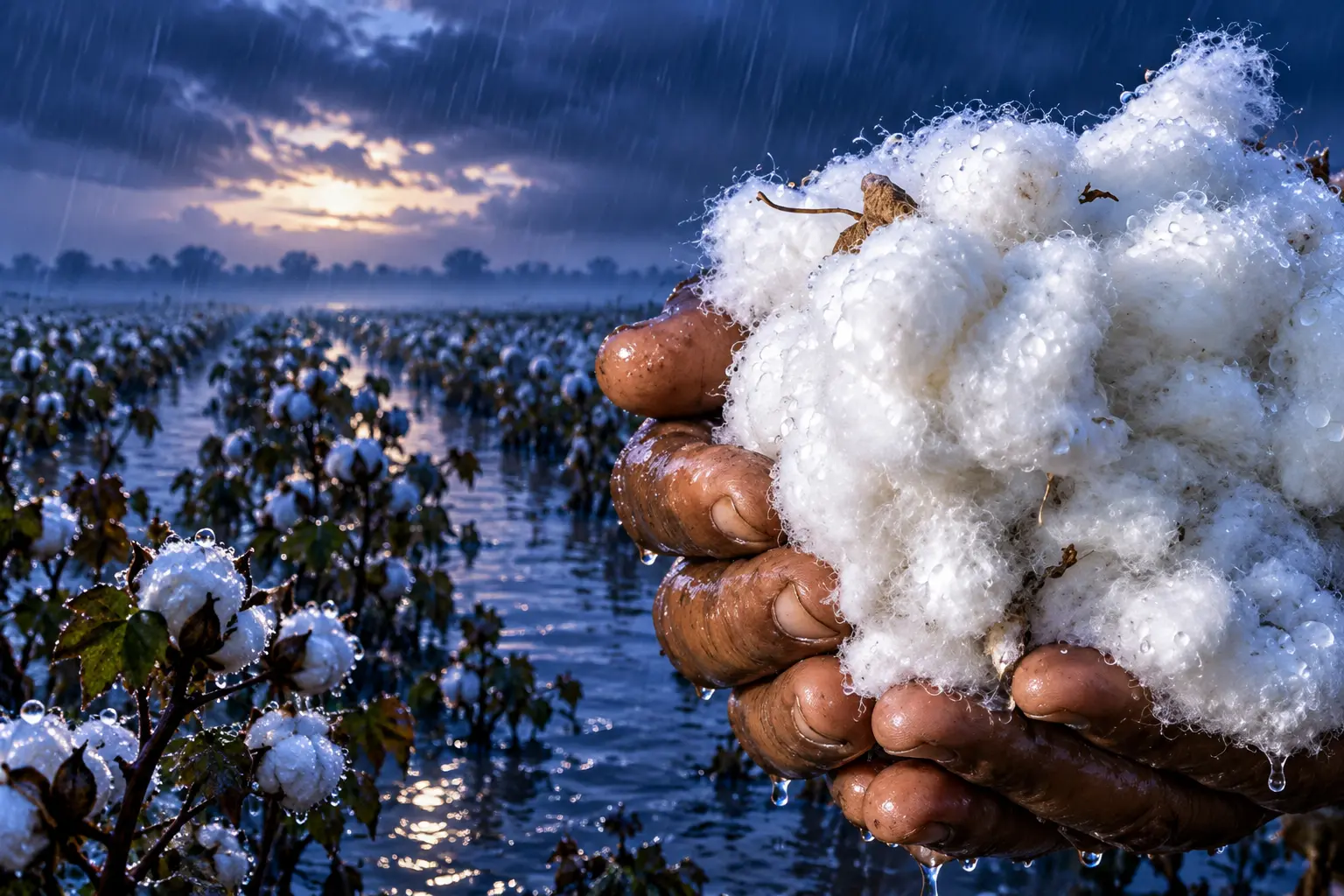
Fashion’s business case for nature is a farm invoice. The U.S. Department of Agriculture later put Pakistan’s 2022/23 cotton crop at 3.7 million 480-lb bales, down from 6.0 million the season before, and Mongolia’s 2024 dzud killed 2.5 million goats.
H&M Group, Kering and BESTSELLER are now paying for soil, grass and herds so the next clip of fibre still exists. Sustainability teams still struggle to put a price on that risk. Farmers already paid it.
The First Invoice Arrived in Sindh
The 2022 monsoon did not wait for a board paper. Floodwater and extreme rain hit Pakistan’s cotton belt before harvest, and ginners, mills and pickers ran out of fibre in the same season brands needed it.
USDA’s Islamabad post first said collections were running about two-fifths under the year before, then locked the season at 3.7 million bales against 6.0 million. That is 2.3 million bales missing from a country whose mills still had to run.
A 2023 satellite study of Sindh, which grows a large share of the national crop, put provincial cotton losses at 88 percent, or about 3.1 million bales, and priced that cotton damage at USD 485 million of a USD 1.30 billion hit across cotton, rice and sugarcane. Researchers using Sentinel imagery found the cotton zone was not the most inundated; the rain core sat on it, and open bolls cracked in the wet.
The International Centre for Integrated Mountain Development recorded 33 million people affected across Pakistan. Jennie Granström, H&M Group’s biodiversity impact lead, said the flood had a huge impact on the group’s ability to get cotton at the price and time it needed.
Now, we are scaling regenerative agriculture in cotton, and that’s primarily for resilience, so we can feel safe that there will be raw material production in a world where climate change puts a lot of pressure on nature and farmers.
Jennie Granström, biodiversity impact lead, H&M Group
Mass-market cotton can, in theory, be bought from another origin. Extra-long staple, a named valley, or a dye that only holds on a certain staple length cannot. Dr Samuel Sinclair, co-founder of the consultancy Biodiversify, told sustainability teams they have to walk the chain far enough to know which of those they actually sell, then take a number to the chief financial officer. His working example was blunt: a USD 60 million risk that could be cut by spending USD 20 million on nature.
2.5 Million Goats Did Not Come Back
Luxury’s problem is even narrower. Mongolian cashmere is not a commodity you swap for an Australian clip without changing the sweater. In the 2023-24 winter, a dzud, heavy snow over ice, stopped herds reaching grass.
The Ministry of Food, Agriculture and Light Industry, cited by the Sustainable Fibre Alliance, said 11.5 percent of national livestock died, more than 7.44 million animals. Of that total, the alliance said there were 2.5 million goats recorded as lost.
Raw cashmere in the 2024 season rose to 185,000 tugrik a kilogram from 165,000 the year before, and some buyers took less volume. SFA-certified fibre fell to 600 tonnes from 1,322 tonnes in 2023, with 800 tonnes the high case. Vandandorj Sumiya, the alliance’s Mongolia coordinator, said delayed combing left more coarse hair in the greasy fibre, so clean yield after dehairing was lower than in a normal year.
TWO SHOCKS THAT HIT FASHION INPUTS
| Event | Official tally | Fibre |
|---|---|---|
| Pakistan floods, 2022 | 3.7 million bales, down from 6.0 million | Cotton |
| Mongolia dzud, 2024 | 2.5 million goats; 7.44 million livestock | Cashmere |
| SFA-certified clip, 2024 | 600 tonnes, down from 1,322 tonnes | Cashmere |
Houses that cannot wait for herds to rebuild are already pulling cutting-room waste back into yarn. That hedge does not restock a herder. It only cuts how much of the next clip a brand must buy.
Why CFOs Finally Opened the Nature File
Investors now ask the questions sustainability teams used to ask alone. On 15 October 2026, on the eve of the UN biodiversity talks, the Taskforce on Nature-related Financial Disclosures said 836 organisations aligned to nature disclosures had committed, across 57 countries, with financial institutions among them holding over USD 26 trillion in assets.
That count was up 14 percent since COP30 in November 2025. Assets tied to those financial adopters were up 19 percent year on year. Listed adopters represented over USD 10.5 trillion in market value, up 12 percent since COP30. More than 1,100 organisations were already making at least one TNFD-aligned disclosure, averaging 8 of the 14 recommended items.
WHAT INVESTORS TOLD TNFD
- Nature as financial risk: 100 percent of investors surveyed said nature loss concerns financial markets.
- Board-level rank: 59 percent placed nature among their three most important sustainability topics.
- Capital already moving: 56 percent were exploring or putting money into nature-related investments.
- The next five years: 74 percent expected that financing to rise two to five times.
Tony Goldner, TNFD’s chief executive, has said switching a supply chain in a panic is brutally expensive, so spending on nature is a way to cut a larger future loss. More than 70 percent of those TNFD surveyed wanted mandatory nature reporting, most of them inside one to three years. The International Sustainability Standards Board is preparing an exposure draft on nature disclosures, and ISO in September 2026 approved turning TNFD’s LEAP method into a standard.
The same week, Biodiversify and Little Blue Research published a survey of 229 sustainability professionals. Climate resilience now leads the reasons bosses act on nature, and worry over raw-material costs was cited by 48 percent, up from 34 percent in 2024. Building the business case was still a major block for 53 percent. Forty-nine percent could not quantify the risks in money, and 42 percent could not see the supply-chain hit clearly. Seventy-two percent said their firms had started to weave nature into processes, up from 64 percent in 2024, but only 16 percent called that work complete. Fifty-five percent wanted stronger business incentives to turn pledges into projects.
THE MONEY TRAIL INTO NATURE
- January 2021: Kering and Conservation International launch the Regenerative Fund for Nature.
- 2022: Pakistan’s cotton harvest collapses; H&M and WWF start a 150-farmer pilot in central India.
- 2023: Inditex joins the fund.
- 19 March 2026: H&M Group publishes land targets checked by the Science Based Targets Network.
- 4 May 2026: BESTSELLER adds USD 3 million for Eastern Cape grazing land.
- 15 October 2026: TNFD reports 836 adopters and releases LEAP 2.0.
- 19 October 2026: COP17 opens in Yerevan.
Dr Michael Burgass, Biodiversify’s co-founder, said boards already grasp heat, drought and storms, and still underplay how soil, water and living systems buffer those shocks. Dr Stephanie Hime, managing director of Little Blue Research, said staff now have tools to spot nature impacts, yet turning those into a financial figure remains the hard step.
A $3 Million Cheque in the Eastern Cape
The people who grow the fibre are the ones the cheques have to reach. On 4 May 2026 in South Africa’s Eastern Cape, BESTSELLER announced a $3 million Regenerative Fund for Nature pledge, about DKK 19 million, joining Conservation International, Kering and Inditex.
WHERE THE FUND SITS NOW
- The book: 14 projects in 10 countries, with 1.1 million hectares (2.7 million acres) enrolled and 105,000 people reached.
- The materials: cotton, wool, leather and cashmere, the four fibres the fund was built to change.
- The Cape already: Kering since 2021 and Inditex since 2023 have helped nearly 1,000 farmers on 17,000 hectares (42,000 acres) shift grazing and animal care.
- The method: rotational grazing meant to restore grassland, cut erosion, store carbon and protect the catchments that feed the Umzimvubu system.
Kering’s own fund page now lists 1.1 million hectares enrolled in projects, past the original aim of one million hectares of crop and rangeland by 2025. The group set out a four-step biodiversity plan in 2020 (avoid, reduce, restore and regenerate, then transform) after years of putting water, land use, pollution and emissions into an Environmental Profit and Loss account.
This investment reflects our commitment to strengthening our value chain by supporting more resilient landscapes.
Dorte Rye Olsen, head of sustainability, BESTSELLER
Virginia Keesee, who leads Conservation International’s global fashion and nature work, said five years of Eastern Cape work had shown gains for farmer incomes and for the land, including better market access. Alice Barlow-Zambodla of Conservation South Africa said those grasslands hold water security and rural livelihoods, not only sheep. Marie-Claire Daveu, Kering’s chief sustainability and institutional affairs officer, called the BESTSELLER money a sign that more groups will pool cash rather than run one-off plots.
Danique Lodewijks, BESTSELLER’s sustainable raw materials manager, told the Textile Exchange conference the same week as the TNFD update that the group is heavily in regenerative cotton and pointed to that USD 3 million gift. The Cape project is sheep and grass. The cotton logic is the same: pay the land before the next drought writes the invoice.
Insurers Still Price From Old Disaster Data
Some executives still treat insurance as the backstop. Sinclair said that only works while losses can be spread, and it fails when “absurd crises happen almost all the time.” Insurers, he said, still lean on what has already happened, and nature risk does not come with those data sets or with a future that moves at the old speed.
Swiss Re has said insured natural-catastrophe losses are rising 5 to 7 percent a year, and that a peak-loss year in 2026 could reach about USD 320 billion. Munich Re said global insured catastrophe losses stayed above USD 100 billion for a sixth straight year in 2025. Reinsurers have already walked away from some regions. Fashion’s dyeing sheds, tanneries, cotton gins and high-street shops sit in the same weather.
Rachel Kolbe Semhoun, head of sustainable sourcing and nature initiatives at Kering, said early movers can feed insurers the field data they lack. She said chief scientists at large insurance groups now argue that nature-based works will matter, because grey infrastructure cannot keep up, and because wetlands, soils and grasslands adapt as the climate shifts. The brand that already maps its farms is the one that can help write the next policy. The brand that does not will buy cover, if it can, on someone else’s terms.
Sean Cady, VF Corp’s vice president of global product stewardship, sustainability and government affairs, told the same Textile Exchange meeting that nature sits inside the firm’s scenario work. One extreme case is a world with so little snow that skiing fades and nobody buys The North Face puffers, a brand VF has owned since 2000. Cady said the point is to build the habit of choosing now against a worse downside later, even if that particular future is unlikely.
Satpura-Pench Now Counts 4,250 Cotton Farmers
H&M Group put numbers on land in March 2026. It became the third company, and one of the first in apparel, to publish science-based targets for land checked through the Science Based Targets Network. WWF, a partner since 2011, helped run the risk filters and the landscape files.
H&M GROUP’S LAND TARGETS
- No conversion: keep upstream land out of new clearing, with a target of 100 percent sustainably sourced material by 2030.
- Land footprint: cut absolute agricultural land use from upstream impacts 3.85 percent by 2030 from a 2019 base, tied to a 50 percent recycled-material share by 2030.
- Priority places: keep funding the REEVA cotton project in central India and regenerative wool in the Eastern Cape Drakensberg grasslands.
The India work sits in the Satpura-Pench corridor, farm and forest mosaic that holds about a fifth of wild tigers and lets tigers, leopards and sloth bears move between reserves. H&M says a 2022 pilot with 150 organic farmers has grown to 4,250 farmers who have used regenerative methods for at least one season, with 21 centres where women’s groups mix natural pest control and fertiliser. The aim is 6,000 farmers by the end of the 2025/2026 harvest. The group has set aside SEK 11.5 million for 2026-2030 across the India cotton work and the South Africa wool project.
On the 150 pilot plots in their third year, H&M says soil carbon is rising faster than expected. That is a start. It is not yet a global cotton market. Leyla Ertur, the group’s chief sustainability officer, has tied the targets to staying in those two landscapes. Erin Billman, chief executive of the Science Based Targets Network, said more than 150 companies were preparing targets, with 30 already signalling through the network’s Step Up for Nature drive.
Inditex has said nature sits under the materials it uses, the mills, the wear phase and the end of a garment, and that it is scaling recycled cotton, working with Canopy against forest loss, and putting money into the same Regenerative Fund. Kari Stoever, Canopy’s head of impact, has warned that wood-based fibres will see more shocks from climate and from geopolitics, and that a low recycled blend can cost about a cent a garment while cutting future extended-producer-responsibility fees. Recycled content is another way to need fewer live acres. It still leaves the remaining acres, and the people on them, in the weather.
Regenerative Cotton Still Needs a Yardstick
The gap that should worry a CFO is measurement. A regenerative stamp on a bale is easy to print. A measured rise in soil carbon, water held in the root zone, or insect counts across a sourcing country is not. Better Cotton is rewriting its standard toward regeneration and buying software to track it, which is an admission that the old claim set was not enough.
Thomas Roulland, head of sustainability standards and analytics at Allianz Global Investors, said nature data is still catching up with climate data, which is why TNFD is useful now, as a path rather than a finished map. Tom Crowther, the ecologist who wrote Nature’s Echo, has argued that the planet has already passed the point where clearing more land raises output, so restoring nature is now the production strategy. Global markets, he said, will lean on that.
Sinclair’s other warning is organisational. Most sustainability staff have never written a business case, and most sit in a silo far from procurement. He said the pitch lands harder when the chief procurement officer carries it, because a missing staple length or a dye that will not stick is then a buying problem, not a values slide. Kolbe Semhoun said the old methods are no longer enough, and that this has “really come home for people” in 2026.
COP17 opens in Yerevan on 19 October 2026 with that split intact. Investors, 100 percent of them in TNFD’s sample, already treat nature loss as a market risk. Only 16 percent of the sustainability staff in the Biodiversify survey work in firms that have fully built nature into how they run. The cotton that did not arrive in 2022, and the goats that did not survive 2024, are still the clearest numbers in the file.

Xbox Sells Cloud Playtime Packs Ahead of November Caps

Xbox Puts a $1,800 Helix Behind a 2027 Handheld

Brussels Asks If Bio-Based Plastic Can Replace Recycled Content

EU Organic Deal Gates the Leaf and Doubles Exemptions

Barilla Strike Exposes Who Gains the Italian Plants

Boston Scientific Cyberattack Leaves Hospitals Waiting on Implants

Guizhou Cave Cafes Spread When Each Cavern Fills

The Second Ned Stark Kit Lands When a Banner Dies

Satellites Saw Nepal’s Ice Slope Move Before the Flood

OpenAI’s Jalapeño Chip Turns Watts Into Faster Agent Steps
-
 NEWS2 months ago
Boston Scientific Cyberattack Leaves Hospitals Waiting on Implants
-
 NEWS2 months ago
Guizhou Cave Cafes Spread When Each Cavern Fills
-
 GAMING2 months ago
The Second Ned Stark Kit Lands When a Banner Dies
-
 NEWS2 months ago
Satellites Saw Nepal’s Ice Slope Move Before the Flood
-
 NEWS2 months ago
OpenAI’s Jalapeño Chip Turns Watts Into Faster Agent Steps
-

 NEWS2 months ago
MLB Quiet Periods Copy a Freeze Other Leagues Use
-

 NEWS2 months ago
Roman Space Telescope Launches After a Decade-Long Budget Bet
-

 BUSINESS2 weeks ago
Saks Kept 15 Stores While Rivals Took the Shoppers