
BUSINESS
France’s Biscuit Tax Dies in the Assembly, Then Revives
Deputies stripped a sugar levy on packaged biscuits 86 to 58, then rejected the receipts bill, sending the original tax back to the Senate.

French deputies voted 86 to 58 on 22 October 2026 to strip a sugar levy on packaged biscuits, cakes and sweets from the 2027 social security bill. Health minister Stéphanie Rist had sold Article 8 as a nudge on recipes, not a hit on the till. A day later the Assembly rejected the whole receipts section, which means the Senate will open the government’s original text, tax included, on 9 November.
The government had put the extra take at €300 million a year for farm workers’ sickness cover. That money is not coming in on the Assembly’s copy. It is back on the table the moment the Senate starts.
An 86-to-58 Vote Wipes Article 8
Public ballot 86 votes to 58 adopted identical deletion amendments led by Laurent Wauquiez, with 3 abstentions. Of 147 deputies in the room, 144 cast a yes or no. The Rassemblement National supplied 64 of the 86 votes to kill the article. Les Républicains and their Ciottiste allies in the UDR voted with them. MoDem, La France Insoumise, the Socialists, the Ecologists and LIOT voted to keep the levy. Ensemble pour la République split, 6 for deletion and 4 against, and Horizons barely showed.
Eddy Casterman, an RN-aligned deputy, called it the end of a “macroniste” tax on confectionery, cakes and viennoiseries.
💪🏻 Grâce à la mobilisation du @groupeRN_off, nous venons de supprimer l’article 8 du PLFSS qui prévoyait de créer une nouvelle taxe macroniste sur les confiseries, les gâteaux et les viennoiseries!
— Eddy Casterman (@EddyCasterman) October 22, 2026
That Thursday win lasted one night as a clean industry victory. On Friday 23 October the receipts part of the same bill fell 115 to 1, with 22 abstentions, on a thin house of 138 deputies out of 577. Under the social-security budget rules, a first-reading rejection of receipts sends the government’s deposited text to the Senate, not the gutted Assembly copy. Article 8 is in that deposited text.
THE PATH OF ARTICLE 8
- 1 October 2026: The government files bill n° 3211, with Article 8 extending the soda tax to packed sweet foods from 1 January 2027.
- 14 October 2026: The social affairs committee keeps the article; a later hemicycle must still start from the government copy.
- 22 October 2026: The hemicycle deletes Article 8 by 86 to 58.
- 23 October 2026: Deputies reject the 2027 receipts block; the spending half is never opened.
- 9 November 2026: The Senate is due to start on the original government bill, tax included.
The solemn Assembly vote once listed for 27 October no longer has a text to bless. A joint committee of 7 deputies and 7 senators is the next repair shop if the Senate writes its own version. Parliament’s constitutional clock on this bill runs to 26 November.
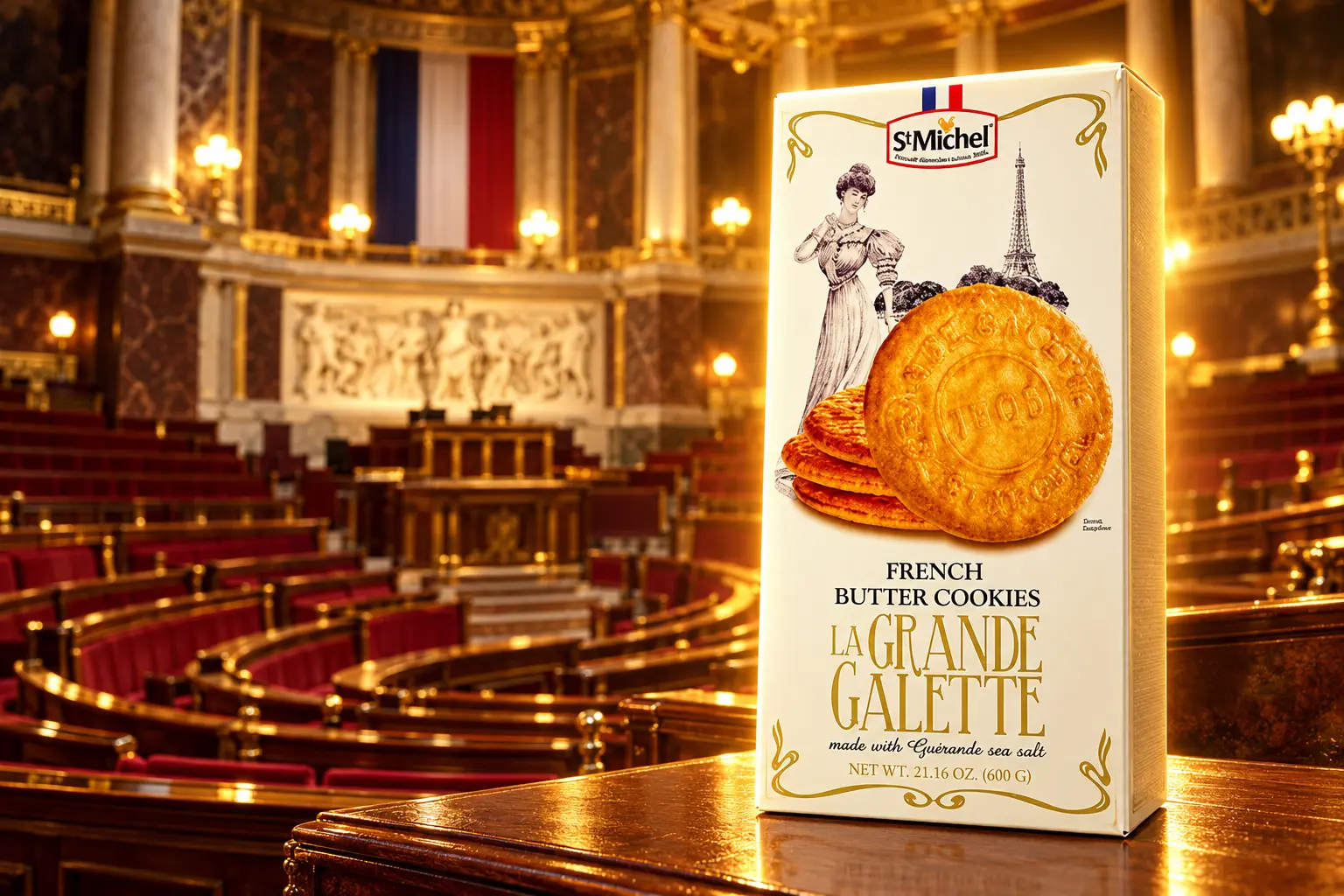
What the Biscuit Levy Would Have Cost a Pack
Article 8 did not invent a new tax so much as stretch two existing ones in the general tax code, the soda levy and the sweetener levy, onto solid food. The net was an earlier push to tax factory biscuits written into customs codes, not a slogan about “ultra-processed” food. A product had to be pre-packed, made to be eaten as is or after a simple reheat, and classed under combined-nomenclature codes 1704, 1806, 1901 90 99, 1904, 1905 or 2105. For the sugar charge it also had to carry at least one food additive under the EU additives rule. Total sugars, not only added sugars, counted. A bakery counter croissant with no additive and no factory wrap sat outside that net even without a separate “artisan” carve-out in the filed article.
FOODS IN THE NET
- Biscuits and cakes: Industrial biscuits, gâteaux and packed viennoiseries under the bakery codes.
- Breakfast lines: Cereals and cereal bars, plus ice cream under code 2105.
- Sweets and chocolate: Confectionery (1704) and cocoa-based products (1806), on a higher sugar ladder because those recipes start sweeter.
Rist told the house the charge would stay under 8 centimes on a pack of cakes if a maker refused to cut sugar. That is a ministry pack estimate, not the tariff itself. The filed rates are per quintal, which is 100 kg, and they step up as the sugar share rises.
| Product group | Sugar in 100 g | Levy per 100 kg |
|---|---|---|
| Biscuits, cereals, ice cream | 10 g to under 23 g | €4.07 |
| Biscuits, cereals, ice cream | 23 g to under 30 g | €14 |
| Biscuits, cereals, ice cream | 30 g and above | €22 ($24.6) |
| Sweets and chocolate | 10 g to under 47 g | €4.07 |
| Sweets and chocolate | 47 g to under 56 g | €14 |
| Sweets and chocolate | 56 g and above | €22 |
Makers using synthetic sweeteners would have paid a second charge on the same pack, €4.50 per quintal up to 120 mg/kg of sweetener and €6 above that, stacked on the sugar band. Swapping sugar for a sweetener would not have opened an exit. Rates would have risen each 1 January with consumer prices excluding tobacco. At the top biscuit band, €22 per 100 kg is 22 centimes a kilogram; a 200 g pack at that band carries 4.4 centimes of tax before any sweetener add-on, which is why Rist could talk in single centimes while Jean-François Loiseau, president of the food-industry body ANIA, still called it a bill the shopper would settle.
The Farm Health Fund Was Counting on €300 Million
The yield figure the government used in the chamber was €300 million a year. That extra take, on top of the existing soda tax, was assigned to the farm health insurance branch of the Mutualité sociale agricole. On 14 October the CCMSA board still voted the whole social-security bill down, 13 against, none in favour, 11 taking note. It “took act” of the sugar-tax extension, said it was glad the supplement would land in its maladie branch, and said it would watch knock-on effects on farm supply lines.
So the one public body that was supposed to cash the levy did not bless the budget around it. After 22 October it does not cash the levy either, at least not on the Assembly’s numbers. The wider bill had aimed to cut the social-security deficit from €21.8 billion in 2026 to €12.7 billion in 2027. Article 8 was a small slice of that. It was also the slice written with a named beneficiary in the farm sickness fund, which already runs cover for a workforce that is older and more spread out than the general scheme.
Rist had told deputies the point was reformulation after 40 rounds of voluntary talks with processors produced no hard commitments. The MSA page does not dispute the health case. It wanted structural answers on prevention and hospitals that the bill, in its view, did not fund. Killing Article 8 saves the snack aisle from a few centimes and leaves that farm branch without the one new receipt the government had earmarked for it.
Britain Cut Drink Sugar by 46 Percent
Rist’s foreign exhibit was the UK Soft Drinks Industry Levy. UK Treasury and revenue papers record a 46% reduction in drink sugar in products in the levy’s scope between 2015 and 2020, sales-weighted. By 2019, 65% of drinks that had sat above 5 g of sugar per 100 ml had been recut below that line, and 89% of that market was under 5 g. The same British programme’s voluntary food track, which had no levy, moved much less: about 15% in breakfast cereals, 14% in yogurts, 7% in ice cream and sorbets.
THE SUGAR GAP THE LEVY WAS MEANT TO HIT
- Child intake: Anses, the food-safety agency, says 75% of children aged 4 to 7 exceed 60 g of sugars a day, excluding lactose and galactose, and 60% of 8-to-12-year-olds exceed 75 g.
- Adult intake: 20 to 30% of adults and teenagers go over 100 g a day on the same basis.
- Rist’s floor: She told the country that more than 80% of children pass the maximum daily sugar dose, a wider claim than the Anses 4-to-7 figure.
- The snack lever: Anses has already named sugary drinks and pâtisseries, biscuits and cakes as the two priority cuts for children.
France already taxes sugary drinks. Article 8 was the attempt to put a similar step-ladder on the other Anses target, the packed goûter. MoDem deputy Cyrille Isaac-Sibille, who had even tried in committee to widen the net, put the health case in one line: the article was about stopping new patients from appearing. The Economic, Social and Environmental Council had backed a levy only with a reservation, arguing that mandatory nutrition targets should be locked with suppliers first and that a tax should then hit products that missed a shared deadline. Deputies did not vote that sequence. They voted the tax out and left the 40 empty talk rounds where they were.
A Raid on the Shopping Basket, Industry Said
Loiseau said on RMC that “ce sont les consommateurs qui vont payer.” He warned that a levy sold at a few hundred million could, over time, become a €1 billion charge on the sector. ANIA had already said suppliers had “reached the limit of their resilience.” Justine Gruet, a Républicains deputy, carried that line onto the floor.
The levy would reduce the purchasing power of our citizens without actually affecting their eating habits or sugar consumption. In short, yes to prevention, yes to nutrition education within the family unit, but no to new taxes that will not solve the problem.
Justine Gruet, deputy, National Assembly
Rist’s reply was that a progressive scale exists to move recipes, and that the UK drinks cut was the proof of concept.
The tax, which is progressive, aims to encourage manufacturers to reduce the amount of sugar in their recipes.
Stéphanie Rist, health minister, National Assembly
A levy sold as a nudge on recipes still lands, in the country, as a charge on the goûter. Families on a tight budget buy the very biscuits in the net, and that is the argument that won on 22 October. It does not answer why 40 rounds of talks failed, and it does not put €300 million into the MSA maladie branch. Patient groups had asked Parliament not to let manufacturers exercise a veto. The Fédération Française des Diabétiques, the Ligue nationale contre le cancer, France Assos Santé and the Collectif National des Associations d’Obèses signed that appeal before the hemicycle vote. They lost the first round in the Assembly. They have not yet lost the text the Senate will read.
Killing the Whole Bill Puts the Tax Back on the Senate Floor
Industry’s Thursday night was real. The Friday receipts vote unpicked it. Because the Assembly refused the 2027 receipts block, the Senate does not inherit the deletions. It inherits bill n° 3211 as filed, Article 8 still in it, start date still 1 January 2027, farm-sickness assignment still written in. Senators can strike it again, rewrite the bands, or keep it. If a joint committee then fails, the text returns to the Assembly, which has the last word. If the 26 November clock runs out, the government can in theory apply a social-security budget by ordinance, a tool that has never been used.
WHAT WE KNOW
- The Assembly copy: Article 8 is gone from the text deputies left behind on 22 October.
- The Senate starting point: The original government bill, levy included, is what the upper house is due to open on 9 November.
- The money: No €300 million supplement reaches the MSA maladie branch unless a final law puts the levy back.
WHAT IS UNCONFIRMED
- A Senate majority: No public whip count yet shows whether the upper house will keep, recut or drop Article 8.
- A joint-committee deal: Seven deputies and seven senators have no agreed draft because the Assembly never finished the bill.
- The 1 January 2027 start: That date holds only if a final statute still says so.
The next test is not another argument about 8 centimes on a cake pack. It is whether the Senate, handed the article deputies had already buried, votes it a second time before the 26 November clock runs out.

Duffy Pins the FAA Ground Stop on a Contractor-Owned Network

Microsoft Tested Its Gateway Fix on the Wrong Machines

Firaxis Cuts a Third of Its Staff as XCOM Slips

The New Chip Rule Favors US Cloud Parents in Asia

European Unions Ask Players to Police GenAI They Cannot See

Boston Scientific Cyberattack Leaves Hospitals Waiting on Implants

Xbox Sells Cloud Playtime Packs Ahead of November Caps

Guizhou Cave Cafes Spread When Each Cavern Fills

The Second Ned Stark Kit Lands When a Banner Dies

Satellites Saw Nepal’s Ice Slope Move Before the Flood
-
 NEWS3 months ago
Boston Scientific Cyberattack Leaves Hospitals Waiting on Implants
-
 GAMING4 weeks ago
Xbox Sells Cloud Playtime Packs Ahead of November Caps
-
 NEWS3 months ago
Guizhou Cave Cafes Spread When Each Cavern Fills
-
 GAMING3 months ago
The Second Ned Stark Kit Lands When a Banner Dies
-
 NEWS2 months ago
Satellites Saw Nepal’s Ice Slope Move Before the Flood
-

 NEWS3 months ago
OpenAI’s Jalapeño Chip Turns Watts Into Faster Agent Steps
-
 NEWS3 months ago
MLB Quiet Periods Copy a Freeze Other Leagues Use
-

 NEWS3 months ago
Roman Space Telescope Launches After a Decade-Long Budget Bet