
BUSINESS
France Taxes Factory Biscuits While Bakeries Walk Free
France’s 2027 social security bill taxes packaged biscuits and cereals with additives, leaving sugar-only and bakery goods outside the levy.

France’s 2027 social-security bill would tax packaged biscuits, cereals, ice cream, sweets and chocolate from 1 January on a sliding sugar scale. The government books the levy at 300 million euros and says factories can shrink it by changing recipes.
Health minister Stéphanie Rist told reporters on 1 October 2026 that the state is extending the drinks tax to processed foods that contain sugar, additives and packaging. Jean-François Loiseau, president of the food-industry body ANIA, said shoppers will pay.
Article 8 Puts a Price on Packaged Sugar
Article 8 of the social-security bill, deposited at the Assemblée nationale on 1 October 2026, does not invent a new duty. It copies the soda tax onto named solid foods and turns the rate up as the sugar share rises.
The first band starts at 10 grams of total sugars per 100 grams of product. Below that line, the sugar levy is zero. A quintal is 100 kilograms, so the opening rate of 4.07 euros per quintal is 4.07 euro cents on each kilogram.
THE TWO SUGAR GRIDS
| Customs codes | Typical foods | 10 g band | Middle band | Top band |
|---|---|---|---|---|
| NC 1901 90 99, 1904, 1905, 2105 | Dessert powders, breakfast cereals, biscuits and cakes, ice cream | 4.07 euros/quintal from 10 to under 23 g/100 g | 14 euros from 23 to under 30 g | 22 euros from 30 g |
| NC 1704, 1806 | Sweets, chewing gum, caramels, chocolate | 4.07 euros/quintal from 10 to under 47 g/100 g | 14 euros from 47 to under 56 g | 22 euros from 56 g |
Chocolate and boiled sweets sit on the higher thresholds because those recipes already run very sweet. The bill taxes total sugars, monosaccharides and disaccharides, whether they were added in the plant or came with the ingredients. Rates would then move each year with consumer prices.
Rist put the point in plain terms on 2 October 2026. More sugar in the cakes, more tax. Less sugar, less tax. She put the hit on a chocolate bar at 1 centime if the recipe stays put.
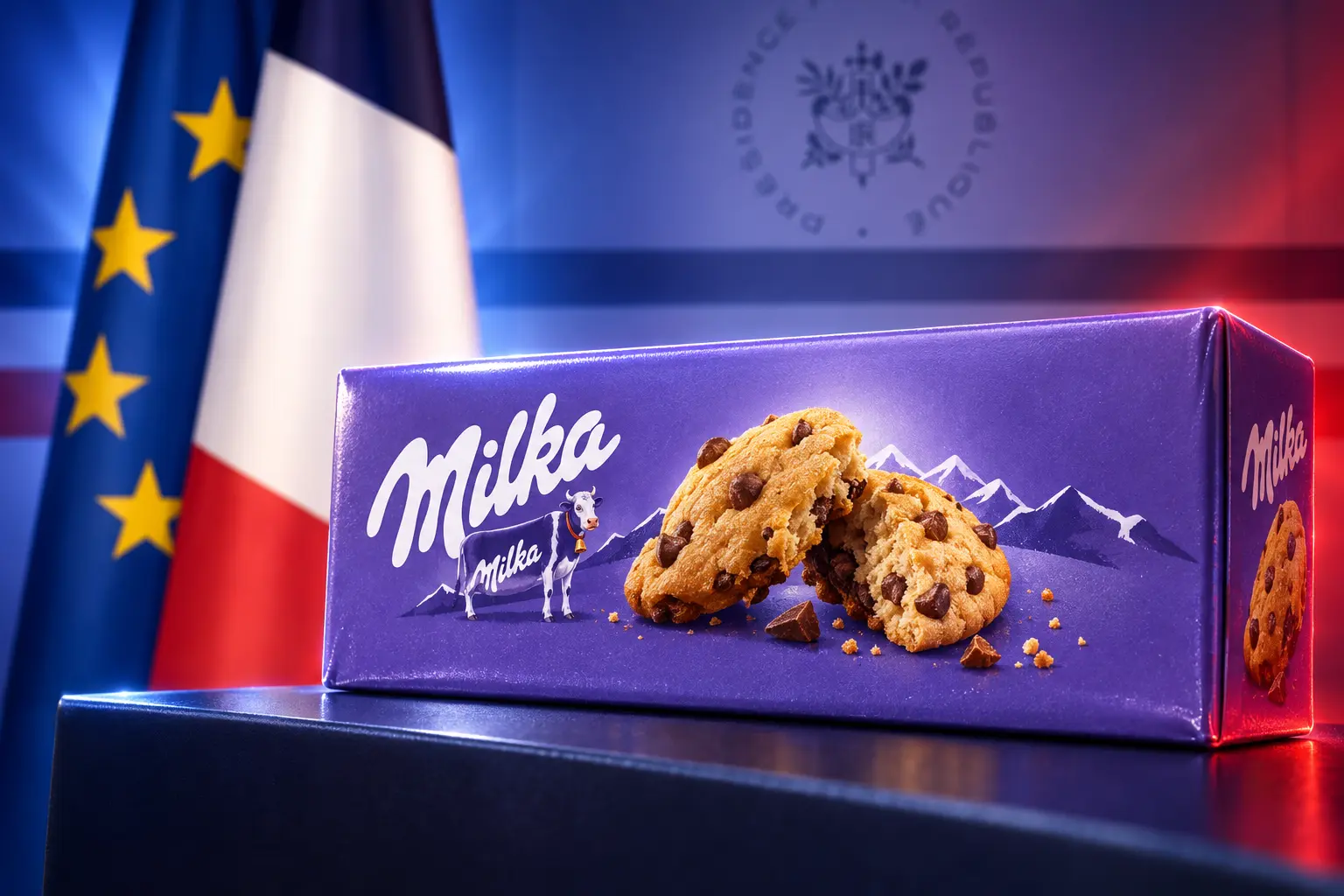
Why a Village Bakery Walks Free
The government’s write-up says it wants to keep the French model of food from farms and to protect artisan goods. The legal text never writes a general artisan holiday. A product drops out only if it fails one of the tests in Article 8.
THE FOUR TESTS IN ARTICLE 8
- The pack: The food must be pre-packed and meant to be eaten as it is, or after a simple reheat or thaw.
- The customs code: It must fall under NC 1704, 1806, 1901 90 99, 1904, 1905 or 2105.
- The sugars: It must contain sugars, added or not, at 10 grams per 100 grams or more before the sugar levy bites.
- The additive: For the sugar levy, it must also carry at least one food additive listed in EU regulation 1333/2008, the E-number family of colours, preservatives, emulsifiers and flavour enhancers.
Rist said products that contain only sugar will not be taxed. A loose croissant from the corner bakery, with no pack and no E-number, is outside the net. A factory biscuit with colour, emulsifier and a printed wrapper is inside it once the sugar share clears 10 grams.
That is the second move hiding under the health speech. The levy is aimed at industrial recipes that combine sugar, additives and a shelf pack, the same foods the bill lists as big contributors to sugar intake in the young: industrial viennoiserie, pastry, biscuits, cakes, breakfast cereals, cereal bars, sweets and chocolate products.
Swapping Sugar for Sweeteners Still Costs
The obvious factory response is to cut sucrose and pour in aspartame, erythritol or maltitol. Article 8 prices that path too. The existing drinks levy on synthetic sweeteners would be extended to the same solid codes.
That extra charge would be 4.50 euros per quintal when synthetic sweeteners sit at or under 120 milligrams per kilogram, and 6 euros per quintal above that line. If a product still carries enough sugar to owe the sugar levy, the sweetener charge is added on top. Cutting sugar by swapping in a high-intensity sweetener does not walk a brand out of the tax.
Rist said manufacturers hold the controls on composition. The fine print says those controls are narrower than a clean jump from sugar to “diet.” A plant that wants to pay nothing has to get total sugars under 10 grams per 100 grams and, for the sugar levy, get the additives out, or leave the customs codes. That is a product-development brief, not a pricing memo.
Rist Ties the Levy to Children’s Daily Sugar
At the 1 October 2026 council-of-ministers briefing, Rist called the measure prevention. She said more than 80 percent of French children exceed the maximum daily dose of sugar, and she tied heavy sugar use to diabetes, heart disease, stroke and some cancers. She also said that by 2035, 70 percent of national health-insurance spending would be linked to that overconsumption. Those two figures are hers.
The food-safety agency ANSES publishes tighter age bands. It tells adults to stay under 100 grams of sugar a day, not counting lactose and galactose, and to keep sweet drinks to one a day. For children it sets 60 grams a day at ages 4 to 7 and 75 grams at ages 8 to 12. On those yardsticks, 75 percent of 4-to-7-year-olds and 60 percent of 8-to-12-year-olds already sit above the line, and 20 to 30 percent of adults exceed 100 grams.
SUGAR LIMITS ON THE BOOKS
- Adult cap: ANSES sets 100 grams of total sugars a day, excluding lactose and galactose, and no more than one sweetened drink.
- Young children: 75 percent of 4-to-7-year-olds exceed the 60 gram daily mark the agency uses for that age.
- Older children: 60 percent of 8-to-12-year-olds exceed the 75 gram mark.
- WHO free sugars: The World Health Organization tells countries to keep free sugars under 10 percent of energy intake, about 50 grams on a 2,000-calorie diet.
Rist’s “more than 80 percent of our children” sits above those age-band shares if “children” means every minor. It is closer if the listener hears the youngest group. The agency’s own adult picture is milder: most adults already sit under 100 grams. The political case is built on the school-age numbers, and on the bill’s claim that the listed packs feed a large slice of sugar intake in the young.
This tax has a public-health aim and a message for manufacturers: you hold our children’s health in your hands.
Stéphanie Rist, health minister, on Sud Radio, 2 October 2026
The consumer group Que Choisir Ensemble said yes to a tax on products that are too sweet, on one condition: that the money helps make healthier food available. The bill books the 300 million euros as a social-security receipt, including for the health-insurance branch. It does not ring-fence the cash for cheaper unsweetened food.
Food Plants Already Carry 5 Billion Euros in Special Taxes
ANIA, the national food-industry association, went out on 30 September 2026, before the bill was tabled, and said the move will hit French purchasing power, especially in the most modest homes. It said French agri-food firms were already drained by the international climate and a bad summer, and that adding another levy on top of 5 billion euros of specific taxes already on the sector would amount to condemning them. ANIA puts the industry at 23,000 companies.
In the end, consumers will pay. The executive has no idea left except to go looking again in the consumer’s purchasing power to plug the holes.
Jean-François Loiseau, president of ANIA, on RMC, 30 September 2026
That pass-through fight is the first-order noise. Plants can swallow the cents, raise the shelf price, or change the recipe. Loiseau’s bet is that the third path is slow and that the till rings first. Rist’s bet is the opposite. Commerce minister Serge Papin, a former Système U chief, had already said on 30 September that a sugar tax was on the table because a nine-year-old has now eaten as much sugar as a grandfather did in a lifetime. He also said he is not for taxes. The bill still arrived.
ANIA has spent the year arguing it is already cutting sugar, salt and fat, and it pointed in March 2026 to work on sweet drinks and breakfast cereals, with pastry commitments still to come. The bill treats those pledges as too slow for the products that feed children’s sugar totals.
The Soda Tax Already Taught This Lesson
France taxed sugar-sweetened drinks in 2012. The first design was flat and low, and it applied to diet drinks as well. A 2019 evaluation found full pass-through onto soda prices and, at most, a very small cut in purchases, about half a litre per person per year, in line with the low rate. Banque de France work on supermarket prices found the 2012 duty had been fully shifted onto sodas within six months.
The drinks tax was then rebuilt. In 2018 it was indexed to added sugar. In 2025 it was recast on a British three-band model. The bill’s own statement of reasons cites a 46 percent drop in sugar in drinks in the United Kingdom between 2015 and 2020 as the effect that model can have on recipes. That figure is the British drinks record as used in the French text, not a French supermarket census.
THE SODA TAX PATH TO BISCUITS
- January 2012: France introduces a flat excise on sweetened non-alcoholic drinks, including drinks with artificial sweeteners.
- 2018: The drinks levy is rewritten so the rate tracks added sugar instead of sitting on a single low band.
- 2025: The drinks scale is cut to three bands on the British model, with a large jump once sugar crosses each line.
- 1 January 2026: Indexed 2026 soda-tax rates of 4.07 euros per hectolitre apply under 5 kilograms of added sugar per hectolitre, 21.38 euros from 5 to 8 kilograms, and 35.63 euros above 8 kilograms.
- 1 January 2027: Article 8 would copy that sliding logic onto named packaged solids, opening at the same 4.07 figure per quintal once sugars hit 10 grams per 100 grams.
The 4.07 euros that now sit on a lightly sweetened litre of soda are the same digits now proposed for a lightly sweetened kilogram of biscuits. The copy is deliberate. A flat 2012-style fee raised little behavioural change. A stepped fee, with a free band under 10 grams and a jump at each threshold, is how a finance text talks to a product-development team.
A 300 Million Euro Line Inside a 12.7 Billion Hole
The social-security accounts are the other half of the page. The 2026 social-security deficit is put at 21.8 billion euros. The 2027 bill sets a 12.7 billion euro deficit target. The packaged-sugar levy is booked at 300 million euros, one receipt among several, including a repeat contribution from complementary health insurers.
That scale is why the shopping-cart fight is the wrong frame for the design. Three hundred million euros does not close a 12.7 billion euro gap. It is large enough to annoy a biscuit line and small enough that a plant which cuts sugar under 10 grams, or strips the additive, can wipe it out on that stock-keeping unit. The health argument and the budget argument are sharing a clause. Only one of them matches the cents on the grid.
Rist had already seen this film. In autumn 2025 she gave a negative opinion on a similar parliamentary amendment, saying other tools, including deals with manufacturers, could meet the health aim. The 2027 text puts her name on the extension anyway. Papin still says he is not for taxes. Article 8 is in the bill.
The Assemblée’s social-affairs committee can rewrite the thresholds, the codes, the additive test or the whole article. The lower house has 20 days after deposit for a first reading, the Senate 15 days after that, and the whole PLFSS clock runs 50 days. Until that process ends, the 1 January 2027 start date is a proposal. A factory that can get a recipe under 10 grams of sugar per 100 grams, and off the additive list, would owe nothing on that pack. Everyone else will argue the recipe in Parliament first.

Xbox Sells Cloud Playtime Packs Ahead of November Caps

Xbox Puts a $1,800 Helix Behind a 2027 Handheld

Brussels Asks If Bio-Based Plastic Can Replace Recycled Content

EU Organic Deal Gates the Leaf and Doubles Exemptions

Barilla Strike Exposes Who Gains the Italian Plants

Boston Scientific Cyberattack Leaves Hospitals Waiting on Implants

Guizhou Cave Cafes Spread When Each Cavern Fills

The Second Ned Stark Kit Lands When a Banner Dies

Satellites Saw Nepal’s Ice Slope Move Before the Flood

OpenAI’s Jalapeño Chip Turns Watts Into Faster Agent Steps
-
 NEWS2 months ago
Boston Scientific Cyberattack Leaves Hospitals Waiting on Implants
-
 NEWS2 months ago
Guizhou Cave Cafes Spread When Each Cavern Fills
-
 GAMING2 months ago
The Second Ned Stark Kit Lands When a Banner Dies
-
 NEWS2 months ago
Satellites Saw Nepal’s Ice Slope Move Before the Flood
-
 NEWS2 months ago
OpenAI’s Jalapeño Chip Turns Watts Into Faster Agent Steps
-
 NEWS2 months ago
MLB Quiet Periods Copy a Freeze Other Leagues Use
-

 NEWS2 months ago
Roman Space Telescope Launches After a Decade-Long Budget Bet
-
 BUSINESS2 weeks ago
Saks Kept 15 Stores While Rivals Took the Shoppers