
NEWS
iPhone 18 Pro Camera Signs Shots the Foldable Cannot
Apple’s iPhone 18 Pro camera adds a six-blade iris and a sensor-signed negative that China cannot use and the EU cannot capture at launch.

Apple’s iPhone 18 Pro camera puts six laser-cut blades on a 48MP Fusion Main lens and signs the pixels that lens records. The Pro starts at $1,199 and the Pro Max at $1,299, with sales opening September 18 in more than 65 countries after a September 9 announcement.
The moving iris is the part that will sell units. The quieter change is a signed photographic negative that China does not get at launch, that the European Union cannot capture yet, and that the $1,999 foldable does not carry at all.
What the Four Aperture Stops Change
Greg Joswiak, Apple’s senior vice president of Worldwide Marketing, framed the phone around that lens. “iPhone 18 Pro makes it easy for anyone to capture stunning photos and videos using variable aperture, while providing more versatility for creators and more control for pros,” he said when the phones were announced.
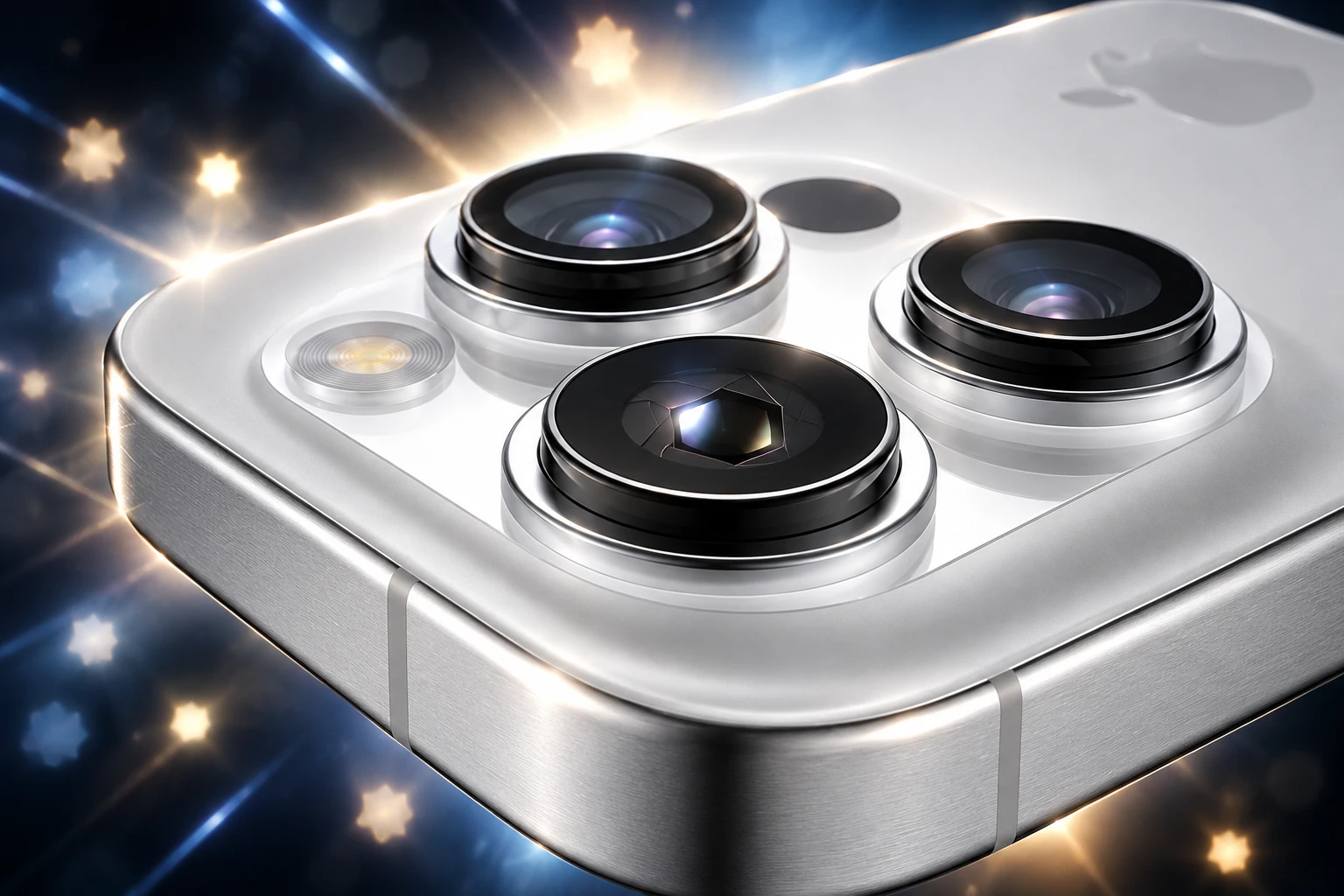
Apple fitted variable aperture on the Fusion Main camera for the first time on an iPhone. A rotor drives six blades, each thinner than a human hair, through four stops: f/1.48, f/1.8, f/2.8 and f/4.0. The 24mm main lens can also crop to a 48mm 2x shot. Leave the camera on automatic and iOS picks a stop from the scene. In a dim room it opens to f/1.48, wider than the fixed f/1.78 on iPhone 17 Pro. For a moving subject it stays wide so the shutter can freeze the frame. For a group at mixed distances it closes toward f/4.0 so more faces stay sharp.
Pro controls in the Camera app let you lock one of those four stops by hand, along with shutter speed up to a full second, white balance, and a live histogram. ISO still sets itself in Apple’s app. Fix the aperture or the shutter and the other value, plus ISO, moves to compensate.
THE FOUR STOPS ON FUSION MAIN
| Setting | Opening | What it favors |
|---|---|---|
| Widest | f/1.48 | Low light and fast action |
| Portrait default | f/1.8 | Apple’s stated balance of light and blur |
| Mid stop | f/2.8 | A tighter hole and more of the scene sharp |
| Narrowest | f/4.0 | Groups, plus six-point stars on small lights |
Stopping down does more than cut light. At f/4.0, diffraction around the six-blade iris turns streetlamps and earrings into six-pointed stars, an optical shape the round holes on older iPhones could not make. The ultra-wide 13mm lens stays at f/2.2. The tetraprism telephoto stays at f/2.8 for both the 100mm 4x and 200mm 8x shots, with a 16x optical-quality range and digital zoom to 40x.
Samsung Tried This Iris Eight Years Ago
Apple’s line is careful: aperture control has come to iPhone for the first time. It has not come to phones for the first time. Samsung shipped a two-position mechanical opening on Galaxy S9 in 2018. Huawei later put a six-blade iris on Mate 50 Pro and P60 Pro. Xiaomi’s 14 Ultra, in 2024, swept a six-blade iris from f/1.63 to f/4.0, a wider top end than Apple’s f/1.48.
PHONE IRISES BEFORE THIS IPHONE
- 2018: Samsung Galaxy S9 ships a two-position mechanical aperture, the first on a major phone.
- 2022-2023: Huawei Mate 50 Pro and P60 Pro use a six-blade iris with several stops.
- 2024: Xiaomi 14 Ultra runs a six-blade sweep from f/1.63 to f/4.0, then later flagships drop the mechanism.
- September 9, 2026: Apple puts four stops on iPhone 18 Pro and iPhone 18 Pro Max only.
The catch-up is real and so is the software around it. Apple is not selling a stepless ring. It is selling four named holes, automatic scene logic, and a developer API that can use in-between stops the stock Camera app does not show. Mountain climber and photographer Jimmy Chin, who shot the Bugaboos on a pre-release 18 Pro for Apple’s “What Holds Us” show, said the resolution surprised him. “I could shoot a few inches of rock and ice, or a massive panorama, and trust that it would hold at size,” Chin said.
The Signed Negative China Cannot Capture
Reference Image is the feature Apple built for a different problem than blur. In Reference mode, an opt-in stills path on the Fusion Main sensor, the chip signs its output before the data leaves the hardware. Apple’s Private Cloud Compute servers then develop that file into an unalterable reference JPEG that sits beside the working photo in Photos, the way a negative sits beside a print.
Apple Security Engineering and Architecture, writing with the Camera and Photos team, put the reason in plain terms. Photorealistic pictures are no longer proof that something happened. Other systems, they argued, wait until after software has processed the frame, which leaves a window for spoofed pixels and ties pictures to a public identity.
Apple Reference Image offers a trustworthy, scalable guarantee that a reference image is what it claims to be: a real photograph, captured by a real sensor in an iPhone camera, at a specific time.
Apple Security Engineering and Architecture and Camera and Photos, Apple Security Research blog
The sensor signs pixel data at capture after a secure boot into reference mode. A SHA-256 digest of a secure timestamp, the device manifest, and the secure boot manifest is embedded in the frame. Off-sensor facts such as digital zoom and focal length are signed by the Secure Enclave. Time does not come from the clock in Settings. The phone keeps a cryptographic timestamp token that, globally, refreshes on average about every 15 minutes, then requests a second token after the shot, so the file carries a proven window rather than a single clock reading.
That path is not worldwide. Apple is not offering Reference Image in China at launch, citing regulatory requirements. In the European Union, capture is held back at launch on iPhone 18 Pro models; iOS 27, iPadOS 27, and macOS 27 can still develop and view reference images. The United Kingdom is in the first group that can capture. The mode is Main-camera stills only. Ultra-wide, telephoto, and video are out. APIs on iOS, iPadOS, and macOS 27 let other apps display the reference, not mint one on a lesser camera.
WHAT WE KNOW
- Where it ships: Capture is live at launch outside China, with the EU limited to developing and viewing.
- What it covers: Fusion Main stills on iPhone 18 Pro and Pro Max, opt-in, with a signed JPEG beside the working file.
- How it is signed: A composite post-quantum signature of RSA-3072 and ML-DSA-87, which Apple calls the only quantum-secure image provenance system it knows.
WHAT IS UNCONFIRMED
- EU capture date: Apple has said it wants to expand capture and has not named a law or a day.
- China path: No public timetable for turning the mode on.
Newsrooms sit in the middle of that map. A photographer in London can file a signed negative. A photographer in Berlin can open one. A photographer in Shanghai cannot make one on this hardware. Apple also points at upcoming SynthID support for images its own tools generate or edit, a second label for synthetic work rather than a substitute for the sensor signature.
Why Apple Built Proof Into the Sensor
The C2PA Content Credentials provenance standard records who touched a file after capture and what they changed. Apple says Reference Image can sit beside that chain. Its security post is less polite about the standard’s timing. Signing after the processing pipeline, the team wrote, is open to injection on the sensor bus and to a compromised operating system that rewrites the picture before the credential is attached. C2PA can also bind an image to a person or a device, which is a problem for anyone working where a byline is a risk.
Apple’s answer is to keep the photographer anonymous in public. The final JPEG is signed by Apple’s service after Private Cloud Compute checks the sensor and the Secure Enclave belong to the same phone. An outsider cannot tell whether two reference images came from the same device. Apple says it cannot see the pixels during develop; every production PCC build is logged, and the binaries are open to inspection. If a sensor later looks fraudulent, Apple can revoke that unit’s pictures without publishing which files shared a chip.
That is a heavy stack for an opt-in toggle most owners will never press. It is also the only new camera feature whose absence is written into launch footnotes by country. Depth of field is a look. Depth of proof is a legal object, and Apple reserved the right to withhold it.
Shutter Speed Lands in the Camera App
The iris forced Apple’s hand on controls. You cannot ship a physical opening and then hide it behind Portrait mode. Pro controls put live f-stop and shutter icons in the configurable row above the viewfinder, the same strip that already holds flash and Live Photos. Tap either and a controller runs along the bottom. Those tools apply to video as well as stills. Main-camera video now records depth, so Cinematic focus can be applied later to clips shot at up to 60 fps. Time-lapse records in 4K Dolby Vision HDR. Audio Mix can isolate music as well as voices. The Fusion Main records 4K Dolby Vision at up to 120 fps, with ProRes up to 4K at 120 fps to an external drive, plus ProRes RAW, Apple Log 2, ACES, and genlock.
WHAT THIRD-PARTY APPS CAN DRIVE
- Full triangle: Developer APIs expose aperture, shutter speed, and ISO, including automatic iris behavior.
- In-between stops: Apps can use openings anywhere between f/1.48 and f/4.0, not only the four Camera-app presets.
- Launch software: Blackmagic Camera for iOS 3.5 adds iris control on the 48MP Fusion Main and ProRes to pro video storage.
Blackmagic Design posted the 3.5 build as the phones went on sale, which is the first independent proof that Apple’s aperture API is live rather than a slide.
Blackmagic Camera for iOS 3.5 now available! Adds support for iPhone 18 Pro models, including variable aperture control on the 48MP fusion main camera for depth of field and exposure, plus Apple ProRes recording using pro video storage. Download now from https://t.co/cdCpQ0cCIR pic.twitter.com/Y8Ur3cCM9H
— Blackmagic Design (@Blackmagic_News) September 18, 2026
Photographic Styles 3 add texture controls for skin, glow, and film grain. The grain is Apple’s own pattern, clumping in the midtones and thinning in highlights and shadows the way dye clouds do on color film. Edits stay reversible. The 18MP Center Stage front camera, at f/1.9, gets shutter, white balance, and a histogram, but no iris.
A Foldable Screen Paired With the Pro Camera
The iris stops at the Pro lineup. Apple’s first foldable, iPhone Duo, uses iPhone Duo dual Fusion cameras, a 48MP main and a 48MP ultra-wide, with no telephoto and no variable aperture. Reference Image is not on that spec sheet. Pre-orders start at 5:00 a.m. PT on October 16. The phone goes on sale October 23 from $1,999, which is $800 above the 18 Pro. Open, the 7.6-inch inner display is 50 percent larger than iPhone 18 Pro Max.
Apple already split this generation between a camera-first Pro and a foldable without a new $799 model. iPhone Handoff, in iOS 27, is the glue for people who buy both. One number follows the owner between two iPhones: unlock one and the line moves to it. It runs on any iPhone that supports iOS 27, with carrier support starting at T-Mobile in the United States and Telekom in Germany. In that pairing the 18 Pro stays the camera and the Duo becomes the screen for reading, edits, and playback. Picking up the Pro for a shoot no longer means leaving the number behind.
CAMERA HARDWARE ON THE TWO NEW BODIES
| Feature | iPhone 18 Pro / Pro Max | iPhone Duo |
|---|---|---|
| Rear system | 48MP main, ultra-wide, telephoto | 48MP main and ultra-wide |
| Variable aperture | f/1.48 to f/4.0 on Fusion Main | None |
| Reference Image | Main stills, opt-in | Not listed |
| Front camera | 18MP Center Stage, f/1.9 | 12MP Center Stage plus under-display FaceTime |
| Starting price | $1,199 / $1,299 | $1,999 |
That split is the second-order product plan hiding under the keynote iris. Apple did not put its new proof hardware, or its new blades, in the most expensive iPhone. It put them in the one you are meant to raise to your eye.
40 Percent More Heat Budget for Long Shoots
A moving iris and a signed negative both lean on a chip that can stay fast. A20 Pro is built on a 2-nanometer process, with a 6-core CPU, a 7-core GPU, and a Dual 16-core Neural Engine, 32 cores in all, double A19 Pro. Memory bandwidth is 50 percent higher than A19 Pro. The GPU is up to 40 percent faster than A19 Pro. Memory no longer sits on top of the die. It sits beside it, a layout borrowed from Apple’s Mac chips, so the processor can press against a vapor chamber with three times last year’s area on iPhone 17 Pro. Apple says that chamber, plus nanotwin copper in the display, yields up to 40 percent more sustained performance than iPhone 17 Pro, a separate figure from the GPU’s peak gain against A19 Pro.
THE HEAT AND BATTERY BUDGET
- Typical use: Up to 24 hours on iPhone 18 Pro and up to 30 hours on iPhone 18 Pro Max, under Apple’s median-user model.
- Video playback: Up to 36 hours on Pro and 45 hours on Pro Max on eSIM-only models, which also gain about two extra hours by dropping the physical SIM tray.
- Charge: Up to 50 percent in about 15 minutes with a 60W-capable adapter, or 50 percent in 30 minutes on MagSafe. Five minutes wired on Pro Max yields about seven hours of video playback.
- Island: Face ID’s infrared camera now sits behind the screen, shrinking Dynamic Island enough for three Live Activities instead of two.
Finishes are black, silver, glacier, and a new burgundy. Storage runs 256GB, 512GB, 1TB, and 2TB. The 6.3-inch Pro weighs 211 grams; the 6.9-inch Pro Max weighs 249 grams. Pre-orders began September 12 at 5 a.m. PT. Twenty more countries join on September 25.
Blackmagic’s 3.5 update is already in the store, and the foldable that cannot match this camera opens for preorder on October 16. The blades will get the unboxings. The signed negative, where it is allowed to run, is the file a newsroom can keep.
Frequently Asked Questions
Can You Set Aperture Values Between the Four Presets?
The Camera app on iPhone 18 Pro offers only f/1.48, f/1.8, f/2.8 and f/4.0, but Apple’s developer API lets third-party apps use intermediate stops anywhere between f/1.48 and f/4.0, along with automatic iris behavior and manual ISO that the stock app does not expose.
Does Apple Reference Image Work on Video or Other Lenses?
No. Reference Image is stills-only on the Fusion Main sensor of iPhone 18 Pro and iPhone 18 Pro Max. The 13mm ultra-wide, the 100mm telephoto, the front camera, and all video modes, including 4K Dolby Vision at 120 fps, do not create a signed negative.
Does iPhone Duo Get the Six-Blade Iris or Reference Image?
No. iPhone Duo ships with a two-lens 48MP Dual Fusion system, a 12MP Center Stage front camera, and no variable aperture, and Apple’s Duo pages do not list Reference Image, so the $1,999 foldable cannot mint a signed Main-camera negative.
What Signature Does a Reference Image Carry?
The published reference JPEG carries a composite post-quantum signature that combines RSA-3072 and ML-DSA-87 after Private Cloud Compute develops the sensor-signed digital negative, a pair Apple says is meant to stay checkable for decades rather than a few years.

Xbox Sells Cloud Playtime Packs Ahead of November Caps

Xbox Puts a $1,800 Helix Behind a 2027 Handheld

Brussels Asks If Bio-Based Plastic Can Replace Recycled Content

EU Organic Deal Gates the Leaf and Doubles Exemptions

Barilla Strike Exposes Who Gains the Italian Plants

Boston Scientific Cyberattack Leaves Hospitals Waiting on Implants

Guizhou Cave Cafes Spread When Each Cavern Fills

The Second Ned Stark Kit Lands When a Banner Dies

Satellites Saw Nepal’s Ice Slope Move Before the Flood

OpenAI’s Jalapeño Chip Turns Watts Into Faster Agent Steps
-
 NEWS2 months ago
Boston Scientific Cyberattack Leaves Hospitals Waiting on Implants
-
 NEWS2 months ago
Guizhou Cave Cafes Spread When Each Cavern Fills
-
 GAMING2 months ago
The Second Ned Stark Kit Lands When a Banner Dies
-
 NEWS2 months ago
Satellites Saw Nepal’s Ice Slope Move Before the Flood
-
 NEWS2 months ago
OpenAI’s Jalapeño Chip Turns Watts Into Faster Agent Steps
-

 NEWS2 months ago
MLB Quiet Periods Copy a Freeze Other Leagues Use
-

 NEWS2 months ago
Roman Space Telescope Launches After a Decade-Long Budget Bet
-

 BUSINESS2 weeks ago
Saks Kept 15 Stores While Rivals Took the Shoppers