
NEWS
SpaceX Pushes Starship Flight 14 While the License Waits
SpaceX slipped Starship Flight 14 to September 28, leaving 26 Starlink V3 satellites and NASA’s lander work waiting on the same license.

SpaceX slipped Starship Flight 14 to as early as Monday, September 28, and left that date pending regulatory approval. The company posted the change on Thursday, September 17, and did not say why the attempt moved.
The new NET is a six-day slip from Tuesday, September 22, the last public target SpaceX had put on the flight. Flight 14 is still framed as the first planned flight into Earth orbit, with 26 Starlink V3 satellites on board.
SpaceX Moves Flight 14 to September 28
The official line is one sentence. SpaceX said it is now targeting launch as early as Monday, September 28, pending regulatory approval, quoting its own September 15 note that still listed September 22.
Now targeting to launch Starship Flight 14 as early as Monday, September 28, pending regulatory approval https://t.co/3nG9wffG6A
— SpaceX (@SpaceX) September 17, 2026
A live webcast is planned about 30 minutes before liftoff, with coverage meant to run through splashdown. The 75-minute window still opens at 7:15 a.m. CT on the mission page. SpaceX has not posted a new countdown clock with the Monday date, so those times are the last full public package.
The public calendar had already moved once before SpaceX owned the slip. FAA airspace plans listed a September 18 window, then shifted the primary block to September 22 with September 23 as backup. Those notices tell the national airspace system when to plan around a flight. They are not a webcast time, and they do not prove every license condition is closed.
THE DATES THAT MOVED
- July 16, 2026: Flight 13 aborts at T-0 after Raptor oxidizer pumps on the booster fail to meet flight speeds.
- July 24, 2026: Flight 13 lifts off at 5:51 p.m. CT from Starbase with Booster 20 and Ship 40.
- August 28, 2026: Booster 21 completes a full-duration 33-engine static fire at Pad 2.
- September 15, 2026: SpaceX targets Tuesday, September 22, pending regulatory approval, after FAA plans list that morning window.
- September 17, 2026: SpaceX moves the earliest date to Monday, September 28, still pending regulatory approval.
Monday is now the earliest date SpaceX will put on Flight 14. Stack readiness, weather, and range still sit beside the license line.
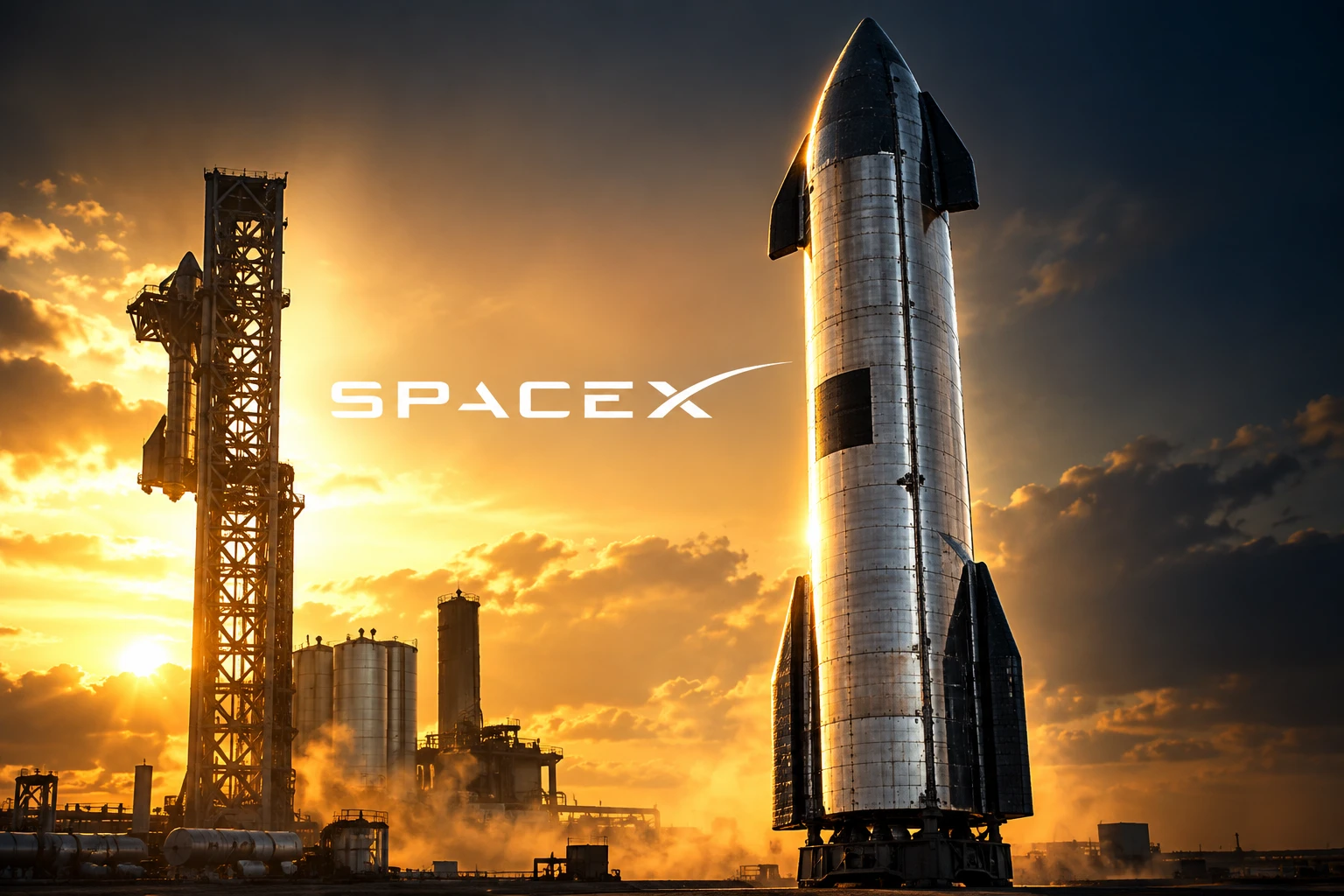
26 Starlink V3 Satellites Ride the First Orbit
Every Starship flight through Flight 13 stayed on a suborbital path on purpose. Flight 14 is built to break that pattern. Ship 41 is supposed to reach about 275 km, complete about six orbits, and fly for nearly 10 hours before a Pacific splashdown west of Chile.
The payload is no longer a short demo. SpaceX plans to deploy 26 production Starlink V3 satellites as Starlink Group 31-1, then have them raise their own orbits and, after checkout, start serving customers as soon as a few weeks after launch. Each satellite is rated for 1 Tbps of downlink capacity, so this mission alone is pitched as adding 26 Tbps to the network, about 10 times the capacity of one Falcon 9 launch of V2 Mini satellites.
Starlink’s own V3 page puts the jump in plainer hardware terms. Downlink is about 10 times V2. Uplink is 160 Gbps, about 22 times V2. Each bird carries 2,048 beams each way, against 192 downlink and 144 uplink beams on V2, plus six 400-gigabit space lasers.
FLIGHT 13 VERSUS FLIGHT 14
| Item | Flight 13 (July 24) | Flight 14 (NET Sept. 28) |
|---|---|---|
| Path | Suborbital on purpose | First planned Earth orbit |
| Ship / booster | Ship 40 / Booster 20 | Ship 41 / Booster 21 |
| Starlink V3 load | 20 satellites, then reentry about 20 minutes after deploy | 26 satellites into the constellation |
| Time aloft | About an hour to the Indian Ocean | Nearly 10 hours, about six orbits |
| Booster return | Hard splashdown after a short landing burn | Boostback and landing burn at an offshore Gulf point |
Three of the 26 satellites carry camera suites to scan Ship 41’s heat shield in orbit. SpaceX also plans heat-shield work drawn from Ship 40 as it floated after Flight 13, including extra tile locks, fixes for plasma paths behind tiles, curved tiles in some zones, and two tiles recovered from Ship 40 flying again on Ship 41, the first tile reuse on Starship.
SHIP 41’S IN-FLIGHT JOBS
- Insertion burn: A Raptor restart about 25 minutes after liftoff, only after the flight team confirms enough spare hardware for the later deorbit burn.
- Payload bay: Deploy starts about 34 minutes after liftoff and runs about 30 minutes.
- Deorbit: A single Raptor burn about 8 hours 52 minutes after liftoff, then entry, flaps, and a Pacific landing burn.
- Booster: Launch, hot-stage, boostback, and a landing burn offshore, with new engine filters and relight software.
That insertion gate is the safety hinge. The ship is not supposed to stay in orbit unless the team already trusts the engine that must bring it down.
Ice Clogged Three Center Engines on Flight 13
Flight 13 on July 24 was the second flight of the V3 stack and the first Starship flight to deploy next-generation Starlink V3 satellites. All 33 Raptor 3 engines lit on Super Heavy. The upper stage burned all six Raptors, hit its planned speed, and put all 20 satellites out on the planned path. Engineers talked to every satellite on radio and laser and pulled telemetry before those birds reentered about 20 minutes later.
The ship then relit a single Raptor in space, a core step for later orbital work, banked on the way home, and splashed down intact in the Indian Ocean. SpaceX got its first clear look at a complete heat shield after entry. The booster was the open item.
In the terminal phase of the burn, the three center engines showed signs of ice clogging which triggered an early end to the maneuver. The booster went on to attempt a landing burn, with 8 of the 13 planned engines reigniting before the booster made a hard splashdown in the Gulf.
SpaceX, Starship Flight 14 mission page
Flight 14’s Super Heavy carries hardware changes to improve filtering to the engines and software changes meant to make relight more reliable. That is the closest thing SpaceX has offered to a technical reason for how this booster differs from the last one. It is not a reason for why September 22 became September 28.
The July 16 abort sits in the same file. Six engines had oxidizer-pump problems in the last seconds, the software stopped the count at T-0, and the stack rolled back. A weather scrub followed. The third try on July 24 flew. Rapid reuse is still the goal. The path to a clean booster landing is not closed.
Why the Clock Now Runs Through the FAA
SpaceX has printed the same clause on both public dates: pending regulatory approval. CEO Elon Musk did not add a hardware note when the Monday target went up. The booster’s 33-engine static fire is already more than two weeks old. The mission page still reads like a vehicle that is waiting on a stamp, not a welding bay.
An orbital profile is a different license problem than a same-day suborbital arc. If the deorbit burn is late, early, or missing, the ground track is no longer a short corridor over water. The FAA licenses launch and reentry under the Commercial Space Launch Act. Radio papers at the FCC are not that license. SpaceX has also said an environmental finding is not, by itself, a green light to fly.
The stack can sit ready while the public date walks. FAA planning moved off September 18. SpaceX then took September 22, then September 28, and kept the license line in the sentence. That is the long pole the company is willing to name.
WHAT WE KNOW
- The new NET: Monday, September 28, is the earliest date SpaceX will now assign to Flight 14.
- The public gate: The company still conditions the attempt on regulatory approval, plus weather and range.
- The payload: 26 Starlink V3 satellites are planned for a real constellation insert, not a 20-minute suborbital drop.
WHAT IS UNCONFIRMED
- The cause: SpaceX has not said whether the slip is license timing, a last vehicle check, range, or some mix.
- The license: No public FAA statement with the September 17 update confirms that every launch and reentry condition is closed.
- The hold: September 28 can still move. SpaceX warns that developmental schedules change.
The honest read is narrower than a blame chart. SpaceX chose to keep the regulatory clause in the only sentence that changed. Until the agency or the company says otherwise, that is the clock the rest of the mission is on.
NASA’s Moon Lander Still Needs This Orbit
Starlink can feel the slip in weeks of capacity. NASA feels it as a missing rung. Starship HLS still has to show it can live in orbit and move cryogenic fuel before a lander can leave Earth with a full tank. The U.S. Government Accountability Office wrote in July 2026 that SpaceX was more than a year behind its original schedule on the critical design review, the long-duration and propellant-transfer demos, and the uncrewed lunar landing test.
Those transfer and long-duration flights were still listed for 2026 in that assessment. NASA had already recast Artemis III as an Earth-orbit docking test in 2027, with a crewed lunar landing later. The GAO tied a $4.9 billion HLS cost baseline to a February 2028 lunar-orbit checkout of SpaceX’s lander. None of that math starts until a Ship can circularize, stay up, and come home on command.
WHO SHARES THIS LICENSE
- Starlink V3: The first operational birds need Ship 41 in a stable orbit, then a few weeks of checkout before they can serve users.
- Heat-shield reuse: Two flown tiles and the camera sats are how SpaceX wants to argue a later return-to-pad catch.
- NASA HLS: Orbit is the floor under the 2026 propellant-transfer test the GAO still had on the calendar.
- The public ticker: SPCX now prices every slip in daylight, on the same day the company declines to explain it.
A six-day move does not, by itself, break a 2028 lander review. A pattern of license-tied nets does eat the only year SpaceX still has on the books for the fuel demo. Flight 14 is the first orbit. It is also the first time that orbit carries a working commercial load NASA did not order and a lander program NASA did.
SPCX Closed Higher on the Delay
Space Exploration Technologies has been public since June 12, 2026, when Class A shares began trading on Nasdaq and Nasdaq Texas as SPCX. The company later said the offering closed on June 15 with 638,888,888 shares, including the full underwriters’ option, for gross proceeds of about $85.7 billion. The IPO price was $135 a share.
On Thursday, September 17, SPCX closed at $154.81, up $3.93, or 2.60%, from a $150.88 prior close. The tape did not treat a six-day slip as a failed test. It treated it as another date on a vehicle that has already flown 13 times, the last time with an intact ship and a hard booster splashdown.
That is the new tension. Private SpaceX could move nets in a blog post and keep the reasons in the factory. Public SpaceX still gives no reason, still gates the attempt on a license, and still asks the market to wait on 26 live satellites and a Moon lander’s first orbital rung. September 28 is the earliest Monday on the page. The sentence that matters is the one SpaceX did not change.
Disclaimer: This article is news reporting and analysis for information only. It is not investment advice, a solicitation, or a recommendation to buy or sell SPCX or any other security. Readers should consult a qualified financial adviser or licensed broker before acting on any market figure in this piece. Prices, launch dates, and license status reflect the company, FAA, and market sources cited here as of the article’s date and can change without notice.

Xbox Sells Cloud Playtime Packs Ahead of November Caps

Xbox Puts a $1,800 Helix Behind a 2027 Handheld

Brussels Asks If Bio-Based Plastic Can Replace Recycled Content

EU Organic Deal Gates the Leaf and Doubles Exemptions

Barilla Strike Exposes Who Gains the Italian Plants

Boston Scientific Cyberattack Leaves Hospitals Waiting on Implants

Guizhou Cave Cafes Spread When Each Cavern Fills

The Second Ned Stark Kit Lands When a Banner Dies

Satellites Saw Nepal’s Ice Slope Move Before the Flood

OpenAI’s Jalapeño Chip Turns Watts Into Faster Agent Steps
-
 NEWS2 months ago
Boston Scientific Cyberattack Leaves Hospitals Waiting on Implants
-
 NEWS2 months ago
Guizhou Cave Cafes Spread When Each Cavern Fills
-
 GAMING2 months ago
The Second Ned Stark Kit Lands When a Banner Dies
-
 NEWS2 months ago
Satellites Saw Nepal’s Ice Slope Move Before the Flood
-
 NEWS2 months ago
OpenAI’s Jalapeño Chip Turns Watts Into Faster Agent Steps
-

 NEWS2 months ago
MLB Quiet Periods Copy a Freeze Other Leagues Use
-
 NEWS2 months ago
Roman Space Telescope Launches After a Decade-Long Budget Bet
-

 BUSINESS2 weeks ago
Saks Kept 15 Stores While Rivals Took the Shoppers