
BUSINESS
Britain’s Delayed CO2 Pig Stun Ban Reaches the Plants
Defra is consulting on banning CO2 pig stunning 23 years after FAWC rejected it, while independent plants fear cheaper EU imports.

Defra opened a UK-wide call for views on 26 October 2026 to ban carbon dioxide stunning of pigs, a method still used on 9.7 million animals a year. High-concentration gas is the standard last step in British pork plants, and the government’s own advisers now call keeping it ethically unacceptable.
The Farm Animal Welfare Council reached that verdict in 2003 and asked for aversive gas mixes to be gone within five years. They were not. Independent plants now say a fast ban, with the EU still using the old method, will hand the cost to them and the cheap pork to importers.
9.7 Million Pigs a Year Still Meet the Gas
The Food Standards Agency’s 2024 Slaughter Sector Survey, cited by the Animal Welfare Committee, found that 90% of pigs reared in England and Wales are stunned in high-concentration carbon dioxide using controlled atmosphere systems. Defra’s consultation uses the same share and puts the annual headcount on that method at 9.7 million.
WHERE THE METHOD SITS NOW
- Share of pigs: 90% of pigs reared in England and Wales go through high-concentration carbon dioxide, per the Food Standards Agency’s 2024 survey.
- Annual headcount: Defra puts the number stunned this way at 9.7 million a year.
- Gas plants: The committee counted carbon dioxide systems in 8 English plants, 3 in Northern Ireland and 1 in Scotland, and none in Wales.
- Specialist sites: 79 slaughterhouses killed pigs in 2024, and only 10 of them were specialist pig premises.
Those gas halls are paternoster lines: rotating gondolas that lower groups of pigs into a pit of carbon dioxide. The remaining 10% are stunned with head-only or head-to-body electricity, or, in a very small number of cases, a penetrative captive bolt.
English rules under the Welfare of Animals at the Time of Killing Regulations 2015, with similar rules in Scotland and Wales, require pigs in gas systems to stay in the mix long enough to be killed, not merely stunned. That stun-to-kill rule is stricter than the EU’s simple-stun standard and is one reason plants cling to a gas that acts fast.
High-concentration carbon dioxide won the industry for speed, meat quality and group handling. Pigs stay together instead of being singled out for tongs, which cut stress for animals and staff and let lines run faster. The committee records that this trade-off, group calm against a painful induction, is how the method became normal even after welfare bodies asked for it to stop.
Inhaled carbon dioxide dissolves on the mucous membranes of the eyes, nose, mouth and lungs and forms carbonic acid. The committee says that activates pain receptors at about 40 to 50% carbon dioxide, and commercial mixes sit far above that. Pigs then show three signs while they are still conscious: vocalisations, heavy breathing and escape attempts. Loss of posture, the usual proxy for unconsciousness, comes after those signs. Induction with high-concentration carbon dioxide has been timed at 21 to 60 seconds.
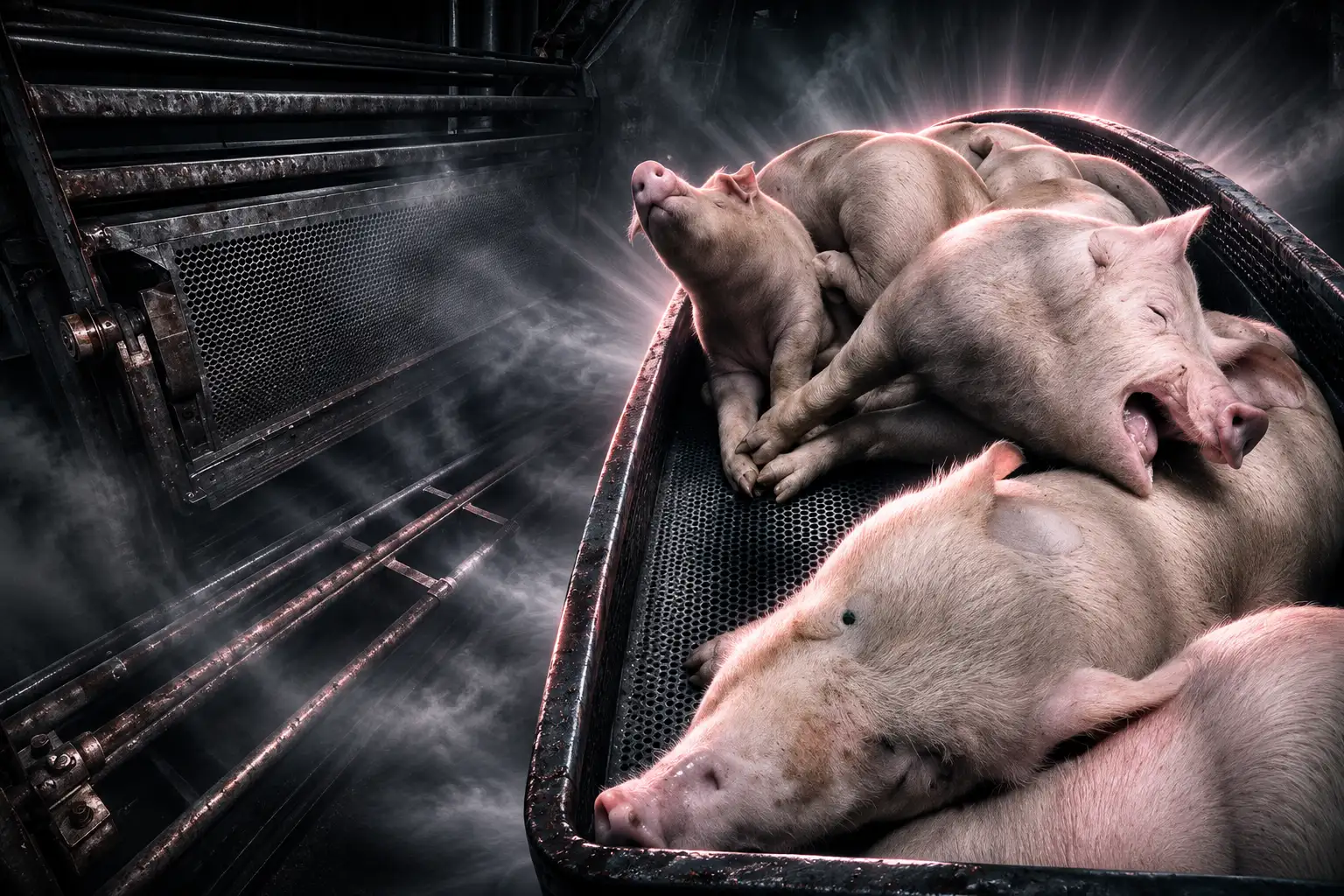
FAWC Called This Unacceptable in 2003
The paper trail is not new. It is a clock that has been reset for more than two decades, which is why a 2026 consultation reads like unfinished business from 2003.
HOW THE FIVE-YEAR CLOCK KEPT RESETTING
- 2003: The Farm Animal Welfare Council concludes that carbon dioxide at 80% and above “is not acceptable” and says aversive gas mixes should be phased out within five years.
- 2004: The European Food Safety Authority finds carbon dioxide above 30% aversive and says the gas used to induce unconsciousness should be non-aversive.
- 2020: A further EFSA opinion calls high-concentration carbon dioxide a serious welfare concern and says it should be replaced with less aversive mixes.
- 2021: A post-implementation review of the English killing rules flags a review of high-concentration carbon dioxide as unfinished work.
- April 2024: Defra begins work with pig processors, equipment makers, gas suppliers and welfare groups on how a switch could be done.
- 16 October 2025: The Animal Welfare Committee publishes an opinion, sent to government on 18 July 2025, calling for carbon dioxide, including in mixes with inert gases, to be taken off the approved list, with any switch as short as possible and in any case within five years.
- 26 October 2026: Defra opens a UK-wide consultation, on behalf of the Welsh Government, the Scottish Government and the Northern Ireland Executive, on a ban after a transition.
The committee’s account of the welfare impacts of high concentration CO2 quotes the 2003 verdict in full. “We conclude that the use of high concentrations of CO2 (80% and above) to stun and kill pigs is not acceptable,” FAWC wrote, and it told government and industry to fund work on non-aversive mixes.
Madeleine Campbell, who chairs the Animal Welfare Committee, used sharper language when the consultation opened.
It was the clear view of the Animal Welfare Committee that the continued use of high concentration CO2 when more humane, legally permitted alternatives are available is ethically unacceptable. The evidence-based argument for moving away from the use of high concentration CO2 on animal welfare grounds is incontrovertible.
Madeleine Campbell, Chair, Animal Welfare Committee, 26 October 2026
England’s pig-killing map shrank while that advice sat on the shelf. The committee says the number of English abattoirs slaughtering pigs has dropped by nearly 100 since 2000, leaving a smaller set of specialised, highly mechanised halls built around carbon dioxide. A method the 2003 report wanted gone became the kit those surviving plants bought.
Two Years, Three Years or Leave CO2 in Place
Farming Minister Stephen Morgan used the consultation to publish new plans to end carbon dioxide stunning and to place the change inside the government’s animal welfare strategy. He said pigs are intelligent animals that deserve care at slaughter, and that shoppers want meat produced to high welfare standards. Defra also argues that a switch would cut the pork sector’s need for carbon dioxide, a gas whose supply can move with events abroad, and it pointed to shortage fears linked to conflict in the Middle East earlier in 2026.
John Powell, chief executive of the British Meat Processors Association, disputes that supply case. He said price rises linked to the Iran conflict had been modest, that supply to the sector had not been cut, and that carbon dioxide is a small share of food production costs. The live argument, in his telling, is throughput, not tanks.
Defra’s own menu is short.
CONSULTATION OPTIONS ON THE TABLE
- Do nothing: Leave high-concentration carbon dioxide as an approved pig-stunning method.
- Ban after two years: Prohibit the gas in slaughterhouses and knacker’s yards after a two-year switch.
- Ban after three years: The preferred option, which Defra says would give plants time for planning permission and extra kit while still cutting the welfare harm.
The department’s modelling states that every extra year of delay subjects about 10 million more pigs to the method. A three-year window, it says, balances welfare against the time processors need to keep current throughput. The process opened on 26 October 2026 and closes at 11:59pm on 21 December 2026. Replies after that date will not be analysed.
Do you have ideas on how we can continue to improve animal welfare standards?
We're consulting on proposals to phase out high concentration CO₂ stunning of pigs and want to hear views from farmers, processors, welfare organisations and the public: https://t.co/N5PmR3TxZ2 pic.twitter.com/a7FaDitcbI
— Defra UK (@DefraGovUK) October 26, 2026
Assimilated EU Regulation 1099/2009 still lists carbon dioxide at high concentration, carbon dioxide with inert gases, and inert gases as lawful pig-stunning methods, alongside electricity and captive bolt. A UK ban would take the first of those off the domestic list after whatever switch period ministers finally set. It would not, on its own, change how pork is stunned in plants that ship into Britain.
What a Conversion Would Cost Per Pig
The Agriculture and Horticulture Development Board commissioned Europe Economics to model plant-level costs of converting from CO2 at a notional high-throughput UK site. Under that model, every other system costs more than the gas plants already run.
| Method | Cost per pig | Uplift vs carbon dioxide |
|---|---|---|
| High-concentration carbon dioxide | £0.42 | Baseline |
| Argon with added capacity | £1.49 | 257% |
| Argon without added capacity | £1.36 | 226% |
| Electrical stunning | £1.11 | 165% |
Those figures bundle gas or power, capital, labour and running costs at one modelled site. They are not a national bill. The levy board did not pick a winner and did not claim welfare results; it said every option is materially more expensive than carbon dioxide and that first movers would carry risk on reliability, gas use and welfare under UK stun-to-kill rules.
Argon, the inert gas Defra names first, needs a longer dwell. The EU PigStun project, which the committee reviewed, found inert gases need about 40% more exposure time than high-concentration carbon dioxide. Timed induction with argon at very low residual oxygen has sat in a 22 to 77 second range. Because English, Scottish and Welsh rules require the animal to come out dead, that extra time bites harder here than in an EU hall that may stun and then kill by another step.
Katie Jarvis, chief policy adviser at the National Pig Association, said argon has been tested, but not at the commercial pace of tens of thousands of pigs a week. That, she said, is the trial still missing, along with staff training and safety rules for a different gas. The AHDB study states that no plant currently runs argon stunning at full commercial scale with stun-to-kill.
Independents Fear Shoppers Will Import the Old Method
The Association of Independent Meat Suppliers asked Defra secretary Angela Eagle to pause the consultation until UK-EU talks on a sanitary and phytosanitary deal are finished. Executive director Jason Aldiss wrote that Defra’s published SPS scope still includes Regulation 1099/2009, which permits high-concentration carbon dioxide, and that the legal path for a stricter UK rule under any alignment deal has not been set out.
If overseas suppliers retain existing systems while our members face conversion and additional operating costs, imports could gain a cost advantage. The policy risks shifting production, investment and jobs overseas while British consumers continue buying pork produced using the same stunning method.
Jason Aldiss, Executive Director, Association of Independent Meat Suppliers, letter to Defra
He pointed to the 1999 ban on sow stalls and tethers as the warning. British producers paid to change; competing suppliers did not, and imports from systems banned here kept arriving. In 2009, he wrote, the Environment, Food and Rural Affairs Committee concluded that warnings of damage to the industry had been justified.
Powell put the same worry in throughput language. He said Defra should have commissioned the needed research before opening the process, that there is no proven commercial stand-in that can hold the kill rate British plants and shoppers need, and that the proposals risk British food security if the EU does not move too. “The EU is not currently proposing a similar ban,” he said, “so, if a ban on CO2 is introduced in the UK, it will dramatically decrease our competitiveness.”
National Pig Association chief executive Lizzie Wilson said the sector knows high-concentration carbon dioxide raises welfare concerns and is looking at other methods. She also said research has not yet shown a feasible option that improves welfare at commercial scale and can be adopted at once, and that a switch of two to three years is totally unworkable.
Labour MP Josh Newbury pressed Morgan at the Environment, Food and Rural Affairs Committee to show that argon and electricity are as proven as the consultation claims. Other members asked what happens to kill capacity if halls have to stop lines to rebuild while pigs are already waiting on farm. Those are committee challenges, not findings, and Defra has not published a final impact number for lost throughput.
WHAT WE KNOW
- The offer: A UK-wide ban is on the table, with Defra preferring three years and also asking about two years or no change.
- The science Defra cites: The Animal Welfare Committee says keeping high-concentration carbon dioxide, when other lawful methods exist, is ethically unacceptable.
- The modelled bill: At a notional high-throughput site, argon with extra capacity is £1.49 a pig against £0.42 for carbon dioxide.
WHAT IS UNCONFIRMED
- The legal route: Whether a domestic ban can sit inside a future UK-EU SPS deal, and whether pork stunned with carbon dioxide abroad would still be sold here.
- The switch length: Two years, three years, or a longer window after ministers read the replies.
- Commercial argon: Whether a stun-to-kill argon line can hold British chain speeds without a second hall and a longer dwell.
A slaughter reform does not end the kill. It changes the last minute of it. The live policy fight is whether UK plants must change that minute while EU pork can still be sold from the old one. That question showed up as soon as the consultation opened, including in replies to Winchester MP and vet Danny Chambers, who welcomed the process after raising the method in Parliament.
No Commercial Argon Line Runs Stun-to-Kill Yet
Defra names argon gas and automated electrical stunning as methods “proven to substantially reduce animal suffering.” The committee is more careful. Of the inert gases tested in PigStun, it judged argon the most suitable for commercial use at this time, taking all factors together. Pigs do not avoid rooms of high-concentration inert gas the way they avoid carbon dioxide. Argon is heavier than air, so in principle it can sit in a modified pit. Nitrogen is lighter and harder to hold at the very low oxygen levels anoxia needs.
Argon is not instant. The committee notes that inert gases do not knock pigs out near-instantly, so some risk of harm during induction remains. Extraction is energy-heavy and the gas costs more. PigStun work suggested a retrofit might take one to two days, but the committee says that has not been proven in practice and that manufacturing, gas supply, training and site procedures still sit in front of any commercial start. Occupational safety is a separate bill: an argon leak is an oxygen-free atmosphere for staff as well as pigs.
Electricity has another history. Automated electrical stunning was once common in British pig plants and was largely replaced by group carbon dioxide because the gas kept pigs in groups, raised line speed and improved meat quality. Unconsciousness with tongs is near-instant if the electrodes land right. The cost is individual handling and restraint, which the committee says can harm welfare before the stun. Defra is funding more work on that handling. Low atmospheric pressure stunning, a sealed-chamber decompression method co-funded with the Humane Slaughter Association, did not beat carbon dioxide on welfare at commercial rates, and the researchers concluded both methods look poor for pigs.
Philip Lymbery, global chief executive of Compassion in World Farming, called the consultation “about time.” Campbell asked all sides to clear the acknowledged industry obstacles “within a transition period which is as short as possible.” Processors are asking for funded UK trials at commercial scale before anyone starts taking halls apart.
Until ministers read the replies and pick a date, the gondolas still drop. The consultation closes at 11:59pm on 21 December 2026. High-concentration carbon dioxide remains a lawful stunning method in British pig plants, used on 9.7 million animals a year, 23 years after FAWC said that use was not acceptable.

Duffy Pins the FAA Ground Stop on a Contractor-Owned Network

Microsoft Tested Its Gateway Fix on the Wrong Machines

Firaxis Cuts a Third of Its Staff as XCOM Slips

The New Chip Rule Favors US Cloud Parents in Asia

European Unions Ask Players to Police GenAI They Cannot See

Boston Scientific Cyberattack Leaves Hospitals Waiting on Implants

Xbox Sells Cloud Playtime Packs Ahead of November Caps

Guizhou Cave Cafes Spread When Each Cavern Fills

The Second Ned Stark Kit Lands When a Banner Dies

Satellites Saw Nepal’s Ice Slope Move Before the Flood
-
 NEWS3 months ago
Boston Scientific Cyberattack Leaves Hospitals Waiting on Implants
-
 GAMING4 weeks ago
Xbox Sells Cloud Playtime Packs Ahead of November Caps
-
 NEWS3 months ago
Guizhou Cave Cafes Spread When Each Cavern Fills
-
 GAMING3 months ago
The Second Ned Stark Kit Lands When a Banner Dies
-
 NEWS2 months ago
Satellites Saw Nepal’s Ice Slope Move Before the Flood
-

 NEWS3 months ago
OpenAI’s Jalapeño Chip Turns Watts Into Faster Agent Steps
-

 NEWS3 months ago
MLB Quiet Periods Copy a Freeze Other Leagues Use
-

 NEWS3 months ago
Roman Space Telescope Launches After a Decade-Long Budget Bet